Theobald von Bethmann Hollweg
Illustration, not an archive object
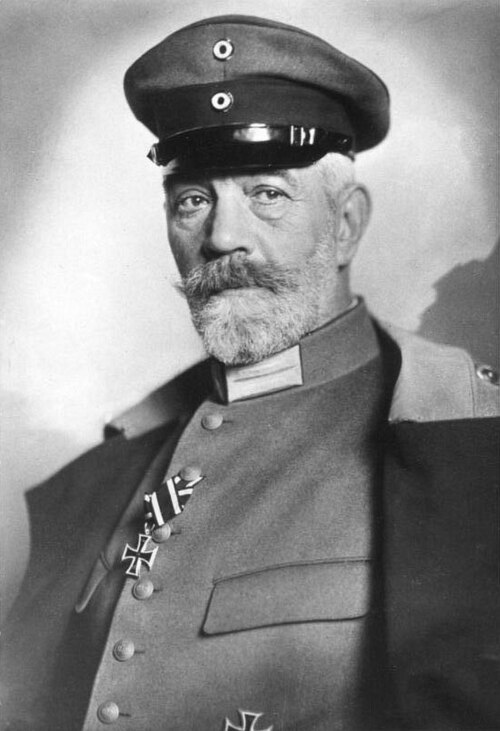

Reich Chancellor (1909-1917) · Germany
On the regime page: German Empire under Wilhelm II
8 quotes, oldest first. Filter with other speakers.
“We are now acting in self-defense, and necessity knows no law. Our troops have occupied Luxemburg and perhaps have already been obliged to cross the Belgian frontier. This action violates international law. [...] Thus we have been forced to disregard the protests of the governments of Luxemburg and Belgium. The wrong which we thus commit we shall try to make good as soon as our military aim is attained. Whoever, like us, is fighting a supreme fight, must think only of forcing his way through.”
English: Alexander R. Hohlfeld, from the stenographic report in Der Tag, 5 August 1914 (Germanistic Society of Chicago, 1914). Original-language text not found.
Bethmann Hollweg spoke on the day war credits were voted, as German troops entered Luxembourg and prepared to cross the Belgian frontier. The speech acknowledged that the action violated international law and promised to make good the wrong after the war.
Speech of Chancellor Theobald von Bethmann Hollweg in the Reichstag, 4 August 1914, in The Session of the German Reichstag on August the Fourth, 1914, compiled and translated by Alexander R. Hohlfeld (Chicago: Germanistic Society of Chicago, 1914), Pamphlet no. 4 Source
Content note: Plan to reduce a neutral state to a vassal state. The words are shown as they were said or written. Why
“Whatever the case, Belgium must in all events – even should it continue to exist as a state – sink to the status of a vassal state; it must cede occupation rights in militarily significant ports; place its coasts at our disposal; become economically a German province.”
Original (German)
Gleichviel, jedenfalls muß Belgien, wenn es auch als Staat äußerlich bestehen bleibt, zu einem Vasallenstaat herabsinken, in etwa militärisch wichtigen Hafenplätzen ein Besatzungsrecht zugestehen, seine Küste militärisch zur Verfügung stellen, wirtschaftlich zu einer deutschen Provinz werden.
English: Jeffrey Verhey and Roger Chickering, in German History in Documents and Images (GHDI)
The memorandum outlined German war aims in the west and in Europe, and was written on 9 September 1914, during the Battle of the Marne. It is preserved in the Reich Chancellery files.
Bethmann Hollweg, memorandum ("September Programme"), Berlin, 9 September 1914, Bundesarchiv Lichterfelde, Reichskanzlei, Grosses Hauptquartier 21, no. 2476, reprinted in Wolfdieter Bihl, ed., Deutsche Quellen zur Geschichte des Ersten Weltkrieges (Darmstadt, 1991), pp. 61-62 Source
“4. A central European economic association is to be constructed through common customs agreements, to comprise France, Belgium, Holland, Denmark, Austria-Hungary, Poland (!) and possibly Italy, Sweden, and Norway. This association will probably have no common constitutional head and will provide for ostensible equality among its members, although it will in fact be under German leadership; it must stabilize Germany’s economic predominance in central Europe.”
Original (German)
4. Es ist zu erreichen die Gründung eines mitteleuropäischen Wirtschaftsverbandes durch gemeinsame Zollabmachungen, unter Einschluß von Frankreich, Belgien; Holland, Dänemark, Österreich-Ungarn, Polen(!) und eventuell Italien, Schweden und Norwegen. Dieser Verband, wohl ohne gemeinsame konstitutionelle Spitze, unter äußerlicher Gleichberechtigung seiner Mitglieder, aber tatsächlich unter deutscher Führung, muß die wirtschaftliche Vorherrschaft Deutschlands über Mitteleuropa stabilisieren.
English: Jeffrey Verhey and Roger Chickering, in German History in Documents and Images (GHDI)
Point 4 of the same memorandum proposed a customs association in central Europe under German leadership.
Bethmann Hollweg, memorandum ("September Programme"), Berlin, 9 September 1914, Bundesarchiv Lichterfelde, Reichskanzlei, Grosses Hauptquartier 21, no. 2476, reprinted in Wolfdieter Bihl, ed., Deutsche Quellen zur Geschichte des Ersten Weltkrieges (Darmstadt, 1991), pp. 61-62 Source
“After the effort failed to defeat France in the first stage of the war, and in view of the course of our military operations in the west during the present, second stage of the war, I, too, have to doubt whether it is still possible to defeat our opponents militarily, as long as the Triple Entente holds together.”
Original (German)
Nachdem die Niederwerfung Frankreichs in der ersten Kriegsperiode mißglückt ist und nach dem Verlauf, den unsere militärischen Operationen im Westen im jetzigen zweiten Kriegsabschnitt nehmen, muß auch ich bezweifeln, daß eine militärische Niederwerfung unserer Gegner noch möglich ist, so lange die Triple Entente zusammenhält.
English: Jeffrey Verhey and Roger Chickering, in German History in Documents and Images (GHDI)
After the failure of the offensive in the west and the first battle of Ypres, General von Falkenhayn urged a separate peace with Russia. The Chancellor wrote to the Foreign Office on the military outlook.
Letter of Chancellor Bethmann Hollweg to Under-Secretary Arthur Zimmermann, 19 November 1914, in André Scherer and Jacques Grunewald, eds., L'Allemagne et les problèmes de la paix pendant la Première Guerre Mondiale, vol. 1 (Paris, 1962), no. 13, p. 15ff, reprinted in Willibald Gutsche, Herrschaftsmethoden des deutschen Imperialismus 1897/8 bis 1917 (East Berlin, 1977), pp. 210-11 Source
“Gentlemen, in August, 1914, our enemies challenged the superiority of power in the world war. To-day we raise the question of peace, which is a question of humanity. We await the answer of our enemies with that sereneness of mind which is guaranteed to us by our exterior and interior strength, and by our clear conscience.”
English: English text of The New York Times, 13 December 1916, as reprinted in the Carnegie Endowment pamphlet. Original-language text not found.
The Chancellor announced to the Reichstag that Germany and its allies had proposed peace negotiations to the Allied powers and read the note. The extract here is the passage immediately after the note.
Speech of Chancellor Bethmann Hollweg in the Reichstag, 12 December 1916 (extract), in Official Communications and Speeches Relating to Peace Proposals, 1916-1917, Carnegie Endowment for International Peace, Division of International Law, Pamphlet no. 23 (Washington, 1917), pp. 1-3, reprinting The New York Times, 13 December 1916 Source
“A new era with a renewed people has arrived. The great war has brought it about. A generation that has been shaken to the core of its being by such extraordinary experiences, a people about whom a moving poem by a soldier poet said that its poorest son was also its most loyal, a nation that has learned a thousand times over every day that only collective strength can withstand and overcome external dangers—gentlemen, these are living forces that cannot be constrained or thrown off course by any party program, neither from the right nor from the left. Wherever political rights are to be reorganized, it is not a question of rewarding the people for what they have given. This idea has always seemed to me downright degrading, because it is solely a matter of finding the appropriate political and governmental expression for what this people is. Enormous political, intellectual, economic, and social tasks await us after the war. We can only solve them if the collective strength that enables us to prevail in this war continues to work in peacetime, if avenues are created in which it can operate freely and joyfully. This cannot be regulated by party templates; it is a demand of our state's inner strength, and this demand will prevail!”
English: English text on German History in Documents and Images (GHDI); translator not named on the page. Original-language text not found.
Bethmann Hollweg spoke in a Reichstag debate on constitutional reform during the war. The extract on GHDI is the passage he read for a sound recording in August 1918.
Speech of Chancellor Bethmann Hollweg in the Reichstag, 27 February 1917, as read in a recording of 26 August 1918, Stiftung Deutsches Rundfunkarchiv (DRA); full text in the Reichstag stenographic report (reichstagsprotokolle.de) Source
“A reactionary military dictatorship would lead us toward destruction. The course of events can make the satisfaction of democratic demands necessary during the war itself, in which case it is possible that the length of the war, the severity of sacrifice, and in the end developments in Russia, too, will make concessions appear insufficient that would have seemed adequate during the first year of the war. Without giving in to nervousness, one must be aware that a “too little” or “too late” can become fatal.”
Original (German)
Eine reaktionär gesinnte Militärdiktatur würde uns dem Untergang entgegen führen. Der Verlauf der Dinge kann die Befriedigung demokratischer Forderungen schon während des Krieges notwendig machen, wobei es möglich ist, daß die lange Dauer des Krieges, die Größe der Opfer und schließlich auch die russischen Vorgänge solche Konzessionen jetzt als ungenügend erscheinen lassen, die im ersten Kriegsjahr noch als ausreichend gelten konnten. Ohne nervösen Stimmungen nachzugeben, muß man sich dessen bewußt sein, daß ein „zu spät“ oder „zu wenig“ verhängnisvoll werden kann.
English: Jeffrey Verhey and Roger Chickering, in German History in Documents and Images (GHDI)
After the March revolution in Russia the Chancellor sent a confidential telegram about the effect on German politics and the press, for the information of the military leadership.
Telegram of the Chancellor to Legation Counsellor Freiherr von Grünau (Supreme Headquarters), 28 March 1917, no. 100, Politisches Archiv des Auswärtigen Amtes, Bonn, Gr. Hauptquartier, vol. 245, reprinted in Wilhelm Deist, Militär und Innenpolitik im Weltkrieg 1914-1918, vol. 2 (Düsseldorf: Droste, 1970), p. 694 Source
“I ejaculated impatiently that, compared to the fearful fact of an Anglo-German war, the treaty of neutrality was only a scrap of paper. This expression was perhaps an indiscretion, but my blood boiled at his hypocritical harping on Belgian neutrality which was not the thing that had driven England into war [...]”
English: George Young (Thornton Butterworth, London, 1920). Original-language text not found.
Bethmann Hollweg describes his talk of 4 August 1914 with the British ambassador Sir Edward Goschen and the remark about the Belgian neutrality treaty that the ambassador reported as "a scrap of paper".
Theobald von Bethmann Hollweg, Reflections on the World War, part 1, translated by George Young (London: Thornton Butterworth, 1920), chapter "The Outbreak of War", pp. 158-159 (German edition: Betrachtungen zum Weltkriege, Berlin: Reimar Hobbing, 1919) Source