Turkmenistan under Niyazov and the Berdimuhamedovs
Illustration, not an archive object
In one line: Turkmenistan has been governed since December 1985 by three leaders in a row, Saparmurat Niyazov (Communist Party first secretary from 1985 and president until his death on 21 December 2006), Gurbanguly Berdimuhamedov (president from 2006 to 19 March 2022) and, since 19 March 2022, his son Serdar Berdimuhamedov, with the father holding the chair of the Halk Maslahaty; the state presents this as stability and permanent neutrality, and the OSCE's election office, Freedom House, Reporters Without Borders and Human Rights Watch describe a system without genuine electoral competition or independent media.
The leader and the people under the leader
Roster as of October 2, 2026. Offices and office-holders change; this page is a dated snapshot.
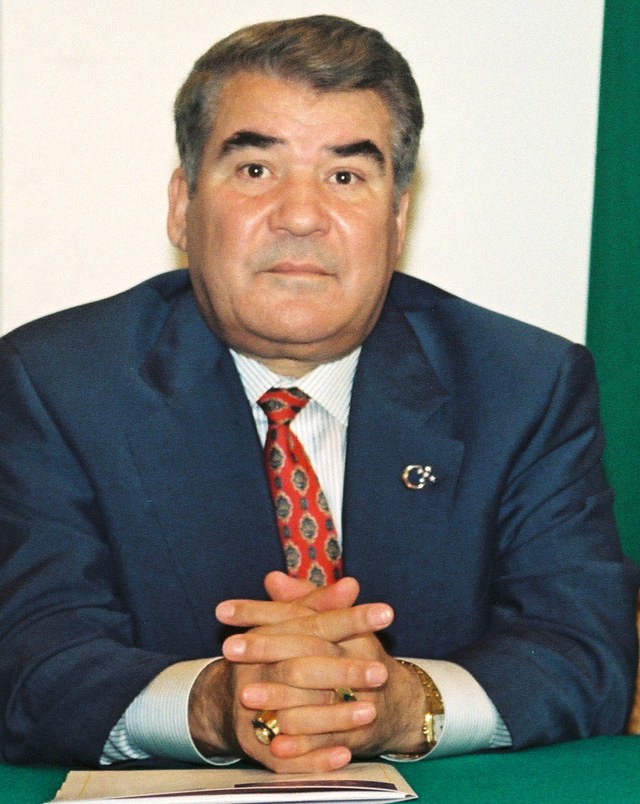
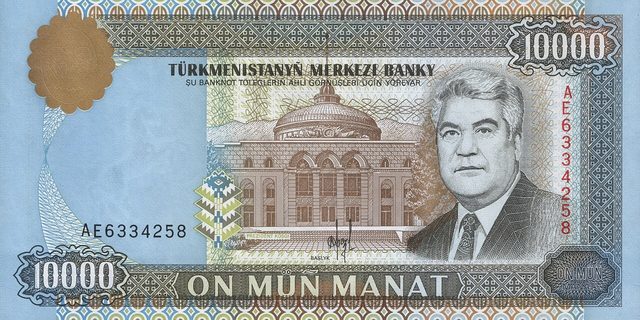
First Secretary of the Communist Party of Turkmenistan; President of Turkmenistan (title Turkmenbashi) · 1985 to 2006
Saparmurat Niyazov: Read more
First Secretary from December 1985, chairman of the Supreme Soviet from January 1990 and president from October 1990; led independent Turkmenistan until his death on 21 December 2006, with the term made unlimited by a vote of 28 December 1999 (RFE/RL, 21 December 2006).
In their words
“This book, written with the help of inspiration sent to my heart by the God who created this wonderful universe and who is able to do whatever He wills, is Turkmen Rukhnama.”
“AT THE MOMENT OF MY BETRAYAL TO MY MOTHERLAND, TO HER SACRED BANNER, TO GREAT SAPARMYRAT TURKMENBASHY LET MY BREATH STOP!”
Leader
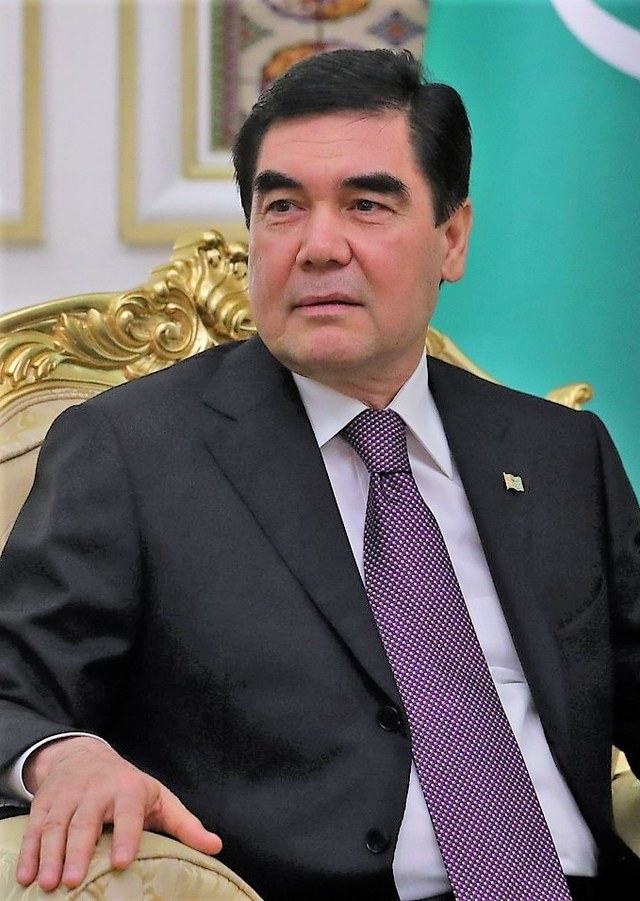
Photo: Presidential Executive Office of Russia (kremlin.ru), CC BY 4.0
Gurbanguly Berdimuhamedov
President of Turkmenistan (2006 to 2022); chairman of the Halk Maslahaty and National Leader of the Turkmen People · 2006 to present
Gurbanguly Berdimuhamedov: Read more
Health minister from 1997; acting president from 21 December 2006 and president from 14 February 2007 to 19 March 2022 (official results 89.23, 97.14 and 97.69 per cent in 2007, 2012 and 2017, as recorded in the ODIHR report of 10 May 2017); chairman of the Halk Maslahaty since 2021 and, by the law of 21 January 2023, National Leader of the Turkmen People (BTI 2026).
Photo: Presidential Executive Office of Russia (kremlin.ru), CC BY 4.0
Serdar Berdimuhamedov
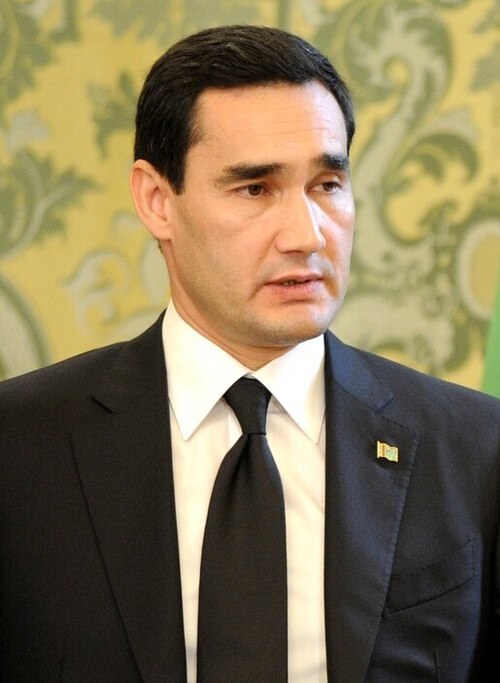
President of Turkmenistan · 2022 to present
Serdar Berdimuhamedov: Read more
Elected on 12 March 2022 with an official 73 per cent in an early election called after his father's announcement of 11 February 2022, and inaugurated on 19 March 2022; ODIHR carried out a needs assessment mission before the vote (report of 8 March 2022).
In their words
“We will continue to ensure a humane state policy in the field of protection of human rights and freedoms.”
Soviet-era party
MGNo public-domain or openly licensed portrait found. Nearest: none located on Wikimedia Commons.
Muhammetnazar Gapurov
First Secretary of the Communist Party of Turkmenistan · 1969 to 1985
Muhammetnazar Gapurov: Read more
First Secretary from December 1969 until 21 December 1985, when the incoming Soviet leader Mikhail Gorbachev removed him in a cotton-related corruption scandal, the vacancy Niyazov filled (reference-work summary; the Soviet-era context is covered on the Soviet Union page).
Foreign affairs
Photo: U.S. Department of State, Public domain (U.S. government work)
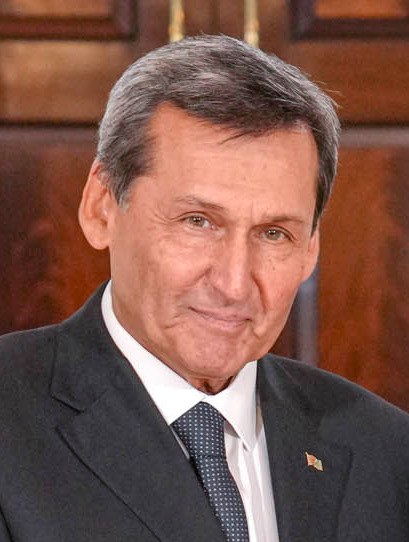
Rashid Meredov
Minister of Foreign Affairs; Deputy Chairman of the Cabinet of Ministers · 2001 to present
Rashid Meredov: Read more
Foreign minister since July 2001 under Niyazov and both Berdimuhamedovs, and listed as Deputy Chairman of the Cabinet of Ministers in a UN General Assembly President's readout of 28 May 2026.
Legislature
OANo public-domain or openly licensed portrait found. Nearest: none located on Wikimedia Commons.
Ovezgeldy Atayev
Chairman of the Mejlis · to 2006
Ovezgeldy Atayev: Read more
Chairman of the Mejlis at the time of Niyazov's death; the constitution of the time made him acting president on a vacancy, but he was arrested shortly after the death and the State Security Council, citing a criminal case against him, named Gurbanguly Berdimuhamedov instead (RFE/RL; press reports). A human-rights news service (Khronika Turkmenistana) reported that a Turkmen deputy foreign minister told the UN Human Rights Committee he had been released (RFE/RL, date not re-checked here); RFE/RL noted that no other confirmation was available, and his whereabouts have not been independently verified.
Photo: Council of the Federation of the Federal Assembly of the Russian Federation, CC BY 4.0
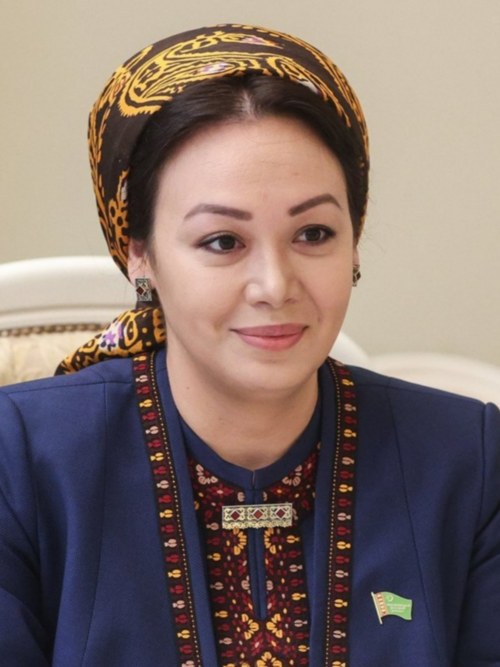
Dunyagozel Gulmanova
Chairperson (Speaker) of the Mejlis · 2023 to present
Dunyagozel Gulmanova: Read more
Elected speaker of the reconstituted single-chamber Mejlis on 6 April 2023 after the 26 March 2023 election, and shown in this role in 2024 OSCE Parliamentary Assembly material; her status on 2 October 2026 is not verified.
Security
BGNo public-domain or openly licensed portrait found. Nearest: none located on Wikimedia Commons.
Begench Gundogdyev
Minister of Defence; Secretary of the State Security Council · 2018 to present (defence minister, second term)
Begench Gundogdyev: Read more
Named in the state portal's report of the State Security Council meeting of 4 September 2026 as Secretary of the Council and Minister of Defence. Reference-work summaries of the presidential decrees (Wikipedia, not the decrees themselves) give his reappointment as defence minister on 14 June 2018, a second term after an earlier one in 2011 to 2015, and his concurrent appointment as Secretary of the State Security Council on 6 April 2022; these dates are not checked against an official source.
Background and rise to power
Turkmenistan became a Soviet republic in 1924. Saparmurat Niyazov (born 1940) rose in the Communist Party of Turkmenistan and became its first secretary in December 1985, after Moscow removed Muhammetnazar Gapurov, who had held the post since 1969. He became chairman of the republic's Supreme Soviet on 13 January 1990 and was elected president of the Turkmen SSR on 27 October 1990 in a popular vote in which he was the only candidate (Library of Congress country profile; Nohlen, Grotz and Hartmann 2001, via the reference-work summary of the vote). The republic voted for independence in a referendum on 26 October 1991 (official 94.1 per cent in favour) and the Supreme Soviet declared it on 27 October. The party was renamed the Democratic Party of Turkmenistan in December 1991, with Niyazov as its chairman. The constitution of 18 May 1992 created a strong presidency, a unicameral parliament (the Mejlis) and a People's Council (Halk Maslahaty), and Niyazov won the presidential election of 21 June 1992 as the only candidate; a referendum on 15 January 1994 extended his term to 2002 (official 99.99 per cent in favour; reference-work summaries, with Bohr 2016 and Peyrouse 2012 on the system). From 1993 he used the title Türkmenbaşy, "head of all the Turkmen" (RFE/RL obituary, 21 December 2006). On 12 December 1995 the UN General Assembly adopted resolution 50/80, which "recognizes and supports the status of permanent neutrality declared by Turkmenistan"; the state still dates its foreign policy from that vote.
On 28 December 1999, two weeks after a parliamentary election of 12 December in which the Democratic Party was the only legal party, the People's Council (Halk Maslahaty) proclaimed him president for life (RFE/RL, "Turkmenistan: Explaining The Presidential Election"; some sources say "parliament"). After a motorcade attack on 25 November 2002 the government arrested and tried people it linked to an exiled former foreign minister, Boris Shikhmuradov; a rapporteur's report under the OSCE Moscow Mechanism (invoked by ten participating states, Emmanuel Decaux, 12 March 2003) documented arbitrary detention and violations of due process, and said the Turkmen authorities had not cooperated with it.
Scholars place the personality cult in two frames. Abel Polese and Slavomir Horak read the cults of both presidents as symbolic nation-building in a new state, and argue that Niyazov's cult "would not have reached the extent it did" without the Soviet political culture of hierarchy, devotion and flattery inside the party (Nationalities Papers, 2015). Annette Bohr (Chatham House, 2016) treats the system as petro-authoritarian, in which gas revenue funds prestige construction that serves both legitimacy and elite patronage, and Sebastien Peyrouse (2012) stresses the strategies of power and the development dilemmas that follow from them. The readings are not exclusive, and the sources cited here do not claim one cause.
How power was organized
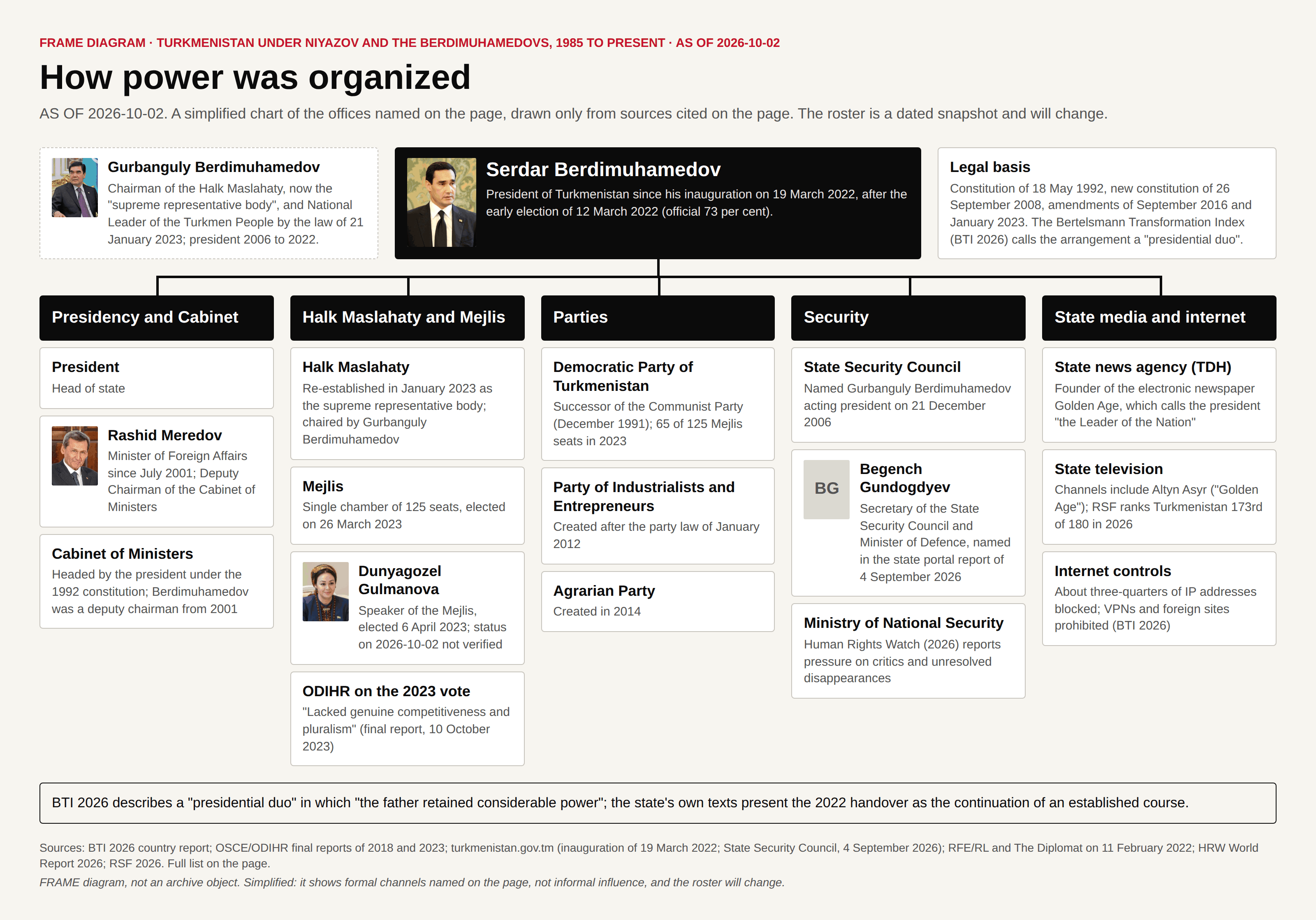
Under the 1992 constitution the president was head of state and of the Cabinet of Ministers, with the Democratic Party the only party in practice until the multi-party law of 2012; the Halk Maslahaty met occasionally and the Mejlis passed laws. Niyazov chaired the Democratic Party. On his death the State Security Council named Gurbanguly Berdimuhamedov, his health minister since 1997 and a deputy chairman of the Cabinet since 2001, acting president (reference-work summary). He was one of six candidates appointed by the People's Council for the election of 11 February 2007, won it with an official 89.23 per cent (RFE/RL, 14 February 2007), took office on 14 February 2007, and was re-elected in February 2012 (official 97.14 per cent, against seven other candidates all from the one party) and on 12 February 2017 (official 97.69 per cent on a 97.27 per cent turnout), figures as recorded in the ODIHR final report of 10 May 2017, which called the 2017 election one held in a "strictly controlled political environment characterized by the lack of genuine opposition and meaningful pluralism"; ODIHR did not observe 2007 or 2012. A constitution of 26 September 2008 enlarged the Mejlis to 125 seats and abolished the large People's Council of the 1992 text, and constitutional amendments of 2016 (September) lengthened the presidential term to seven years and removed the upper age limit for candidates (reference-work summary; ODIHR 2017 report). Under the party law of 2012 the Democratic Party was joined by the Party of Industrialists and Entrepreneurs (2012) and, later, the Agrarian Party (Bohr 2016; the Agrarian Party's founding year is not re-verified here).
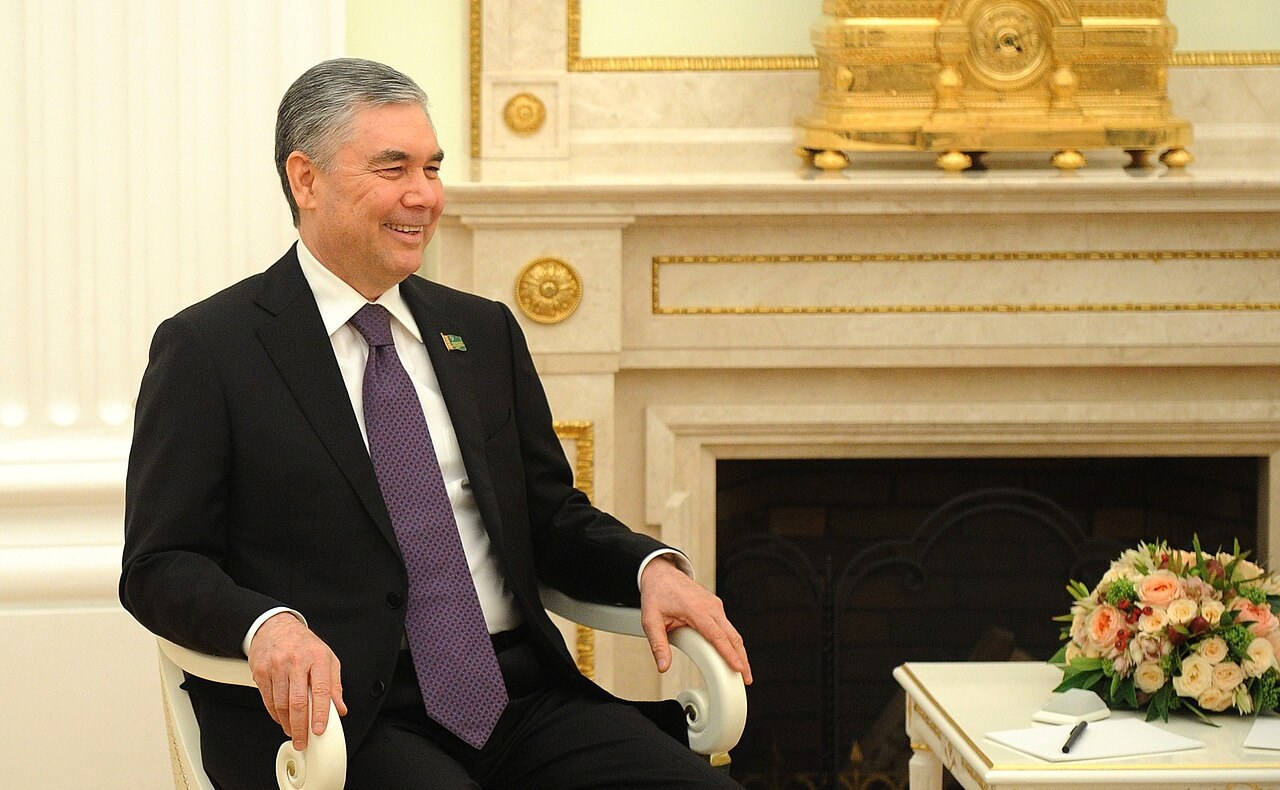
Gurbanguly Berdimuhamedov, chairman of the People's Council of Turkmenistan, at the Kremlin on 3 November 2022, eight months after his son became president (kremlin.ru). Source: kremlin.ru, CC BY 4.0, via Wikimedia Commons, CC BY 4.0.
How power was organized, as of 2 October 2026: a chart of the offices named on this page, simplified from the sources cited on this page. Source: FRAME diagram. Portraits, cropped to thumbnails: Council of the Federation of the Russian Federation, CC BY 4.0, via Wikimedia Commons; kremlin.ru, CC BY 4.0, via Wikimedia Commons; U.S. Department of State, Flickr (statephotos) photograph of 20 August 2025, public domain; kremlin.ru, CC BY 4.0, via Wikimedia Commons, CC BY 4.0 (FRAME archive content); portraits: CC BY 4.0; Public domain (U.S. government work).
In 2021 the Halk Maslahaty became a standing chamber and Gurbanguly Berdimuhamedov became its chairman. On 11 February 2022 he told the Halk Maslahaty it was time to give "young leaders" the chance to lead (The Diplomat, 15 February 2022; RFE/RL). His son Serdar won the early election of 12 March 2022 with an official 73 per cent and was inaugurated on 19 March 2022 (OSCE/ODIHR needs assessment, 8 March 2022; state portal). In January 2023 constitutional changes made the Halk Maslahaty the "supreme representative body", chaired by Gurbanguly, and a law of 21 January 2023 named him "National Leader of the Turkmen People"; the Mejlis returned to a single chamber of 125 seats, elected on 26 March 2023 (BTI 2026; ODIHR final report, 10 October 2023). In the Mejlis the Democratic Party took 65 seats (BTI 2026). The Bertelsmann Transformation Index (BTI 2026) calls the arrangement a "presidential duo" in which "the father retained considerable power"; the government's own English-language texts present it as the continuation of an established course.
Security bodies include the State Security Council, which named the acting president in 2006, and the Ministry of National Security. Human Rights Watch (World Report 2026) says the authorities target activists, critics and their families, including those in exile, and that dozens of enforced disappearances remain unresolved; the UN Human Rights Committee examined Turkmenistan's report under the Covenant on 2 March 2023 (137th session), with questions on judicial independence, corruption, the targeting of human rights defenders, enforced disappearances, freedom of expression and religion, and forced labour in cotton (UN Geneva meeting summary), and adopted concluding observations in March 2023 (CCPR/C/TKM/CO/3; its text was not read for this page).
Illustration, not an archive object
The propaganda apparatus
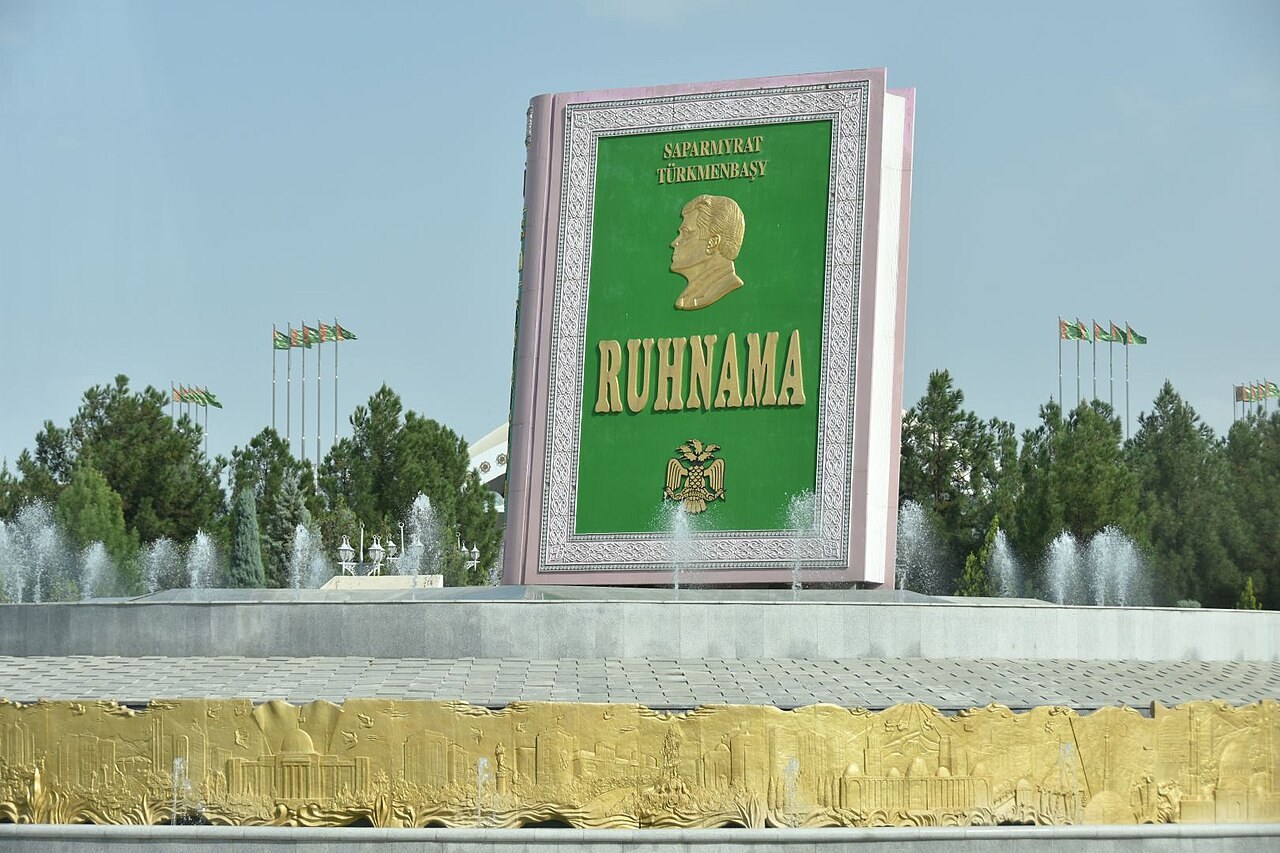
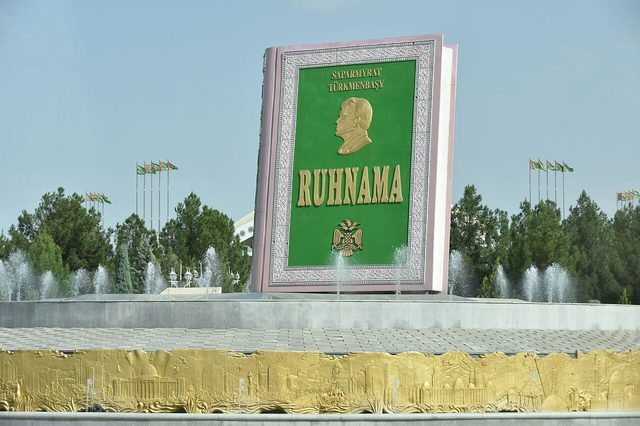
Niyazov, 1991 to 2006. The centre was the Ruhnama ("Book of the Soul"), published in 2001 with a second volume after it. It opens: "This book, written with the help of inspiration sent to my heart by the God who created this wonderful universe and who is able to do whatever He wills, is Turkmen Rukhnama" (English edition, Ashgabat, 2003, p. 9). The same edition prints an oath whose last lines are "AT THE MOMENT OF MY BETRAYAL TO MY MOTHERLAND, TO HER SACRED BANNER, TO GREAT SAPARMYRAT TURKMENBASHY LET MY BREATH STOP!" and a national anthem that begins its refrain "The great creation of Turkmenbashy". Study was compulsory in schools, universities and for civil-service posts, and journalists report that driving tests and job interviews drew on it (RFE/RL obituary; Slate, 2014). Forum 18 (1 March 2005) documented that the Kipchak (Gypjak) mosque, opened in October 2004 in Niyazov's home village, carried the inscription "Ruhnama is a holy book; The Koran is Allah's book" on its gateway, that copies of the book shared reading stands with the Koran, and that at a February 2005 government meeting clergy were told it was a priority to spread the ideas of "our great leader's sacred books".
Other measures: a law of August 2002 renamed the months and days, so that January became Türkmenbaşy and April took the name of his mother, Gurbansoltan (CNN, 17 August 2002; RFE/RL); the 1998 Neutrality Arch in central Ashgabat carried a gilded statue of Niyazov that turned to face the sun; and, from 2001, opera and ballet were banned as incompatible with Turkmen mentality (Al Jazeera, 2019), with the circus also covered by the ban that was lifted later (CBC). Many further anecdotes about his decrees circulate in travel writing and on the web; this page leaves out those whose wording or date the cited sources do not fix.
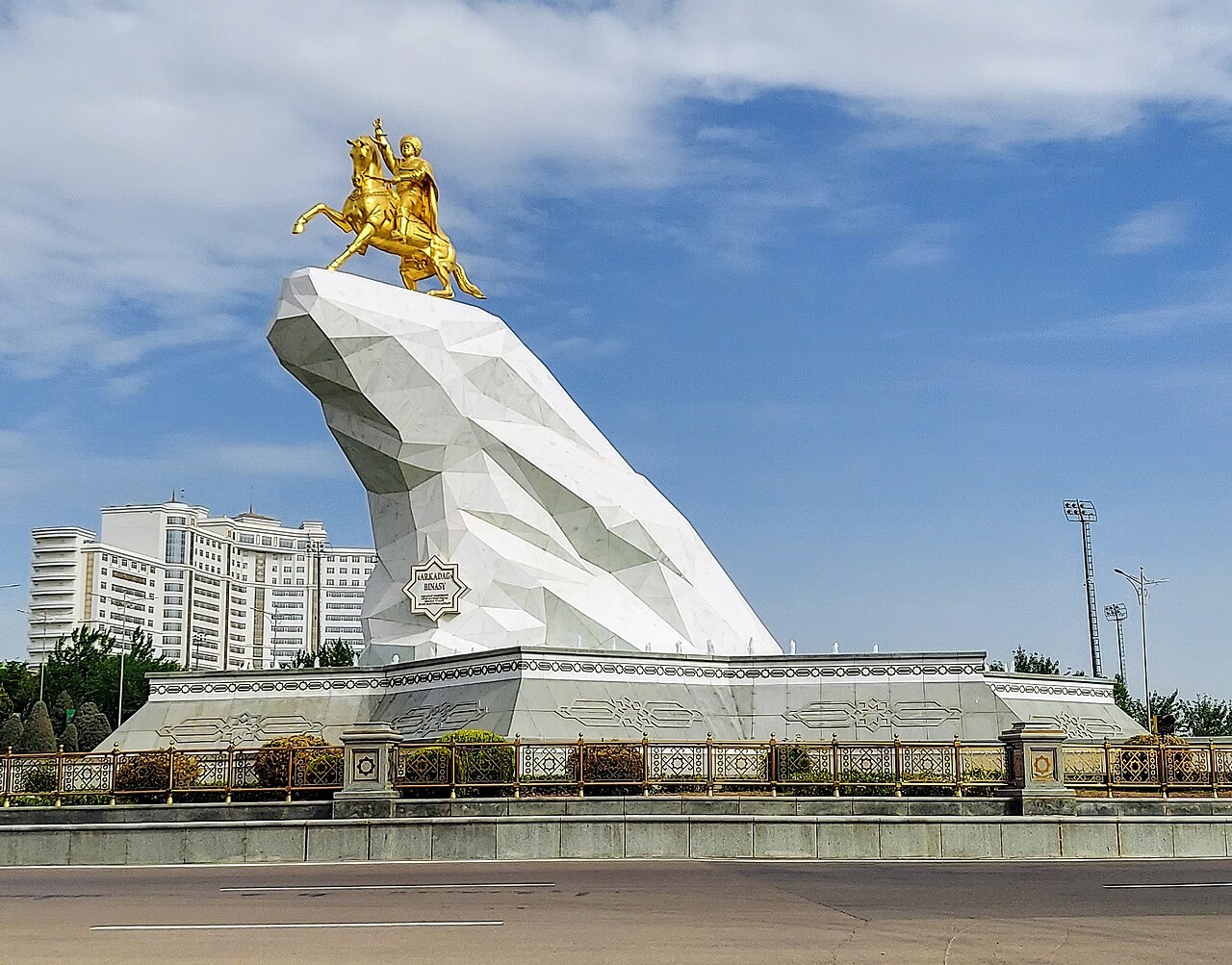
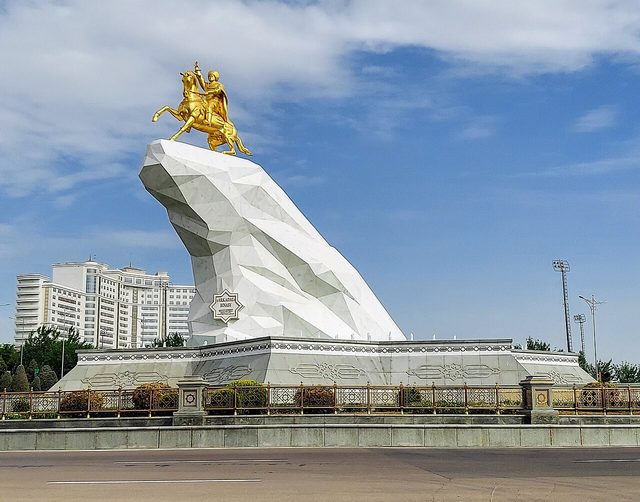
Berdimuhamedov, 2006 to 2022. The new president kept the machinery and changed its subject. The months and days returned to their earlier names in 2008 after the president agreed to a request put by the Mejlis speaker, who cited "thousands of citizen letters" (RFE/RL, 23 April 2008). On 18 January 2010 a presidential decree ordered the gilded statue removed from the top of the Neutrality Arch, which state media said would "improve the architectural image of Ashgabat"; the monument was moved in 2010 to a park on the southern outskirts. Analysts at the Centre for Eastern Studies (OSW) and RFE/RL saw it as a step in replacing the cult of the first president with that of the new one (RFE/RL, 18 January 2010; OSW, 23 June 2010). Study of the Ruhnama was reduced in steps whose dates sources give differently, from 2007 to 2014, and Eurasianet and AsiaNews reported it still tested in some university examinations. In its place the state promoted the Akhal-Teke horse and the president's own titles. Arkadag means "protector" and the president was called by it; a gilded statue of him on horseback, about 21 metres high on a white-marble cliff, was unveiled in Ashgabat on 25 May 2015 (Moscow Times, 25 May 2015; Meduza; CNN), and a gilded statue of the Alabai dog followed in November 2020 (CNN, 13 November 2020). In 2013 Guinness World Records gave Ashgabat the record for the highest density of white-marble-clad buildings, and its editor-in-chief called it a sign of "the architectural re-styling effort led by the Turkmen government" (Moscow Times, 27 May 2013). The Arkadag city, 30 km from the capital and named for him, was opened on 29 June 2023 (his birthday) and described on the state portal as "a vivid example of a 'smart city'".
State media and the internet. The state news agency (TDH) founded the electronic newspaper Golden Age, whose English text calls the president "the Leader of the Nation" and credits him with "boldness and scale of intentions, deliberateness and foresight in taking decisions" (state portal, ten-year review). Television is state-run, with channels including Altyn Asyr ("Golden Age"). Reporters Without Borders ranks Turkmenistan 174th of 180 in 2025 and 173rd in 2026 and says all media must disseminate the government line; Human Rights Watch says there is no independent media; BTI 2026 reports that about three-quarters of IP addresses are blocked and that VPNs and foreign sites are prohibited; Freedom House (2025) says social-media users who visited the accounts of independent media or exiled groups faced interrogation and confiscation of devices, and that in one month some previously blocked VPNs became accessible but could be monitored.
The state's account. The government says the 2007 election was one of "democratic elections held on broad alternative basis" (state review, 2017), and that the country follows a policy of permanent neutrality recognised by the UN General Assembly (resolution 50/80). Serdar Berdimuhamedov said at his inauguration, in the state portal's English text: "We will continue to ensure a humane state policy in the field of protection of human rights and freedoms."
Outside findings, in the bodies' words. ODIHR's final report on the 25 March 2018 parliamentary elections (30 May 2018) found they "lacked important features of a genuinely democratic electoral process" and that "any campaigning other than that organized by the authorities was effectively prohibited". Its report on the 26 March 2023 elections found they "took place in an environment that lacked genuine competitiveness and pluralism" and that "media is tightly controlled by the state". Freedom House's Freedom in the World 2025 scores Turkmenistan 1 of 100 (0 of 40 for political rights, 1 of 60 for civil liberties), "Not Free". These are assessments by outside bodies; the state's own account is given above, and the archive reports both.
The archive's definitions fit as follows: identity fusion (the leader's name in the anthem and oath, the Ruhnama alongside scripture), manufactured consensus (official results of 89 to 99 per cent), card stacking (state-only media and the blocking of foreign sources), glittering generalities ("Golden Age", "smart city") and transfer (the book set beside the Koran).
Timeline
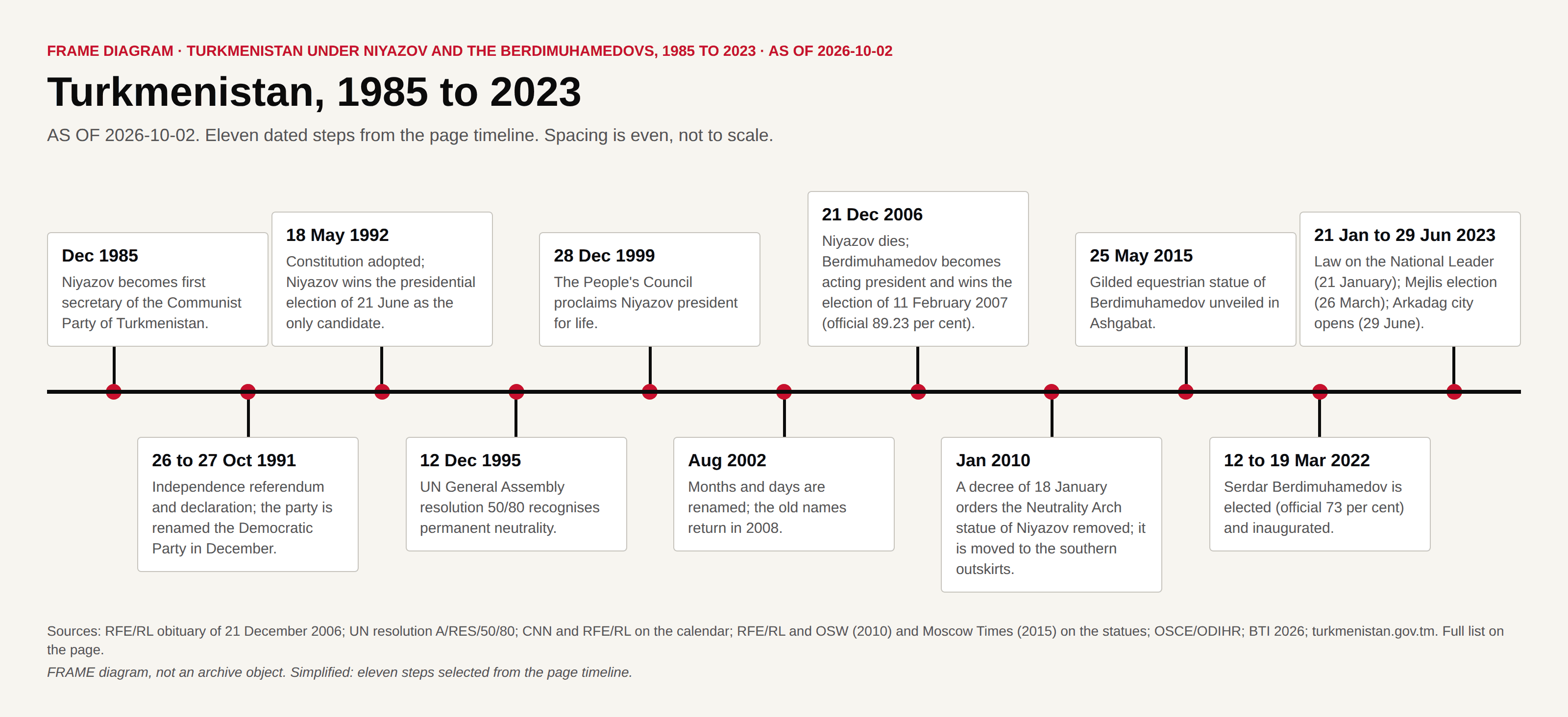
December 1985: Niyazov becomes first secretary of the Communist Party of Turkmenistan (Gapurov out); 13 January 1990: chairman of the Supreme Soviet.
27 October 1990: elected president of the Turkmen SSR as sole candidate.
26 to 27 October 1991: independence referendum and declaration; December 1991, party renamed Democratic Party of Turkmenistan.
18 May 1992 and 21 June 1992: constitution adopted; Niyazov elected as the only candidate; 15 January 1994: referendum extends his term to 2002.
12 December 1995: UN General Assembly resolution 50/80 recognises permanent neutrality.
28 December 1999: People's Council proclaims Niyazov president for life.
2001: first volume of the Ruhnama; opera and ballet ended.
August 2002: months and days renamed.
October 2004: Kipchak mosque opened.
21 December 2006: Niyazov dies; Berdimuhamedov becomes acting president.
11 February 2007: Berdimuhamedov elected (official 89.23 per cent).
2008: months and days restored; new constitution (26 September).
18 January 2010: decree to remove the Neutrality Arch statue; moved during 2010.
2013: Guinness record for white-marble buildings in Ashgabat.
25 May 2015: gilded equestrian statue of Berdimuhamedov unveiled.
September 2016: presidential term lengthened to seven years.
11 February to 19 March 2022: announcement, election (12 March) and inauguration of Serdar Berdimuhamedov.
21 January 2023 and 26 March 2023: law on the National Leader; Mejlis election.
29 June 2023: Arkadag city opened.
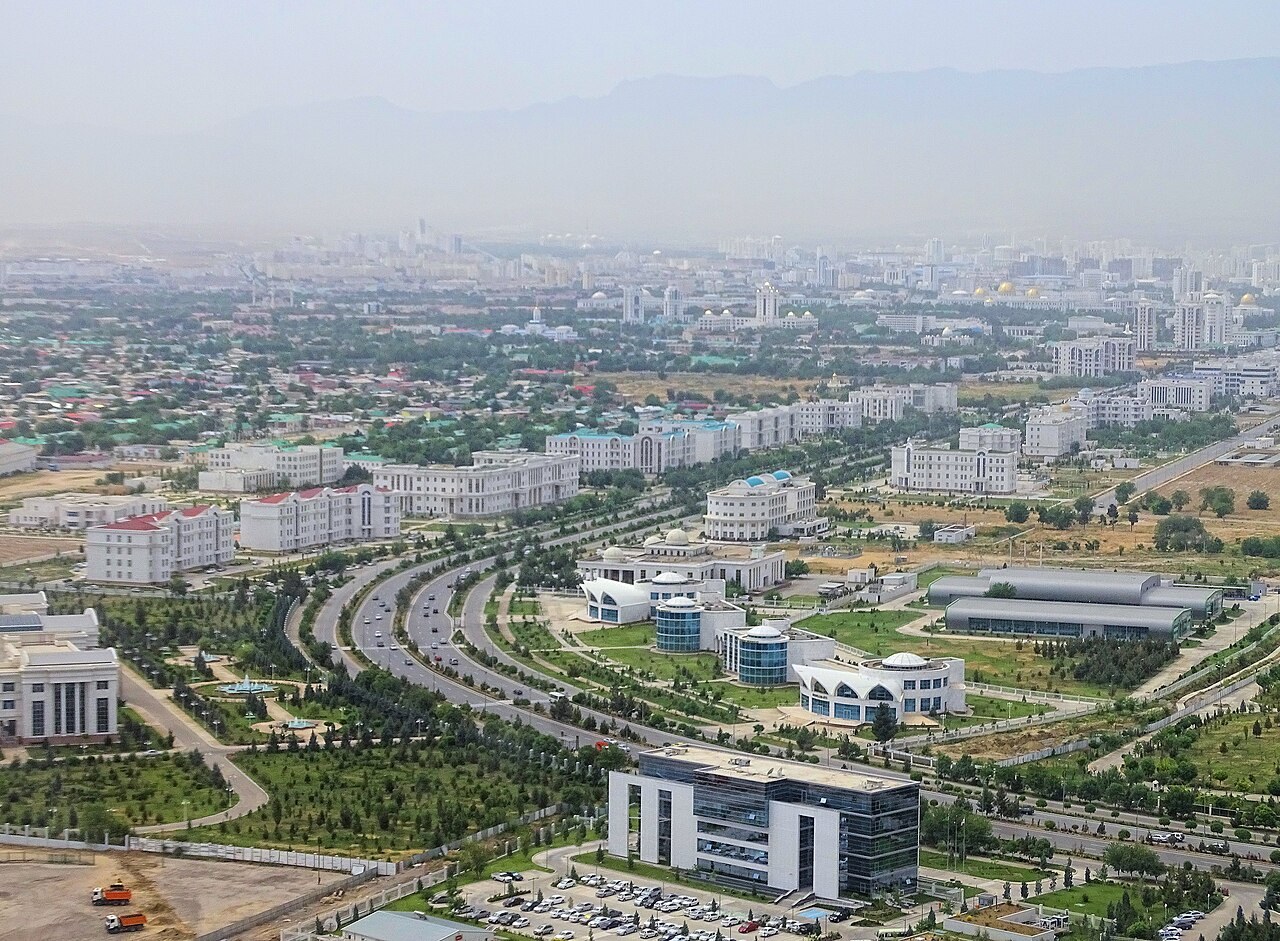
Golden equestrian statue of Gurbanguly Berdimuhamedov on a white-marble cliff, Ashgabat, 2015. From the collection. The gilded equestrian statue unveiled on 25 May 2015.Neutrality Road and white-clad buildings in Ashgabat, May 2015; the 2013 Guinness record for white-marble-clad buildings in the timeline concerns this kind of building. Source: Bjorn Christian Torrissen (bjornfree.com), CC BY-SA 4.0, via Wikimedia Commons, CC BY-SA 4.0.
Timeline, as of 2 October 2026: eleven dated steps selected from this page, simplified from the sources cited on this page. Source: FRAME diagram, drawn from the sources listed on this page, CC BY 4.0 (FRAME archive content).
Where it stands as of October 2, 2026
Illustration, not an archive object
As of October 2, 2026 Serdar Berdimuhamedov is president and Gurbanguly Berdimuhamedov chairs the Halk Maslahaty, which opened a session on 23 September 2026 ahead of the 35th anniversary of independence (Trend, 23 September 2026). Rashid Meredov, foreign minister since July 2001, is also deputy chairman of the Cabinet (UN General Assembly readout, 28 May 2026). The Mejlis speaker elected on 6 April 2023 is Dunyagozel Gulmanova; her current status is not verified as of October 2, 2026. Freedom House's 2025 score is 1 of 100; the RSF 2026 index places the country 173rd; BTI 2026 scores it 2.69 of 10 (rank 125 of 137). The government's own accounts continue to describe a policy of neutrality and a "Golden Age"; scholars and outside bodies cited above describe a continued personalised system, and no outside body cited here reports a competitive election since 1991.
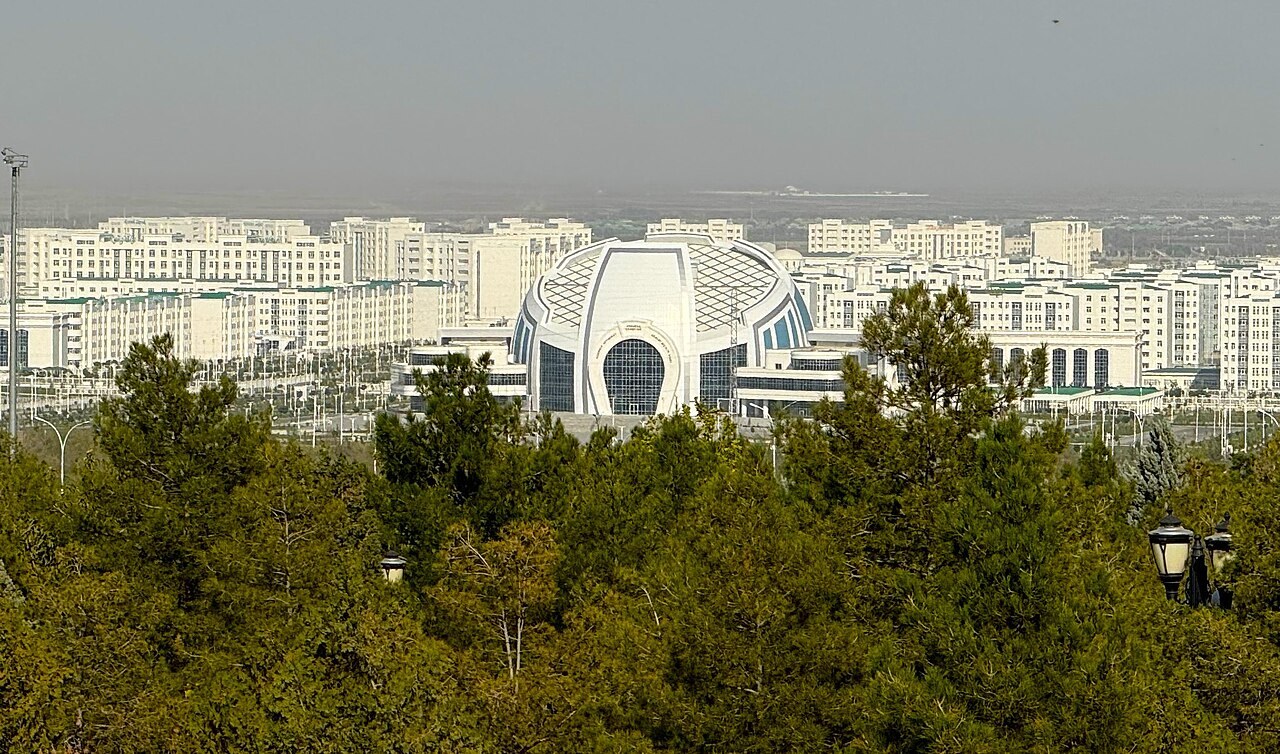
Arkadag city, opened on 29 June 2023 and named for Gurbanguly Berdimuhamedov's title; the state portal calls it a 'smart city' (photograph of November 2023). Source: Bayram A, CC BY-SA 4.0, via Wikimedia Commons, CC BY-SA 4.0.
Same-standard note
This page uses the same structure and definitions as every other regime page: a technique is listed only where the archive's working definition and a documented example fit, the same technique ids apply to every state, and offices and dates are stated without judging the people who held them. Official statements are quoted in their own terms and outside assessments are attributed by name. Scale and context are set out as history, not ranked: a gas-exporting state of a few million people, governed by one party-dominated system, whose documented record here concerns a leader cult, state-run media, restrictions on expression and elections without genuine competition, as the sources cited describe them. Other regime pages record other systems, each with its own scale, intent and context, and this page implies no equivalence with them.
Sources
UN General Assembly, resolution 50/80 A, "Permanent neutrality of Turkmenistan", 12 December 1995 (A/RES/50/80); UN Human Rights Committee, Concluding observations on the third periodic report of Turkmenistan, CCPR/C/TKM/CO/3, March 2023 (listed, text not read), and the UN Geneva meeting summary of March 2023.
Saparmyrat Turkmenbashy, Ruhnama: Reflections on the Spiritual Values of the Turkmen (Ashgabat, 2003, English edition, scan on the Internet Archive).
OSCE/ODIHR: needs assessment mission report, early presidential election, 8 March 2022; final report, presidential election, 12 February 2017 (10 May 2017); final report, parliamentary elections, 25 March 2018 (30 May 2018); election assessment mission final report, parliamentary elections, 26 March 2023 (10 October 2023); OSCE Rapporteur's report (E. Decaux) under the Moscow Mechanism on Turkmenistan, 12 March 2003.
State of Turkmenistan: turkmenistan.gov.tm (inauguration of 19 March 2022; "President Gurbanguly Berdimuhamedov: ten years of reforms and achievements"; Arkadag report of 2023); oilgas.gov.tm (National Leader, January 2023); all read 2 October 2026.
Freedom House, Freedom in the World 2025: Turkmenistan; Reporters Without Borders, Turkmenistan country page and World Press Freedom Index 2025 and 2026; Human Rights Watch, World Report 2026: Turkmenistan; Bertelsmann Stiftung, BTI 2026 Country Report Turkmenistan.
Annette Bohr, Turkmenistan: Power, Politics and Petro-Authoritarianism (Chatham House, 2016); Sebastien Peyrouse, Turkmenistan: Strategies of Power, Dilemmas of Development (M. E. Sharpe, 2012); Abel Polese and Slavomir Horak, "A tale of two presidents: personality cult and symbolic nation-building in Turkmenistan", Nationalities Papers 43(3), 2015; Library of Congress Federal Research Division, Turkmenistan: A Country Study.
Reference-work summaries (Wikipedia articles on Niyazov, Gapurov, Gundogdyev, Berdimuhamedov, the 1990, 1991 and 1994 votes and the Constitution of Turkmenistan), used for dates only and not checked against the primary decrees. Press: Daniel Kimmage, obituary, RFE/RL, 21 December 2006; Felix Corley, Forum 18, 1 March 2005; CNN, "Turkmen leader redefines ages of man", 17 August 2002; RFE/RL, "Turkmenistan: 'April' returns to Ashgabat", April 2008; Slate, February 2014; Al Jazeera, "Turkmenistan stages first opera after 19-year ban", 19 November 2019; CBC, "President of Turkmenistan lifts ban on operas, circuses"; RFE/RL, "Turkmen Leader Orders Predecessor's Statue Removed", 18 January 2010; Centre for Eastern Studies (OSW), "The golden statue of Turkmenbashi removed from the centre of Ashgabad", 23 June 2010; RFE/RL, "New Turkmen President Sworn In", 14 February 2007; RFE/RL, "Turkmenistan: Explaining The Presidential Election"; RFE/RL, "Turkmenistan: Atayev Reportedly Released"; UN Geneva, meeting summary of the Human Rights Committee dialogue with Turkmenistan, 2 March 2023; Moscow Times, 25 May 2015 and 27 May 2013; Meduza, 25 May 2015; CNN, 13 November 2020; The Diplomat, 15 February 2022 (Catherine Putz); RFE/RL, March 2022; Trend, 23 September 2026; UN General Assembly President's readout, 28 May 2026.

_02.jpg)
.jpg)
.jpg)
.png)
_1.jpg)

