Also called Coded language, Coded appeal, Multivocal communication, Code word
A phrase that reads as innocuous to a general audience but carries a second, targeted meaning to an in-group.
How to spot Dog whistle: the tell
The phrase is documented with a specific in-group meaning, and its use clusters where that audience is being addressed.
What Dog whistle is not
Ordinary words that only critics, not the intended audience, read as coded.
History and effect of Dog whistle propaganda
The metaphor comes from the dog whistle, a sound pitched so that dogs hear it and people do not. William Safire's political dictionary traces the political sense to opinion polling: Richard Morin of the Washington Post described a "dog whistle effect" in 1988, where respondents hear something in a question that the researchers do not. The label entered Australian political commentary in the 1990s, often applied to John Howard's campaigns, and reached British debate in 2005 through the Conservative campaign run by Lynton Crosby, who had worked for Howard. The practice is older than the name. The earliest case on this page is from 1949, with others from 1968 and 1981.
Explain moreShow less
This is a contested label, and this page treats it that way. A speaker accused of a dog whistle can almost always deny it, because the deniability is the design, and a critic can almost always assert it, because the second meaning is not in the literal words. For that reason the cases below are limited to ones where the coded meaning is documented outside the critic's own reading: the speaker's own later explanation, the in-group's own usage, or the statements of the state that ran the campaign. Cases that rest only on a critic's reading are listed separately as contested and are not counted.
The effect on the in-group is recognition: the listener feels addressed by a speaker who shares their view. The speaker keeps an outer audience that would object to the open version of the message.
Lineage: 1980s Australian and 1990s British political usage; coded appeals
How Dog whistle propaganda works
A dog whistle needs two audiences and a shared key. The surface meaning must be defensible in public ("states' rights", "cosmopolitan", "Zionist"). The second meaning must be known to the target group, through repeated use, an earlier open version of the same message, or an explicit in-group explanation. The speaker then relies on one of two things: the outer audience does not notice, or the outer audience notices and the speaker can deny.
Explain moreShow less
There are two broad kinds. In the first, the code is built for the purpose: numbers and symbols that a movement agrees on among itself, such as "88" for "Heil Hitler" (H is the eighth letter), which the Anti-Defamation League describes as one of the most common white supremacist symbols. In the second, an ordinary word is attached to a second meaning by use: a policy term that stands in for a group, or a label that was once explicit and is now said without the explicit part. Philosophers and political scientists describe a third, accidental kind, where part of the audience hears a second meaning the speaker did not intend. That kind is exactly what the contested label is applied to.
Why Dog whistle propaganda works
Political scientist Tali Mendelberg's research on racial appeals in U.S. campaigns (The Race Card, Princeton University Press, 2001) found that implicit appeals could move voters in ways that explicit ones could not, because an openly racial message triggers a norm of equality that makes people reject it, while a message that avoids the open reference does not. Bethany Albertson's experiments (Political Behavior, 2015) found that religious coded phrases drew a favorable response from religious listeners while leaving other listeners unmoved. The two findings share a mechanism: shared identity makes the coded meaning easy to retrieve for the target group, and the lack of an open statement lets everyone else disregard it.
Explain moreShow less
Robert Goodin and Michael Saward argued in 2005 that the technique is also a problem for democratic mandates: if a party wins on a message that half the electorate did not hear, it is unclear what the electorate authorised.
Dog whistle propaganda examples across eras and sides
- United States, 1981 (Republican campaign strategist). In an interview recorded in 1981 by the political scientist Alexander Lamis, Lee Atwater, then working in the Reagan White House, described how appeals had changed from open racial language to abstractions. Of the newer vocabulary he said: "So you say stuff like, uh, forced busing, states' rights, and all that stuff, and you're getting so abstract." Lamis published the interview in 1984 without Atwater's name, after Atwater asked whether he was being quoted, and the full tape was released after Atwater's death in 1991 (Rick Perlstein, The Nation, 13 November 2012). The interview is the speaker's own account of the mechanism. It is not a statement that a particular speech used it.
- Soviet Union, 1949 (state press). In the anti-cosmopolitan campaign, the Soviet press attacked "rootless cosmopolitans" and "those who kneel before the West" without naming a nation. A Pravda article of 28 January 1949, "About one anti-patriotic group of theatre critics", opened a new stage, and state media printed writers' birth names in parentheses beside their pseudonyms to show that they were Jews (Wikipedia, citing Yaacov Ro'i in the YIVO Encyclopedia). The historian Gennady Kostyrchenko said that "everyone understood who these 'cosmopolitans' were" (Oleg Yegorov, Russia Beyond, 2018). The code here was the state's own, and the meaning was understood well beyond any in-group. The campaign was followed by arrests, and in a related case thirteen Soviet Jewish writers were convicted in 1952. The scale and the power behind it differ greatly from the other cases.
- Poland, 1967 to 1968 (communist government). After the Six-Day War, Polish officials spoke of "Zionists" in the party, the military and the universities. Władysław Gomułka said on 19 June 1967 that some Polish Jews could be a "fifth column", and on 19 March 1968 he divided Polish Jews into Polish, cosmopolitan and Zionist groups. A 11 March 1968 article in Słowo Powszechne called Jewish-sounding student organisers "natural-born Zionists" (Simon Gansinger, Fathom, citing the Polish press). Gansinger notes that the "Zionist means Jew" reading explains much of the campaign but is incomplete, since the campaign also built a political conspiracy story around Zionism itself.
Show all 5Show fewer
- United States and online, 2014 to 2016 (far-right blog and followers). The neo-Nazi blog The Right Stuff used triple parentheses, "(((name)))", on its podcast and site from 2014 to mark Jewish names, and said in its own words that the symbol meant that Jews' past actions made their names "echo". Mic reported on the practice on 1 and 2 June 2016. Google removed the "Coincidence Detector" browser extension, which had added the marks to a list of 8,771 names, on 3 June 2016, and the ADL added the symbol to its hate-symbol database on 6 June 2016. Jews and non-Jews then began putting their own names in parentheses, which changed the symbol's public meaning (Wikipedia, "Triple parentheses", with the primary reports it cites). The in-group explained the code itself.
- United States, Australia and New Zealand, 2017 to 2019 (online trolls, then a mass shooter). In 2017 users of 4chan falsely claimed that the "OK" hand gesture stood for "white power", as a hoax meant to provoke journalists into accusing ordinary people. By 2019 some white supremacists used the gesture sincerely. The Australian Brenton Tarrant flashed it in a New Zealand courtroom in March 2019 after the Christchurch mosque attacks. The ADL's entry says the gesture's ordinary meaning of approval remains the most common and that a person "cannot be assumed" to be using it as a trolling or white supremacist symbol without other evidence. This case shows both sides of the label: a code that was invented, then used, and an ordinary gesture that accusers could not safely read as one.
Explain moreShow less
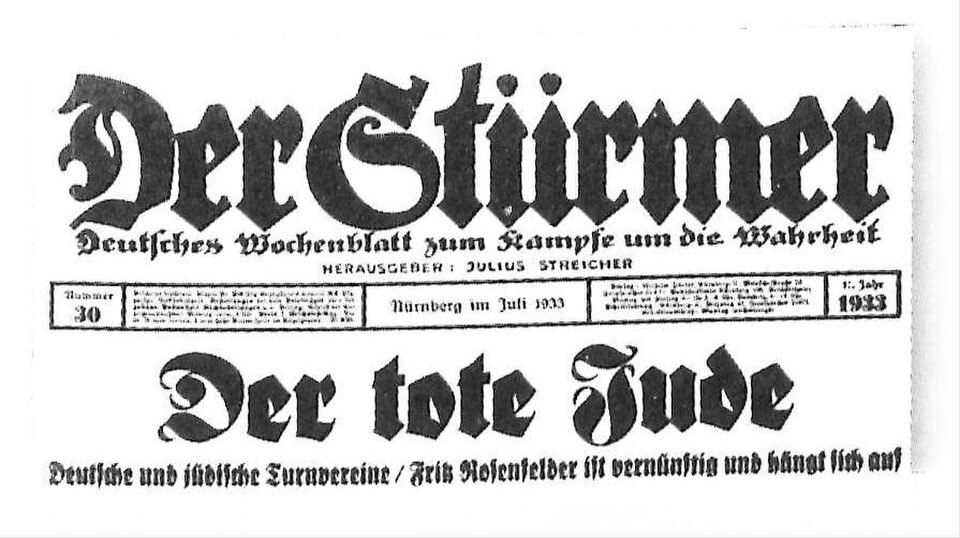
Der Stürmer, no. 30 (Nuremberg, July 1933), masthead and lead headline "Der tote Jude" with the caricature masked on the scan. Publisher Julius Streicher. Wikimedia Commons. Public domain (masthead and text, per Commons). Shown for contrast: it states its message outright, where a dog whistle would not.
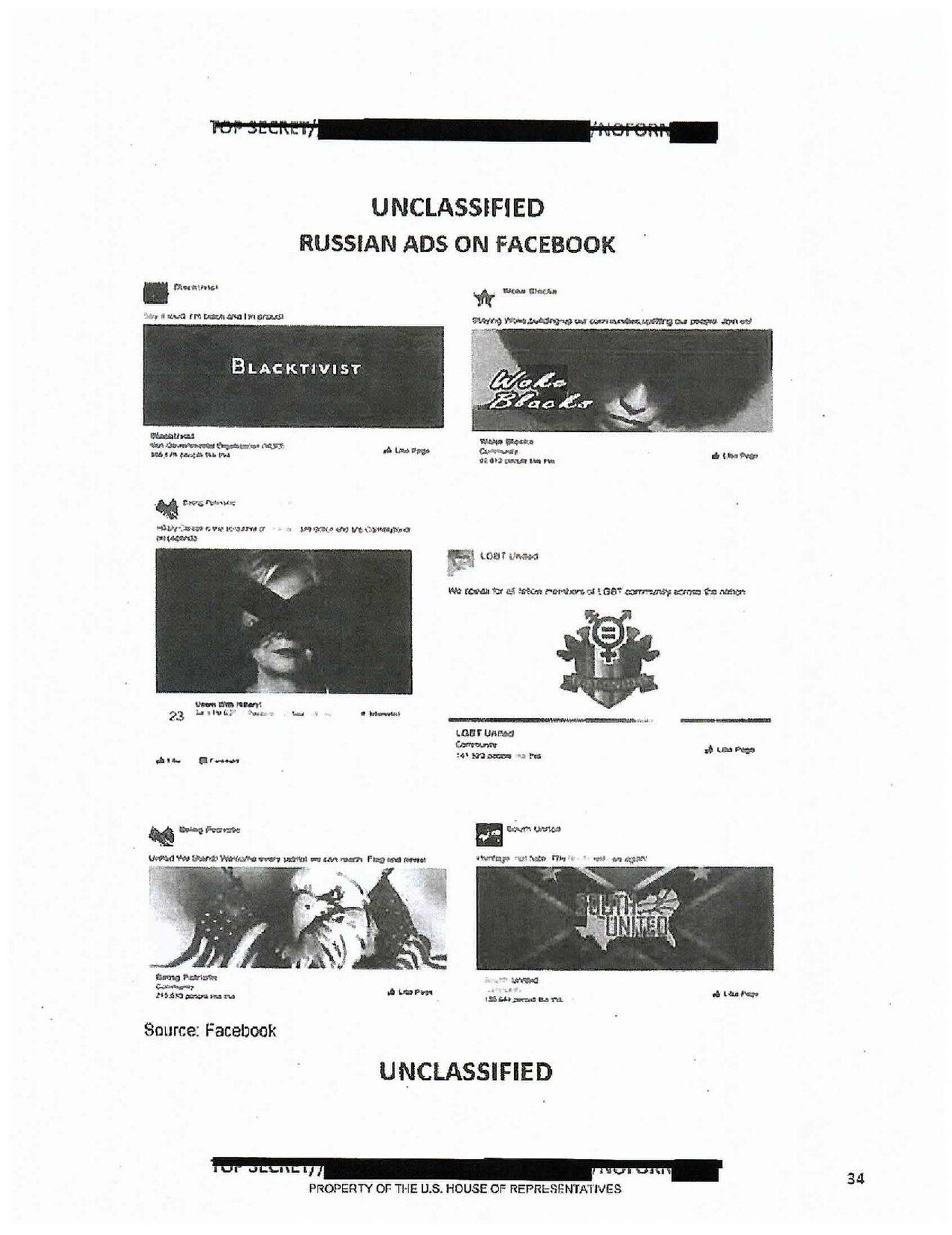
Facebook pages run by the Internet Research Agency under American community names, reproduced in the House Permanent Select Committee on Intelligence's Report on Russian Active Measures (2018), p. 34. Public domain (U.S. government work). It shows identity-specific messaging aimed at separate audiences, not a coded phrase.
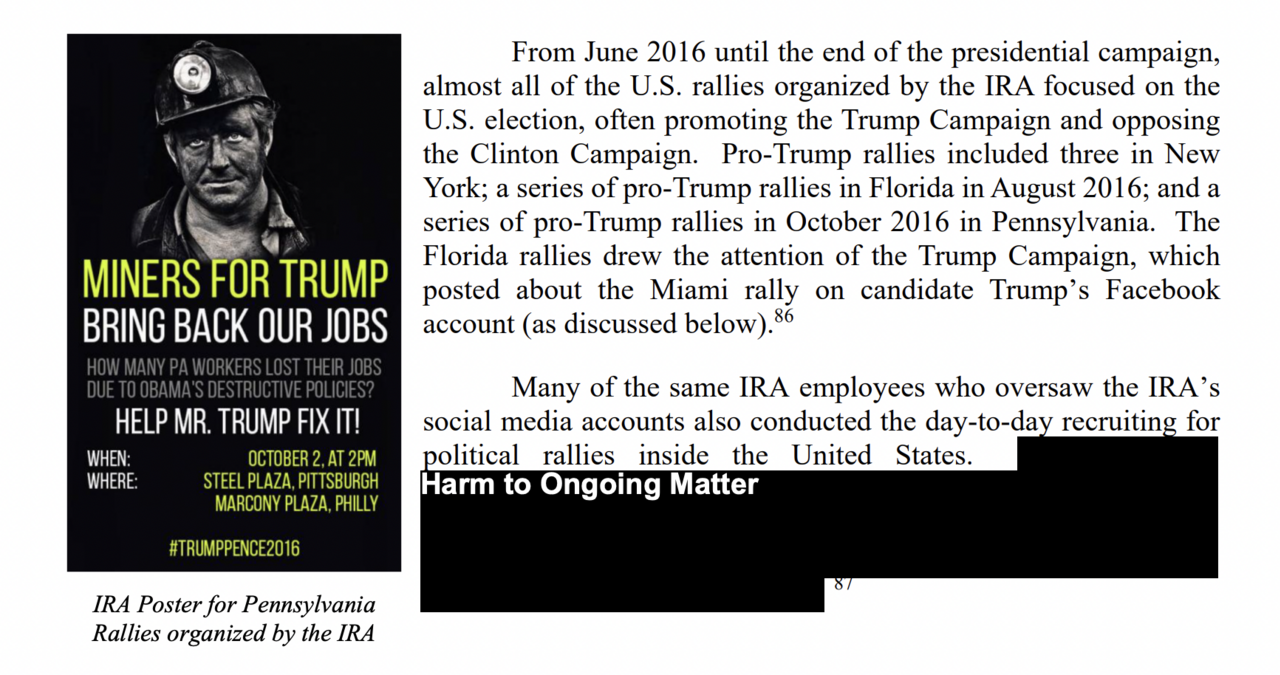
'Miners for Trump' rally poster promoted by the Internet Research Agency through accounts posing as American activists, October 2016. U.S. Department of Justice, Special Counsel's Office report (2019), vol. I, p. 31. Public domain (U.S. government work). Audience-targeted framing, shown for the two-audience logic, not as a dog whistle.
Contested cases, not counted above. Some of the best-known accusations rest on a critic's reading. In 2012 the Romney campaign's welfare-work ads were called "dog-whistle racism" by MSNBC's Rachel Maddow, and the political scientist Tali Mendelberg said they communicated "black equals no work, white equals work"; a campaign aide said the charge "doesn't deserve the dignity of a response", and Newt Gingrich said that discussing dependency "doesn't mean you're racist" (see The steelworker ad and the welfare ads: two fact-checked attacks from the 2012 U.S. presidential race, which separates what is documented from what is not). In 2003 George W. Bush's State of the Union phrase "wonder-working power" was read by evangelical leaders Richard Cizik and Jim Wallis as a signal to evangelicals, an allusion to a hymn; another evangelical leader, Richard Land, said there was no conscious effort to signal anything (PBS Frontline, "The Jesus Factor"). The phrase "from the river to the sea" is read by some groups as a call to destroy Israel and by others as a call for equal rights, and the people who use it are not agreed on which it is. None of these has the second meaning documented from the speaker or in-group, so they are examples of the dispute, not of the technique.
Gaps. No archive object shows a documented dog whistle in its original setting, so the images above illustrate the contrast and the two-audience logic and are not instances. No case from a speaker on the political left in a Western democracy with a documented coded meaning has been sourced for this page. The left-wing cases here are the communist state campaigns of 1949 and 1968. The definition applies unchanged, and a sourced case will be added when found.
How to spot Dog whistle propaganda
- Is the second meaning documented by the speaker, by the in-group's own usage, or by internal papers? If the only evidence is a critic's reading, treat the case as a contested charge.
- Did the same speaker or movement once say the explicit version? A policy term that replaced an open statement carries the old meaning more often than a term that never had one.
- Does the phrase cluster in venues, outlets or events where the target audience is, and drop out where it is not?
Show all 6Show fewer
- Can the sentence be defended on its literal terms, and does the speaker defend it only that way when challenged?
- Is the phrase doing work the literal policy does not need? A sentence that adds nothing to the stated argument but a group signal is a candidate.
- Check the opposite direction. Would the same reading be applied to a phrase from your own side?
Where Dog whistle propaganda ends: edge cases and legitimate persuasion
4 items · Shared jargon is not a dog whistle. Religious, professional and subcultural groups all…
- Shared jargon is not a dog whistle. Religious, professional and subcultural groups all use phrases that mean more to members than to outsiders, and a speaker who uses a church's language in a church is addressing a church. The technique starts when the speaker wants the outer audience not to notice, or to be able to deny.
- Numbers and symbols have innocent uses. The ADL notes that "88" appears in non-extremist contexts, such as amateur radio, where it means "hugs", and NASCAR, and that every symbol in its database must be read in its context.
- Accusation is itself persuasive. Calling a phrase a dog whistle can discredit a speaker without engaging the argument. Mark Liberman has argued that partial uptake of a phrase is normal in speech and is not by itself evidence of a double message, and Steven Pinker has warned that the label lets anyone claim that anyone says anything. Hindess (Whistling the Dog, 2023) argues that the definition depends on the investigator's disapproval. This page treats those objections as the reason for the documentation standard above.
- A code the whole society understands is closer to Euphemism / doublespeak or open Scapegoating, as with the Soviet and Polish campaigns. A technically defensible claim that retreats to a modest reading when challenged is Motte and bailey. A word whose meaning is changed to carry a hidden loading is Semantic hijacking. Repeated coded appeals can also move what is acceptable to say in public, which is Overton window shifting.
Sources and further reading
Sources
14 items · Perlstein, Rick. "Exclusive: Lee Atwater's Infamous 1981 Interview on the Southern…
- Perlstein, Rick. "Exclusive: Lee Atwater's Infamous 1981 Interview on the Southern Strategy." The Nation, 13 November 2012. https://www.thenation.com/article/archive/exclusive-lee-atwaters-infamous-1981-interview-southern-strategy/
- Lamis, Alexander P. The Two-Party South. Oxford University Press, 1984 (interview published without Atwater's name; republished with his name in a later edition).
- Wikipedia. "Anti-cosmopolitan campaign" (citing Ro'i, Yaacov, "Anticosmopolitan Campaign", YIVO Encyclopedia of Jews in Eastern Europe, 2010). https://en.wikipedia.org/wiki/Anti-cosmopolitan_campaign
- Yegorov, Oleg. "Fighting the 'rootless cosmopolitan': How Stalin attacked Soviet Jews after WWII." Russia Beyond, 26 January 2018 (quoting Gennady Kostyrchenko). https://www.rbth.com/history/327399-stalin-versus-soviet-jews
- Gansinger, Simon. "Communists against Jews: The anti-Zionist campaign in Poland in 1968." Fathom Journal. https://fathomjournal.org/communists-against-jews-the-anti-zionist-campaign-in-poland-in-1968/
- Wikipedia. "Triple parentheses" (citing Mic, 1 and 2 June 2016; Gizmodo, June 2016; ADL). https://en.wikipedia.org/wiki/Triple_parentheses
- Anti-Defamation League. "Okay Hand Gesture" and "88", Hate on Display hate symbols database. https://www.adl.org/resources/hate-symbol/okay-hand-gesture ; https://www.adl.org/resources/hate-symbol/88
- Wikipedia. "Dog-whistle politics" (Safire; Morin 1988; Goodin and Saward 2005; Hindess 2023; Liberman and Pinker objections). https://en.wikipedia.org/wiki/Dog-whistle_politics
- Mendelberg, Tali. The Race Card: Campaign Strategy, Implicit Messages, and the Norm of Equality. Princeton University Press, 2001.
- Albertson, Bethany L. "Dog-Whistle Politics: Multivocal Communication and Religious Appeals." Political Behavior 37(1), 2015, pp. 3-26.
- Goodin, Robert E., and Michael Saward. "Dog Whistles and Democratic Mandates." The Political Quarterly 76(4), 2005.
- Haney López, Ian. Dog Whistle Politics: How Coded Racial Appeals Have Reinvented Racism and Wrecked the Middle Class. Oxford University Press, 2014.
- PBS Frontline. "The Jesus Factor": "Invoking the Language of the Faithful." https://www.pbs.org/wgbh/pages/frontline/shows/jesus/president/invoking.html
- Case study The steelworker ad and the welfare ads: two fact-checked attacks from the 2012 U.S. presidential race in this archive (Maddow, Mendelberg, Tesler and campaign responses, with sources).
Sourcing note (7 October 2026): the Atwater, Soviet, Polish, ADL and Frontline passages were read directly on the linked pages, except that the Pravda article title and the parentheses practice come from Wikipedia's summary of Ro'i. The triple-parentheses dates were read on Wikipedia and not checked against the original Mic and Gizmodo reports. Mendelberg, Albertson, Goodin and Saward, and Haney López are cited from the scholarly record and the Wikipedia summary and were not re-opened. The Atwater passage opens with a racial slur that this page does not reproduce; the full tape is at The Nation.
The science
Research on the psychology this technique relies on, from the Learn library:
Research on the psychology this technique relies on, from the Learn library:
- In-group favoritism — In-group favoritism
- Social identity — Social identity
- Priming — Priming
- Motivated reasoning — Motivated reasoning