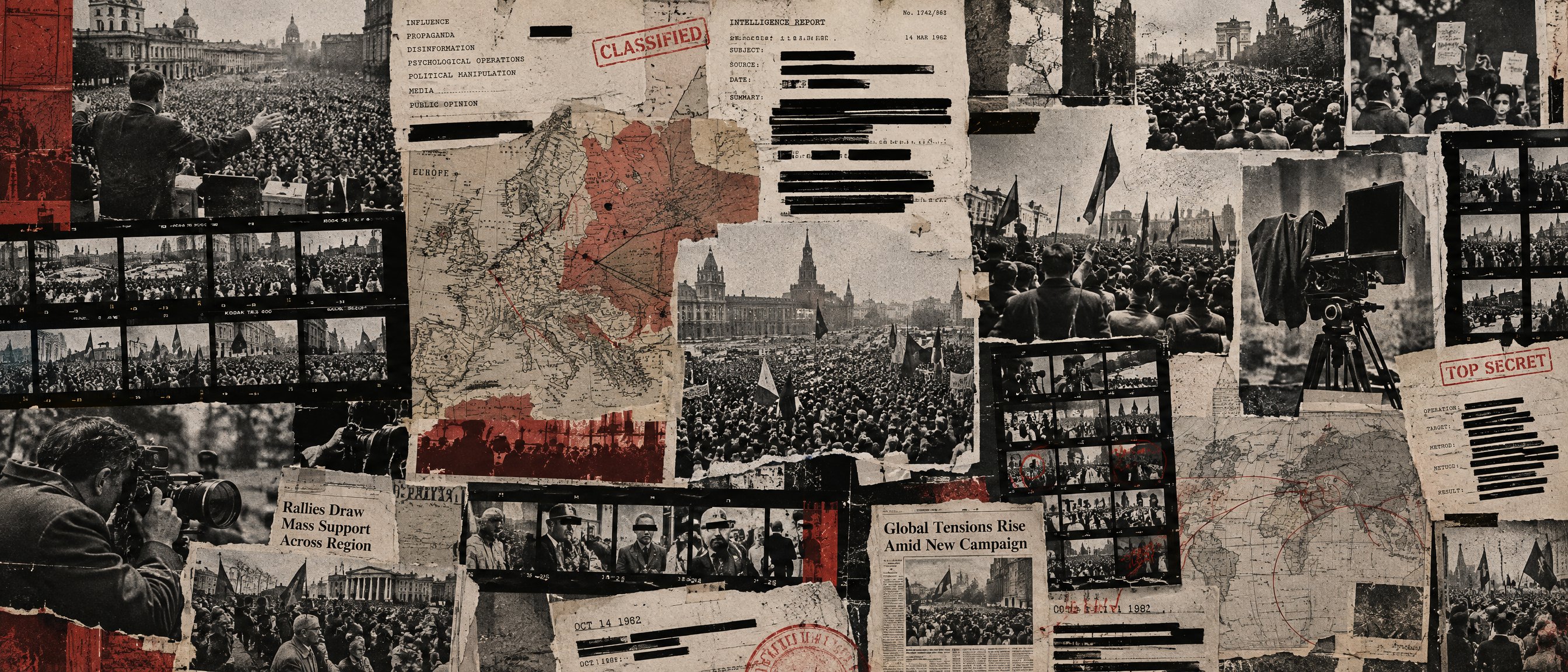
Area: Group identity · Evidence: strong (How we rate the evidence). Several meta-analyses confirm a reliable, moderate tendency to favor one's own group; what drives it, and how far it extends to hostility, is still debated.
In brief
People tend to treat members of their own group better than outsiders: they trust them more, give them more, and judge them more generously. The effect appears even for groups created on the spot, and it is strong for politically charged groups such as parties. An important nuance is that favoring one's own side is usually a matter of warmth toward insiders rather than active hostility toward outsiders, and political messages differ in which of the two they try to stir.
What the research shows
The classic evidence comes from the minimal group experiments of Henri Tajfel and colleagues, in which boys assigned to groups on trivial grounds consistently allocated more money to anonymous members of their own group, and often preferred allocations that widened the gap between groups over ones that gave their own group the most [1].
A 1992 meta-analysis by Brian Mullen, Rupert Brown and Colleen Smith pooled 137 tests of this "in-group bias" and found a highly significant effect of moderate size. Bias was stronger when the in-group was salient, for example when it was a small group or a real rather than laboratory group, and it interacted with status: high-status groups favored themselves more on dimensions that mattered to the comparison, while low-status groups favored themselves on dimensions that mattered less [2].
Daniel Balliet, Junhui Wu and Carsten De Dreu later pooled studies of cooperation, in which people decide whether to pay a personal cost to benefit someone else. People cooperated more with in-group than out-group members, with a small-to-medium effect size (d = 0.32, where 0.2 is conventionally "small" and 0.5 "medium"). The pattern was driven mostly by extra generosity toward the in-group rather than by punishing the out-group, and it was stronger when people's outcomes depended on each other [3].
That distinction was set out by Marilynn Brewer, who argued that "in-group love" and "out-group hate" are separate things. Cross-cultural and laboratory evidence suggests that strong attachment to one's own group does not automatically produce hostility to others; much discrimination consists of preferential treatment of insiders [4]. Brewer also noted the conditions under which the two become linked, such as competition over scarce resources, perceived threat, and moral superiority claims.
Politics provides a vivid modern demonstration. Shanto Iyengar and Sean Westwood asked Americans to choose between two high school seniors for a scholarship. When the applicants differed by party, about 79 percent of Democrats chose the Democratic applicant and 80 percent of Republicans chose the Republican one, and partisans often picked their co-partisan even when the other applicant had a clearly higher grade point average. In their studies, partisan favoritism rivaled or exceeded favoritism based on race [5].

Drawn by FRAME from Iyengar and Westwood (2015) [5], as summarized above. CC BY 4.0 (FRAME).
Has it held up?
The basic effect is among the best replicated in social psychology, as the two meta-analyses above show [2], [3]. The disputes concern explanation and scope. A review by Miles Hewstone, Mark Rubin and Hazel Willis lists the main moderators: strength of identification, group size, status and power, and perceived threat all change how much bias appears [6]. One critique holds that favoritism in minimal groups reflects expectations of reciprocity (helping those who might help you) rather than identity alone [7], and Balliet and colleagues found support for both identity-based and reciprocity-based accounts [3].
Another important boundary is the "positive-negative asymmetry." Amélie Mummendey and Sabine Otten showed that people readily favor their group when handing out rewards, but are much more reluctant to discriminate when the task is handing out burdens or penalties [8]. Favoring insiders comes easily. Harming outsiders usually needs something more, such as threat or a story that justifies it.
The scholarship finding shows real favoritism in a hypothetical choice. How much partisan favoritism shapes high-stakes behavior outside survey experiments is less clear, and one set of experiments that reduced partisan animosity found little change in political choices such as support for norm-breaking by one's own side [10].
How it shows up in political messaging
- Wartime home-front appeals. The American Let's Fly This Flag: Everybody at Least 10 Percent in War Bonds poster makes buying war bonds a matter of the whole workplace belonging together, and the Westinghouse poster We Can Do It! uses "we" to recruit effort. The German Helft uns siegen! Zeichnet die Kriegsanleihe (Help Us Win! Subscribe to the War Loan) ("Help us win!") makes the same move from the other side of an earlier war. All are "in-group love" appeals.
- The shift to out-group hate. Posters such as Beat Back the Hun with Liberty Bonds pair the in-group appeal with a degraded enemy, which is the combination Brewer identified as the dangerous one [4].
- Partisan favoritism in both American parties. The scholarship experiment found near-identical rates of co-partisan favoritism among Democrats and Republicans [5], and campaign messages that frame issues as "our side" versus "theirs" draw on it regardless of party.
- Insurgent solidarity. A 2011 survey of Libyan revolutionaries found frontline fighters' bonds to their battalion rivaled their bonds to their own families — for many, battalion came first — the same fusion the wartime posters above try to build, arising here in an anti-government insurgency rather than a state's own forces [9].
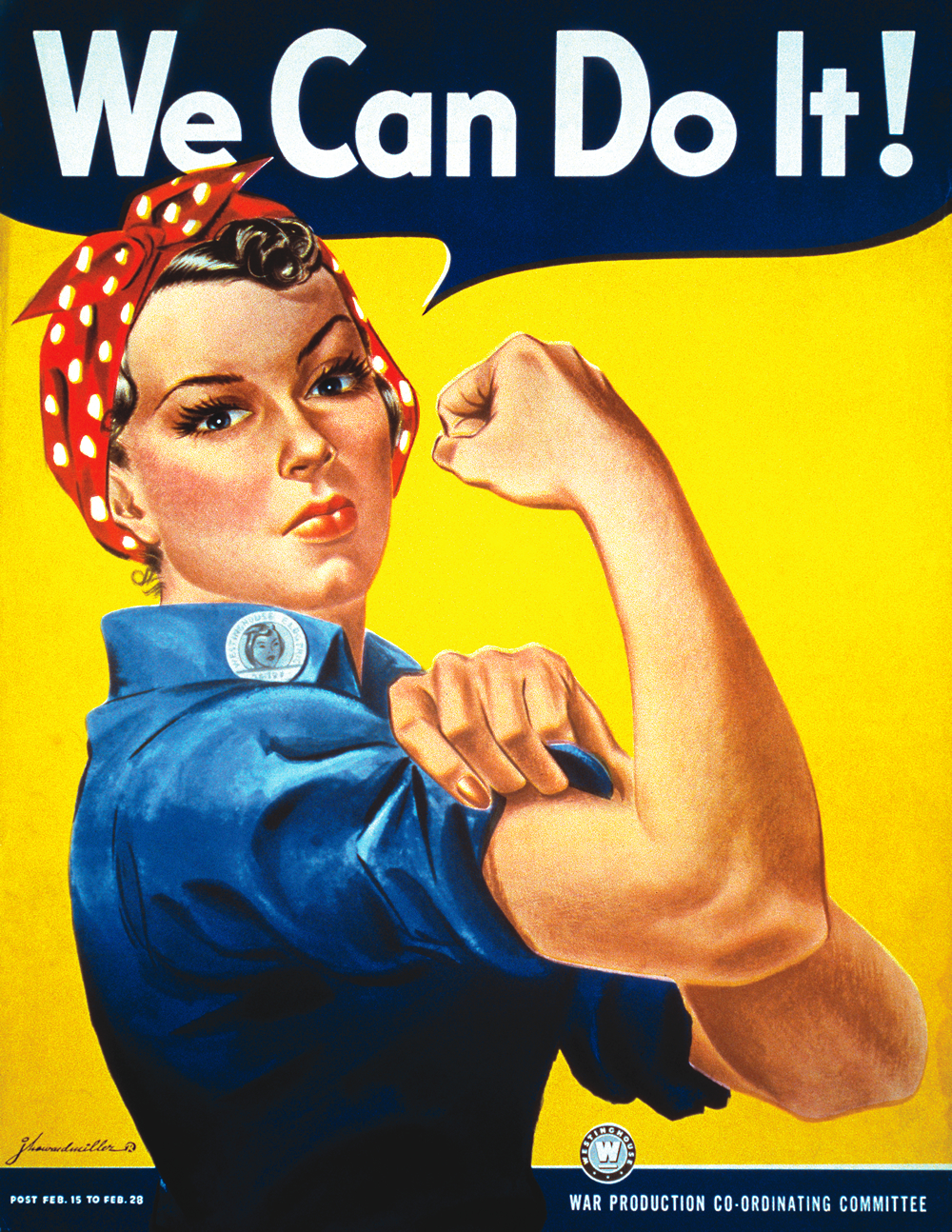
We Can Do It!: "We Can Do It!", Westinghouse Electric / War Production Co-ordinating Committee, 1943. Public domain.
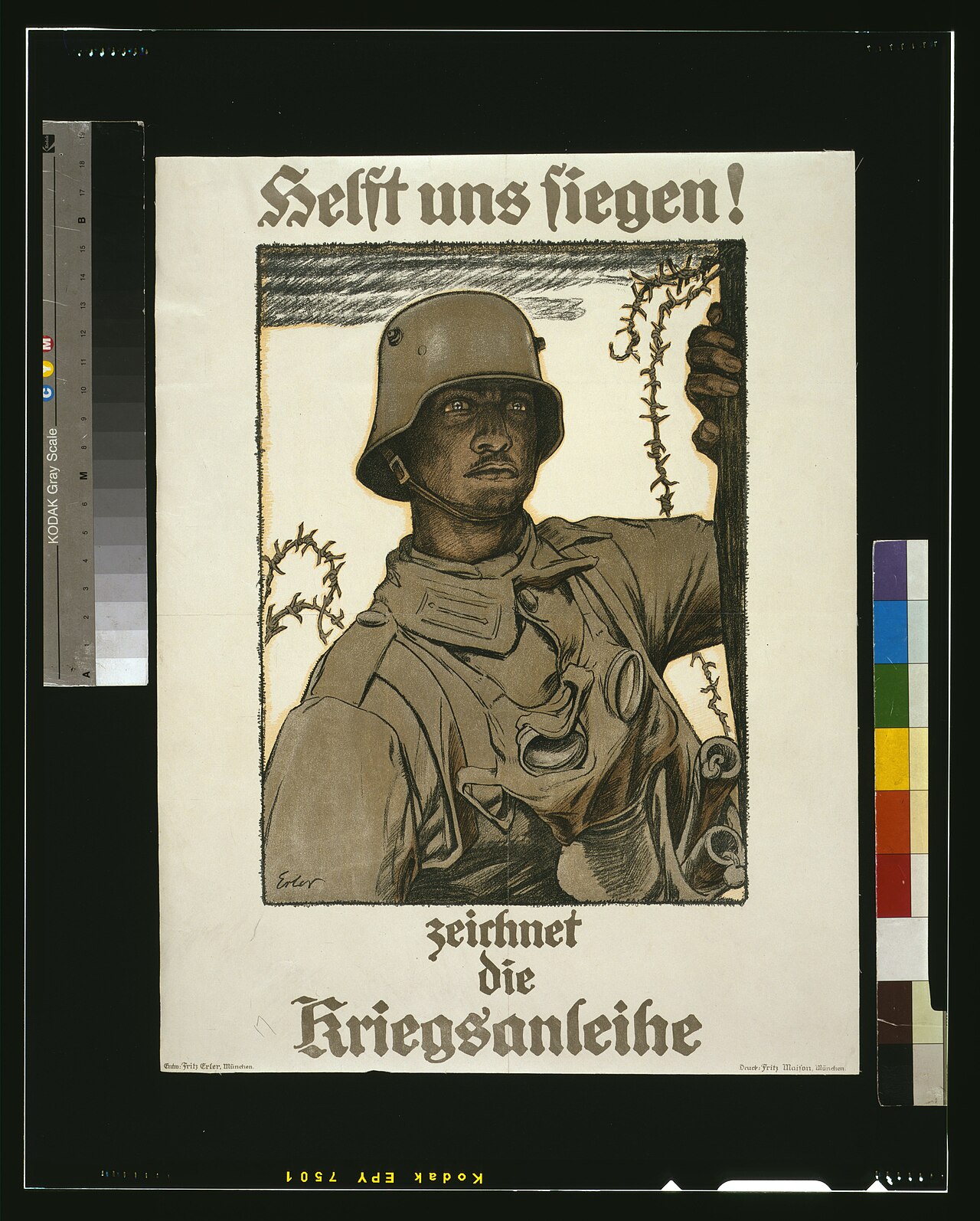
Helft uns siegen! Zeichnet die Kriegsanleihe (Help Us Win! Subscribe to the War Loan): "Helft uns siegen!" (Help us win!), Imperial German war-loan campaign, 1917, artist Fritz Erler. Public domain.
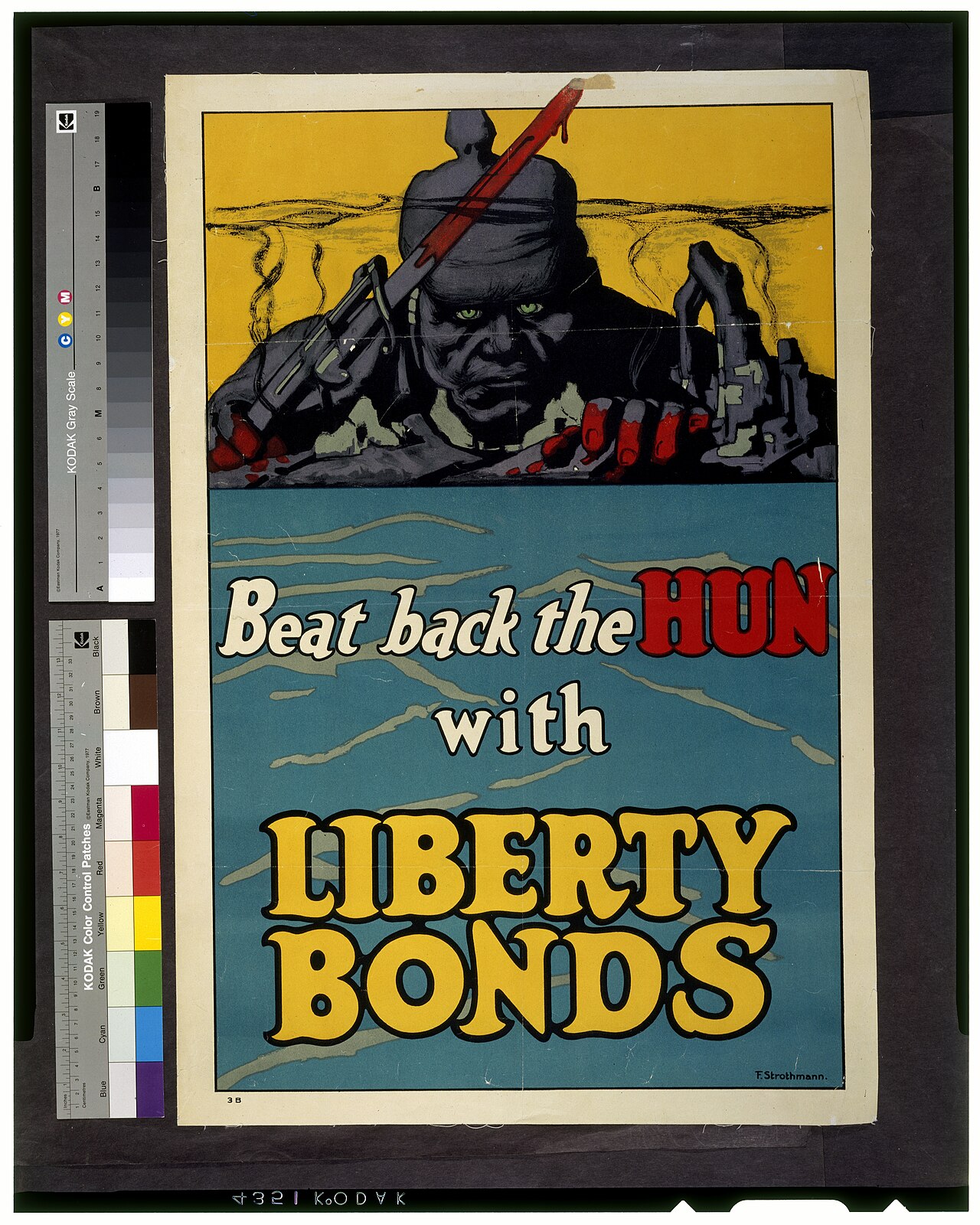
Beat Back the Hun with Liberty Bonds: "Beat Back the Hun with Liberty Bonds", U.S. Treasury Department, 1918. Shown as the in-group appeal paired with a degraded enemy. Public domain.
How to spot it
- The message tells the audience who "we" are before telling them what is true.
- Evidence is judged by who produced it ("our experts," "their media") rather than by its quality.
- Insiders' failings are excused while outsiders' identical failings are condemned.
- Praise of the in-group slides into claims about what the out-group deserves.
- The speaker's credential is membership ("as one of you") rather than knowledge.
Persuasion or manipulation?
Appealing to shared membership is a normal part of political life, and "in-group love" can motivate generosity, volunteering and solidarity. Honest use states the shared interest openly and applies the same standards of evidence to insiders and outsiders. It becomes manipulative when group loyalty is used to excuse double standards, when the audience is asked to judge a claim by its source's team rather than its evidence, or when warmth toward the in-group is quietly converted into license to harm those outside it.
Archive techniques that lean on this
- Plain folks — Plain folks: the speaker claims in-group membership to inherit the audience's favoritism toward insiders.
- Identity fusion — Identity fusion: turns favoritism into a loyalty test, so questioning an insider's claim feels like betrayal.
Related topics
- Social identity — Social identity
- Out-group homogeneity — Out-group homogeneity
- Dehumanization — Dehumanization
- Group polarization — Group polarization
- Motivated reasoning — Motivated reasoning
- Scapegoating — Scapegoating
Sources
- Tajfel, H., Billig, M. G., Bundy, R. P., & Flament, C. (1971). Social categorization and intergroup behaviour. European Journal of Social Psychology, 1(2), 149–178. https://doi.org/10.1002/ejsp.2420010202
- Mullen, B., Brown, R., & Smith, C. (1992). Ingroup bias as a function of salience, relevance, and status: An integration. European Journal of Social Psychology, 22(2), 103–122. https://doi.org/10.1002/ejsp.2420220202
- Balliet, D., Wu, J., & De Dreu, C. K. W. (2014). Ingroup favoritism in cooperation: A meta-analysis. Psychological Bulletin, 140(6), 1556–1581. https://doi.org/10.1037/a0037737
- Brewer, M. B. (1999). The psychology of prejudice: Ingroup love and outgroup hate? Journal of Social Issues, 55(3), 429–444. https://doi.org/10.1111/0022-4537.00126
- Iyengar, S., & Westwood, S. J. (2015). Fear and loathing across party lines: New evidence on group polarization. American Journal of Political Science, 59(3), 690–707. https://doi.org/10.1111/ajps.12152
- Hewstone, M., Rubin, M., & Willis, H. (2002). Intergroup bias. Annual Review of Psychology, 53, 575–604. https://doi.org/10.1146/annurev.psych.53.100901.135109
- Rabbie, J. M., Schot, J. C., & Visser, L. (1989). Social identity theory: A conceptual and empirical critique from the perspective of a behavioural interaction model. European Journal of Social Psychology, 19(3), 171–202. https://doi.org/10.1002/ejsp.2420190302
- Mummendey, A., & Otten, S. (1998). Positive-negative asymmetry in social discrimination. European Review of Social Psychology, 9, 107–143.
- Whitehouse, H., McQuinn, B., Buhrmester, M., & Swann, W. B., Jr. (2014). Brothers in arms: Libyan revolutionaries bond like family. Proceedings of the National Academy of Sciences, 111(50), 17783–17785. https://doi.org/10.1073/pnas.1416284111
- Broockman, D. E., Kalla, J. L., & Westwood, S. J. (2023). Does affective polarization undermine democratic norms or accountability? Maybe not. American Journal of Political Science, 67(3), 808–828. https://doi.org/10.1111/ajps.12719
Images
| Image | Source | Licence |
|---|---|---|
| Bar chart: co-partisan choice (Iyengar and Westwood 2015) | Drawn by FRAME from the cited study (make_group_identity_charts.py) |
CC BY 4.0, FRAME |
| We Can Do It! (1943) | FRAME gallery, We Can Do It! | Public domain |
| Helft uns siegen! (1917) | FRAME gallery, Helft uns siegen! Zeichnet die Kriegsanleihe (Help Us Win! Subscribe to the War Loan) | Public domain (published before 1923) |
| Beat Back the Hun (1918) | FRAME gallery, Beat Back the Hun with Liberty Bonds | Public domain |
Image gaps
Photographs of Tajfel's Bristol experiments and of the 2011 Libyan battalions were not sought in open collections; none is hosted.