- Techniques
- Card stackingGlittering generalities
In one line: on Monday 11 November 1918 an American paper and a Canadian paper printed the end of the First World War. Both belonged to Allied countries and printed the same wire news; they chose different leads and different words for what had happened.
| The New York Times | Victoria Daily Times | |
|---|---|---|
| Place | New York, United States | Victoria, British Columbia, Canada |
| Date | Monday 11 November 1918 | Monday 11 November 1918 |
| Government then | President Woodrow Wilson | Prime Minister Robert Borden |
| Banner | "ARMISTICE SIGNED, END OF THE WAR! BERLIN SEIZED BY REVOLUTIONISTS; NEW CHANCELLOR BEGS FOR ORDER; OUSTED KAISER FLEES TO HOLLAND" | "ENTENTE TRIUMPHS" |
| Lead subject | The armistice and the German revolution | The Allied victory and the armistice terms |
What happened. The armistice was signed in a railway carriage at Compiègne in the early hours of 11 November 1918 and took effect at 11 a.m. Paris time. Germany had been in revolution since early November; Kaiser Wilhelm II abdicated on 9 November and went to the Netherlands. The text of the terms was published that day.
The New York Times (United States)
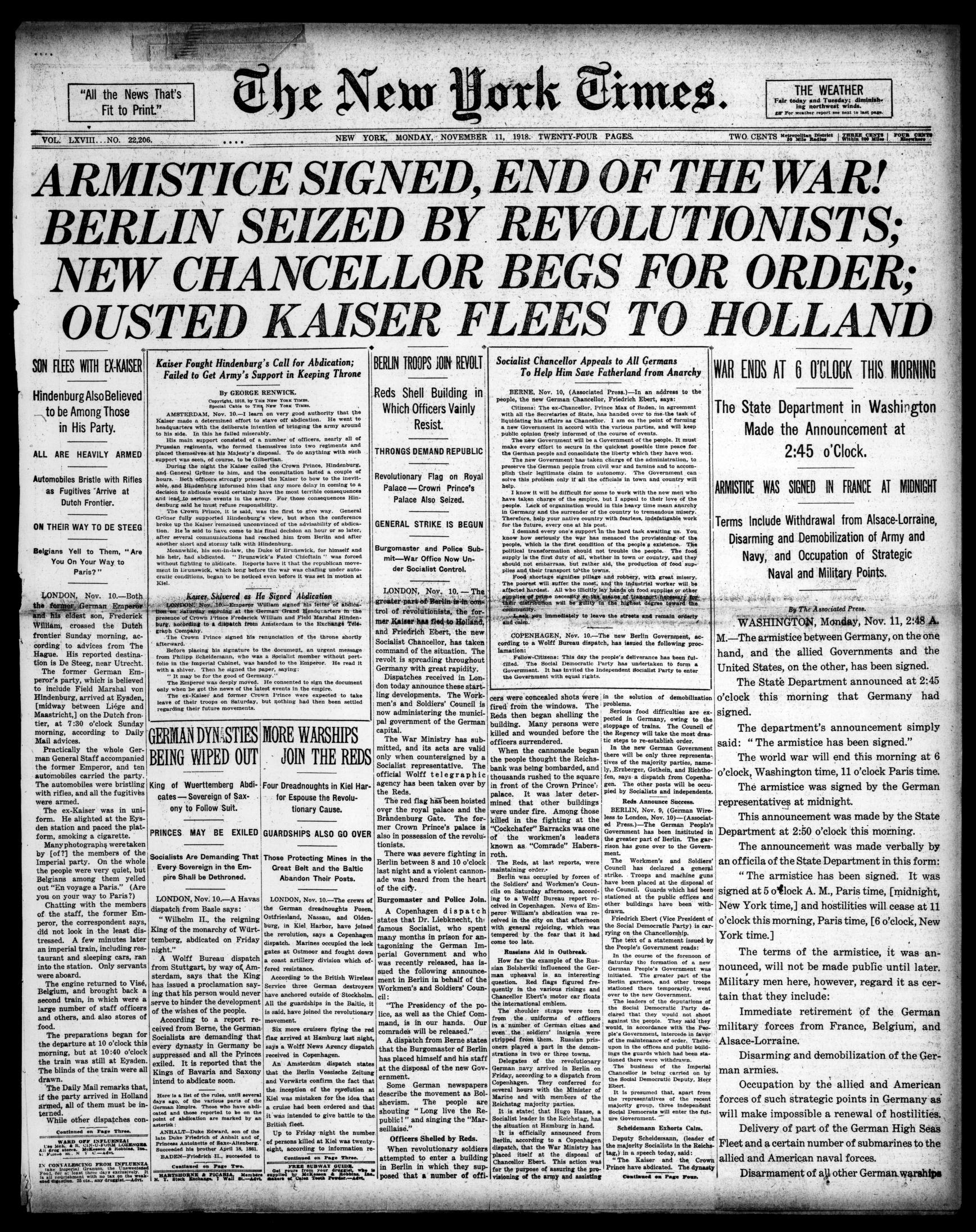
The New York Times, front page (New York, 11 November 1918): 'Armistice signed, end of the war!'. Front page, 11 November 1918. Public domain (published before 1931); scan by the Internet Archive.
Headline. "ARMISTICE SIGNED, END OF THE WAR! BERLIN SEIZED BY REVOLUTIONISTS; NEW CHANCELLOR BEGS FOR ORDER; OUSTED KAISER FLEES TO HOLLAND." A right-hand column, "WAR ENDS AT 6 O'CLOCK THIS MORNING", carries the State Department's 2:45 a.m. announcement and says the terms "will not be made public until later."
How it maps. The banner puts three German-side events (revolution, a chancellor "begging" for order, a fleeing Kaiser) in the same four-line display as the armistice. This is a choice of order, which is what Card stacking describes: "Select, omit, or order facts so the remaining pile can only be read one way." Whether it is a distortion is a reader's call; the facts printed are all datelined and sourced (Associated Press, Wolff Bureau, London, Amsterdam, Copenhagen), and the paper printed the American announcement in full. "Begs" and "ousted" are the paper's own verbs.
The Victoria Daily Times (Canada)
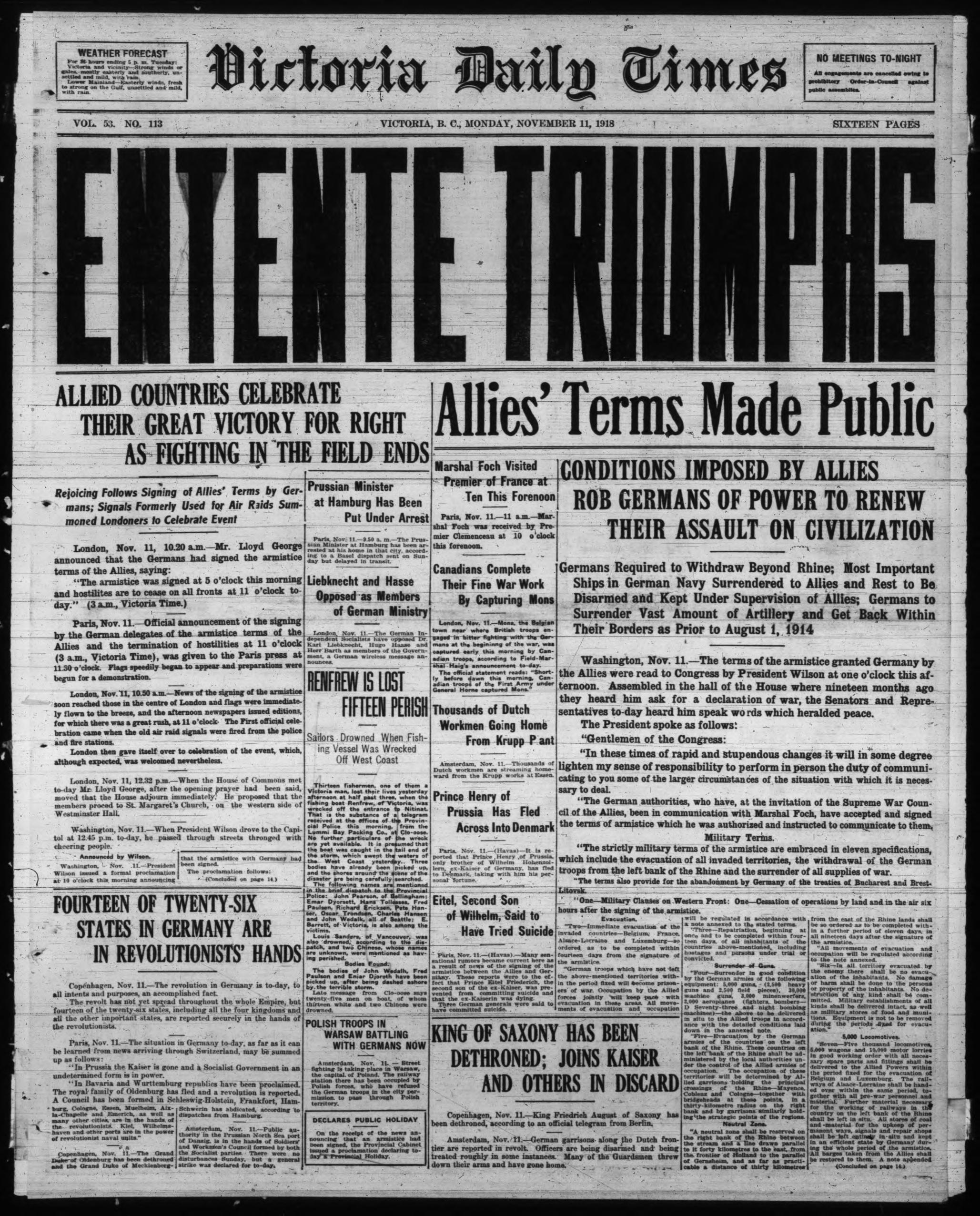
Victoria Daily Times, front page (Victoria, B.C., 11 November 1918): 'Entente triumphs'. Front page, 11 November 1918. Public domain (published before 1931); University of Victoria collection via the Internet Archive.
Headline. "ENTENTE TRIUMPHS", then "ALLIED COUNTRIES CELEBRATE THEIR GREAT VICTORY FOR RIGHT AS FIGHTING IN THE FIELD ENDS" and "CONDITIONS IMPOSED BY ALLIES ROB GERMANS OF POWER TO RENEW THEIR ASSAULT ON CIVILIZATION." A box notes a prohibition on public meetings by Order-in-Council, and a Canadian item reads "Canadians Complete Their Fine War Work By Capturing Mons."
How it maps. "Victory for Right" is a Glittering generalities phrase: "Virtue words (freedom, security, the people, science) used as substitutes for a testable claim." "Assault on civilization" is a label on one side's war aims, in the sense of Name-calling: "Attach a loaded label so the audience rejects the target without checking the claim." The page also prints the terms themselves (evacuation behind the Rhine, surrender of guns and ships), so the reader can check the claim against the text it sits over.
Where the two pages differ
- Banner. The Times leads with the end of the war and the collapse in Germany; the Victoria paper leads with a verdict ("Entente triumphs") in banner capitals.
- Terms. The Victoria page prints the terms as read by President Wilson to Congress; the Times page says they "will not be made public until later."
- Own-side news. The Victoria page includes the Canadian capture of Mons; the Times page's lead columns are Germany and Washington.
- Wartime control. Canada's censorship regime and the American Espionage and Sedition Acts both applied in November 1918. Neither page shows its effect directly, so this page does not assert any.
- What they share. The same wire stories (the Kaiser's flight, the Berlin revolution) and the same hour of signing.
Image gaps
No British, French or German paper of 11-12 November 1918 is hosted: none could be licence-verified in this pass, and Chronicling America was not reachable from the research environment. The German side of the story appears only through the Allied papers' datelines. For the earlier comparison of this kind see Same day, different front pages: the sinking of the Lusitania (New York and Victoria, B.C., 8 May 1915).