- Techniques
- Name-callingTestimonial
Content note. One of the pages below uses the words "Huns" and "Savages" for Germans, and "murdered" in its banner. They are shown as printed, as evidence of how a belligerent paper framed the event.
In one line: on Saturday 8 May 1915 a neutral-country paper and a wartime-empire paper printed the same news, a German submarine's sinking of a Cunard liner the day before, and chose different words, different speakers and different headlines for it.
| The New York Times | Victoria Daily Times | |
|---|---|---|
| Place, status | New York; the United States was neutral | Victoria, British Columbia; Canada was at war as part of the British Empire |
| Date | Saturday 8 May 1915 | Saturday 8 May 1915 |
| Government then | President Woodrow Wilson | Prime Minister Robert Borden |
| Banner | "LUSITANIA SUNK BY A SUBMARINE, PROBABLY 1,000 DEAD; ..." | "1,364 WERE MURDERED BY THE GERMANS" |
| Number of dead printed | "Probably 1,000" | 1,364 (703 saved of 2,067) |
What happened. On 7 May 1915 the German submarine U-20 torpedoed the Cunard liner RMS Lusitania off the south coast of Ireland. About 1,200 of the nearly 2,000 people aboard died, 128 of them Americans. The ship's manifest carried rifle cartridges and shrapnel shells, which the German government cited in its defence (see the notes to Enlist). Both front pages below were set in the first 24 hours, before the figures settled.
The New York Times (United States, neutral)
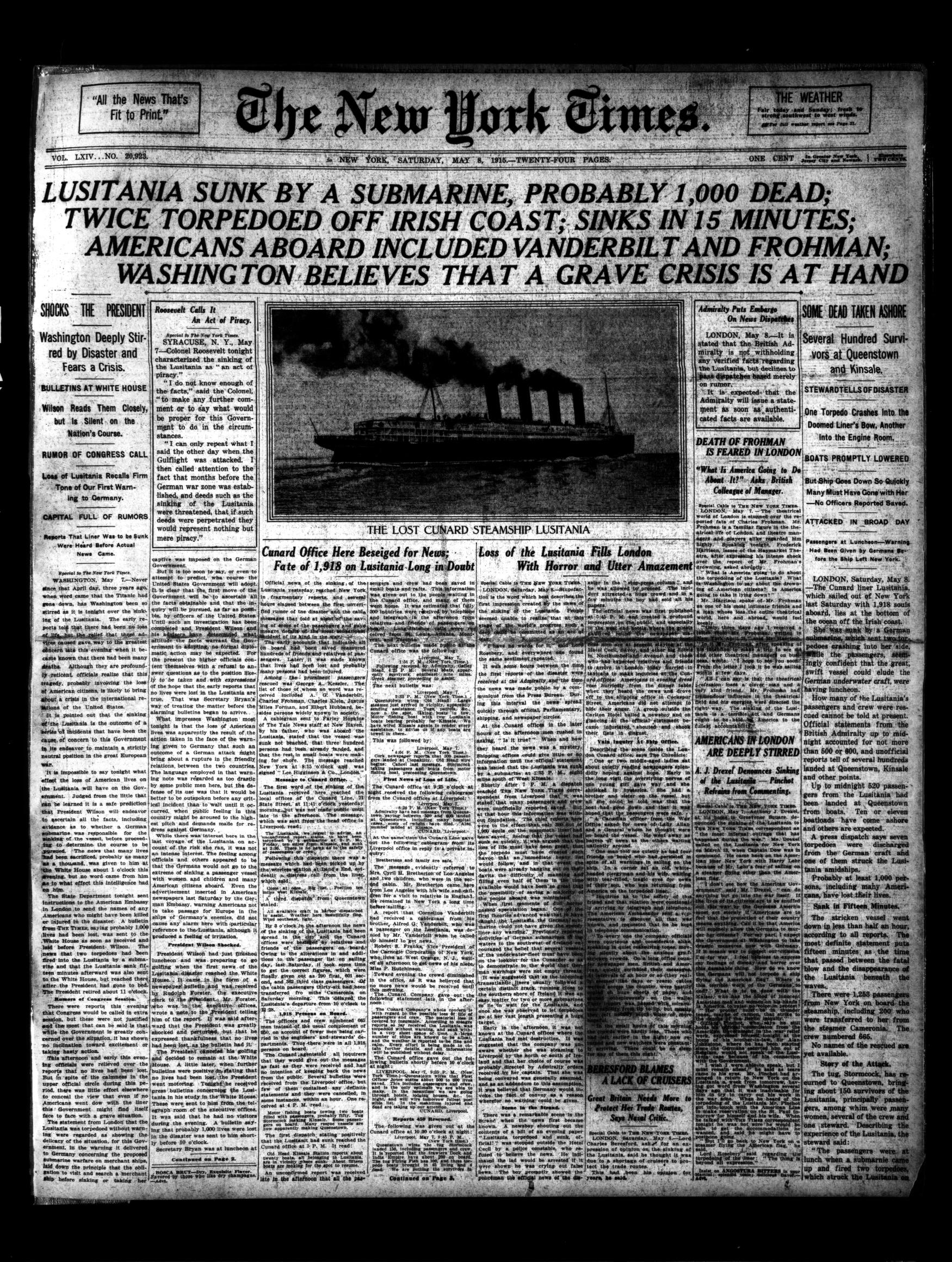
The New York Times, front page (New York, 8 May 1915): Lusitania sunk. Front page, 8 May 1915. Public domain (published before 1931); scan by the Internet Archive.
Headline. "LUSITANIA SUNK BY A SUBMARINE, PROBABLY 1,000 DEAD; TWICE TORPEDOED OFF IRISH COAST; SINKS IN 15 MINUTES; AMERICANS ABOARD INCLUDED VANDERBILT AND FROHMAN; WASHINGTON BELIEVES THAT A GRAVE CRISIS IS AT HAND." The banner names the weapon, not a nation.
How it maps to the technique definitions. The loaded word on the page is a quotation: a deck reads "Roosevelt Calls It An Act of Piracy." That is Testimonial, whose archive definition is "A named person or institution vouches; the vouch is meant to end checking." Here the speaker is named, and the paper reports his own qualifier ("I do not know enough of the facts"). A second deck, "Admiralty Puts Embargo On News Dispatches", tells the reader that British official news was being held back. Most of the page is plain report: Cunard office queues, lists of passengers, the White House bulletins.
The Victoria Daily Times (Canada, at war)
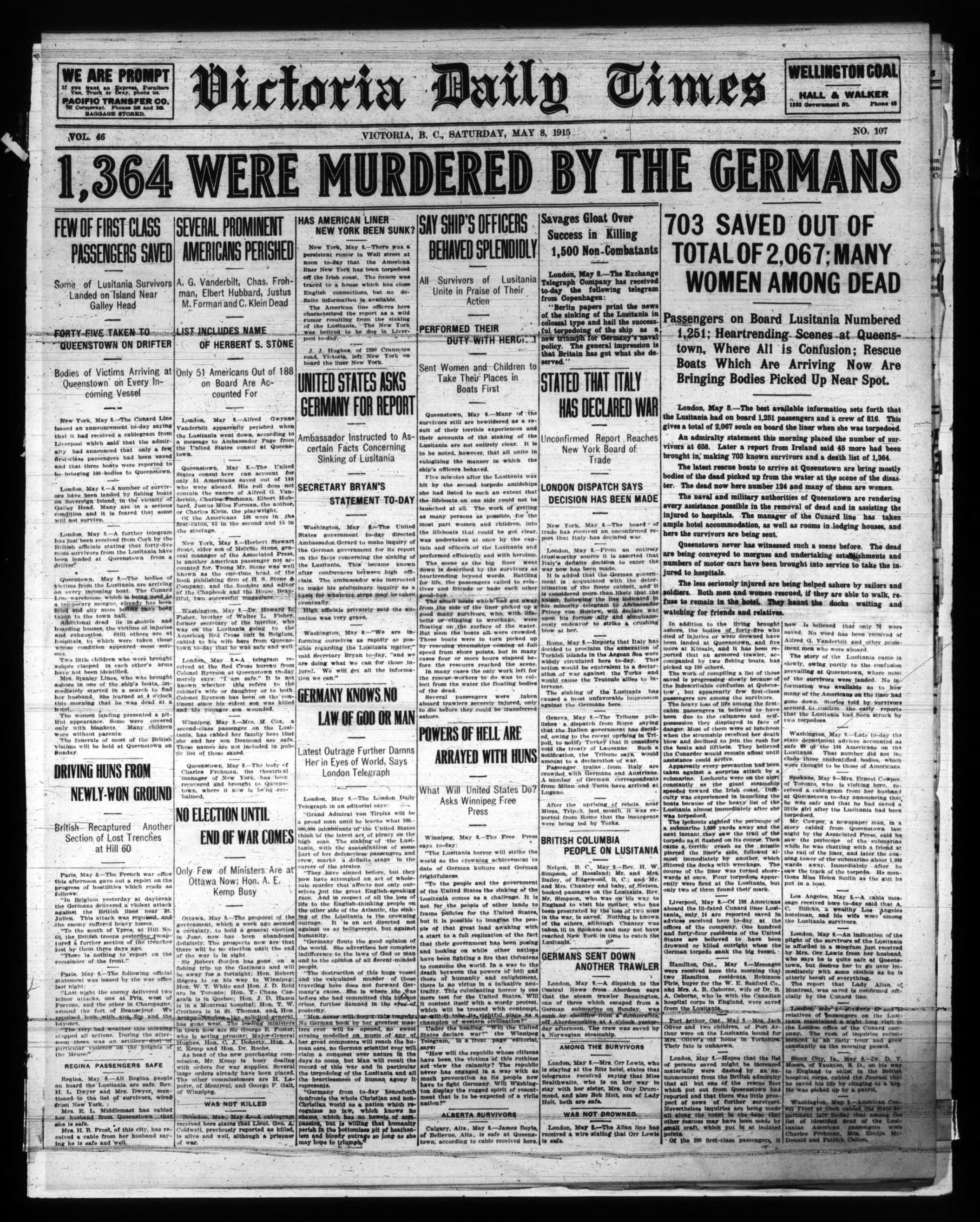
Victoria Daily Times, front page (Victoria, B.C., 8 May 1915): '1,364 were murdered by the Germans'. Front page, 8 May 1915. Public domain (published before 1931); University of Victoria collection via the Internet Archive.
Headline. "1,364 WERE MURDERED BY THE GERMANS." Inside: "Savages Gloat Over Success in Killing 1,500 Non-Combatants"; "GERMANY KNOWS NO LAW OF GOD OR MAN"; "POWERS OF HELL ARE ARRAYED WITH HUNS"; "UNITED STATES ASKS GERMANY FOR REPORT."
How it maps. The banner and several decks fit Name-calling: "Attach a loaded label so the audience rejects the target without checking the claim." The labels are "murdered", "Savages", "Huns" and "Powers of Hell". Some of the wording is the paper's own; some quotes the London Daily Telegraph and the Winnipeg Free Press, which is Testimonial. The "Savages Gloat" deck rests on a Copenhagen dispatch saying "Berlin papers print the news of the sinking of the Lusitania in colossal type and hail the successful torpedoing"; the page gives the report second-hand and does not show the German papers.
Where the two pages differ
- Status. The United States was neutral and the Times carried no censorship; Canada was at war under the War Measures Act, with a Chief Press Censor.
- The agent. The Times banner says "a submarine"; the Victoria banner says "the Germans" and "murdered".
- Who speaks. The Times leads with Washington's reaction and a named ex-President; the Victoria page prints the British press and Cunard dispatches.
- Numbers. Both figures are early estimates. The Victoria count (1,364) is the Admiralty's figure on the day, and the Times "probably 1,000" is a guess; both were later revised.
- What they share. Both lead with the sinking, both name prominent American passengers (Vanderbilt and Frohman), and both date the sinking to the day before.
Image gaps
No German, British or other paper of 7-9 May 1915 is hosted: German pages could not be licence-verified in this pass, and the Library of Congress's Chronicling America site was not reachable from the research environment. The Victoria page carries the one second-hand report of German press reaction. The archive's Lusitania poster and medal (Enlist, Karl Goetz "Lusitania" medal (Germany, 1915)) show the later use of the event.