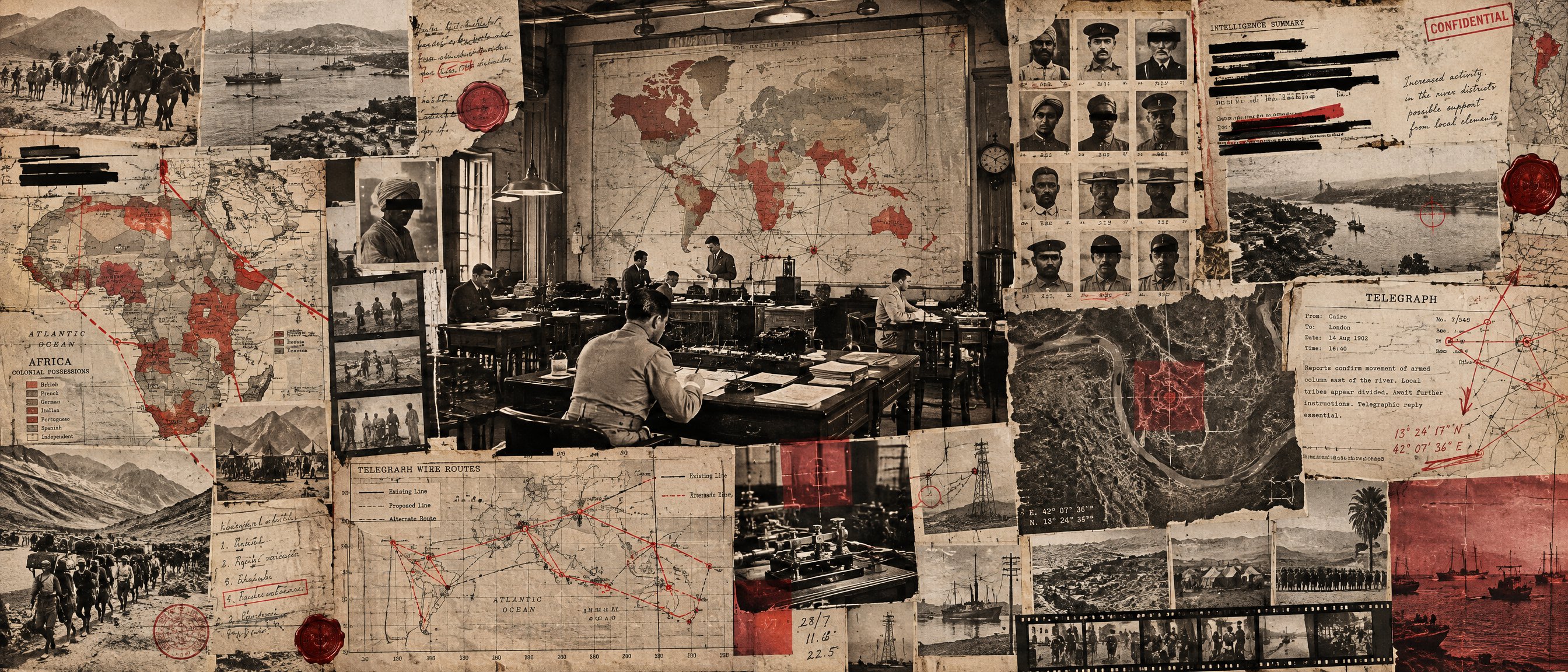
In one line: a 1922 book by an American journalist who had just worked in wartime propaganda, arguing that people act on simplified "pictures in their heads" rather than on the world itself, and that whoever controls access to events can shape those pictures; it gave later scholars the phrase "manufacture of consent".
The source
- Citation: Walter Lippmann, Public Opinion (New York: Harcourt, Brace and Company, 1922). Companion volume: Walter Lippmann, The Phantom Public (New York: Harcourt, Brace and Company, 1925).
- Author: Walter Lippmann (1889-1974), co-founding editor of The New Republic, later a syndicated columnist.
- Language: English.
- Rights status on this archive: both books were published in the United States before 1931 and are in the public domain in the US. They are quoted directly below where the wording was checked.
Context
Lippmann wrote Public Opinion straight after serving in the U.S. war effort of 1917-1918. In 1917 he was an assistant to Secretary of War Newton D. Baker, then secretary of "the Inquiry", the postwar planning group whose territorial memoranda fed into President Wilson's Fourteen Points. On 28 June 1918 he was commissioned a captain and assigned to the intelligence section of the American Expeditionary Forces headquarters in France, where he helped produce leaflets urging German soldiers to desert and promising them good treatment and food as prisoners. Printing was handled from Paris and distribution from the front under Captain Heber Blankenhorn. In the same period Lippmann sent a critical report on George Creel's civilian Committee on Public Information (CPI), and Creel sought his removal; Lippmann left to assist the U.S. delegation at the Paris Peace Conference.
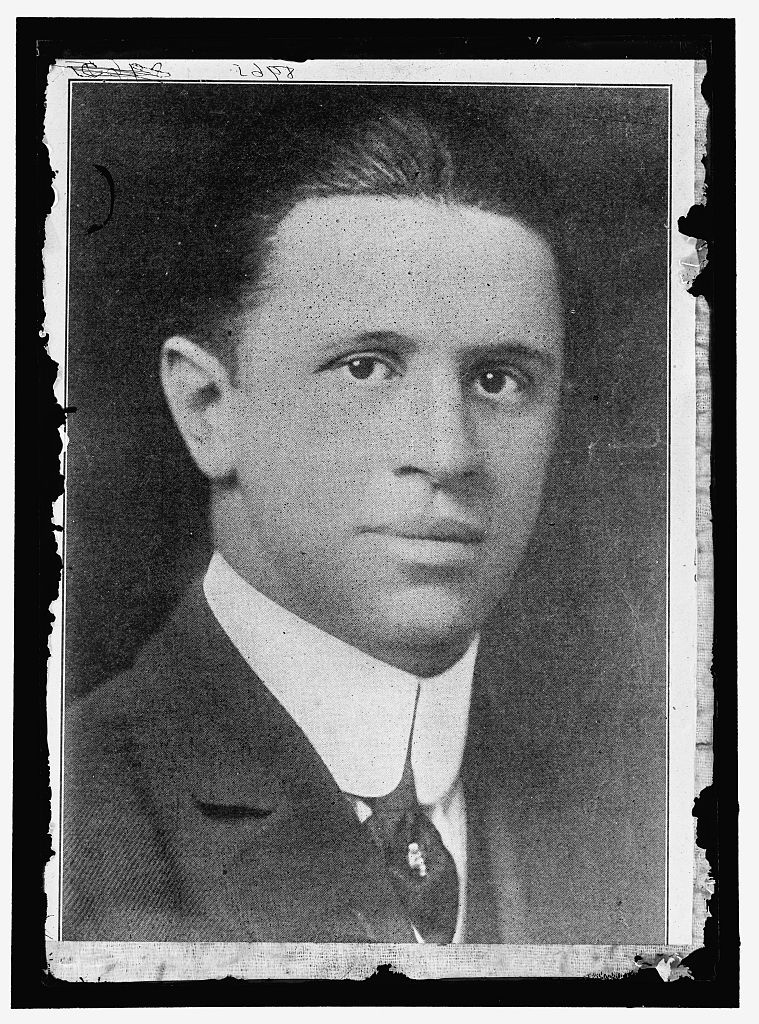
George Creel, chairman of the Committee on Public Information, 1917. Harris & Ewing. Library of Congress, Prints and Photographs Division, Harris & Ewing Collection; no known restrictions on publication.
Two studies came between the war and the book. Liberty and the News (1919-1920) argued that the press was failing to supply reliable facts. With Charles Merz, Lippmann published A Test of the News (a supplement to The New Republic, 4 August 1920), which read three years of New York Times reporting on the Russian Revolution and concluded that the coverage showed what editors and reporters hoped would happen rather than what did; the authors counted repeated reports that the Bolshevik government was about to fall. Public Opinion turns those findings into a general theory.
What it says
The pseudo-environment. The first chapter is titled "The World Outside and the Pictures in Our Heads". Lippmann writes that "The world that we have to deal with politically is out of reach, out of sight, out of mind. It has to be explored, reported, and imagined." Between a person and the real environment sits a "pseudo-environment", and it is to that pseudo-environment that behaviour responds, while the consequences of the behaviour land in the real world.
Stereotypes. Lippmann uses "stereotype", a printer's term, for the preformed images people use to sort experience: "For the most part we do not first see, and then define, we define first and then see." In the world's "great blooming, buzzing confusion", he writes, we pick out what our culture has already defined for us. He treats stereotypes as an economy of attention that everyone uses, and also as the point at which a picture can be supplied from outside.
Censorship as the precondition of propaganda. In his discussion of the barriers that limit access to facts, Lippmann writes: "Without some form of censorship, propaganda in the strict sense of the word is impossible. In order to conduct a propaganda there must be some barrier between the public and the event." Access to the real environment must be limited, he continues, before anyone can create a pseudo-environment "that he thinks wise or desirable". The wartime censorship he had just watched is his model.
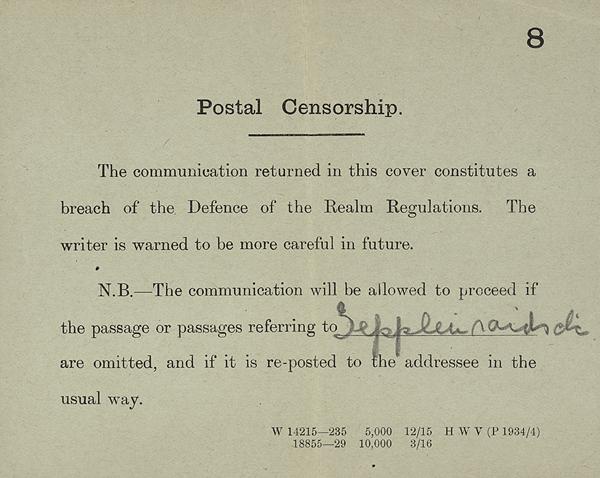
Postal Censorship notice, British government, 1916; the censor has written in "Zeppelin raids" as the passage to remove. Imperial War Museum, Documents.8252, via Wikimedia Commons. Public domain (UK Crown copyright expired; published before 1931).
Symbols that fuse factions. In the chapters on how a common will is made, Lippmann describes how political leaders use broad symbols such as "Americanism" and "Progressivism" to combine the emotions of groups that want different things; the symbol carries loyalties across without any agreement on specifics.
The manufacture of consent. Chapter XV, "Leaders and the Rank and File", states: "That the manufacture of consent is capable of great refinements no one, I think, denies." Lippmann presents this as a description of how opinion is in fact organised, noting that the opportunities for manipulation are open to anyone who understands the process. He treats it as a condition of modern politics to be managed, not as an accusation.
Expertise instead of the "omnicompetent" citizen. Lippmann argues that without institutions that report the environment well, "the common interests very largely elude public opinion entirely, and can be managed only by a specialized class whose personal interests reach beyond the locality." His proposed remedy is independent intelligence bureaus attached to government and industry that would supply decision-makers with tested facts.
The Phantom Public (1925). The sequel narrows the public's role further: the public can at most align itself for or against those who act, at moments of crisis. Its best-known line is that the public "must be put in its place, so that it may exercise its own powers, but no less and perhaps even more, so that each of us may live free of the trampling and the roar of a bewildered herd."
How it worked in practice
Public Opinion is a diagnosis rather than an operating manual, and its uses are indirect.
- Public relations. Edward Bernays names Lippmann in Propaganda (1928) among the writers who described the group mind, and his "engineering of consent" (1947) echoes Lippmann's phrase. See Edward Bernays, Propaganda (1928).
- Communication research. The first chapter's image of media as the link between events and the pictures in people's heads is widely cited as a forerunner of agenda-setting research, the line of work opened by Maxwell McCombs and Donald Shaw's study of the 1968 US election ("The Agenda-Setting Function of Mass Media", Public Opinion Quarterly 36:2, 1972).
- Propaganda analysis. Harold Lasswell's Propaganda Technique in the World War (1927) and the Institute for Propaganda Analysis (1937) worked in the same post-1918 climate of concern about wartime opinion management. See Harold D. Lasswell, Propaganda Technique in the World War (1927) and Institute for Propaganda Analysis, How to Detect Propaganda (1937).
- Critique of media. Edward Herman and Noam Chomsky took the title of Manufacturing Consent (1988) from Lippmann's phrase and applied it to a structural account of US news media. See Edward S. Herman and Noam Chomsky, Manufacturing Consent (1988).
Lippmann's own practice as a wartime leaflet writer is the documented case where he applied these ideas: the leaflets offered German soldiers a picture of captivity (fair treatment, food) chosen to change what they did.
Techniques in this archive's taxonomy
- Glittering generalities: Lippmann describes leaders using symbols like "Americanism" and "Progressivism" to unite factions that attach different meanings to the word, so no testable claim is made.
- Transfer: the same discussion describes emotion and loyalty attached to one symbol being carried over to the leader or policy that takes the symbol up.
- Card stacking: Lippmann's claim that propaganda needs "some barrier between the public and the event" is an account of control over which facts reach the audience; A Test of the News documents the effect in practice, in coverage selected by hope rather than evidence.
A note on vocabulary: Lippmann's "manufacture of consent" is broader than this archive's Manufactured consensus, which means faking the appearance that independent voices reached the same conclusion. The two should not be treated as the same thing.
Reception and criticism
- John Dewey answered Lippmann's two books with The Public and Its Problems (New York: Henry Holt, 1927). He argued that the public was "in eclipse" rather than a phantom and that better communication could revive it, and he wrote that "No government by experts in which the masses do not have the chance to inform the experts as to their needs can be anything but an oligarchy managed in the interests of the few."
- Noam Chomsky and Edward Herman read Lippmann as a theorist of elite management of opinion, and Chomsky has cited the "bewildered herd" passage repeatedly in lectures and essays.
- Michael Schudson argues that the idea of a "Lippmann-Dewey debate", popularised by the communication scholar James Carey in the 1980s, misreads Lippmann as anti-democratic, and that Lippmann was concerned with fitting expertise into a working democracy ("The 'Lippmann-Dewey Debate' and the Invention of Walter Lippmann as an Anti-Democrat 1986-1996", International Journal of Communication 2, 2008).
- Lippmann's later position. In The Good Society (1937) Lippmann argued against centrally planned economies, and a 1938 Paris colloquium organised around that book appears in histories of economic liberalism. Readers who cite him as an advocate of rule by experts (from the left, as above) and readers who cite him as a critic of state planning are drawing on different books from different decades.
Same-standard note
Lippmann's account applies to any government that controls access to events and supplies a picture in their place: the US CPI and Military Intelligence leaflet sections he knew, British wartime censorship and the Wellington House propaganda bureau, and German wartime press offices all worked by limiting and shaping what their publics could see. The differences in scale and method between a wartime democracy with a partly free press and a one-party state with full media control are large, and are covered on Lenin and the Communist Party of the Soviet Union, the agitprop model (1902-1991) and Hitler, Goebbels and the Reich Ministry for Public Enlightenment and Propaganda (1925-1945); the concept of a pseudo-environment is the same for each.
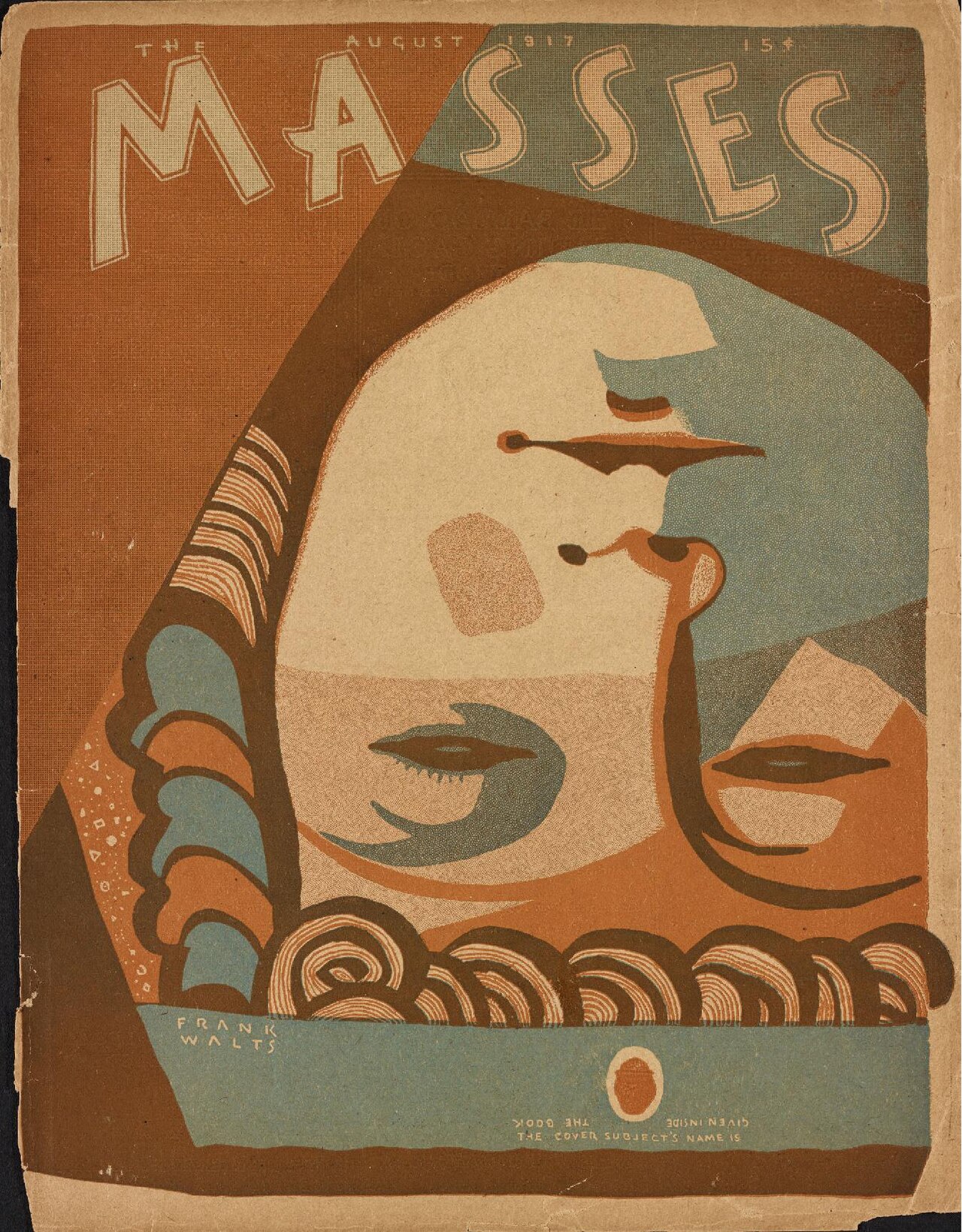
Cover of The Masses, August 1917, by Frank Walts. The New York postmaster refused this issue for mailing under the Espionage Act. Scan: Brown University Library, via Wikimedia Commons. Public domain (published in the United States in 1917).
Sources
Full text in this archive: Public Opinion (1922), complete.
- Walter Lippmann, Public Opinion (New York: Harcourt, Brace and Company, 1922), esp. ch. I "The World Outside and the Pictures in Our Heads", ch. VI "Stereotypes", ch. XV "Leaders and the Rank and File". Text: Project Gutenberg; Wikisource, ch. 15.
- Walter Lippmann, The Phantom Public (New York: Harcourt, Brace and Company, 1925), ch. 14.
- Walter Lippmann and Charles Merz, "A Test of the News", supplement to The New Republic, 4 August 1920.
- Walter Lippmann, Liberty and the News (New York: Harcourt, Brace and Howe, 1920).
- Walter Lippmann, An Inquiry into the Principles of the Good Society (Boston: Little, Brown, 1937).
- John Dewey, The Public and Its Problems (New York: Henry Holt, 1927).
- Michael Schudson, "The 'Lippmann-Dewey Debate' and the Invention of Walter Lippmann as an Anti-Democrat 1986-1996", International Journal of Communication 2 (2008): 1031-1042. IJoC.
- Maxwell E. McCombs and Donald L. Shaw, "The Agenda-Setting Function of Mass Media", Public Opinion Quarterly 36:2 (1972): 176-187.
- Edward S. Herman and Noam Chomsky, Manufacturing Consent: The Political Economy of the Mass Media (New York: Pantheon, 1988).
- Ronald Steel, Walter Lippmann and the American Century (Boston: Little, Brown, 1980), biography covering the Inquiry and 1918 intelligence service.
- "Journalism and its discontents", Salon, 25 October 2007, on Lippmann's report on the CPI and Creel's response. Salon.
- "Allied PSYOP of WWI", psywarrior.com, on the AEF propaganda sections of Lippmann and Blankenhorn. psywarrior.com.