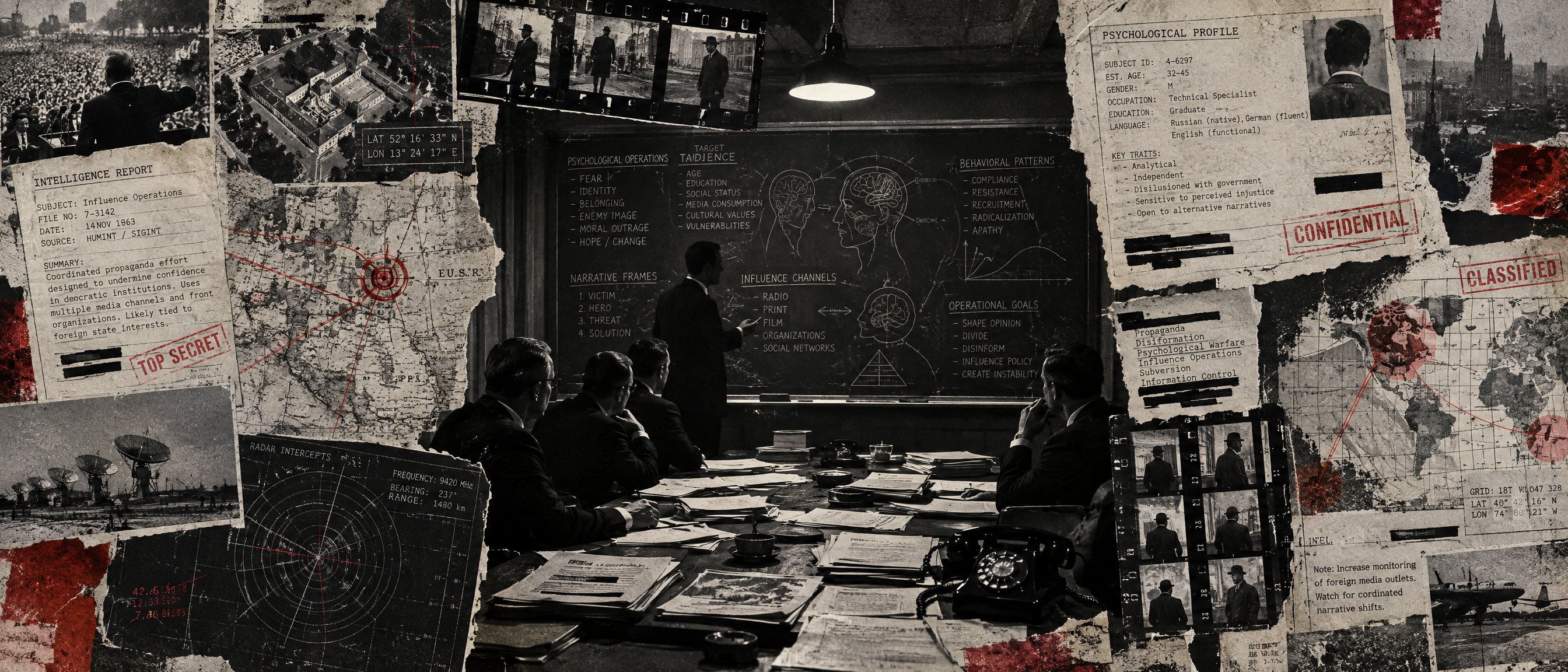
In one line: a short 1937 bulletin from a New York educational institute that named seven "propaganda devices", a checklist that entered American school teaching within a few years and from which this archive's classical technique family descends.
The source
- Work: Institute for Propaganda Analysis, "How to Detect Propaganda", Propaganda Analysis 1, no. 2 (November 1937), pp. 5-7. The monthly bulletin was published in New York.
- Book-length application: Alfred McClung Lee and Elizabeth Briant Lee, eds., The Fine Art of Propaganda: A Study of Father Coughlin's Speeches (New York: Harcourt, Brace and Company for the Institute for Propaganda Analysis, 1939).
- Author/body: the Institute for Propaganda Analysis (IPA), a non-profit body; the device list is usually credited to Clyde R. Miller, its founding secretary. J. Michael Sproule's 2001 research note examines who drafted it and how it spread.
- Language: English.
- Rights on this archive: both were published in the US after 1930 and are treated here as in copyright. They are summarised, with short quotations only.
Context
The IPA was set up in New York in 1937 at the suggestion of Clyde R. Miller, a former newspaper reporter who was then an associate professor of education at Teachers College, Columbia University. Its founders are usually listed as Miller, the Boston merchant and philanthropist Edward A. Filene and the Harvard geologist Kirtley F. Mather. Filene gave a first-year grant of $10,000, and his Good Will Fund later agreed to continue funding for three years. The board and contributors were social scientists, historians, educators and journalists.
The founders were responding to the memory of First World War propaganda, which many Americans had come to regard as having misled the public (see Harold D. Lasswell, Propaganda Technique in the World War (1927) and Arthur Ponsonby, Falsehood in War-Time (1928)), and to the growth of radio and organised public relations (see Edward Bernays, Propaganda (1928)). Later summaries describe its aim as teaching people how to think about persuasion rather than what to think about any issue.
The IPA operated from 1937 until early 1942. It stopped publishing in January 1942, a few weeks after the United States entered the Second World War. The Institute said the cause was lack of money; historians also point to the political pressure described below. The Institute's history as a counter-propaganda effort, from its funding to its closure and what is known of its effect, is told in the case study The Institute for Propaganda Analysis (1937-1942).
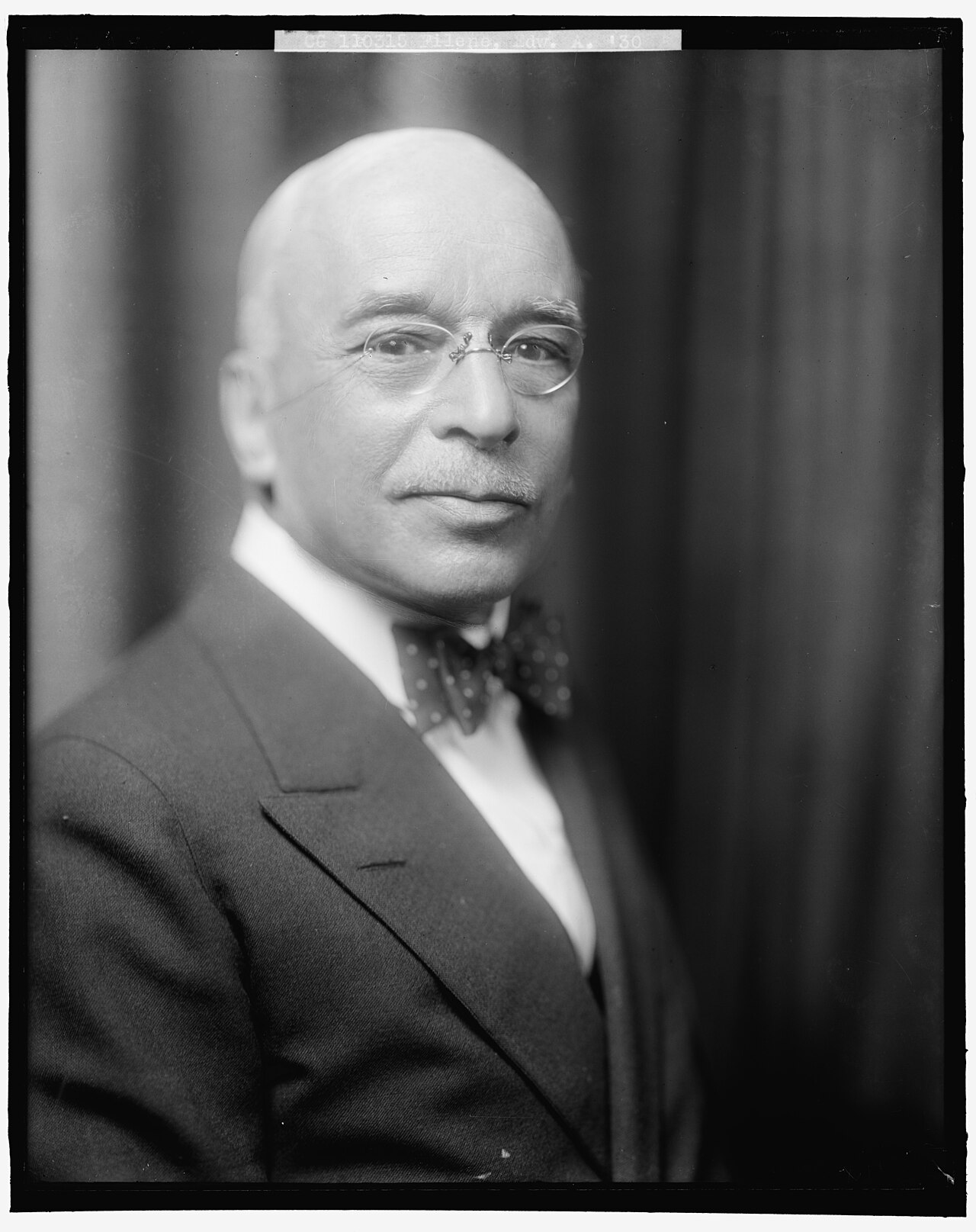
Edward A. Filene, one of the Institute's founders, whose $10,000 grant and Good Will Fund paid for its early years. Harris & Ewing studio portrait, Library of Congress. Public domain.
What it says
Propaganda is identified by its devices, not its cause. The 1937 bulletin treats propaganda as opinion or action deliberately aimed at shaping other people's opinions or actions toward ends set in advance, and it does not ask the reader to decide whether the cause is good. The test is whether a message works by getting the audience to accept or reject something without examining the evidence.
Name calling. Attaching a bad label to a person or idea, described as "giving an idea a bad label", so that the audience rejects it without looking at the evidence.
Glittering generalities. Linking a proposal to "virtue words", broad words of approval, so that the audience accepts it without looking at the evidence.
Transfer. Carrying the authority, prestige or sanction of something respected, such as church, nation or science, over to something else so that it is accepted.
Testimonial. Having a respected or disliked person say that an idea or product is good or bad.
Plain folks. A speaker presenting himself or his ideas as good because they are "of the people", ordinary and homespun.
Card stacking. Selecting and using facts or falsehoods, illustrations or distractions, and logical or illogical statements to give the best or worst possible case, described in IPA material as stacking the cards against the truth.
Band wagon. An appeal whose theme is, in the IPA's wording, "everybody—at least all of us—is doing it", so that the audience follows the crowd.
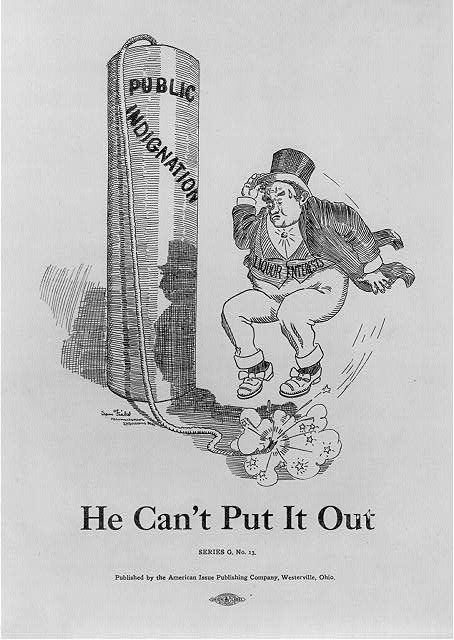
"He Can't Put It Out", American Issue Publishing Company (Anti-Saloon League of America), 1917, drawing by Sam Fickel. Library of Congress. Public domain. An example from the archive of the appeal the IPA called band wagon.
How it worked in practice
The bulletin. Propaganda Analysis appeared monthly. Each issue took a current controversy and walked through the devices at work in it, followed by reading lists and suggested discussion questions for classrooms and adult study groups. In May 1938 the IPA issued a case study on the propaganda techniques of the German government. The IPA reported around 5,900 subscriptions in its first year and correspondence with some 2,500 teachers; it also said that by the late 1930s about a million school pupils were using its methods (Hobbs and McGee, 2014). These are the Institute's own figures.
School curricula. Teachers' guides and study outlines were distributed to high schools, and in 1939-1940 the IPA wrote a series for Scholastic magazine titled "What Makes You Think So?". The seven-device list, with its short labels, suited classroom use, and it remained in American textbooks on composition, civics and later media literacy long after the Institute closed (Sproule, 2001).
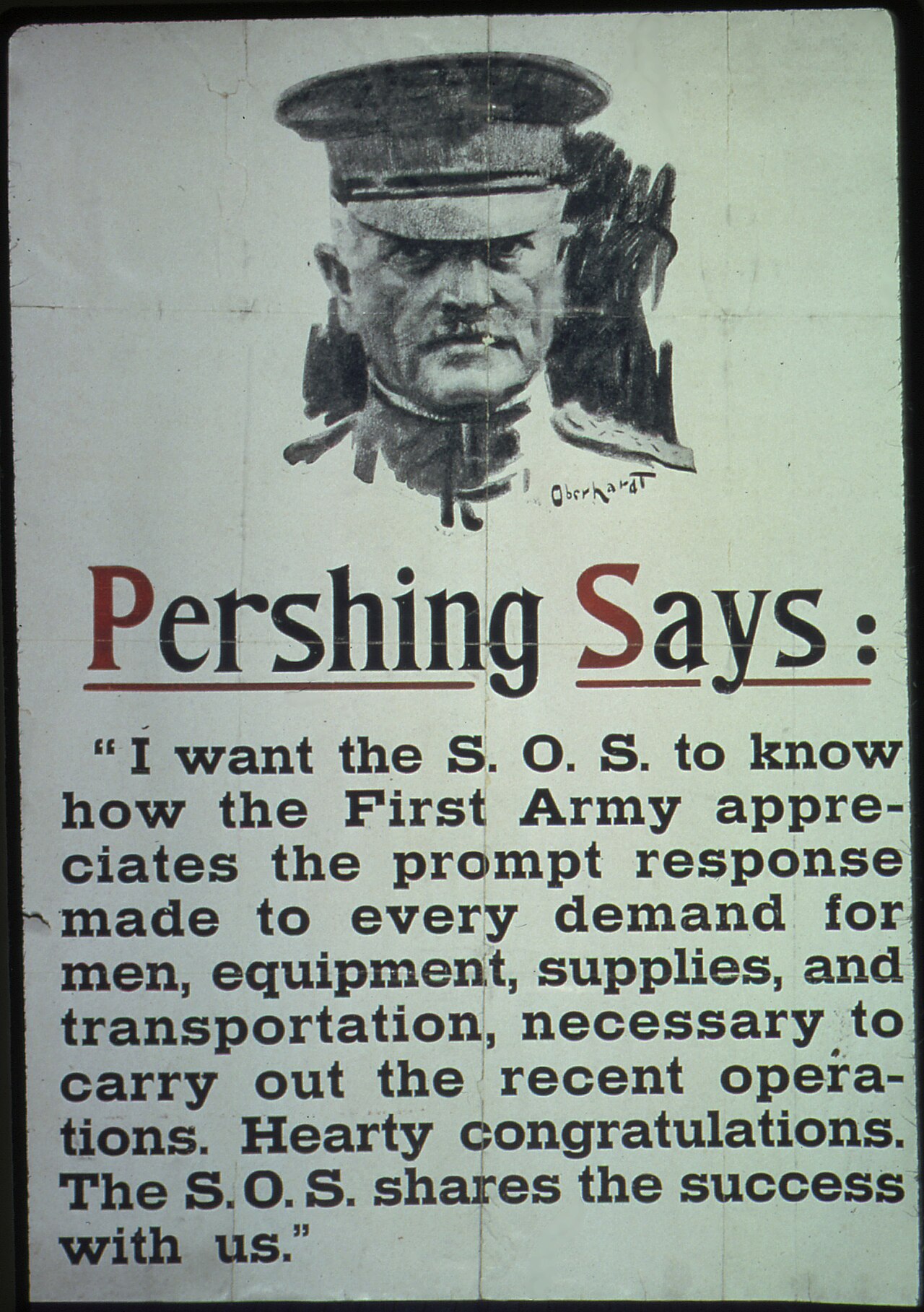
"Pershing Says: The S.O.S. Shares the Success With Us", American Expeditionary Forces poster, 1918, drawing by Oberhardt. US National Archives (NARA 512615) via Wikimedia Commons. Public domain. An example from the archive of the appeal the IPA called testimonial.
The Coughlin study. The Fine Art of Propaganda (1939) applies the devices to radio talks by Father Charles E. Coughlin, a Catholic priest in Royal Oak, Michigan, whose national broadcasts in 1938-1939 included antisemitic content and material favourable to the German government of the day. The IPA explained the choice by describing the talks as a typical case of an American speaker borrowing propaganda methods from anti-democratic movements abroad. The Lees, both sociologists, quote passages from the speeches and label them by device.
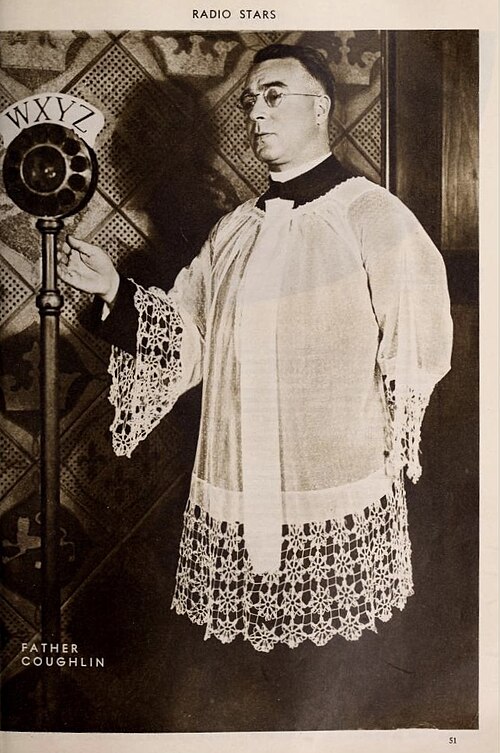
Father Charles E. Coughlin at a WXYZ microphone, from Radio Stars, May 1934, p. 51. The IPA's 1939 book The Fine Art of Propaganda analysed his radio talks. Photographer unknown. Public domain (no copyright renewal found for the serial).
Institutional analysis alongside the devices. Sproule (1997, 2001) stresses that the IPA did not only teach a checklist. Its bulletins also traced who funded and organised campaigns: business associations, political parties, governments and pressure groups. In later decades the checklist travelled without this institutional half.
Techniques in this archive's taxonomy
This archive's classical family takes its first seven entries directly from the IPA list. Each device maps to one id:
- Name-calling: the IPA's "name calling", a bad label used in place of evidence.
- Glittering generalities: the IPA's "glittering generalities", virtue words used in place of a testable claim.
- Transfer: the IPA's "transfer", borrowed authority of church, nation or science.
- Testimonial: the IPA's "testimonial", a respected or disliked person vouching for or against.
- Plain folks: the IPA's "plain folks", the speaker presented as one of the people.
- Card stacking: the IPA's "card stacking", selection and omission to build the best or worst case.
- Bandwagon: the IPA's "band wagon", everybody is doing it.
Reception and criticism
- Educators at the time adopted the devices widely. The IPA presented itself as non-partisan and applied them to speakers from a US radio priest to foreign governments.
- Accusations of partisanship at the time. In May 1938 the House of Representatives set up the special committee on un-American activities under Representative Martin Dies of Texas. The IPA's own records, now at the New York Public Library, include correspondence on allegations that some of its officers were Communists or Communist sympathisers. These allegations questioned whether the Institute was as non-partisan as it said.
- Wartime objections. As the United States mobilised for war, the IPA's practice of analysing all propaganda, including that of its own government and of the Allied cause, came under pressure as out of step with national mobilisation, and some treated it as "un-American". In its last years the IPA lost support from publishers and several board members resigned (Hobbs and McGee, 2014). Historians list this pressure alongside the IPA's money problems as reasons it folded.
- Pedagogical objections. Some teachers and critics at the time argued that the device list produced cynicism, a habit of dismissing messages, rather than careful reflection (summarised in Hobbs and McGee, 2014).
- Social-science objections. J. Michael Sproule argues in "Propaganda Studies in American Social Science" (1987) and Propaganda and Democracy (1997) that by the late 1930s academic research was moving toward statistical and experimental "communication research", which treated the IPA's approach as unscientific and displaced it. Sproule himself argues that the IPA represented a progressive, citizen-centred tradition that this shift pushed aside.
- Later scholarship. Historians of media literacy such as Renee Hobbs treat the IPA as a founding case for teaching propaganda analysis in schools.
Same-standard note
This archive applies the seven devices to any speaker, whatever the party, government, era or cause, as the IPA itself said it did when it analysed both an American radio priest and the German government in the same bulletin series. Harold D. Lasswell, Propaganda Technique in the World War (1927) made the same move a decade earlier by treating Allied and Central Powers propaganda under one set of headings. The difference in kind is plain: the IPA was a small, privately funded educational body teaching citizens to analyse messages, not a state apparatus producing them, such as those described in Hitler, Goebbels and the Reich Ministry for Public Enlightenment and Propaganda (1925-1945) or Lenin and the Communist Party of the Soviet Union, the agitprop model (1902-1991).
Sources
- Institute for Propaganda Analysis, "How to Detect Propaganda", Propaganda Analysis 1, no. 2 (November 1937): 5-7.
- Alfred McClung Lee and Elizabeth Briant Lee, eds., The Fine Art of Propaganda: A Study of Father Coughlin's Speeches (New York: Harcourt, Brace and Company, 1939).
- J. Michael Sproule, "Authorship and Origins of the Seven Propaganda Devices: A Research Note", Rhetoric & Public Affairs 4, no. 1 (2001): 135-143.
- J. Michael Sproule, Propaganda and Democracy: The American Experience of Media and Mass Persuasion (Cambridge: Cambridge University Press, 1997).
- J. Michael Sproule, "Propaganda Studies in American Social Science: The Rise and Fall of the Critical Paradigm", Quarterly Journal of Speech 73, no. 1 (1987).
- Renee Hobbs and Sandra McGee, "Teaching about Propaganda: An Examination of the Historical Roots of Media Literacy", Journal of Media Literacy Education 6, no. 2 (2014): 56-67.
- Institute for Propaganda Analysis records, 1937-1968, Manuscripts and Archives Division, New York Public Library (finding aid: https://archives.nypl.org/mss/1513).
- "Institute for Propaganda Analysis", Wikipedia (pointer only, for the IPA's stated reason for choosing the Coughlin talks): https://en.wikipedia.org/wiki/Institute_for_Propaganda_Analysis