Content note. This page quotes 1980s headlines, columns and sermons that called AIDS a "gay plague" and a punishment, and a proposal to tattoo people with HIV. They are quoted as evidence of the method. They are not this archive's description of anyone.
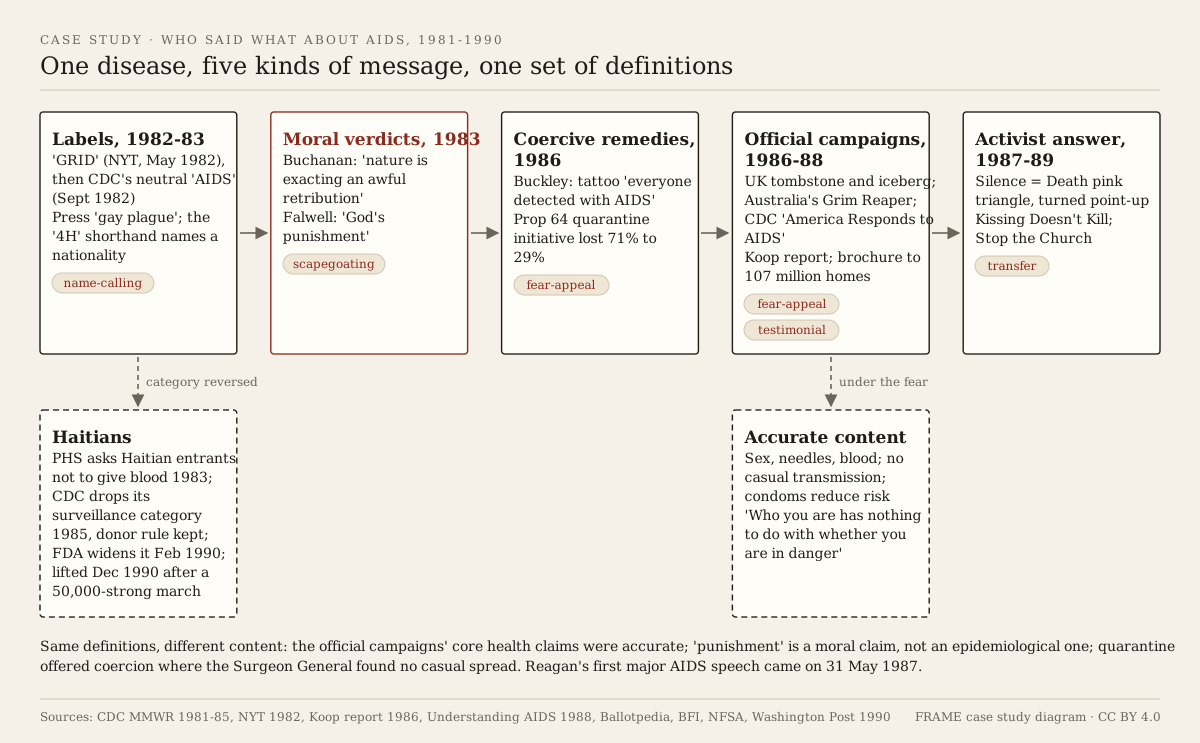
In one line: in the first decade of AIDS, tabloid labels, moral commentary, quarantine campaigns, government health campaigns and activist posters all competed to define the disease, and the same technique definitions apply to each of them, although their accuracy, aims and effects differed sharply.
What happened
- 5 June 1981. The CDC's MMWR reports Pneumocystis pneumonia in five previously healthy young gay men in Los Angeles, the first published report of what became AIDS.
- 11 May 1982. The New York Times headlines "New Homosexual Disorder Worries Health Officials" and reports the working name GRID, "gay-related immune deficiency". Through 1982 U.S. papers print "gay plague"; the Philadelphia Daily News runs '"Gay Plague" Baffling Medical Detectives' in August. British tabloids take up the phrase in 1983.
- 24 September 1982. The CDC uses "acquired immune deficiency syndrome (AIDS)" in MMWR, reporting 593 cases and 243 deaths; about 75% of cases are in homosexual or bisexual men.
- 15 October 1982. At a White House briefing, reporter Lester Kinsolving asks about the "gay plague". Press secretary Larry Speakes answers "I don't have it. Do you?" to laughter, and acknowledges that no one at the White House, the President included, knows anything about the epidemic.
- 4 March 1983. A CDC, FDA and NIH recommendation lists the groups with most reported cases: gay men with multiple partners, injecting drug users, Haitians and people with hemophilia. Press shorthand becomes the "4H" list. As "a temporary measure", the recommendation asks members of the listed groups, "Haitian entrants to the United States" among them, not to donate blood or plasma.
- 24 May 1983. Pat Buchanan writes in the New York Post ("Homosexuals and Retribution"): "The poor homosexuals, they have declared war upon nature, and now nature is exacting an awful retribution." He argues for barring homosexuals from food-handling jobs.
- 1983. Jerry Falwell, founder of the Moral Majority, is widely quoted as saying in Lynchburg in June that "AIDS is not just God's punishment for homosexuals, it is God's punishment for the society that tolerates homosexuals". He argues the same position against Troy Perry on the CBC in July.
- April 1985. The CDC stops listing Haitian birth as a separate risk category, citing evidence that heterosexual contact and exposure to contaminated needles explained the cases. Its MMWR report of 10 May adds that the Public Health Service donor guidelines, including the one for "Haitian entrants to the United States", "continue to apply".
- 17 September 1985. Asked at a news conference, President Reagan calls AIDS research "one of the top priorities". It is his first public comment on the disease.
- 18 March 1986. William F. Buckley Jr. writes in the New York Times ("Crucial Steps in Combating the AIDS Epidemic: Identify All the Carriers") that "everyone detected with AIDS should be tattooed in the upper forearm, to protect common-needle users, and on the buttocks, to prevent the victimization of other homosexuals."
- 22 October 1986. Surgeon General C. Everett Koop releases his report on AIDS. It sets out how the virus is and is not transmitted, recommends condoms and calls for sex education from the third grade.
- 4 November 1986. California's Proposition 64, placed on the ballot by the LaRouche-affiliated "Prevent AIDS Now Initiative Committee" (PANIC), would have classed AIDS as a communicable disease open to quarantine and barred people with HIV from attending or teaching in schools. It loses 71% to 29%.
- January 1987. Britain's "AIDS: Don't Die of Ignorance" campaign opens: a £5 million TV and cinema campaign (a tombstone chiselled with "AIDS", then an iceberg), directed by Nicolas Roeg and narrated by John Hurt, plus a leaflet sent to every household.
- Early 1987. The Silence = Death Project, a six-man New York collective, posts its pink-triangle poster; ACT UP forms in March and adopts it.
- 5 April 1987. Australia's National Advisory Committee on AIDS airs the "Grim Reaper" ad: a hooded reaper bowls down men, women and children as pins in a bowling alley. UPI reports children screaming and parents protesting the next day.
- 31 May 1987. Reagan gives his first major speech on AIDS, at the American Foundation for AIDS Research dinner. Parts of the audience boo his call for wider testing.
- October 1987. The CDC launches America Responds to AIDS, a multi-year campaign of TV spots, posters and print.
- May to June 1988. Understanding AIDS, an eight-page brochure, is mailed to all 107 million U.S. households, the largest public-health mailing the government had made.
- 1989. The Gran Fury collective's "Kissing Doesn't Kill: Greed and Indifference Do" runs on buses in several U.S. cities. On 10 December ACT UP and WHAM! stage "Stop the Church" at St. Patrick's Cathedral against Cardinal O'Connor's opposition to condom and sex education (and, for WHAM!, to abortion rights); 111 people are arrested, 53 inside, and one protester crumbles a consecrated communion wafer.
- 1990. In February the FDA widens the donor exclusion in place since 1983 to everyone born in Haiti or sub-Saharan Africa. On 20 April some 50,000 people, mostly Haitian Americans, march across the Brooklyn Bridge against the rule. On 5 December the U.S. government announces it will lift the national-origin exclusion.
The same years also saw a Soviet-bloc campaign claiming the virus was made in a U.S. military laboratory, which the intelligence historian Thomas Boghardt, writing in the CIA's journal Studies in Intelligence, traces to KGB and Stasi active-measures work (see Sources); this archive covers it on the comparison page Then and now: "the Americans made it" (Soviet AIDS story 1983, Chinese Fort Detrick claim 2020).
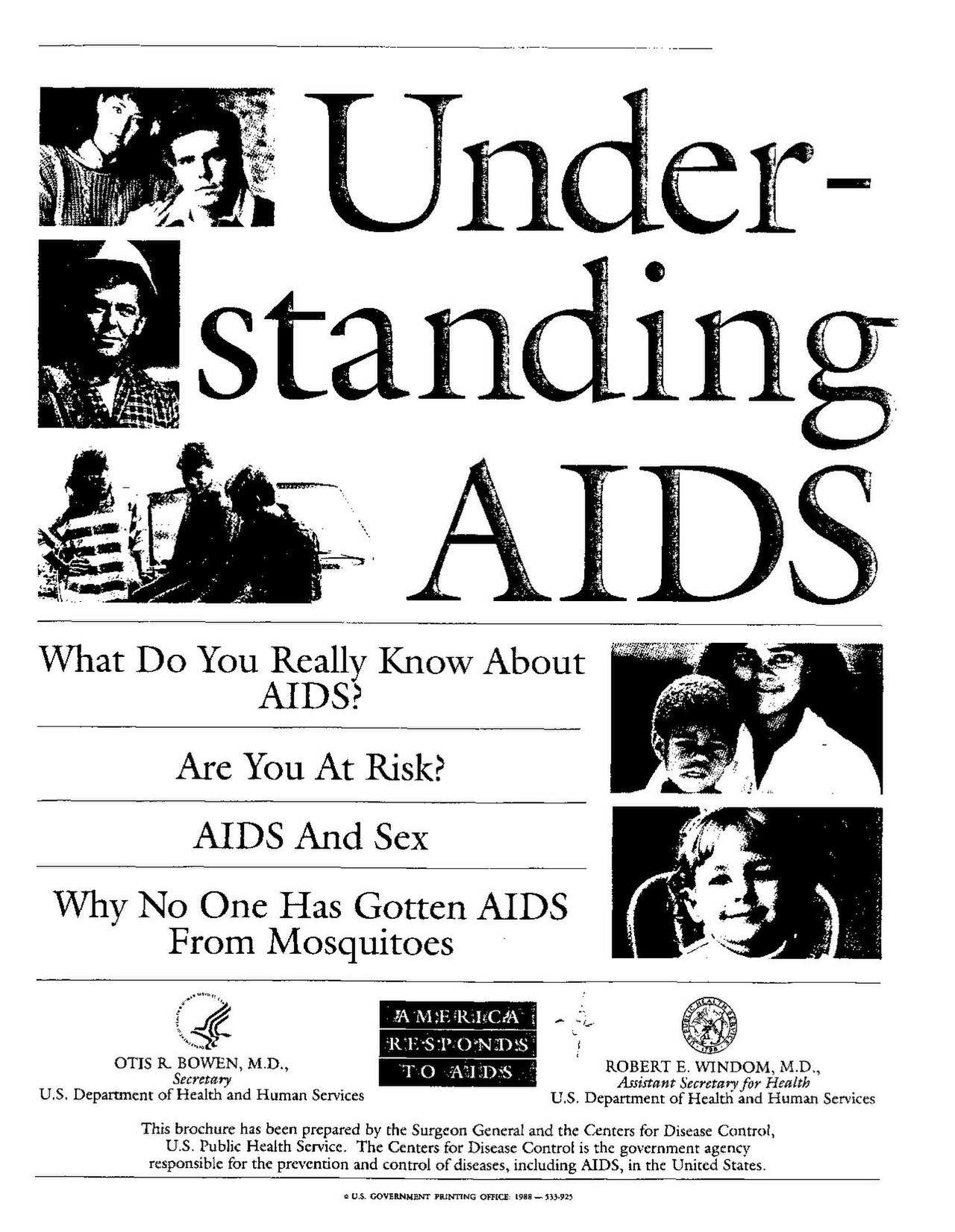
Cover of Understanding AIDS (1988), mailed to every U.S. household. U.S. Public Health Service. Public domain.
How it works
- Name-calling: "gay plague" attaches the disease to an identity rather than to a way of transmission, and "plague" carries its own dread. It came from newspapers, not from the CDC, which moved from GRID to the neutral AIDS within months. The popular "4H club" shorthand did the same to four groups, one of them a nationality. The Understanding AIDS brochure answers this framing directly: "Many people feel that only certain 'high risk groups' of people are infected by the AIDS virus. This is untrue. Who you are has nothing to do with whether you are in danger of being infected with the AIDS virus. What matters is what you do."
- Scapegoating: Buchanan's "declared war upon nature ... awful retribution" and Falwell's "God's punishment" place the blame for an epidemic on one group, and turn a medical event into a verdict on that group's morals. That is a moral claim, not an epidemiological one: the CDC's March 1983 recommendations already named people with hemophilia and exposure to blood or blood products, and described an infectious agent, not a verdict. The Haitian category is held to the same test. The CDC and FDA said their categories rested on surveillance data, and the March 1983 recommendations asked "Haitian entrants to the United States", with the other listed groups, not to give blood. When the CDC dropped its separate Haitian surveillance category in April 1985, citing heterosexual contact and needle exposure, the same report put antibody prevalence among Haitian-American controls at 5%, "several times higher than that seen in random blood donors", and said the donor guidelines "continue to apply". In February 1990 the FDA widened the exclusion to everyone born in Haiti or sub-Saharan Africa; an FDA spokesman said Haitians and Africans were more likely to transmit the virus through heterosexual sex, and that the rule was not meant to single out any ethnic group. After the April march across the Brooklyn Bridge, the FDA announced a new collection system in December and said the changes would "eliminate the need for excluding certain donor populations based solely on their geographical or national origins". On this record, national origin stayed a marker in blood-donor screening for more than five years after it left the CDC's surveillance categories, and was widened before it was dropped; the stated basis throughout was blood safety. The protesters' position, that the rule stigmatised a whole nationality, is set out below.
- Fear appeal: the definition covers imminent harm staged so that the offered protection is accepted without weighing base rates or alternatives. Proposition 64 offered quarantine as protection against a spread that the Surgeon General's report said does not happen through casual contact; Buckley's tattoo proposal offered compulsory marking as protection for needle users and sexual partners. The official campaigns also staged fear: a tombstone and an iceberg in Britain ("if you ignore AIDS, it could be the death of you. So don't die of ignorance"), a reaper felling children in Australia, and a CDC poster of a stop sign ("gonorrhea, syphilis & herpes are fair warning ... Hope they paid attention"). The difference is in the content. The government campaigns' core health claims (sexual and blood transmission, no known cure, condoms reduce risk, no casual transmission) were accurate and are still accurate; the quarantine initiative treated AIDS as easily communicable, which the Surgeon General's report of the same year said it was not, and 71% of California voters rejected it. Accurate content does not remove the fear technique; it changes what the fear is attached to.
- Transfer: Silence = Death takes the pink triangle that Nazi camps forced on men imprisoned as homosexuals, turns it point-up, and applies its weight to what its makers called official silence about AIDS. The borrowing is deliberate and open, and the poster names no data claim, only a political equation. Gran Fury's "Kissing Doesn't Kill: Greed and Indifference Do" (1989) makes the same kind of equation from the activists' side: it assigns the deaths to motives, greed and indifference, without a data claim.
- Testimonial: the U.S. campaign's first phase was titled "Humanizing AIDS" and relied on named witnesses. The 1988 brochure opens with a signed letter from the Surgeon General ("we have consulted with the top health experts in the country") and quotes "Carole", who has AIDS: "AIDS is not a 'we,' 'they' disease, it's an 'us' disease." The brochure also supplies the checkable transmission facts, and the testimonials appear beside them.
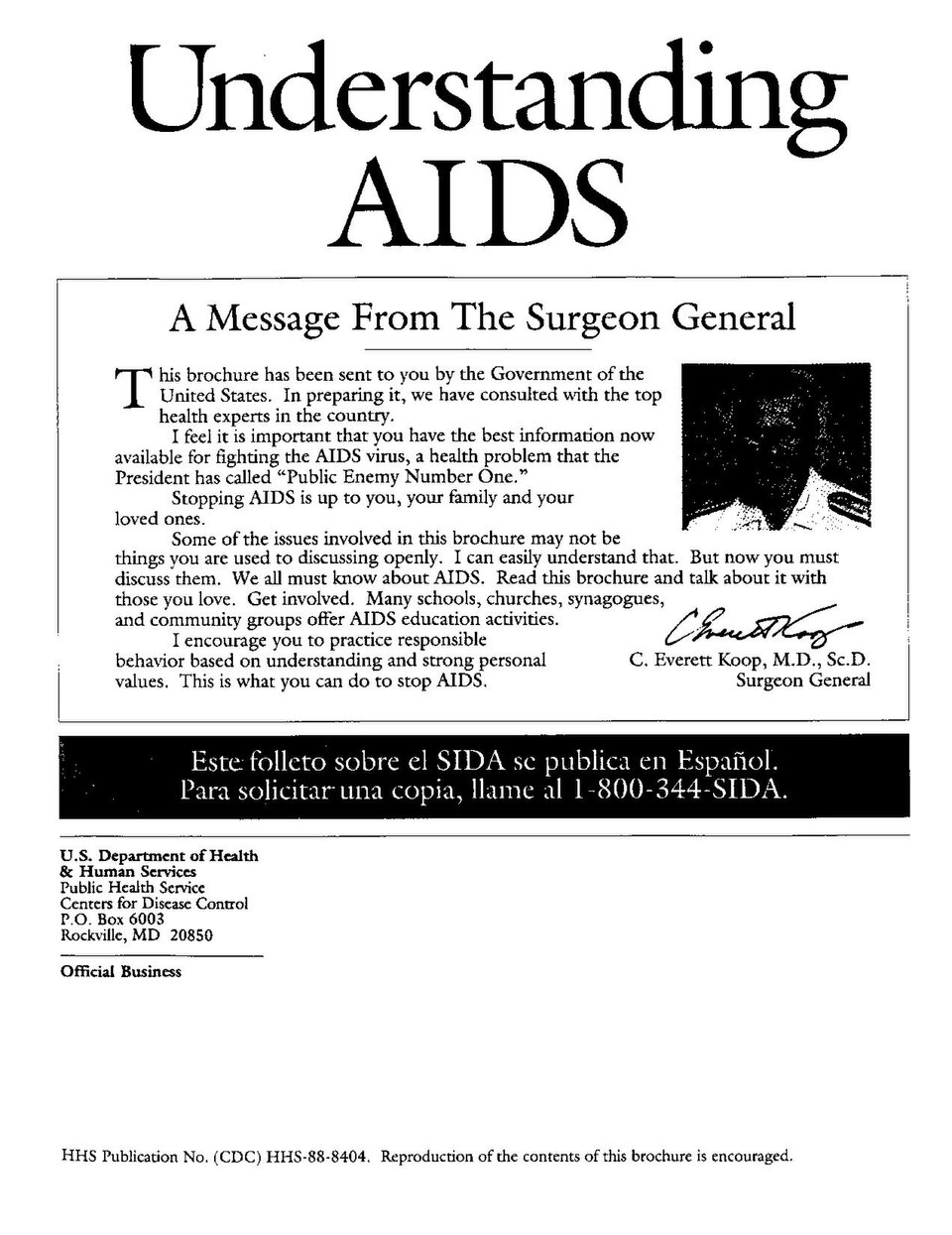
The Surgeon General's signed letter in Understanding AIDS. It quotes the President calling AIDS "Public Enemy Number One". Public domain.
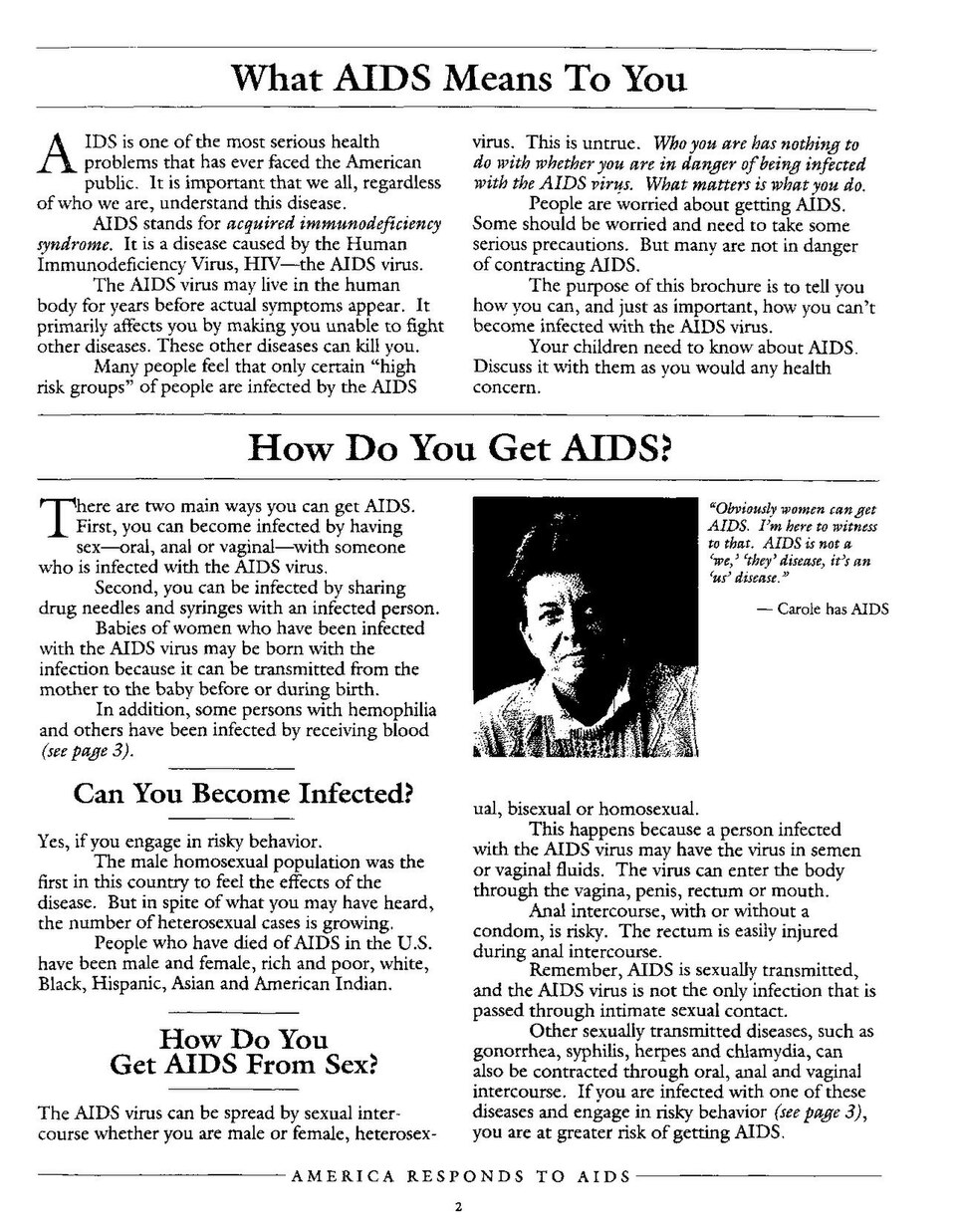
Page two of the brochure, which rejects the "high risk groups" framing in so many words. Public domain.
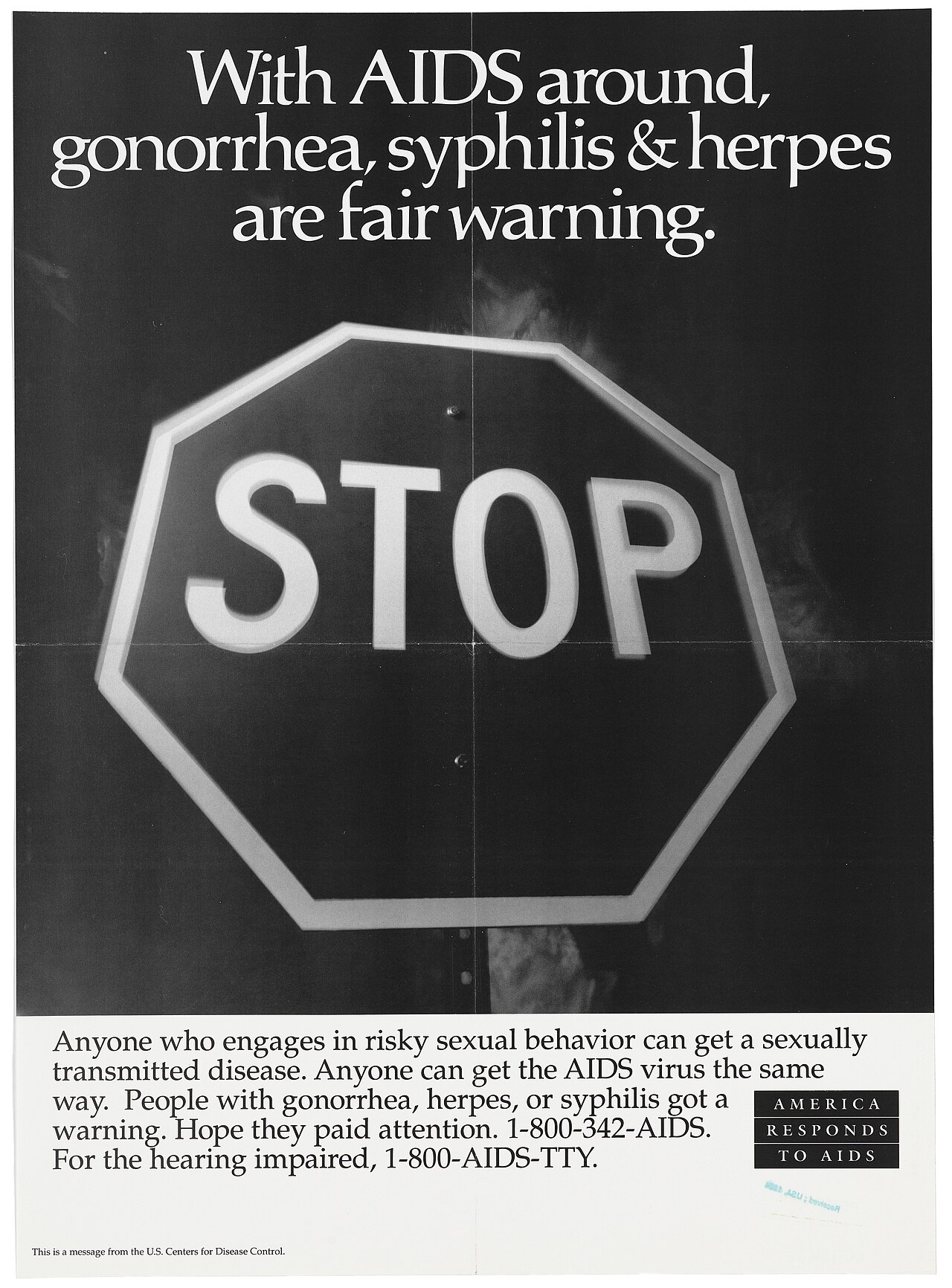
America Responds to AIDS poster, U.S. Centers for Disease Control, late 1980s to early 1990s. Public domain. A fear appeal attached to accurate content.
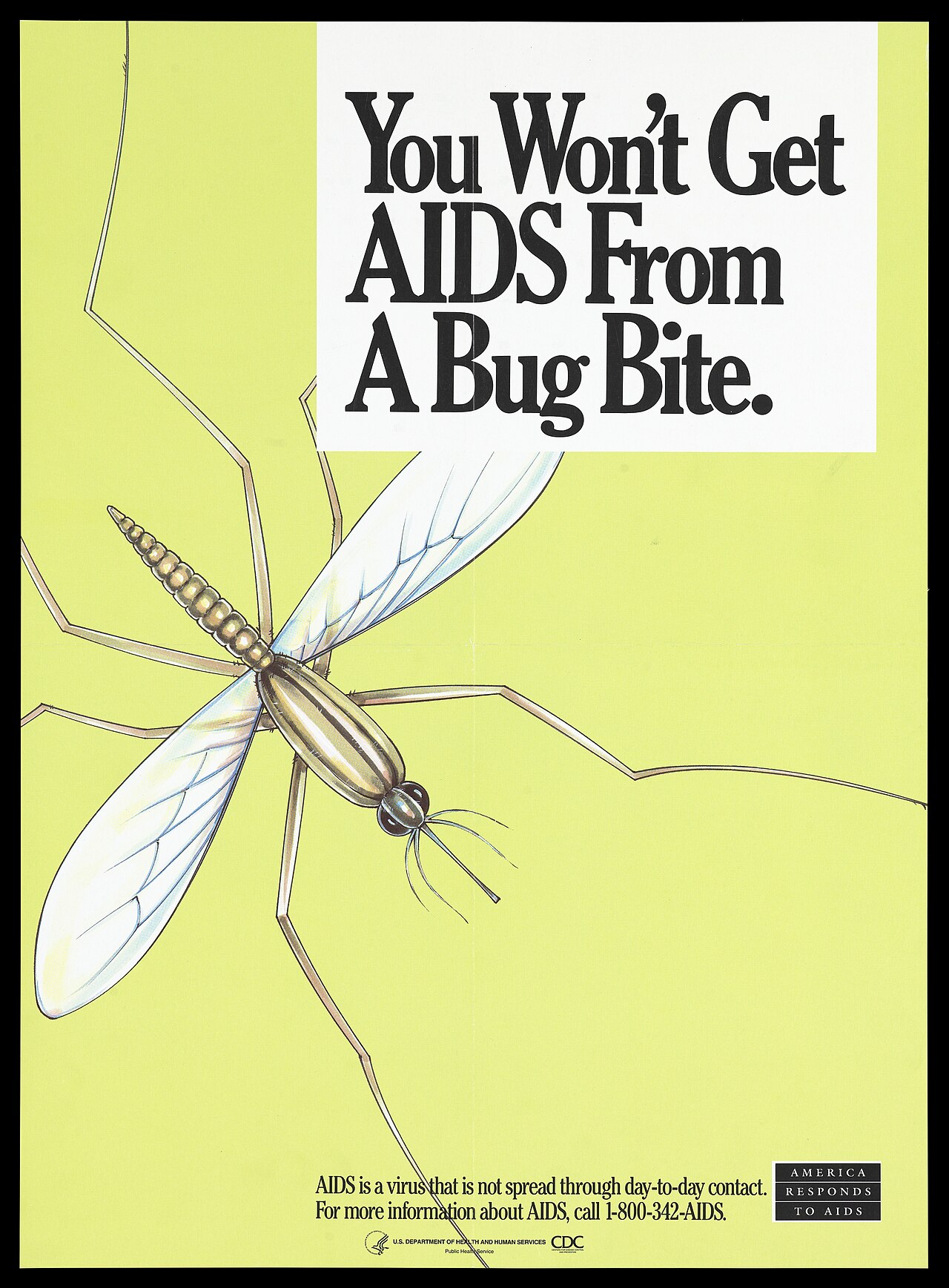
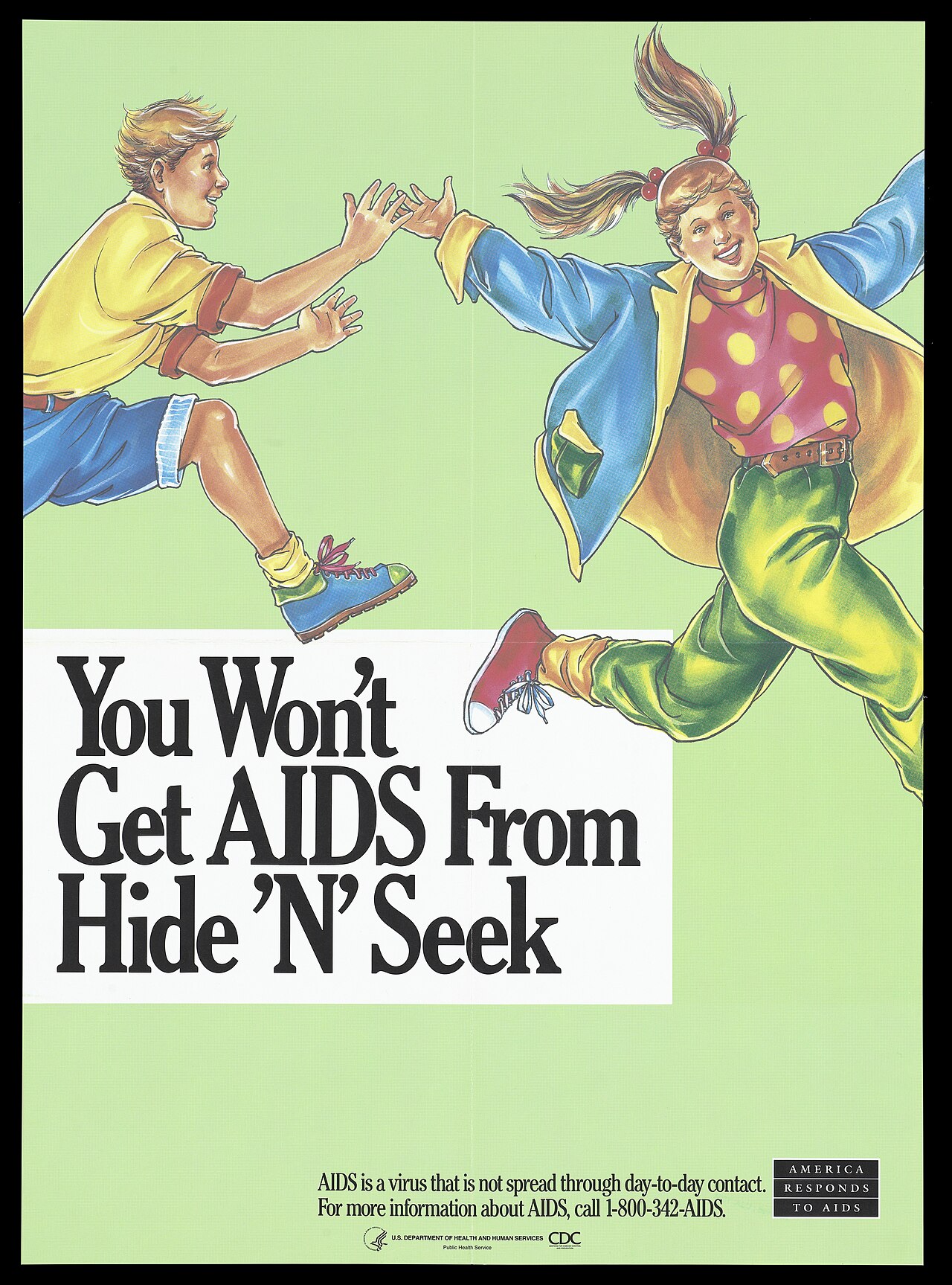
Two America Responds to AIDS posters (U.S. Department of Health and Human Services and CDC; public domain) aimed at the casual-contact fear that Proposition 64 relied on.
Then and now

The Real Cost — "Your Skin", U.S. Food and Drug Administration, 2014. Public domain.
The FDA's 2014 anti-smoking spot, like the 1987 tombstone and reaper, stages a real harm as immediate horror to change behaviour. The archive tags both as fear appeals and both as built on accurate health claims. The AIDS campaigns differ in one documented way: the Grim Reaper ad's imagery was read by many viewers as pointing at gay men, which Ron Penny, a leading figure in Australia's early response, later called unintended.
The Silence = Death poster itself is not hosted here (see Image gaps); the Smithsonian and the Brooklyn Museum hold copies, linked under Sources.
The Haitian national-origin category shares one feature with 'Instructions to All Persons of Japanese Ancestry' (exclusion order posted in San Francisco): a rule applied to people by origin rather than by individual assessment. It differs sharply in scale and coercion: the 1942 order removed people from their homes, while the donor exclusion, in place from 1983 and widened in February 1990, barred people from giving blood until the government announced its end in December 1990.
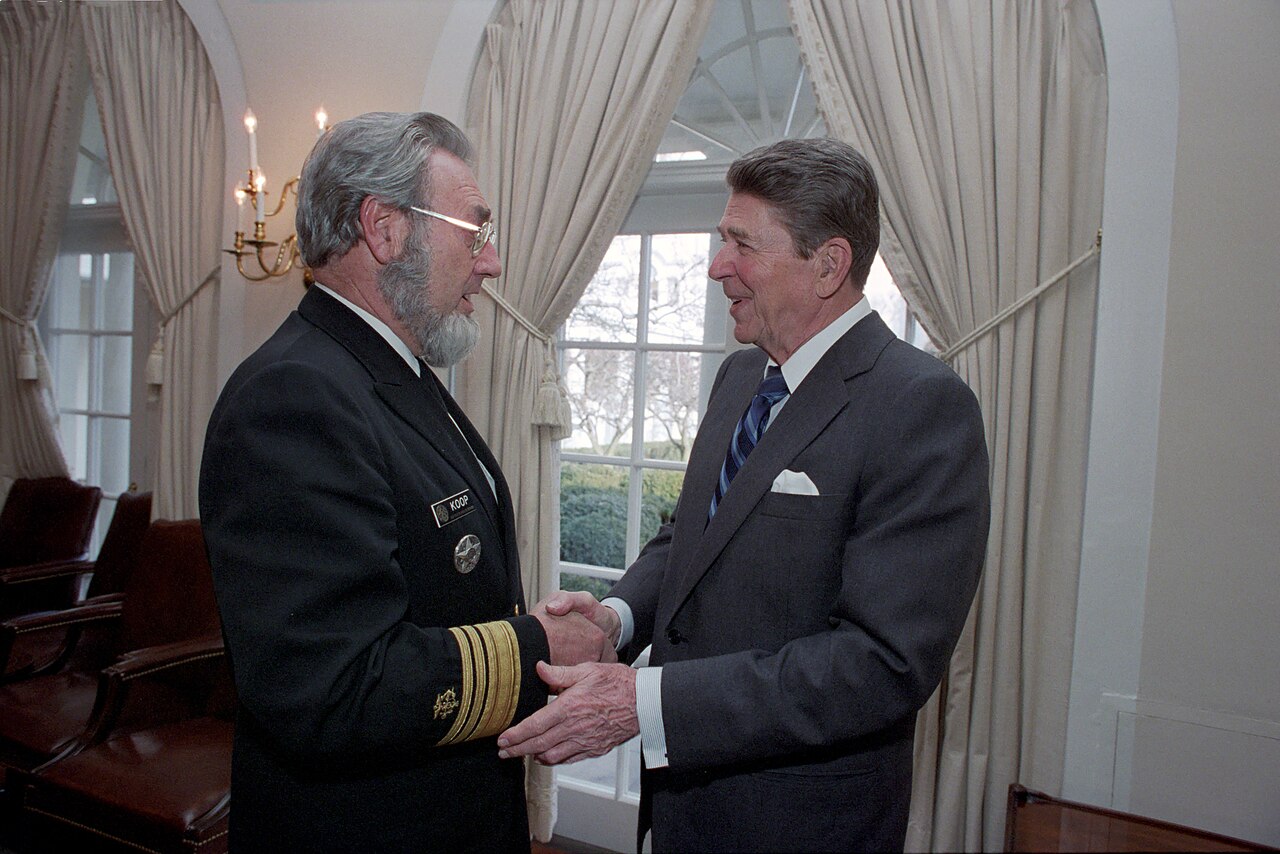
Surgeon General Koop and President Reagan, 22 January 1986, at a White House meeting with pro-life leaders, nine months before Koop's AIDS report. White House Photographic Office. Public domain. The photo is not of an AIDS event.
Positions on the record
- Public-health authorities (CDC, Surgeon General, DHSS, NACAIDS) said their campaigns aimed to warn a public that did not yet take the risk seriously, and to replace myths with transmission facts. Koop's report treated AIDS as a health issue rather than a moral one; Bill Bowtell, who commissioned the Grim Reaper ad, said in 2007 that it "created a great deal of demand for information".
- Critics of the fear campaigns said they stigmatised the people most affected. Dr Ron Penny said the reaper "became identified with gay men rather than as the Reaper", and in 2022 ACON's Brent Mackie told a New South Wales hate-crimes inquiry the ad "certainly contributed" to violence against gay men. In 1996 the Wall Street Journal argued that the U.S. "everyone is at risk" message, while technically true, overstated the risk to most heterosexuals.
- Moral and religious commentators presented AIDS as a moral verdict: Buchanan wrote that nature was "exacting an awful retribution", and Falwell was quoted calling it "God's punishment" for homosexuals and for "the society that tolerates homosexuals"; Buckley presented tattooing as protection of others; PANIC presented quarantine as prevention.
- The Reagan administration said AIDS research was a top priority and pointed to its research funding (1985); its own Surgeon General produced the 1986 report and the 1988 national mailing. Critics, including ACT UP, pointed to the President's six years without a major speech.
- ACT UP and allied artists said official silence and inaction were killing people; Stop the Church targeted the Archdiocese's opposition to condom and sex education. The Archdiocese, which ran care services for people with AIDS, held to Church teaching against condom distribution and sex education; the disruption of a Mass was widely reported and criticised at the time.
- Haitian marchers said the national-origin rule stigmatised a whole people; the FDA's stated basis was blood safety.
- What is documented: the headlines, columns, ballot result, reports, ads, brochure, posters, protests and reversals listed above.
- What is not shown: that any single campaign caused or prevented a measurable number of infections, or that any official campaign was designed to stigmatise a group. This page makes no finding about any individual's motives beyond their own stated words.
Same-method test
Swap the sponsors and the scores stay the same. A 1987 poster by a religious group showing a grim reaper felling children, with an accurate message about condoms, would be tagged fear-appeal just as NACAIDS's ad is. An activist group that painted a respected symbol of past persecution onto a present-day government would be tagged transfer whichever cause it served, as the pink triangle is here. A health ministry that named a disease after a nationality would be tagged name-calling just as tabloids were for "gay plague". The difference that remains after the swap is the content: whether the health claim was accurate, and whether the remedy on offer was information or coercion.
How to spot it
- Ask whether a label names what spreads a disease (sex, needles, blood) or who has it. Only the first tells a reader what to do.
- Separate a moral claim ("punishment", "retribution") from an epidemiological one (routes, rates). Each needs its own kind of evidence.
- In a fear-led ad, look for the facts under the fear: is the transmission information there, and is it right? The UK leaflet and the U.S. brochure carried it; the Grim Reaper spot, by its critics' account, did not.
- Check whether a category (a nationality, a group) is dropped when data about conduct arrives. If it outlasts the data, look for the basis its authors give for keeping it, and check that basis against the data.
Images
| Image | Source | Licence |
|---|---|---|
| Mechanism diagram (above) | Drawn for FRAME from this page's sourced facts (make_diagrams.py) |
CC BY 4.0, FRAME |
| Understanding AIDS (1988), cover, Surgeon General's letter and page 2 | Wikimedia Commons, from CDC Stacks | Public domain (U.S. government work) |
| America Responds to AIDS: stop sign poster | Wikimedia Commons, Wellcome Collection L0052355 | Public domain (PD-USGov-HHS-CDC) |
| America Responds to AIDS: "Bug Bite" poster | Wikimedia Commons, Wellcome Collection L0052397 | Public domain (U.S. government work) |
| America Responds to AIDS: "Hide 'N' Seek" poster | Wikimedia Commons, Wellcome Collection L0052398 | Public domain (U.S. government work) |
| Koop and Reagan, 22 January 1986 | Wikimedia Commons, White House Photographic Office | Public domain (U.S. government work) |
| The Real Cost, "Your Skin" (2014) | FRAME gallery | Public domain (U.S. government work) |


Image gaps
- The Silence = Death poster (1987). Wikimedia Commons marks a Wellcome Collection photo of it public domain as a simple shape and text, but the sheet carries a "© 1987 The Silence = Death Project" line and Wellcome lists the image as CC BY-NC. That is not a verified open licence, so it is not hosted. Fillable if the rights holder's release or a clear public-domain ruling is found.
- UK "Don't Die of Ignorance" tombstone and iceberg films and the 1987 leaflet. Crown copyright, not expired, and not released under the Open Government Licence as far as could be found. Not hosted; the BFI streams the film. Not fillable unless a Crown-copyright release is found.
- Australia's Grim Reaper ad (1987). Commonwealth copyright; held by the NFSA. Not hosted. Not fillable under this archive's licence rules.
- "Kissing Doesn't Kill" (Gran Fury, 1989). Copyright of the collective; held by the V&A and the Library of Congress with rights not cleared. Not fillable.
- Newspaper pages ("gay plague" headlines, Buchanan's and Buckley's columns). Copyrighted. Not fillable.
- Photos of Stop the Church, the 1990 Brooklyn Bridge march and Proposition 64 campaign material. No openly licensed photos were found on Wikimedia Commons. Possibly fillable if a photographer's CC-licensed image surfaces.
- More CDC and NIH posters. The NLM's AIDS poster collection (public domain for federal items) could not be reached from the environment used to build this page. Fillable.
Sources
- Thomas Boghardt, "Soviet Bloc Intelligence and Its AIDS Disinformation Campaign", Studies in Intelligence 53:4, 2009
- CDC, MMWR, 5 June 1981: Pneumocystis pneumonia, Los Angeles
- Lawrence K. Altman, "New Homosexual Disorder Worries Health Officials", New York Times, 11 May 1982 (PDF copy)
- CDC, MMWR, 24 September 1982: Update on AIDS
- CDC, MMWR, 4 March 1983: Prevention of AIDS, inter-agency recommendations
- CDC, MMWR, 10 May 1985: Update on AIDS; Haitian category discontinued, donor guidelines continue
- CDC, "AIDS: the Early Years and CDC's Response" (2011)
- Gay in the 80s: early "gay plague" headlines
- Slate, 1 December 2015: Speakes briefing audio (When AIDS Was Funny)
- Patrick J. Buchanan, "Homosexuals and Retribution", New York Post, 24 May 1983; quoted in Poynter, 2021 and FAIR
- CBC Archives: Jerry Falwell and Troy Perry debate AIDS, 1983; Pew Research Center, "Jerry Falwell, 1933-2007"
- William F. Buckley Jr., "Crucial Steps in Combating the AIDS Epidemic: Identify All the Carriers", New York Times, 18 March 1986, p. 27; quoted in FAIR, 2008
- Reagan Library: The President's News Conference, 17 September 1985
- Reagan Library: Remarks at the amfAR Awards Dinner, 31 May 1987; Washington Post, 1 June 1987
- NLM Profiles in Science: the Surgeon General's report on AIDS (1986)
- Ballotpedia: California Proposition 64 (1986); Online Archive of California: No on 64 records
- BFI: "Beyond the tombstone"; UK National Archives blog: the AIDS health campaign; Vice: interview with Norman Fowler
- NFSA: The Grim Reaper; UPI, 6 April 1987; ABC News, 5 April 2007; TheBody: Ron Penny on the Grim Reaper; ABC News, 22 November 2022: LGBTIQ hate-crimes inquiry
- Smithsonian NMAH: Silence = Death poster; Brooklyn Museum: SILENCE=DEATH
- Nowak et al., "America Responds to AIDS: its content, development process, and outcome", Public Health Reports (1991)
- UPI, 4 May 1988: AIDS brochure goes to 107 million households; Understanding AIDS (1988), CDC Stacks
- V&A: "Kissing Doesn't Kill. Greed and Indifference Do."
- ACT UP Oral History Project: Stop the Church; EBSCO Research Starters: ACT UP protests at St. Patrick's Cathedral
- Washington Post, 21 April 1990: 50,000 protest ban on blood donations by Haitians, Africans; Washington Post, 6 December 1990: U.S. to lift Haitian blood donor ban; UPI, 20 April 1990: Haitians protest blood ruling; UPI, 5 December 1990: FDA unveils new blood donation guidelines
- Amanda Bennett and Anita Sharpe, "AIDS Fight Is Skewed by Federal Campaign Exaggerating Risks", Wall Street Journal, 1 May 1996 (see Pulitzer Prize citation)