Content note. This case describes torture, massacre, mutilation as punishment, and forced unveiling, and quotes the labels each side used for its enemies ("hors-la-loi", "traîtres"). The labels are quoted as evidence of the method. They are not this archive's description of anyone.
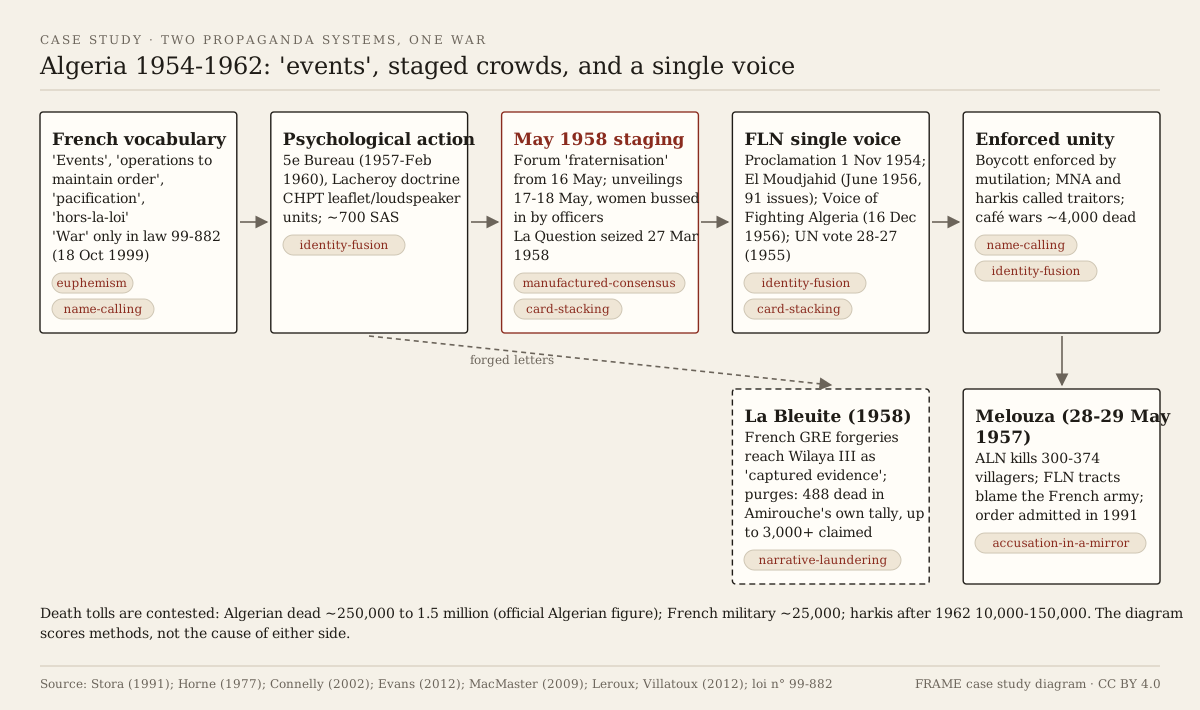
In one line: for eight years France called a war "events" and "operations to maintain order", built an army branch for psychological action, staged crowds of "fraternisation" and seized a book about torture by its paratroopers, while the FLN presented itself as the only voice of Algeria, punished rivals and dissenters, and blamed its own Melouza massacre on the French army.
What happened
- 1 November 1954. The FLN opens the war with coordinated attacks and a proclamation calling for "the restoration of the sovereign, democratic and social Algerian state within the framework of Islamic principles", and presents itself as the one front for all Algerians. On 12 November, Interior Minister François Mitterrand tells the National Assembly "L'Algérie, c'est la France."
- 1954-1962, the French vocabulary. Official language moves from "events" to "police operations", then "operations to maintain order" (after the special-powers vote of March 1956) and "pacification" (Stora). Rebels are "hors-la-loi" (outlaws). French army records list 21,132 prisoners and suspects as "fuyards abattus" ("shot while fleeing") out of 145,195 insurgents counted as killed (Meynier, citing army figures). Parliament replaces "operations carried out in North Africa" with "the Algerian war" only by the law of 18 October 1999 (loi n° 99-882).
- June 1955. An FLN tract calls on Algerians to stop smoking to cut French tobacco revenue. Horne records that the FLN enforced the boycotts of tobacco and alcohol by cutting off offenders' lips or noses and killing repeat offenders.
- 26 September 1955. Governor-General Jacques Soustelle creates the Sections administratives spécialisées (SAS): officers in blue kepis who ran rural administration, schools, clinics and propaganda. There were about 700 by 1958.
- 30 September 1955. The UN General Assembly votes 28 to 27 to put Algeria on its agenda; the French delegation walks out. Connelly argues the FLN's decisive arena was diplomatic and media opinion abroad, not the battlefield.
- 1955-1960, psychological action. The army's psychological-action bureau (renamed 5e Bureau in 1957) draws on Colonel Charles Lacheroy's "guerre révolutionnaire" theory, first set out in lectures on "parallel hierarchies" in Indochina from November 1952. By June 1956 three loudspeaker-and-leaflet companies (CHPT), each of 85 men and 20 vehicles, tour villages with leaflets, loudspeaker trucks, photo exhibitions and cinema vans showing Arabic-language films.
- June 1956. El Moudjahid, the FLN's official organ, first appears clandestinely in Algiers; 91 issues follow until March 1962, later printed in Morocco and, from November 1957, in Tunis. 20 August 1956: the Soummam Congress sets the primacy of the political over the military and of the interior over the exterior. 16 December 1956: the Voice of Fighting Algeria begins broadcasting from outside Algeria, alongside Cairo's Sawt al-Arab. Fanon wrote that the French stock of radio sets sold out within weeks.
- 28-29 May 1957, Melouza. An ALN unit kills at least 300 men of Mechta-Kasbah, a village it treated as loyal to the rival nationalist MNA (figures given run from about 300 to 374). FLN tracts blamed the French army. In a 1991 documentary, Colonel Mohammedi Saïd acknowledged giving the order. In France the FLN-MNA "café wars" left about 4,000 dead (official French count: 3,975 dead and 10,223 dead or wounded).
- 1958, La Bleuite. Captain Paul-Alain Léger's Groupe de renseignement et d'exploitation feeds forged documents and false informants into Wilaya III, suggesting that its cadres were working for the French. Colonel Amirouche's purges follow. His own partial tally of March 1959 lists 542 tried and 488 dead; other estimates run from about 1,600 to "more than 3,000" (Ferhat Abbas). The figures are contested.
- February-March 1958. Henri Alleg's La Question, his account of being tortured by French paratroopers in 1957, is published by Éditions de Minuit and seized on 27 March after about 60,000 copies had sold. It was the first book banned in France for political reasons since the eighteenth century.
- 13-18 May 1958. After the 13 May seizure of the Gouvernement général in Algiers, the army stages "fraternisation" rallies of Europeans and Muslims on the Forum (from 16 May). On 17-18 May, Muslim women unveil in public, sometimes unveiled by European women, and burn veils. MacMaster shows that psychological-action officers organised the unveilings and brought women in by bus.
- 28 September 1958. In the constitutional referendum, which the army organised and promoted in Algeria, 96.6% vote yes, with Muslim women on the rolls for the first time. February 1960: after the Barricades Week, the 5e Bureau is dissolved.
- 17 October 1961, Paris. Police break up an FLN-called demonstration of Algerians against a curfew. The Prefecture of Police's communiqué gives two dead in an "exchange of gunfire" at the Pont de Neuilly, later raised to three. Historians' counts run from about 31 to 50 (Brunet) to about 200 that night (Einaudi). On 17 October 2012 President Hollande recognised the "bloody repression" of the demonstrators.
- Toll (contested). French military: about 25,000 dead, including about 8,000 from accidents or illness, and 485 missing (French defence ministry). Algerian dead: from about 250,000 (French demographic estimates) to 300,000-400,000 (Pervillé) to Algeria's official 1.5 million. Harkis and their families killed after the ceasefire of March 1962: estimates run from 10,000 to 150,000.
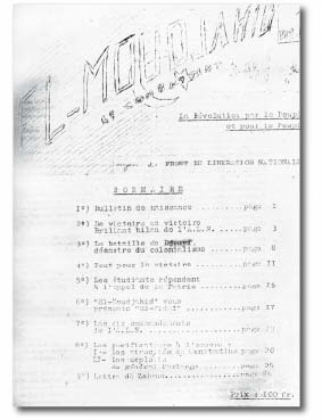
El Moudjahid no. 1, June 1956: the FLN's official organ, first produced clandestinely in Algiers. Public domain in Algeria (Commons PD-Algeria); see the licence note under Images.
How it works
- Euphemism / doublespeak: "events", "operations to maintain order", "pacification" and "shot while fleeing" put administrative words where war and killing would sit. Soldiers' slang did the same: "corvée de bois" (wood-gathering duty) meant a summary execution. The official word "war" came 37 years after the ceasefire.
- Card stacking: seizing La Question, along with newspaper seizures, removed the torture evidence and left the "maintenance of order" account standing. The Paris police communiqué of 17 October 1961 gave two dead in an "exchange of gunfire", a figure historians' later counts put far below the dead of that night. On the FLN side, El Moudjahid reported ALN operations and French abuses, and did not report the Melouza killings or the Wilaya III purges as FLN acts.
- Manufactured consensus: the May 1958 fraternisation rallies and unveilings were presented as Muslim Algerians spontaneously choosing French Algeria. The record shows officers selecting, transporting and staging the participants.
- Narrative laundering: in the Bleuite, a French intelligence message ("your cadres are traitors") reached FLN commanders disguised as their own captured evidence: letters, informants, stamps. Its origin was hidden, so the FLN acted on it as its own finding.
- Accusation in a mirror: FLN tracts blamed the French army for the Melouza massacre, which an ALN unit had carried out and an FLN colonel later acknowledged ordering.
- Name-calling: French texts called the fighters "hors-la-loi", "rebelles" and "fellagha". FLN texts and radio called harkis, MNA members and dissenters "traîtres". Each label settled the case before any evidence was weighed.
- Identity fusion: "L'Algérie, c'est la France" made questioning the war a question about the nation itself. The FLN's claim to be the sole representative of the Algerian people turned support for the MNA, or for smoking, into betrayal, punished by mutilation or death.
Then and now
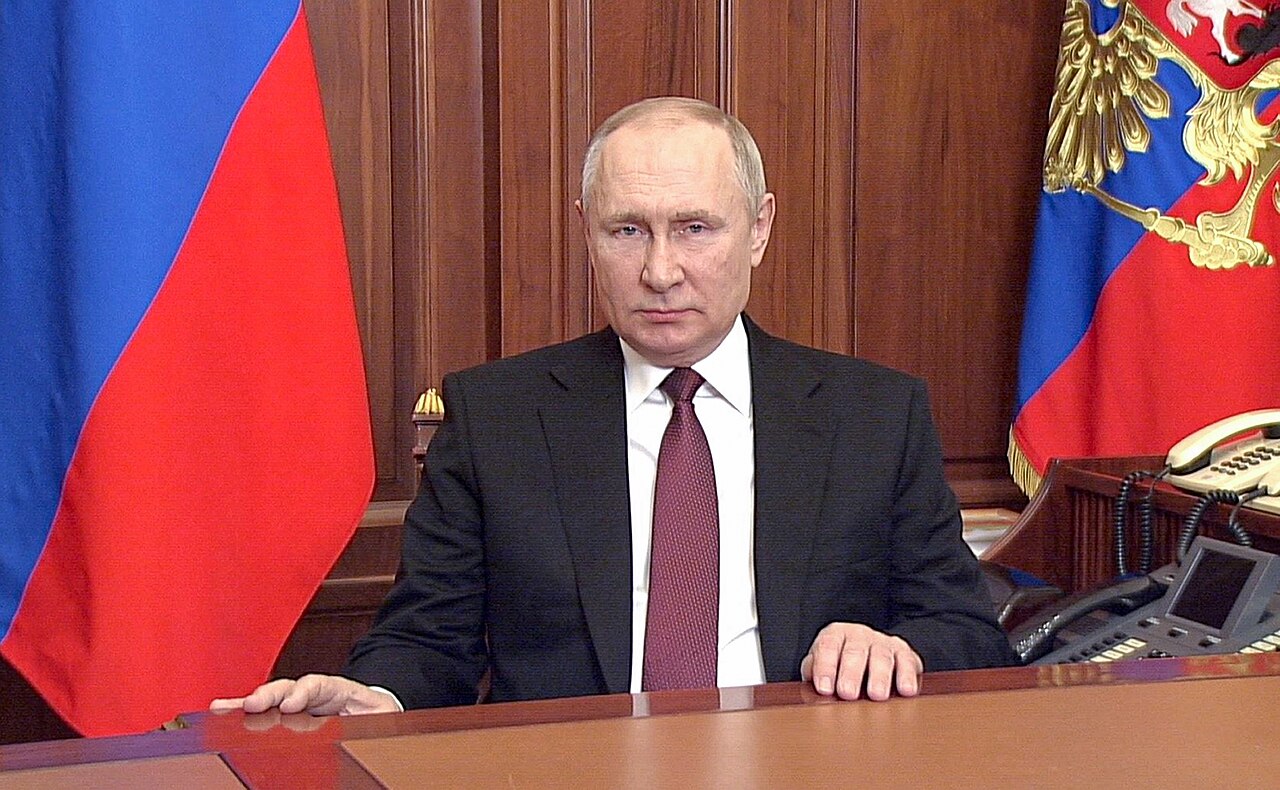
Address announcing a 'special military operation', Presidential Executive Office of Russia, 2022. CC BY 4.0.
In 1954-1962 the French state called a war "events" and "operations to maintain order". In 2022 Russia called its invasion of Ukraine a "special military operation" and made the word "war" legally risky in the media. The device is the same: an administrative label replaces the word for what is happening. The contexts differ. France was fighting inside territory it counted as three of its own départements, against an armed independence movement. Its press remained contested, and books and newspaper issues were seized by individual order rather than under a blanket law. Russia invaded a recognised neighbouring state and criminalised "discrediting" the army within days. France wrote the word "war" into law in 1999.
Positions on the record
- French state and army: Algeria was France; the FLN was a minority using terror against Muslims and Europeans alike. Psychological action and the SAS were presented as protecting and developing the population, and unveiling as emancipating women.
- FLN: the war was a national liberation struggle for a sovereign state, the FLN was the people's only legitimate voice, and those who served France or the MNA were traitors. Its press and radio set out to tell the world what French censorship held back.
- What is documented: the official vocabulary and the 1999 law; the 5e Bureau, CHPT and SAS; the organisation of the May 1958 unveilings; the seizure of La Question; the Bleuite and the purges; the Melouza killings, the FLN's attribution of them to the French army, and the later admission; the enforced boycotts; the French army's use of torture (Branche); the UN vote.
- What is not shown: exact death tolls on any side (all ranges above are contested); how many May 1958 participants attended willingly; how far the Bleuite, rather than internal rivalries, drove each purge. This page takes no position on whether French Algeria or independence was right.
Same-method test
The findings hold if the flags are swapped. A liberation movement that called its own massacre an enemy atrocity is scored the same as a state that did so. An army that bussed in "spontaneous" crowds is scored the same as a party that bussed in its own. The British "Emergency" in Malaya and Kenya used the same euphemism device and would get the same Euphemism / doublespeak tag. So would any insurgent press that reported only the other side's killings, which is Card stacking.
How to spot it
- Ask what a law or casualty count calls the conflict, and why the word changes over time.
- When a crowd is reported as "spontaneous", ask who transported and selected the participants, and who filmed them.
- When a massacre is attributed to the enemy within hours, check who had forces in the area, and look for later testimony.
- A document that "proves" treason inside your own ranks may have been written by the enemy. Check how it reached you.
- If a movement or state claims to be the only voice of a people, ask what happens to people who disagree.
Images
| Image | Source | Licence |
|---|---|---|
| Mechanism diagram (above) | Drawn for FRAME from the page's sourced facts (make_diagrams.py) |
CC BY 4.0, FRAME |
| El Moudjahid no. 1 (June 1956) | Wikimedia Commons, via memoria.dz | Public domain in Algeria (PD-Algeria). US status rests on Algeria's 1973 ordinance: a 25-year term for this collective, unsigned work expired before the U.S. restoration date of 19 April 1998, so the work was not restored |
| Address announcing a 'special military operation' (2022) | FRAME gallery | CC BY 4.0 (kremlin.ru) |

Image gaps
- French psychological-action leaflets, CHPT trucks, SAS posters and 1958 referendum posters. Photos of these are held by ECPAD / ImagesDéfense and the Archives nationales under French government copyright, not an open licence. Leaflets are mostly unsigned army works from 1955-1960 and are not public domain in the U.S. Not fillable unless an open-licensed copy appears.
- Photographs of the 16-18 May 1958 fraternisation and unveiling. These are press-agency or ECPAD photos, still in copyright. INA holds the newsreels. Not fillable from open sources found.
- The 1 November 1954 proclamation as a printed document. No open-licensed scan was found on Commons. The text is available at marxists.org. Possibly fillable from an Algerian public-domain scan.
- Later El Moudjahid issues (1957-1962) on Commons. These are tagged PD-Algeria, but they were printed in Tetouan and Tunis, so the source country for U.S. purposes is unclear. They are left out pending review.
Sources
- Benjamin Stora, La Gangrène et l'oubli. La mémoire de la guerre d'Algérie (Paris: La Découverte, 1991). Publisher page
- Alistair Horne, A Savage War of Peace: Algeria 1954-1962 (London: Macmillan, 1977; NYRB Classics reissue 2006): the tobacco and alcohol boycott enforcement, Melouza, the Bleuite and the Amirouche purges.
- Matthew Connelly, A Diplomatic Revolution: Algeria's Fight for Independence and the Origins of the Post-Cold War Era (Oxford University Press, 2002).
- Martin Evans, Algeria: France's Undeclared War (Oxford University Press, 2012), 457 pp.
- Neil MacMaster, Burning the Veil: The Algerian War and the 'Emancipation' of Muslim Women, 1954-62 (Manchester University Press, 2009; open-access edition 2020). OAPEN
- Denis Leroux, Une armée « révolutionnaire ». Contre-insurrection et subversion militaire pendant la guerre d'Algérie (La Découverte), from his thesis Une armée révolutionnaire : la guerre d'Algérie du 5e bureau (Paris 1, 2018). Publisher · theses.fr
- Peter Paret, French Revolutionary Warfare from Indochina to Algeria: The Analysis of a Political and Military Doctrine (New York: Praeger, 1964).
- Marie-Catherine and Paul Villatoux, "Aux origines de la « guerre révolutionnaire » : le colonel Lacheroy parle", Revue historique des armées 268 (2012): 45-53. OpenEdition
- Raphaëlle Branche, La torture et l'armée pendant la guerre d'Algérie, 1954-1962 (Paris: Gallimard, 2001).
- Gilbert Meynier, Histoire intérieure du FLN, 1954-1962 (Paris: Fayard, 2002): army figures for "fuyards abattus".
- Loi n° 99-882 du 18 octobre 1999, Légifrance · Chemins de mémoire: 18 octobre 1999
- Chemins de mémoire (French defence ministry): military aspects of the Algerian war, losses
- FLN, Proclamation of 1 November 1954 (English translation, Marxists Internet Archive)
- Cambridge University Library, "El Moudjahid" (2014) · Andrea L. Stanton, "The changing face of El Moudjahid during the Algerian War of Independence", Journal of North African Studies 16:1 (2011). DOI
- Frantz Fanon, "Ici la voix de l'Algérie", in L'An V de la révolution algérienne (Paris: Maspero, 1959); English A Dying Colonialism (1965).
- Atalayar, "The role of clandestine radio stations in Algeria's independence" (2020): Voice of Fighting Algeria from 16 December 1956.
- TIME, "Algeria: Walkout" (October 1955): the 28-27 UN vote.
- CDHA, "Les sections administratives spécialisées" · ImagesDéfense, Compagnie de haut-parleurs et de tracts
- INA Fresques, "Après le massacre de Melouza, mai 1957"
- "Complots et purges dans l'Armée de libération algérienne (1958-1961)", in Genèse de l'Algérie algérienne (Cairn): Amirouche's tally and the range of purge estimates.
- "Fratricidal War: The Conflict between the MNA and the FLN in France during the Algerian War (1954-1962)", British Journal of Middle Eastern Studies 39:2 (2012). DOI
- "Reprisal Violence and the Harkis in French Algeria, 1962", The International History Review 39:1 (2017). DOI
- Guy Pervillé, "La guerre d'Algérie : combien de morts ?" (2004)
- Henri Alleg, La Question (Paris: Éditions de Minuit, 1958); English The Question, preface by Jean-Paul Sartre (University of Nebraska Press, Bison Books, 2006). Publisher
- Commons: Copyright rules by territory/Algeria, for the licence reasoning on El Moudjahid.
- Jean-Luc Einaudi, La Bataille de Paris: 17 octobre 1961 (Seuil, 1991); Jean-Paul Brunet, Police contre FLN: le drame d'octobre 1961 (Flammarion, 1999); TIME, 18 October 2012: Hollande acknowledges the 1961 killings; France 24, 17 October 2012.