In one line: the landing of 17–19 April 1961 was, in Havana's account, a mercenary invasion organised by the United States and defeated in under seventy-two hours, declared on the eve to be the defence of a socialist revolution of the humble; in Washington's account that week it was Cuban patriots against a Cuban dictator, not an intervention by the United States armed forces, and then a failure for which the President said he was the responsible officer.
What happened
Havana: mercenaries, a socialist revolution, and the rally
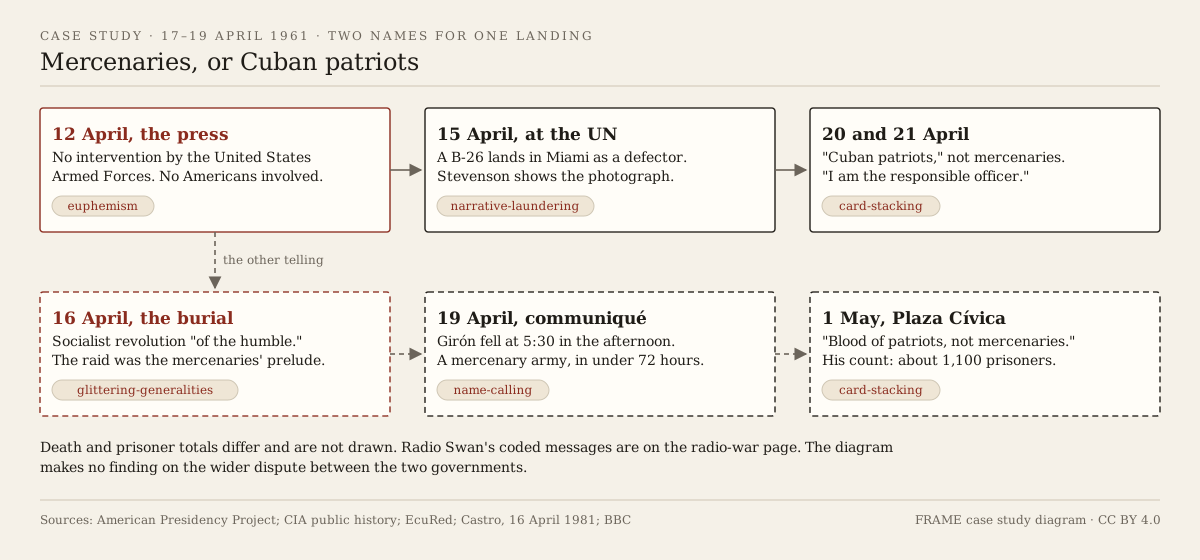
- 15 April 1961. Aircraft strike Cuban airfields. At the burial of the dead the next day, Castro, quoted by himself on the twentieth anniversary, put the toll of that raid at seven lives and called it "el preludio de la agresión de los mercenarios" ("the prelude to the mercenaries' aggression"). EcuRed, the Cuban state encyclopedia, says seven people were killed and 53 wounded.
- 16 April 1961. At that burial, before an armed crowd, Castro declared the socialist character of the revolution. In the 1981 speech he put the 1961 words in quotation marks: "esta es la revolución socialista y democrática de los humildes, con los humildes y para los humildes" ("this is the socialist and democratic revolution of the humble, with the humble and for the humble"), and "esa revolución no la defendemos con mercenarios, la defendemos con los hombres y las mujeres del pueblo" ("we do not defend that revolution with mercenaries; we defend it with the men and women of the people"). Granma, the Communist Party paper, gives the companion sentences as his exact words: a socialist revolution "right under the United States' very nose," defended "with these guns." Cuban official speeches place the declaration at the corner of 23rd and 12th. A retired State Department milestone page later places the open proclamation of socialism after the defeat. That is not the date on the 16 April speech.
- 17–19 April 1961. A force lands at the Bahía de Cochinos (Bay of Pigs), at Playa Girón and Playa Larga. Havana's name for it is an invasion of mercenaries armed, trained and transported by the United States. EcuRed calls the result the first great defeat of Yankee imperialism in Latin America. The same article gives three durations: 60 hours in the lead, 66 hours further down, and, in the communiqué it reproduces, under seventy-two. Communiqué No. 4, as EcuRed and the magazine Bohemia reproduce it, says forces of the Rebel Army and the militias took the last mercenary positions, that Playa Girón fell at 5:30 in the afternoon, and that the army the United States government had organised for many months was destroyed in under seventy-two hours.
- 1 May 1961, Plaza Cívica. The victory rally. Castro says the blood shed there "fue sangre de patriotas, no fue sangre de mercenarios" ("was the blood of patriots, not the blood of mercenaries"), against "el ideal del mercenario que vende su alma al oro del imperio" ("the ideal of the mercenary who sells his soul for the empire's gold"). He says about 1,100 mercenary prisoners are in custody, not counting ship crews, and of 1,000 of them about 800 came from well-off families holding, on his figures, 27,556 caballerías of land, 9,666 houses, 70 industries, 10 sugar mills, two banks and five mines, with 135 former soldiers of Batista's army and 65 "lumpen." That is his classification at the rally, not an independent census. On 16 April 1981 he also quoted what he had said in 1961: that Washington would have to confess that the planes, the bombs and the bullets were its own, and that the mercenaries were organised, trained and paid by it.
- The tolls Havana has published do not agree with each other. Communiqué No. 4, in EcuRed's text, says more than 150 revolutionary combatants died, and that several civilians were killed by the invaders' aircraft. José Ramón Fernández, a Cuban commander, in a book co-authored with Castro, put the Cuban loss at 176 dead, 300 wounded and 50 disabled (BBC). Bohemia in 2023 gives 176 Cuban dead and about 600 wounded, of whom 50 disabled for life. For the invaders, EcuRed's battle passage says 89 dead, 250 wounded and 1,197 prisoners; Bohemia says about 200 dead and about 1,200 prisoners. EcuRed adds that more than 1,200 prisoners were later handed to "their Yankee masters," who paid in medicines and food for Cuban children.
Washington: Cuban exiles, a defector story, and the failure
- 12 April 1961. Kennedy, at his news conference: "there will not be, under any conditions, an intervention in Cuba by the United States Armed Forces." The government would "make sure that there are no Americans involved in any actions inside Cuba." "The basic issue in Cuba is not one between the United States and Cuba. It is between the Cubans themselves."
- 15 April 1961. The CIA's public history says the cover for the strikes was that Brigade pilots would pose as pilots of Castro's air force who had attacked their own fields and defected. One such aircraft landed at Miami, and the pilot told that story. Ambassador Adlai Stevenson, whom the CIA's account says was unaware of the operation, told the UN Political and Security Committee that the strikes were the work of defectors and held up photographs. The account says the pictures undid the story: the Miami aircraft had a metal nose, and the Cuban air force's B-26s had plastic noses. Stevenson, on that account, was furious when the truth came out.
- 17–19 April 1961. The Office of the Historian states what the April speeches did not: Eisenhower had directed the CIA in March 1960 to plan the overthrow; the Agency trained and funded Cuban exiles as Brigade 2506; Kennedy consented; men of the brigade landed at the Bay of Pigs on 17 April and were defeated within two days by Cuban forces under Castro. The CIA's public history says it recruited 1,400 exiles. BBC reports the surrender at about 5:30 p.m. on 19 April.
- 18 April 1961. Kennedy's letter to Khrushchev: "the United States intends no military intervention in Cuba." Refugees, he wrote, had been using whatever means were available to return and support their countrymen. "While refraining from military intervention in Cuba, the people of the United States do not conceal their admiration for Cuban patriots who wish to see a democratic system in an independent Cuba."
- 20 April 1961. To the American Society of Newspaper Editors: "this was a struggle of Cuban patriots against a Cuban dictator," and "the armed forces of this country would not intervene in any way." He answers Havana's noun directly. "Mr. Castro has said that these were mercenaries." A press report of the last message from the beach, he says, had the commander answer a question about evacuation with "I will never leave this country." "That is not the reply of a mercenary."
- 21 April 1961. At his news conference he will not discuss the details. "There's an old saying that victory has 100 fathers and defeat is an orphan." Further statements "are not to conceal responsibility because I'm the responsible officer of the Government." He does not, in that answer, say that the CIA organised the landing.
- What the CIA's public history adds to the April wording. Pleas from the brigade for air and naval support "were refused at the highest US Government levels," but CIA contract pilots flew supply missions, and four of them were killed: Pete Ray, Leo Baker, Riley Shamburger and Wade Gray. That sits against the 12 April sentence that no Americans would be involved in actions inside Cuba. The same history says the later negotiation with Castro concerned 1,113 brigade members. BBC, citing the president of the Brigade 2506 veterans' association, Johnny López de la Cruz, gives 103 dead and about 100 wounded on the invading side, and says an exact count is hard because naval personnel died on ships that sank. BBC also reports that nine prisoners died in a sealed truck on the way to Havana, that about 1,100 were detained out of about 1,400, and that from 23 December 1962 the prisoners were released for $53 million in medicine and food. Those figures are not the same count as Havana's 89, about 200, 1,197 or "more than 1,200."
- Radio Swan, in one paragraph. The coded broadcasts are already documented on The Cuba-United States radio war: Radio Swan's cover story and Havana's 'gusanos'. During the operation that station, a CIA broadcaster on the air since May 1960, sent coded messages to people inside Cuba and, after the landing failed, urged fighters to continue. The rising the broadcasts were meant to help start did not happen. This page does not retell the station.
How it works
- Narrative laundering: the 15 April strikes were passed through a more legitimate-looking surface, a defecting Cuban pilot in an aircraft wearing Cuban air force markings, and then through the United States ambassador at the UN. A listener or a delegate was meant to see a mutiny inside Castro's air force, not a CIA strike. The CIA's own later account says that was the cover, and that Stevenson had not been told.
- Euphemism / doublespeak: "no intervention by the United States Armed Forces" and "intends no military intervention" name a narrower thing than the landing the CIA had organised. "Armed forces" can be read as uniformed services. The same 12 April answer also said there would be no Americans involved in any actions inside Cuba. The operational words, a CIA-recruited brigade and CIA contract pilots, are not in the sentence.
- Name-calling: "mercenarios," and Castro's line that mercenary and millionaire are the same thing, ask the audience to reject the men before any individual case. Kennedy's 20 April speech answers with one reported sentence from the beach, offered as proof the word cannot fit. The check the label skips is two facts that sit together in the record: the brigade was Cuban, and, on the CIA's public history, the CIA recruited, trained and equipped it. "Hired foreign soldier" does not say the first. "A quarrel only among Cubans" does not say the second.
- Glittering generalities: "Cuban patriots," "the spirit of liberty," and "of the humble, by the humble and for the humble" are virtue formulas. Each asks for assent. Neither says who holds command, who is paid, or who may dissent.
- Card stacking: the 1 May inventory stacks land, houses, sugar mills and former Batista soldiers as the face of the prisoners, and does not present the brigade as the mixed exile force the veterans' association describes. Washington's April speeches stack "patriots" and "no intervention" and leave out the CIA direction that the Office of the Historian later states in one paragraph. The death tolls are a second stack: more than 150, or 176, on the Cuban side; 89, 103, or about 200 on the invading side; about 1,100, 1,113, 1,197, or more than 1,200 prisoners. Each can be a count of a different set. Publishing one as the toll is the device.
Then and now
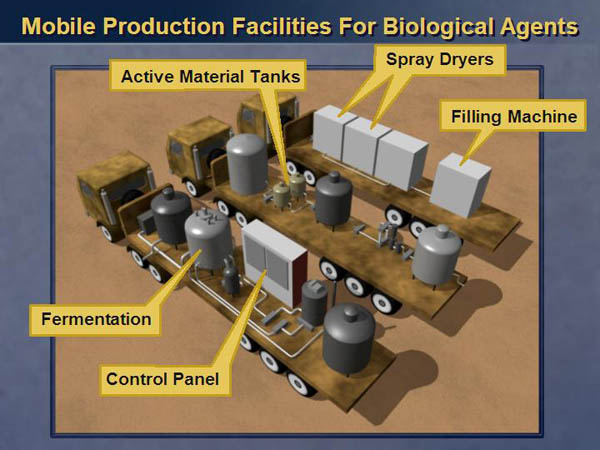
Mobile Production Facilities for Biological Agents (UN Security Council slide), U.S. Department of State, remarks to the UN Security Council, 5 February 2003. Public domain.
Stevenson on 15 April 1961 held up a photograph of an aircraft and told the UN committee it showed a defecting Cuban pilot. On the CIA's later account the aircraft was part of a prepared cover, and he had not been told. On 5 February 2003 Secretary of State Colin Powell showed the Security Council a diagram of truck-mounted biological-weapons plants as established fact. No such labs were found. The Senate Select Committee on Intelligence and the Robb-Silberman commission found that the claim rested largely on one source, and that warnings about him did not reach Powell. The device that matches is a picture at the UN doing work the picture cannot do, offered by an official who did not have the contradiction in front of him. The acts are not the same. One was a cover story for strikes then underway. The other was an intelligence assessment presented without its doubts. The wars are not the same scale, and this page does not equate them.
Positions on the record
- Havana, on the landing: a mercenary invasion organised, trained and paid by the United States, defeated by militia and the Rebel Army in under seventy-two hours, and the first great defeat of Yankee imperialism in Latin America. The 1 May rally is presented as the people celebrating that victory.
- Havana, on 16 April: the revolution's socialist character was proclaimed at the burial of the air-raid dead, the day before the landing, and the men who fought the next day fought for that.
- Washington, in the April speeches: Cuban patriots against a Cuban dictator; the armed forces would not intervene; Castro's "mercenaries" rejected; the President the responsible officer, without a public account in those speeches of the CIA's role.
- Washington, in later official history: the CIA trained and funded Brigade 2506, Kennedy approved the landing, the brigade was defeated, and four CIA contract pilots were killed. The cover story for the 15 April strikes is described in the CIA's own public history.
- What is documented: the 12, 18, 20 and 21 April wording; the 16 April declaration as Castro later quoted it and as Granma renders it; Communiqué No. 4 as EcuRed and Bohemia reproduce it; the 1 May rally speech; the CIA account of the defector story and of Stevenson; the casualty and prisoner figures above, which do not match.
- What is not shown here: which death toll is the right one, or a full order of battle. This page takes no position on the wider dispute between the two governments. The Radio Swan messages are on The Cuba-United States radio war: Radio Swan's cover story and Havana's 'gusanos', not here.
Same-method test
A government that calls a force it recruited and directed "patriots" acting on their own, or that has its ambassador show a disguised aircraft as a defection, would be scored as euphemism and narrative laundering here, whichever government it was. A government that calls the opposing soldiers "mercenaries" so the label does the work of a case would be scored as name-calling, including when the soldiers are foreigners hired for pay and the word is simply true: the test is whether the word replaces the check, not which flag is on the truck. A communiqué or a press conference that gives one casualty total and leaves the rival total out would be scored as card-stacking.
How to spot it
- When the public name of a force is "exiles," "patriots" or "mercenaries," ask who recruited, trained and directed it, and whether the people in it were nationals of the country they landed in. Both questions can be answered "yes" at once.
- When an ambassador holds up a photograph of markings, ask whether those markings were the aircraft's own, and whether the speaker was in a position to know.
- When two official death tolls do not match, print both and say what each count claims to include. A single round number is not the toll until the other number is accounted for.
Images
| Image | Source | Licence |
|---|---|---|
| Mechanism diagram (above) | Drawn for FRAME from the sources below | CC BY 4.0, FRAME |
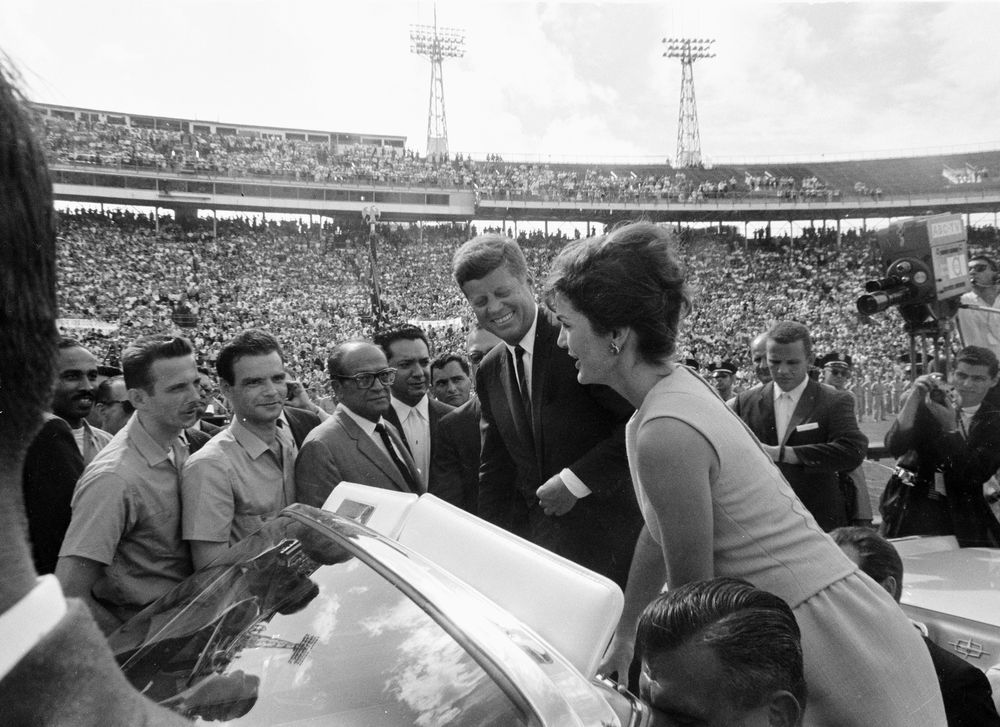
| Kennedy greets Brigade 2506, Orange Bowl, 29 December 1962 | Cecil Stoughton, White House; John F. Kennedy Presidential Library, via Wikimedia Commons | Public domain (U.S. government work) |
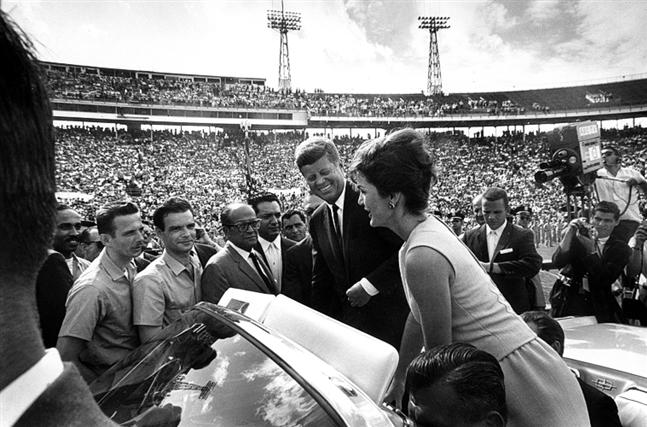
| Kennedy with brigade leaders, same day | Cecil Stoughton, White House, via Wikimedia Commons | Public domain (U.S. government work) |
| Mobile-labs slide, UN Security Council (2003) | FRAME gallery, from Wikimedia Commons | Public domain (U.S. government work) |
Image gaps
- The 16 April 1961 burial at 23rd and 12th, and the 1 May rally in the Plaza Cívica. No openly licensed photograph was used.
- The Miami B-26, and Stevenson's photograph of it at the UN. Not used. A public-domain print was not established for this page.
- Castro with the forces at Playa Girón, including the widely reproduced tank photographs. Cuban state pictures of the battle have no public-domain tag confirmed here.
- Brigade 2506 prisoners, or the brigade flag. Not used. The licences on the copies found were not clear enough to host.
Sources
- John F. Kennedy, news conference, 12 April 1961, HistoryCentral transcript of the Public Papers.
- John F. Kennedy, message to Chairman Khrushchev, 18 April 1961, American Presidency Project.
- John F. Kennedy, address to the American Society of Newspaper Editors, 20 April 1961, American Presidency Project.
- John F. Kennedy, news conference, 21 April 1961, American Presidency Project.
- Office of the Historian, "The Bay of Pigs Invasion and its Aftermath". The milestone series is retired and no longer maintained.
- CIA, "The Bay of Pigs Invasion" (public history, 18 April 2016).
- Fidel Castro, speech of 16 April 1981 quoting the 16 April 1961 declaration, official transcript.
- Fidel Castro, speech of 16 April 2001, placing the declaration at 12 y 23, official transcript.
- Fidel Castro, speech at the Plaza Cívica, 1 May 1961.
- "Socialism: Never again a foreign word", Granma, 16 April 2020, giving an English text of the 16 April 1961 lines.
- "Invasión por Playa Girón", EcuRed, presented as the Cuban state's framing, including its text of Communiqué No. 4.
- "Girón, triunfo de un team de acero", Bohemia, 2023.
- "How the Bay of Pigs invasion began - and failed - 60 years on", BBC, 23 April 2021, and the Spanish account, "Cómo se gestó y fracasó la invasión de Bahía de Cochinos", BBC News Mundo, for the Fernández figures, the veterans' association figures, the nine deaths in the truck, and the $53 million release.
- Radio Swan's coded messages: The Cuba-United States radio war: Radio Swan's cover story and Havana's 'gusanos' on this site. Not re-documented here.