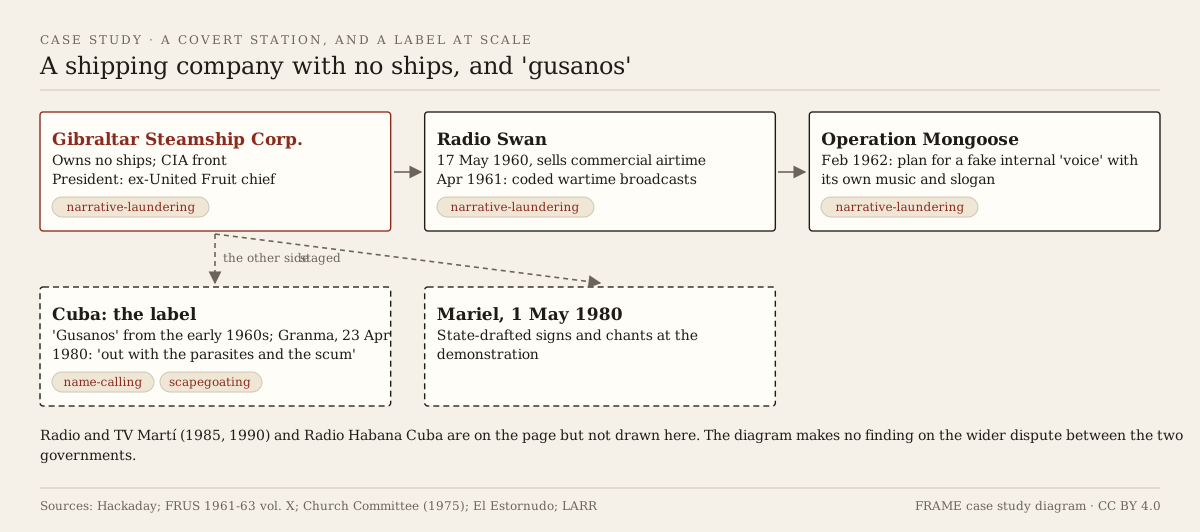
In one line: in May 1960 a station calling itself Radio Swan went on air from a Caribbean island, nominally owned by a shipping company that owned no ships, actually a CIA operation that broadcast coded messages ahead of the Bay of Pigs invasion; on the other side, Cuban state media built a decades-long identity, "Patria o Muerte", around casting emigrants and dissenters as "gusanos" ("worms") and, at Mariel in 1980, as "escoria" ("scum") to be driven out in organized street demonstrations.
What happened
The United States: Radio Swan and the covert stations
- 17 May 1960. Radio Swan goes on air from Great Swan Island, about 350 miles from Cuba, broadcasting entirely in Spanish with US Navy logistical support. It is owned on paper by the Gibraltar Steamship Corporation, a company that owns no ships, whose president is Thomas Dudley Cabot, a former president of the United Fruit Company. It is in fact a CIA operation, run by CIA propaganda officer David Atlee Phillips, who had earlier run clandestine broadcasting in Guatemala in 1954. It presents itself as a commercial station, selling advertising time, including to Cuban exile groups.
- Autumn 1960. Castro denounces Radio Swan by name in a speech to the UN General Assembly. Honduras disputes sovereignty over Swan Island; the US recognises Honduran sovereignty in 1971.
- March to April 1961. Ahead of the planned invasion, the station stops selling political airtime and switches to round-the-clock news on up to 14 frequencies. During the 15 to 19 April 1961 Bay of Pigs operation it broadcasts coded messages to agents inside Cuba, such as "Look well at the rainbow. The fish will rise very soon", and urges fighters to continue after the landing fails. The internal uprising the broadcasts were meant to trigger does not occur.
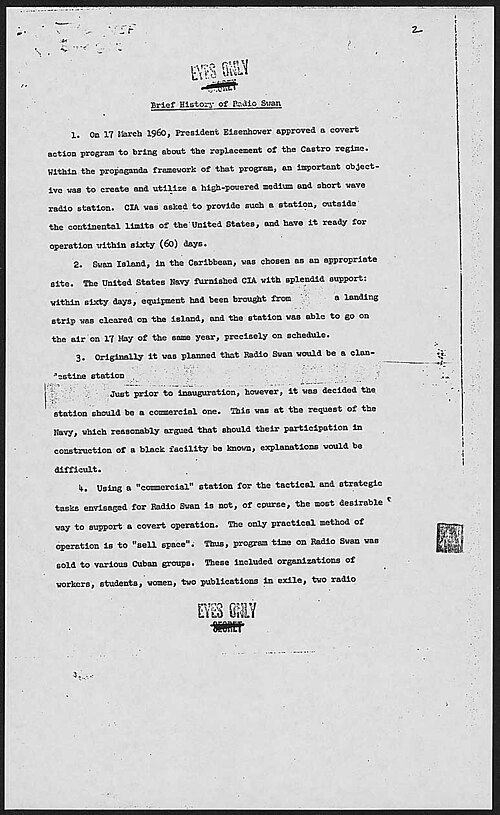
"Brief History of Radio Swan", annex to a 1961 memorandum, one page of the scan. Its paragraphs say the station was first planned as clandestine, was made "commercial" at the Navy's request, and "sold space" to various Cuban groups. Office of the Special Assistant to the President, John F. Kennedy Presidential Library, via DPLA and Commons; public domain (U.S. federal government record).
- November 1961 to late 1962. President Kennedy authorises Operation Mongoose to "use our available assets to help Cuba overthrow the Communist regime", under Brig. Gen. Edward Lansdale. Lansdale's "Cuba Project" memo of 20 February 1962 includes, among political, economic, military and sabotage measures, a psychological plan for a fabricated internal opposition "voice", ideally from a mobile transmitter inside Cuba, complete with its own music and slogan, taking credit for sabotage and naming "criminals against the people".
- 20 November 1975. The Senate's Church Committee reports "concrete evidence of at least eight plots" against Castro's life between 1960 and 1965, and describes Lansdale's proposed "dirty tricks", including a Joint Staff plan (2 February 1962) to fabricate evidence of Cuban interference with John Glenn's Mercury spaceflight so Cuba could be blamed if it failed.
- 20 May 1985. Radio Martí, authorised by the Radio Broadcasting to Cuba Act of 1983, begins broadcasting on Cuba's independence day. Havana responds by suspending the 1984 US-Cuba migration agreement.
- 27 March 1990. TV Martí begins test broadcasts from a transmitter tethered to a balloon, nicknamed "Fat Albert", 10,000 feet over Cudjoe Key, Florida. Cuba begins jamming the signal about 23 minutes after the first test starts; a Voice of America spokesman calls the signal "indecipherable in Havana". Critics cite jamming, pre-dawn scheduling and entertainment-heavy content for low measured viewership inside Cuba.
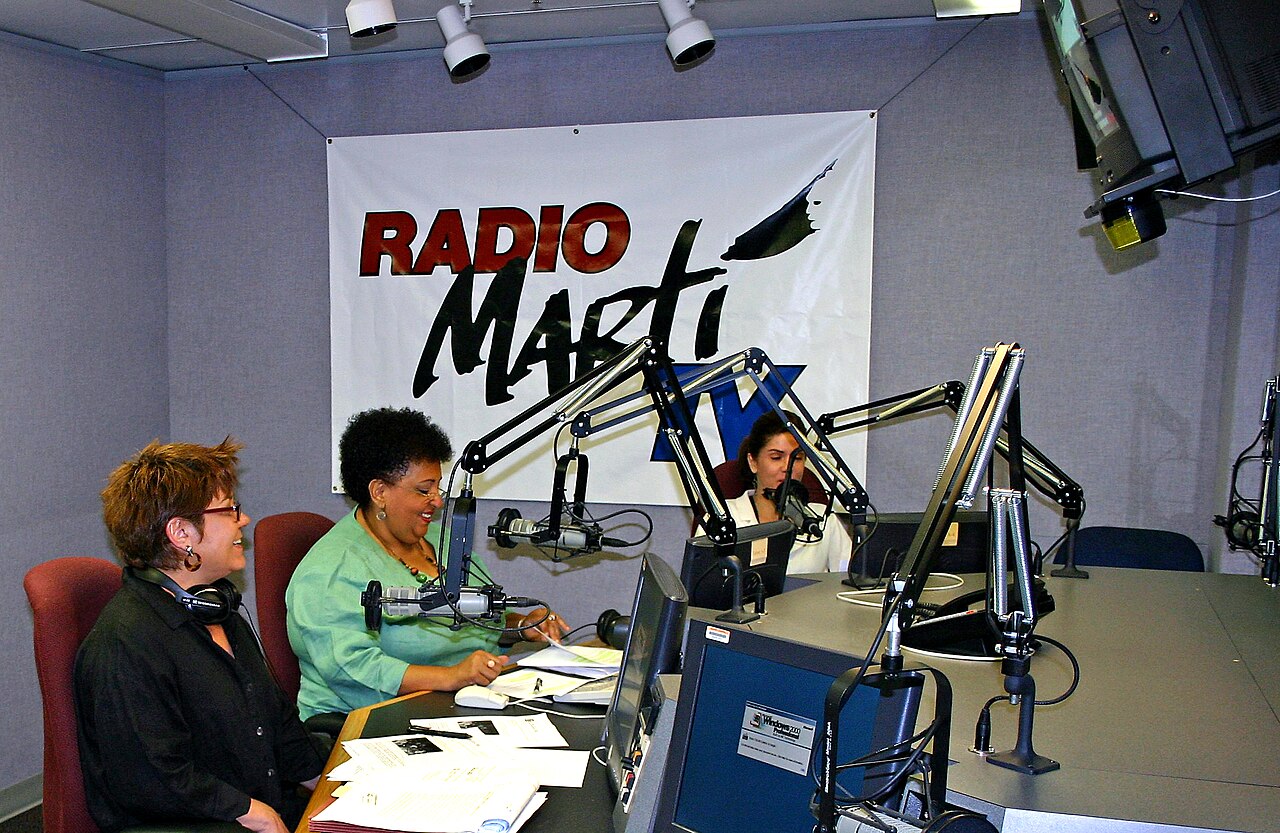
Presenters in a Radio Martí broadcast studio, undated (c. 2008). Broadcasting Board of Governors, U.S. government; public domain (PD-USGov-BBG).
Cuba: state media and the label "gusanos"
- 28 September 1960. At a rally outside the former Presidential Palace, on his return from the UN, Castro announces the Committees for the Defense of the Revolution: "We are going to establish a system of collective revolutionary vigilance." The CDR becomes a neighbourhood-level structure, described in official accounts as defence against foreign aggression and, by outside researchers, as a mechanism of surveillance.
- 30 June 1961. In his closing speech to a series of meetings with writers and artists at the National Library, Castro says: "Dentro de la Revolución, todo; contra la Revolución, nada" ("Within the Revolution, everything; against the Revolution, nothing"), a line later read as the founding limit on artistic freedom under the government, and defended by state commentary as commonly taken out of context.
- Early 1960s. "Gusanos" ("worms") becomes a standing label in state media and official speeches for emigrants and domestic opponents, used at organised public demonstrations against people preparing to leave the country.
- 1 May 1961. Radio Habana Cuba is officially inaugurated, broadcasting the victory rally after the defeated Bay of Pigs invasion, and is presented officially as a truthful alternative to the Voice of America.
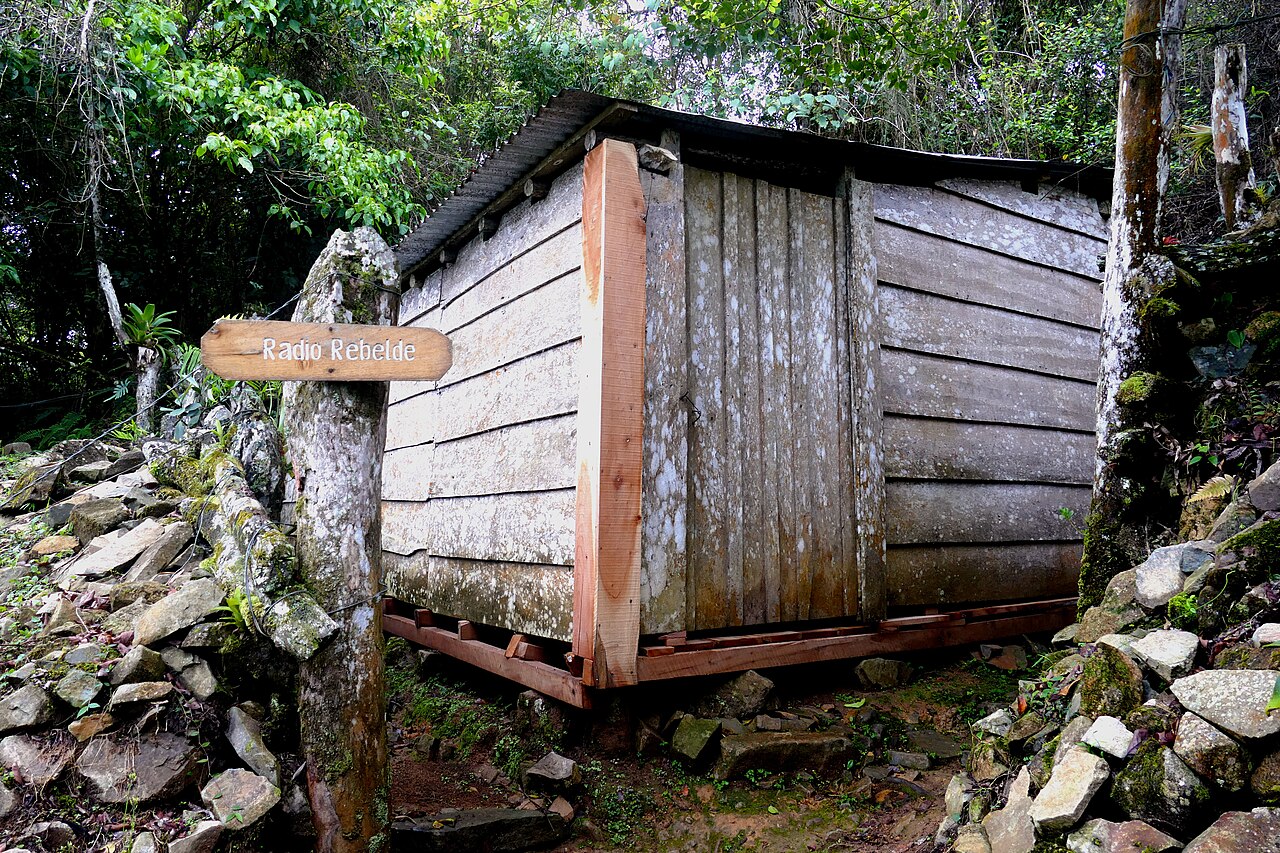
Wooden hut and sign marked "Radio Rebelde" in the Sierra Maestra, Cuba. Radio Rebelde was the rebel forces' station from 1958, before the 1959 government took power; the photograph does not say whether the hut is original or a later marker. Photograph by Maxence, undated, Wikimedia Commons, CC BY 2.5.
- 5 March 1960. At a funeral for victims of the La Coubre munitions-ship explosion in Havana harbour, which Castro blames on US sabotage, he says: "…nuestro dilema será: ¡Patria o Muerte!" ("…our dilemma will be: Homeland or Death!"). "¡Venceremos!" ("We shall win!") is added the following July.
- April to May 1980, the Mariel boatlift. After thousands of Cubans seek asylum at the Peruvian embassy, the government organises demonstrations against those seeking to leave. Granma's 23 April 1980 edition prints slogans for a 1 May march, including "¡Que se vayan los parásitos y la escoria!" ("Out with the parasites and the scum!") and "¡Gusanos, si sacan los pies se los cortamos!" ("Worms, if you stick your feet out we'll cut them off!"). At the 1 May rally in the Plaza de la Revolución, Castro calls those seeking to leave "lumpen" and "escoria" while the crowd chants "¡Abajo la escoria!" ("Down with the scum!"). Research by the journalist Abel Sierra Madero documents that state bodies designed the signage, sound systems and press coverage of these acts of repudiation.
- Throughout. Official Cuban media describe US broadcasts as "guerra radioelectrónica" ("radio-electronic war") and "transmisiones ilegales" ("illegal transmissions") that violate international broadcasting rules, and Cuba has raised the issue at the UN Committee on Information.
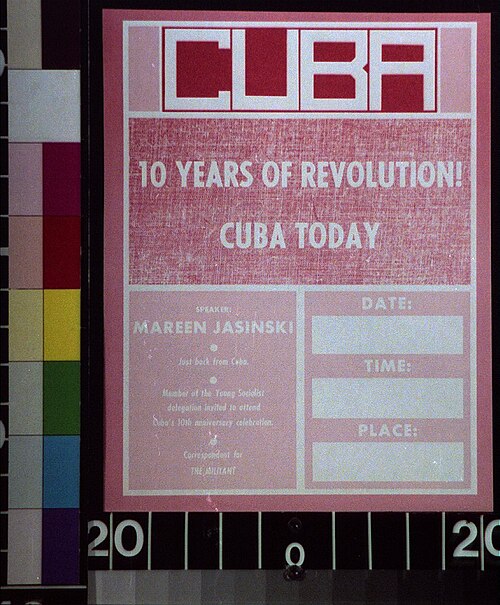
Handbill template, "Cuba: 10 Years of Revolution! Cuba Today", United States, 1969: a talk by a speaker described as just back from Cuba, a member of the Young Socialist delegation invited to the 10th anniversary celebration and a correspondent for The Militant; date, time and place left blank. Publisher not named; Yanker Poster Collection, Library of Congress, via Commons; public domain (no copyright notice).
How it works
- Narrative laundering: a CIA station was built to look like a commercial Spanish-language broadcaster owned by a shipping firm, selling airtime like any other station, so that a listener would not know a government, let alone a foreign one, stood behind it. Operation Mongoose's plan for a fake internal "voice" was the same device aimed one step further inward: not a station pretending to be commercial, but a station pretending to be a spontaneous domestic resistance.
- Name-calling: "gusanos" and "escoria" marked emigrants and dissenters with a single dehumanising word, applied before any individual case was made, and carried by the state's own newspaper as a printed slogan for a demonstration it organised.
- Scapegoating: at Mariel, a large and disparate group of people, seeking to leave the country for many different reasons, was compressed into one bounded category, "parasites and scum", that a state-choreographed crowd was then directed against.
Then and now
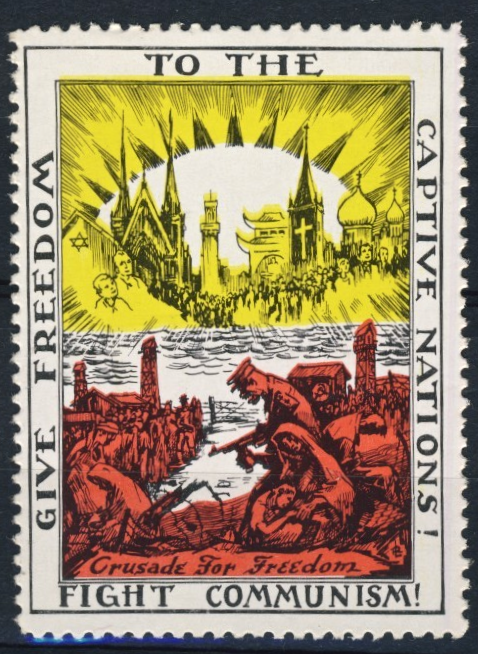
Give Freedom to the Captive Nations! Fight Communism!, Crusade for Freedom / National Committee for a Free Europe, 1951. Public domain.
Radio Swan's front, a shipping company that owned no ships, selling commercial airtime to hide a CIA station, is the same device as the Crusade for Freedom's donor stamps, which cast a mainly CIA-funded broadcaster as citizen-funded charity. Both hid a state's hand behind the appearance of private enterprise or private giving. The stations differed sharply in what they were for: Radio Swan supported a covert invasion, while Radio Free Europe broadcast news into the Soviet bloc over decades.
Positions on the record
- Havana, on its own media: presents "Patria o Muerte", the CDR and Radio Habana Cuba as legitimate defence of national sovereignty against a hostile foreign power, and Mariel's demonstrations as popular anger at those choosing to leave.
- Havana, on US broadcasts: calls them illegal aggression under international broadcasting rules, directed by the CIA and aimed at subverting the constitutional order.
- Washington, on Radio Swan at the time: presented it publicly as a private commercial station; its CIA ownership was not officially acknowledged until later.
- Washington, on the Martí stations: presents them as a free press service reaching a closed society, without the covert ownership of Radio Swan.
- What is documented: Radio Swan's ownership structure and operators, its wartime broadcasts, the Lansdale memo's psychological-warfare plans, the Church Committee's findings, the Radio and TV Martí launch dates and jamming, the CDR's founding speech, "gusanos" as a standing label, and the Mariel slogans and rally.
- What is not shown here: full CIA authorship of the Operation Peter Pan "patria potestad" rumour, which remains disputed between Cuban government accounts, which treat it as a CIA operation, and the account of the Catholic Welfare Bureau organisers, who describe a humanitarian response to a fear already in circulation. Independent evaluations of Radio and TV Martí's journalistic standards by the GAO or the State Department's Inspector General were not reviewed for this page. This page takes no position on the broader political dispute between the two governments.
Same-method test
A government-funded station of any country that hides its funding behind a private commercial front, or plans a broadcast impersonating a spontaneous domestic movement, would be scored as narrative laundering here. A state that labels people seeking to leave "parasites" or "vermin" in its own press, and organises crowds against them, would be scored as name-calling and scapegoating whichever government did it.
How to spot it
- Check who owns a station licensed to sell advertising in a language and to an audience with no obvious commercial market for it.
- Ask whether an "internal opposition voice" you are hearing has any verifiable presence inside the country it claims to speak from.
- When a state newspaper prints the chants for a demonstration in advance, the demonstration is choreography, not spontaneous public opinion, whatever the demonstrators' own feelings.
Images
| Image | Source | Licence |
|---|---|---|
| Mechanism diagram (above) | Drawn for FRAME from the sources below (make_diagrams_regions.py) |
CC BY 4.0, FRAME |
| Radio Swan history memo (1961) | Wikimedia Commons (JFK Presidential Library record) | Public domain (U.S. federal government record) |
| Radio Martí studio (2008) | Wikimedia Commons | Public domain (U.S. Broadcasting Board of Governors) |
| "Ten Years of Revolution" handbill (1969) | Wikimedia Commons | Public domain (no copyright notice) |
| Radio Rebelde, Sierra Maestra | Wikimedia Commons | CC BY 2.5 |
| Give Freedom to the Captive Nations! (1951) | FRAME gallery | Public domain |
Image gaps
- Bay of Pigs psychological-warfare leaflets. No openly licensed copies were found.
- A photograph of the Radio Swan transmitter site on Swan Island. Not found; only a later, unrelated amateur-radio card exists on Commons.
- The TV Martí aerostat over Cudjoe Key. No openly licensed photograph was found.
- Castro-era Cuban state billboards ("Patria o Muerte", CDR). Recent Commons photographs of these are under CC BY-SA for the photograph only; the billboard artwork itself has no public-domain tag and Cuba's freedom-of-panorama status is unclear, so these were not used.
Sources
- "Swans, Pigs, and the CIA: An Unlikely Radio Story", Hackaday.
- Foreign Relations of the United States, 1961-1963, vol. X (Cuba), doc. 399, Lansdale's "The Cuba Project".
- "Military Had Plan to Blame Cuba If Glenn's Space Mission Failed", Washington Post, 1997.
- Church Committee, interim report on alleged assassination plots involving foreign leaders (20 November 1975).
- "TV Marti Gets Poor Reception in Cuba", Tampa Bay Times, 1990.
- Congressional Research Service, Radio and Television Broadcasting to Cuba: Background and Issues Through 1994.
- Fidel Castro, Palabras a los intelectuales (30 June 1961), official text.
- Abel Sierra Madero, "Pequeña historia natural de los actos de repudio en Cuba", El Estornudo.
- "We Are Happy Here: Creating Communist Cuba and the Mariel Crisis of 1980", Latin American Research Review.
- María de los Ángeles Torres, The Lost Apple: Operation Pedro Pan, Cuban Children in the U.S., and the Promise of a Better Future (Beacon Press, 2003).
- "Guerra radioelectrónica contra Cuba", EcuRed (Cuban state-affiliated encyclopedia), presented as the Cuban government's own framing.