Content note. One poster shown here, the Empire Marketing Board's Jungles To-day Are Gold Mines To-morrow, draws two African figures as racial stereotypes (feathered headdress, spear and shield) standing either side of a trade table. The page also records riots in Bombay in 1921 in which people were attacked for their dress or their loyalty, and deaths at Chauri Chaura in 1922.
In one line: in the same decade, the British government told shoppers that buying Empire butter was a duty to the Empire, and the Indian national movement told buyers that wearing foreign cloth was a betrayal of India; both turned a shopping choice into a test of loyalty to a political community.
What happened
- 7 August 1905. A meeting at Calcutta Town Hall adopts a boycott of British goods in protest at Lord Curzon's partition of Bengal, which takes effect on 16 October 1905. In the swadeshi ("own country") campaign that follows, historian Sumit Sarkar records public burnings of foreign cloth, pickets of shops, and social boycott: priests refusing to officiate at marriages involving foreign goods, washermen refusing to wash foreign clothes, barbers refusing service.
- 1923-1926. Stanley Baldwin's Conservatives fight the December 1923 election on tariffs and lose. Back in office in 1924 on a pledge not to bring in general protection, they set up the Empire Marketing Board in May 1926 under Leo Amery. Its grant, nominally £1 million a year, was roughly the value of the imperial preferences that had been dropped. Publicity replaced tariffs.
- 1926-1933. The EMB, with Stephen Tallents as secretary, commissions posters from artists including E. McKnight Kauffer, MacDonald Gill and Clive Gardiner. At its peak it rents about 1,800 hoardings across Britain for its poster frames. It backs Empire Shopping Weeks run by local traders and councils, and issues an "Empire Christmas Pudding" recipe listing where each ingredient in the Empire came from. John Grierson joins in 1927; his film Drifters, about the North Sea herring fleet, premieres in November 1929.
- 31 July 1921. During Non-Cooperation (1920-22), Gandhi lights a bonfire of foreign clothes at the Elphinstone Mill compound in Bombay. The Bombay Chronicle notice of 30 July asks everyone to come "in Swadeshi Clothes of Khadi" and those "who have not given away their Foreign Clothes" to bring them. India's Ministry of Culture archive puts the pile at about 150,000 pieces and the crowd at 10,000-12,000. Bonfires follow across India.
- 22 September 1921. At Madurai, Gandhi takes up the short dhoti, saying he wants to dress like India's poorest.
- October 1921. Rabindranath Tagore, in "The Call of Truth", objects that the burned cloth could have clothed the poor, and that the call works on obedience rather than reason. Gandhi answers in Young India ("The Great Sentinel") that burning was the right treatment for cloth that stood for India's economic subjection.
- 17-20 November 1921. When the Prince of Wales lands in Bombay, a Congress hartal (general strike) and cloth bonfires turn into riots. Non-Cooperation and Khilafat supporters attack Parsis, Anglo-Indians and others who are seen as loyal to the visit, some for wearing foreign clothes. Counts of the dead range from about 53 to at least 58. Gandhi fasts until the violence stops, and writes that the swaraj (self-rule) he had seen in those days disgusted him (paraphrased).
- 4-12 February 1922. At Chauri Chaura a crowd burns a police station, killing 22 or 23 policemen (sources differ). Gandhi suspends Non-Cooperation.
- 1930-1931. In Civil Disobedience, Congress volunteers picket cloth shops, many of them women in khadi saris. Merchants' foreign-cloth stocks are "sealed" under Congress pledges, and in Bombay carters are said to need a Congress permit to move bales past the pickets. Summaries of the campaign say cotton piece-goods imports fell by autumn 1930 to between a third and a quarter of the year before. The figure comes from secondary summaries and has not been checked here against trade returns.
- 1932-1933. The Ottawa Imperial Economic Conference (1932) brings in the tariff preferences the EMB had stood in for. The Board is wound up in 1933, and its film unit moves to the General Post Office. Tallents sets out his case for state publicity in The Projection of England (1932).
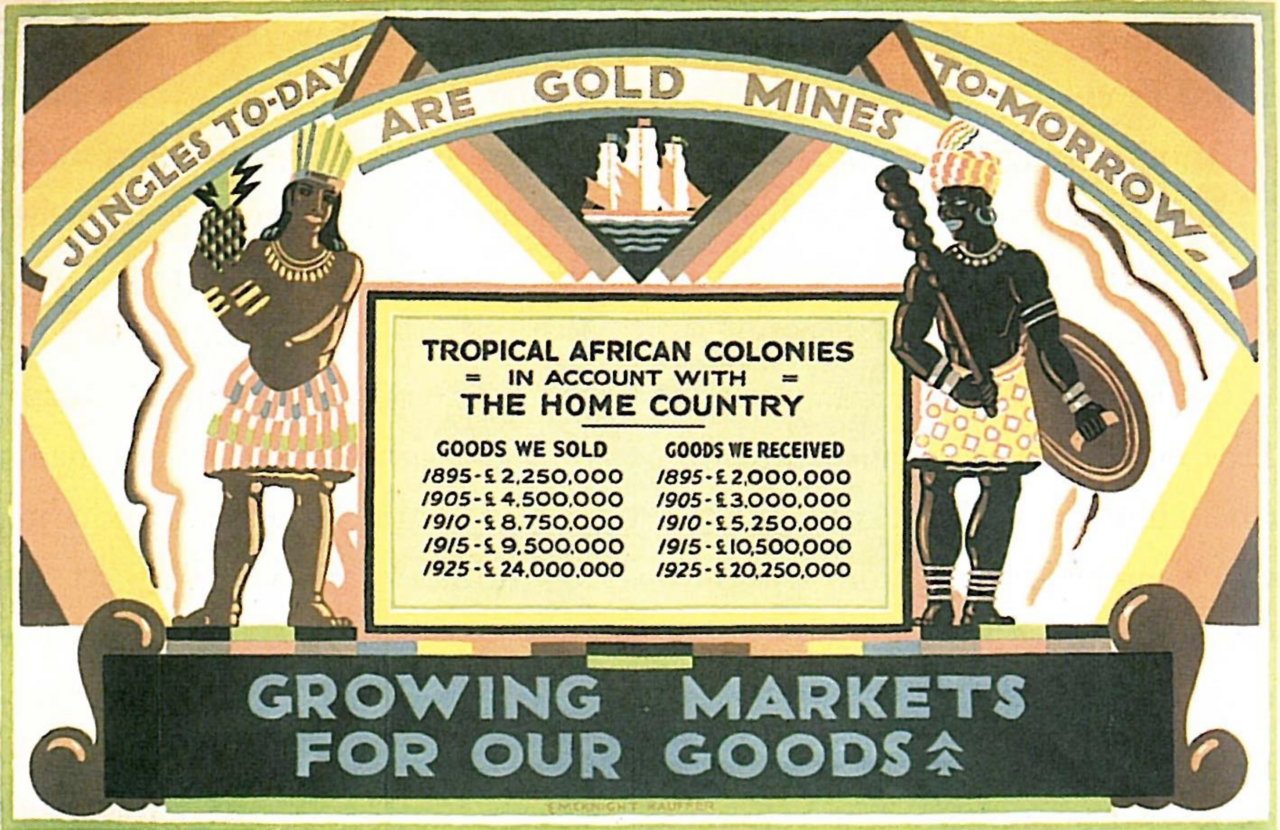
"Jungles Today, Gold Mines Tomorrow" (Empire Marketing Board, 1926), E. McKnight Kauffer, Empire Marketing Board, c. 1926-27. Two stock "native" figures stand on either side of a ledger headed "Tropical African colonies in account with the home country". Public domain.
How it works
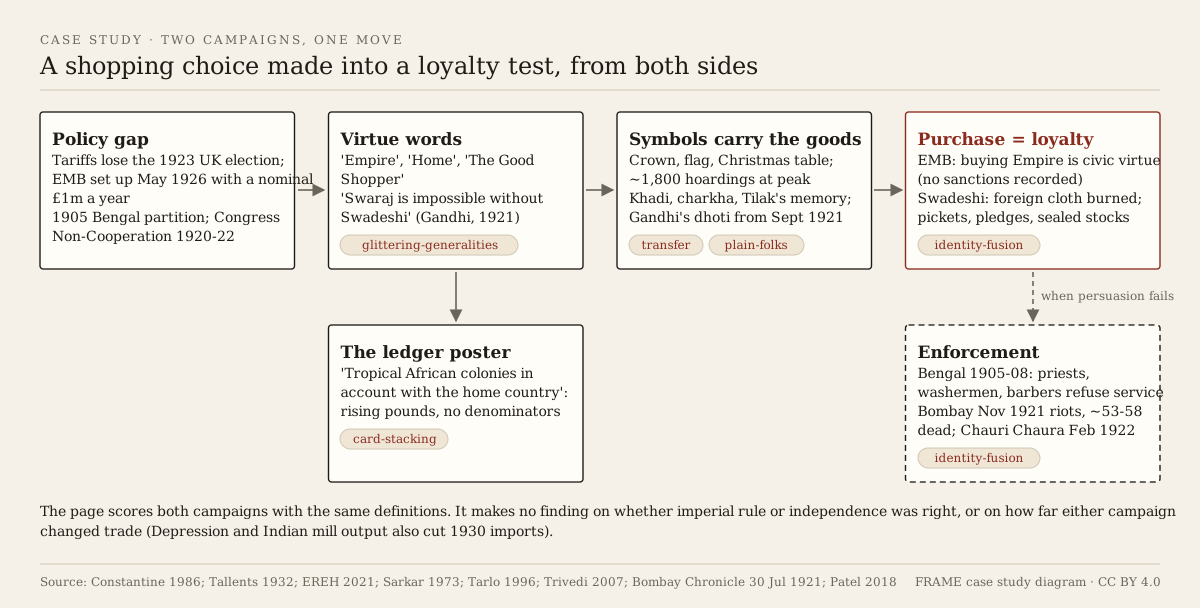
- Glittering generalities: "Empire", "Home", "the Good Shopper" on one side; "Swaraj" and "Swadeshi" on the other. At the 1921 bonfire Gandhi said Swaraj was "impossible without Swadeshi". Neither side's slogans gave figures for what a given purchase would change, for whom, or by how much.
- Transfer: the EMB set Dominion butter and colonial fruit against the Crown, the Union Jack, the family Christmas table and heroic images of labour. The Congress campaign attached the national cause to khadi and the charkha (spinning wheel), and dedicated the Bombay bonfire to the memory of Bal Gangadhar Tilak. In both cases, the feeling for the symbol was carried over to a commodity.
- Identity fusion: in swadeshi and Congress practice, buying or wearing foreign cloth was treated as a betrayal of the nation, not as a price comparison. It was enforced by pickets, pledges, sealed stocks and, in Bengal in 1905-08, by withdrawn services from priests, washermen and barbers. The EMB also cast Empire buying as a civic virtue ("The Good Shopper"), but there is no record of it penalising people who did not comply. This technique fits the swadeshi campaign more strongly.
- Card stacking: Kauffer's poster presents colonial trade as a ledger of rising pounds (sales from £2.25 million in 1895 to £24 million in 1925). It gives no prices, no population and no share of the returns for the colonial producers it draws. In Constantine's and Kothari's reading, the EMB's films and posters showed colonial production as orderly, willing work. This page does not find a matching use of selected figures in the Congress cloth campaign, so the tag applies to the EMB side only.
- Plain folks: from September 1921, Gandhi dressed in the homespun of India's poorest and spun in public, including at mass meetings. Emma Tarlo and Lisa Trivedi both read this as deliberate political dress. It was also a practice he kept up for the rest of his life, which is why this archive treats it as a borderline case of the technique rather than a costume.
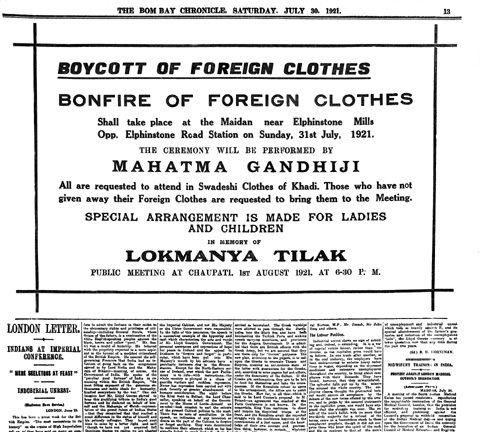
The Bombay Chronicle reports a foreign-cloth bonfire (1921): "Boycott of Foreign Clothes. Bonfire of Foreign Clothes ... All are requested to attend in Swadeshi Clothes of Khadi." Public domain.
Then and now
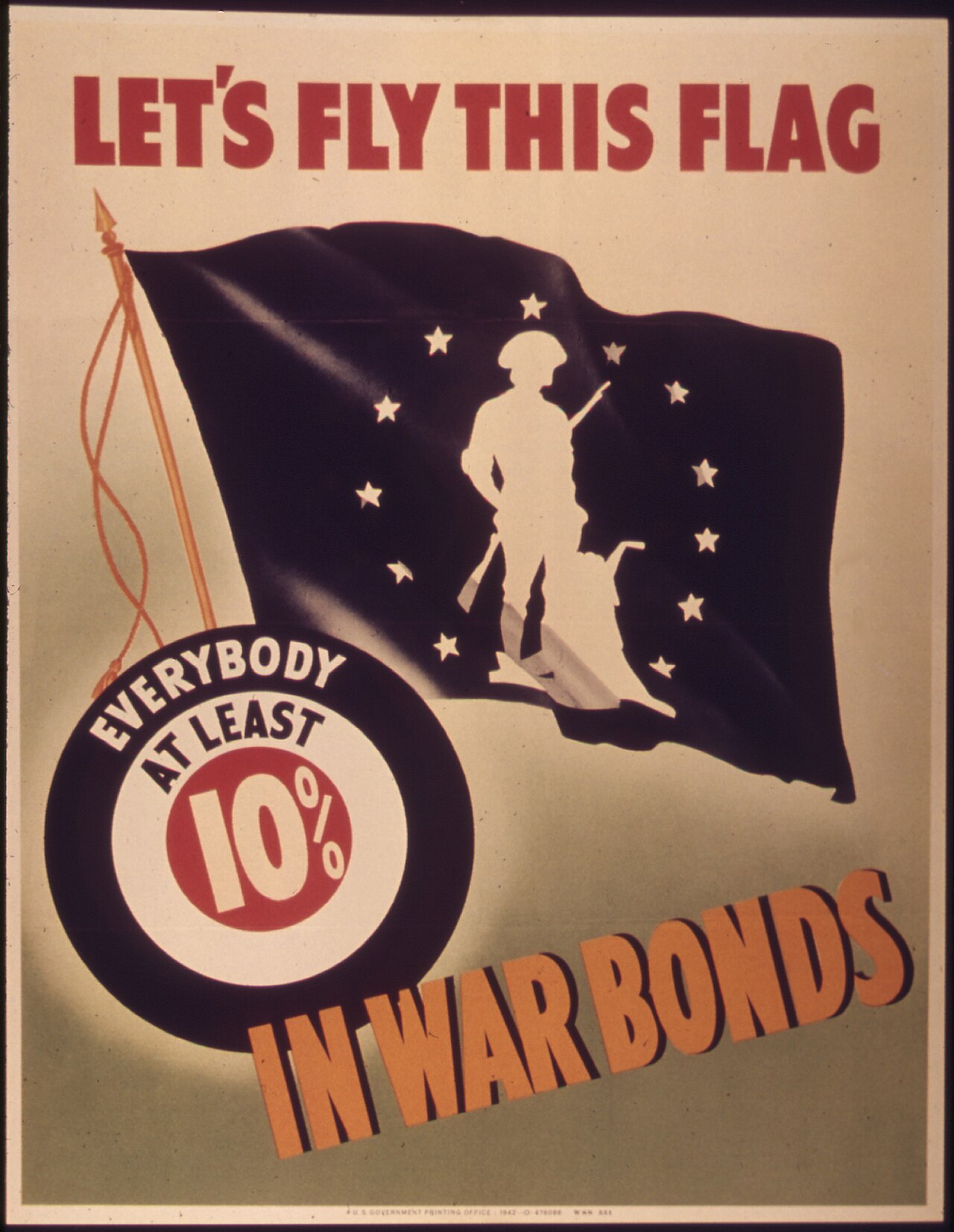
Let's Fly This Flag: Everybody at Least 10 Percent in War Bonds, U.S. Treasury War Bonds campaign, 1943. Public domain.
The U.S. Treasury's 1943 payroll poster also turned a money decision into a sign of belonging: the shop flies the flag when everyone puts in 10 percent. The poster is the same kind of device as the EMB's "Good Shopper" and the swadeshi pledge. The differences are just as clear. The bond drive was run by a state at war and asked for a loan, not a change in diet or dress. Its social pressure ran through payroll drives at the workplace rather than through pickets or refused services. And unlike the Congress campaign, it did not come from a movement without state power organising against the government that ruled it. We Can Do It! shows the plain-folks side of the same era.
Positions on the record
- The EMB and its founders: Amery and Tallents presented the Board as a way to develop the Empire as one economic family, help producers overseas and create jobs at home ("Empire buying makes busy factories", as a Clive Gardiner poster put it), without food taxes. Tallents argued that a modern state must "project" itself to its own people and the world.
- Critics of the EMB: Free-traders and Labour objected to public money being spent steering shoppers. Recent economic history argues the Board did not measurably shift Britain's import pattern (European Review of Economic History, 2021). Historians including Stephen Constantine and Uma Kothari write that its images of colonial producers were idealised and racialised.
- Gandhi and Congress: swadeshi was presented as economic self-help for India's handloom workers and as self-purification, and Gandhi described the bonfire as a symbol of an inner fire. Gandhi insisted that picketing be non-violent, and he suspended the campaign after Chauri Chaura.
- Critics of the boycott: Tagore objected to the burning and to the move from persuasion to command. The Government of India and loyalist groups called the picketing intimidation. The government answered the 1930 campaign with emergency ordinances that curbed the press, banned meetings and targeted the movement's organisation, and more than 60,000 people were arrested in its first months; the Gandhi-Irwin Pact of 5 March 1931 withdrew the ordinances and allowed peaceful picketing of foreign-cloth shops (Britannica; Swarthmore database). The 1921 riots and Sarkar's account of social boycott show that coercion did occur, though how widespread it was varied by place and year.
- Not shown here: whether the EMB changed what British households bought; how much of the 1930 fall in imports was caused by the boycott rather than the Depression or Indian mill competition; and how many buyers complied out of conviction and how many out of fear. This page makes no finding on whether imperial rule or independence was right.
Same-method test
Swap the flags and the scoring holds. If the EMB had organised pickets outside grocers selling Danish butter and asked barbers to refuse customers who bought it, Identity fusion would be tagged on the British side as firmly as on the Indian. If Congress had printed a ledger of "goods we lost" with no denominators, Card stacking would be tagged on the Indian side. A present-day counterpart is the 2025 Canadian "Buy Canadian" boycott of U.S. goods during the tariff dispute. It is scored the same way: patriotic words and flag branding on products are glittering generalities and transfer, and naming and shaming retailers would count as identity-fusion.
How to spot it
- When a purchase is sold as loyalty, ask what the purchase actually does, for whom, and by how much. Then check whether an answer is given.
- Watch for symbols (a crown, a spinning wheel, a flag) doing the work that a price or quality comparison would normally do.
- Separate persuasion from enforcement. A poster that invites people to buy is not the same as a picket, a pledge list or a refused service, but both belong on the record.
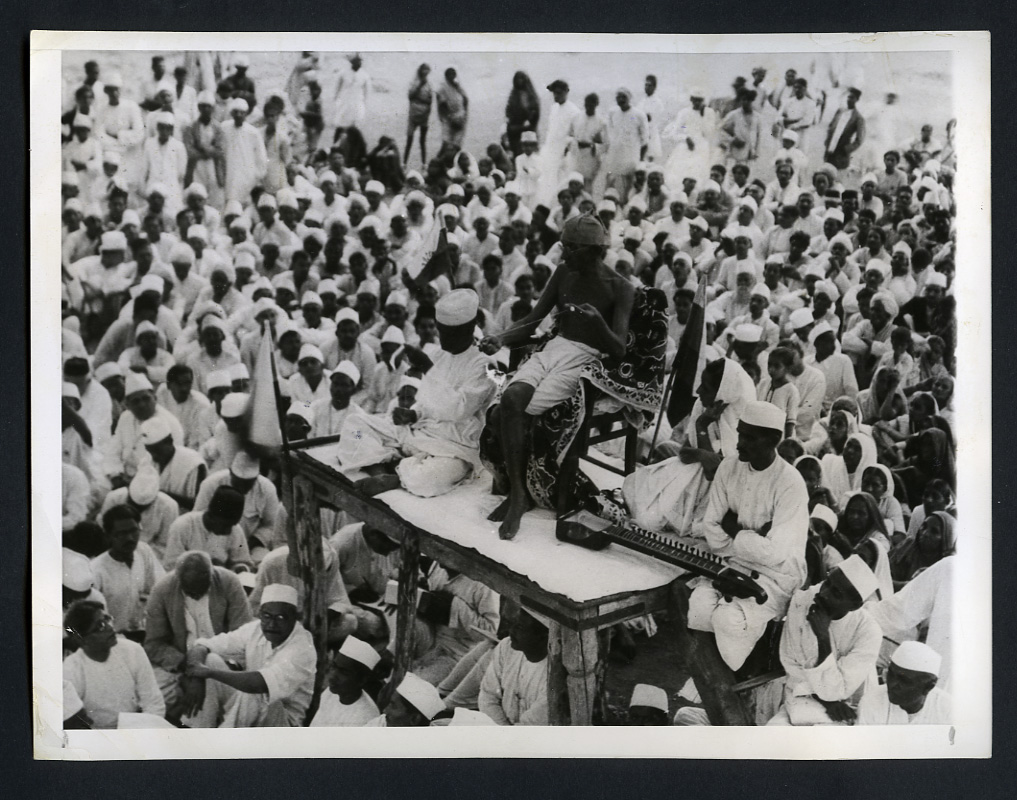
Gandhi spins while addressing a crowd (1930), on a raised platform while addressing a crowd dressed largely in khadi and Gandhi caps (news-bureau photograph). Public domain.
Images
| Image | Source | Licence |
|---|---|---|
| Mechanism diagram (above) | Drawn for FRAME from the page's sourced facts (make_diagrams.py) |
CC BY 4.0, FRAME |
| "Jungles Today, Gold Mines Tomorrow" (Empire Marketing Board, 1926) (EMB, c. 1926-27) | FRAME gallery | Public domain |
| "The Good Shopper" (Empire Marketing Board) (EMB, c. 1926-34) | FRAME gallery | CC BY 2.0 (LAC Flickr release) |
| The Bombay Chronicle reports a foreign-cloth bonfire (1921), 30 July 1921 | FRAME gallery | Public domain |
| Gandhi spins while addressing a crowd (1930), addressing followers | FRAME gallery | Public domain |
| Let's Fly This Flag (1943) | FRAME gallery | Public domain (U.S. government work) |
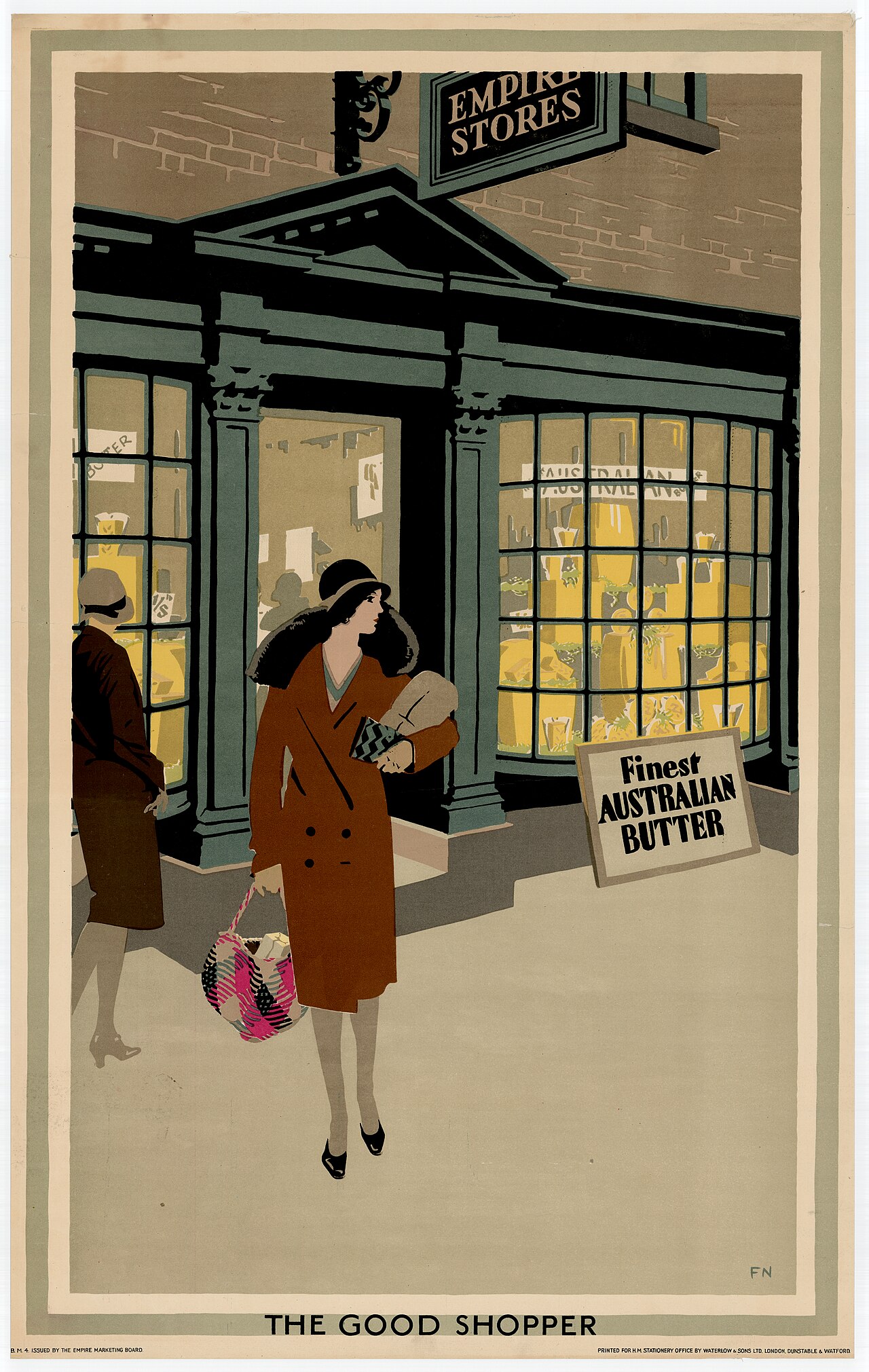
"The Good Shopper" (Empire Marketing Board), signed F.N., issued by the Empire Marketing Board and printed for H.M. Stationery Office, c. 1926-34. A shopper walks away from "Empire Stores" past a sign for "Finest Australian Butter". Library and Archives Canada, CC BY 2.0.
Image gaps
- A photograph of a foreign-cloth bonfire in progress (1921 or 1930). Press photographs exist in Indian archives and at the Mani Bhavan Gandhi museum, but no copy with a confirmed licence was found on Commons. Fillable if a PD-India copy that was published before 1966 can be sourced.
- Congress pickets at cloth shops (1930) and "sealed stock" notices. No PD copy was located. Probably fillable from the Indian Ministry of Culture's digital archive once its licence terms are checked.
- An EMB Empire Shopping Week programme and a still from Drifters (1929). Both are Crown works long out of copyright, but no copy was found on Commons. The BFI holds the film. Fillable.
- The Empire Christmas Pudding recipe poster is on Commons (TNA CO 956/63, no known restrictions). It was not added because of rate limits, and can be.

Sources
- Stephen Constantine, "'Bringing the Empire Alive': The Empire Marketing Board and Imperial Propaganda, 1926-33", in John M. MacKenzie (ed.), Imperialism and Popular Culture (Manchester University Press, 1986).
- Stephen Constantine, Buy & Build: The Advertising Posters of the Empire Marketing Board (HMSO/Public Record Office, 1986).
- Stephen Tallents, The Projection of England (Faber & Faber, 1932).
- "Britain's Empire Marketing Board and the failure of soft trade policy, 1926-33", European Review of Economic History 25:4 (2021): the £1 million nominal grant and its link to the preferences dropped after the 1923 election.
- "From 'Empire Shopping' to 'Buying British'", Economic History Society conference paper (2020): Buy British campaign and the 1933 wind-up.
- "Food and the Empire Marketing Board in Britain, 1926-1933" (journal article, ResearchGate record).
- Uma Kothari, "Trade, consumption and development alliances: the historical legacy of the Empire Marketing Board poster campaign", Third World Quarterly 35:1 (2014).
- Colonial Film: Empire Marketing Board production company record.
- University of Kent, Munitions of the Mind blog: "Jungles To-day Are Gold Mines To-morrow": depictions of Africa and Africans in EMB posters (2021).
- The National Archives (UK), CO 956 (EMB posters and artwork) and CO 758 (EMB papers); Manchester Art Gallery EMB poster collection.
- Sumit Sarkar, The Swadeshi Movement in Bengal, 1903-1908 (People's Publishing House, 1973), chapters on boycott and social boycott.
- Emma Tarlo, Clothing Matters: Dress and Identity in India (Hurst / University of Chicago Press, 1996), ch. 3-4.
- Lisa Trivedi, Clothing Gandhi's Nation: Homespun and Modern India (Indiana University Press, 2007).
- Indian Culture (Ministry of Culture, India): "Bonfire of Foreign Clothes in Bombay"; Mani Bhavan: Gandhi in Bombay chronology.
- The Bombay Chronicle, 30 July 1921, p. 13 (bonfire notice, via Commons).
- Rabindranath Tagore, "The Call of Truth", Modern Review (October 1921); M. K. Gandhi, "The Great Sentinel", Young India, 13 October 1921 (reprinted in The Collected Works of Mahatma Gandhi).
- Dinyar Patel, "Beyond Hindu-Muslim unity: Gandhi, the Parsis and the Prince of Wales Riots of 1921", Indian Economic and Social History Review 55:2 (2018).
- Global Nonviolent Action Database (Swarthmore): Indians campaign for independence (Salt Satyagraha), 1930-1931; mkgandhi.org: Salt Satyagraha and the Civil Disobedience movement: pickets, sealed stocks, permits and the fall in imports.
- Britannica, "Gandhi-Irwin Pact": withdrawal of the 1930 ordinances and permitted peaceful picketing.