Content note. This page quotes eugenic language of the period, including "feeble-minded", "imbeciles", "defectives", "asocial" and "hereditarily ill", and a 1924 statement calling a family "worthless". These words are quoted as evidence of the method. They are not this archive's description of anyone. The page also describes forced sterilisation and the killing of disabled people.
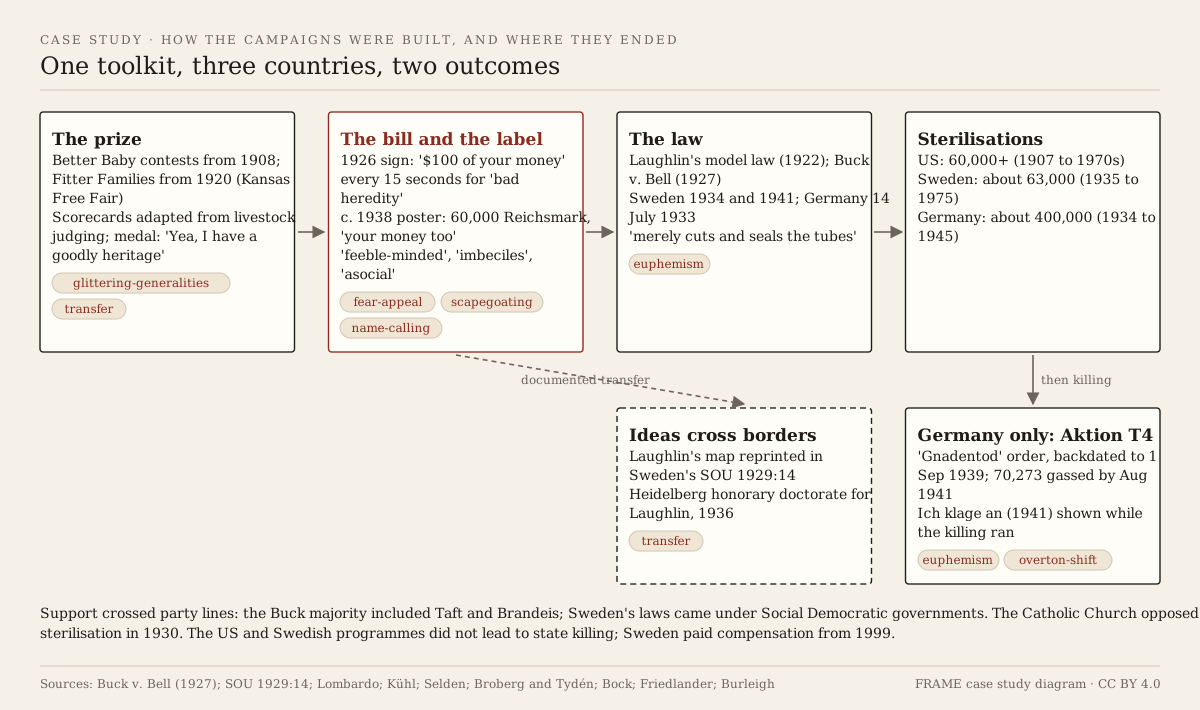
In one line: between about 1910 and 1945, public campaigns in the United States, Sweden and Germany used the same toolkit (prize contests, science branding, cost arithmetic and clinical labels) to win support for sterilising people judged hereditarily unfit; all three states passed sterilisation laws, but only Germany went on to kill disabled people in their tens of thousands.
What happened
United States
- 1910. The Eugenics Record Office opens at Cold Spring Harbor, New York, under Charles Davenport, with Harry H. Laughlin as superintendent. It trains field workers to collect family pedigrees (Kühl; Lombardo).
- 1907 onward. Indiana passes the first state sterilisation law in 1907; about thirty states follow over the next three decades (Reilly; Lombardo).
- 1908 to 1913. "Better Baby" contests spread from state fairs in Louisiana and Iowa. Babies are examined and scored on cards adapted from livestock judging, and newspapers print the scores. In 1913 the Sunday Oregonian ran a page headlined "Oregon babies make near-perfect scores at county eugenic tests" (Selden 2005; Lovett).
- 1920. The first Fitter Families contest is held at the Kansas Free Fair in Topeka, organised by Mary T. Watts and Florence Brown Sherbon. Families undergo medical and intelligence tests and submit family histories, and the winners receive medals inscribed "Yea, I have a goodly heritage". The American Eugenics Society later sponsors the contests across several states (Lovett; Selden 2005). A photograph from the Kansas fair shows the "Eugenics Building" with a sign for a "Governor's Trophy" to be awarded to the "Fittest Family".
- 1922. Laughlin publishes Eugenical Sterilization in the United States, with a "model eugenical sterilization law" for states to copy (Kühl; Lombardo).
- 1926. At the Philadelphia Sesquicentennial Exposition, an American Eugenics Society exhibit includes flashing-light signs. One reads: "Every 15 seconds $100 of your money goes for the care of persons with bad heredity such as the insane, feeble-minded, criminals and other defectives." Companion lights count the births of people the exhibit calls mentally deficient and of "high grade" people fit for leadership (Selden 1999; Selden 2005).
- 2 May 1927. In Buck v. Bell, the Supreme Court upholds Virginia's 1924 law, which was drawn from Laughlin's model. Laughlin had sent the trial a written deposition about Carrie Buck's family without examining her, describing them as belonging to "the shiftless, ignorant, and worthless class of anti-social whites of the South" (Lombardo). Justice Oliver Wendell Holmes Jr. writes for the Court that society may stop "those who already sap the strength of the State" from having children, "in order to prevent our being swamped with incompetence", and ends: "Three generations of imbeciles are enough." The vote is 8 to 1; only Justice Pierce Butler dissents. Carrie Buck is sterilised that October. Her daughter Vivian, cited as the third generation, later made her school's honour roll before dying at eight (Lombardo).
- 1938. The Human Betterment Foundation of Pasadena reports in a pamphlet that California institutions "have sterilized nearly 12,000 insane and feebleminded patients" and says the operation "merely cuts and seals the tubes".
- Totals. More than 60,000 people are sterilised under U.S. state laws, most of them before the 1970s (Reilly; Lombardo). In 1942 the Supreme Court strikes down Oklahoma's punitive sterilisation of some criminals in Skinner v. Oklahoma, without overruling Buck.
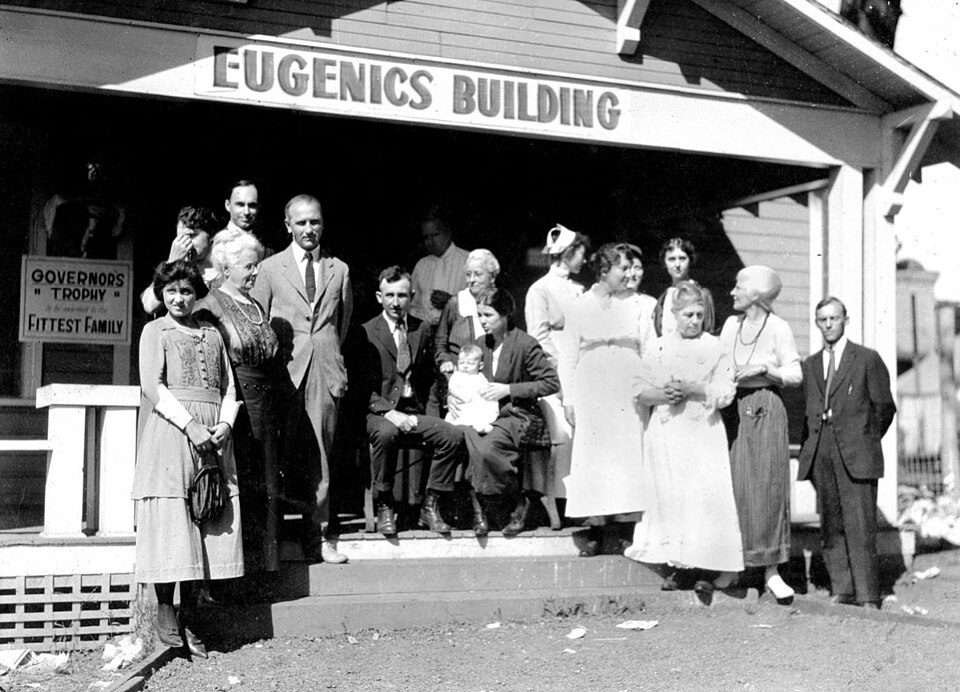
Kansas Free Fair, Topeka, c. 1925. American Eugenics Society photograph, American Philosophical Society Library. Public domain.
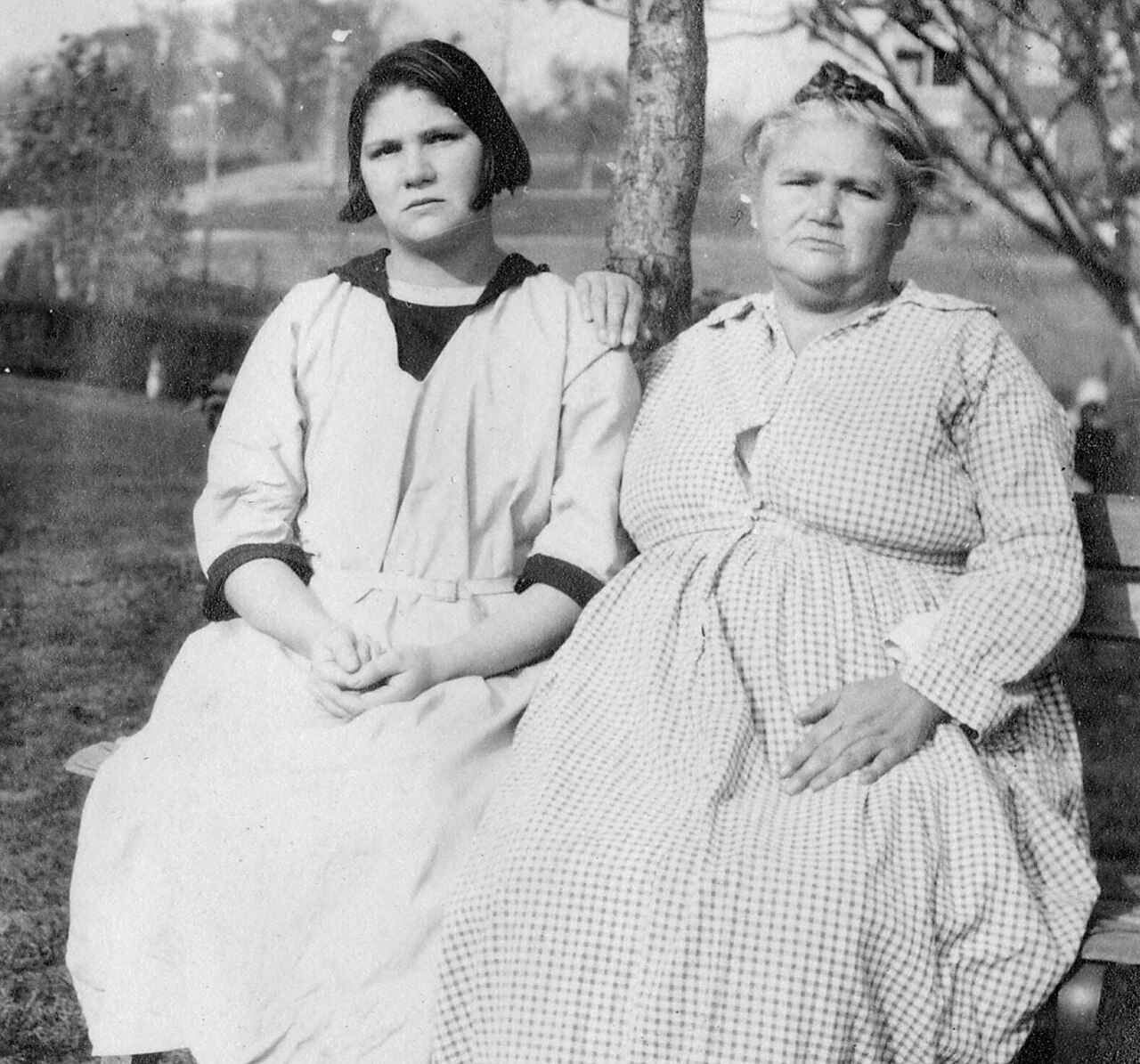
Carrie Buck (left) and her mother Emma at the Virginia Colony, 1924, photographed by the Eugenics Record Office field worker Arthur Estabrook before the trial. University at Albany archives. Public domain.
Sweden
- 1922. The State Institute for Racial Biology (Statens institut för rasbiologi) opens in Uppsala after a Riksdag decision in 1921 backed by members of several parties. Herman Lundborg directs it until 1935 and leads anthropometric surveys of the Swedish population, including the Sámi (Broberg and Tydén).
- 1929. A government committee's report on a proposed sterilisation law (SOU 1929:14) reprints an American map of "Legal status of the sterilization laws", drawn from Laughlin's notes and marking the 1927 Buck v. Bell decision.
- 1934. Alva and Gunnar Myrdal's Kris i befolkningsfrågan (Crisis in the Population Question) places sterilisation of people judged unfit within a Social Democratic programme of population and welfare policy. The Riksdag passes a sterilisation law the same year, under a Social Democratic government; a wider law follows in 1941 that adds social grounds such as an "asocial way of life" (Broberg and Tydén; Runcis).
- 1935 to 1975. About 63,000 people are sterilised under the laws, the great majority of them women. The laws are replaced in 1975 (Steriliseringsutredningen).
- August 1997. Maciej Zaremba's series in Dagens Nyheter brings the history to international attention. The government appoints a commission the same year. It finds that many operations recorded as voluntary had been made a condition of release from an institution, of marriage or of an abortion. A 1999 law grants SEK 175,000 to each person sterilised under pressure who applies (Zaremba; Steriliseringsutredningen).
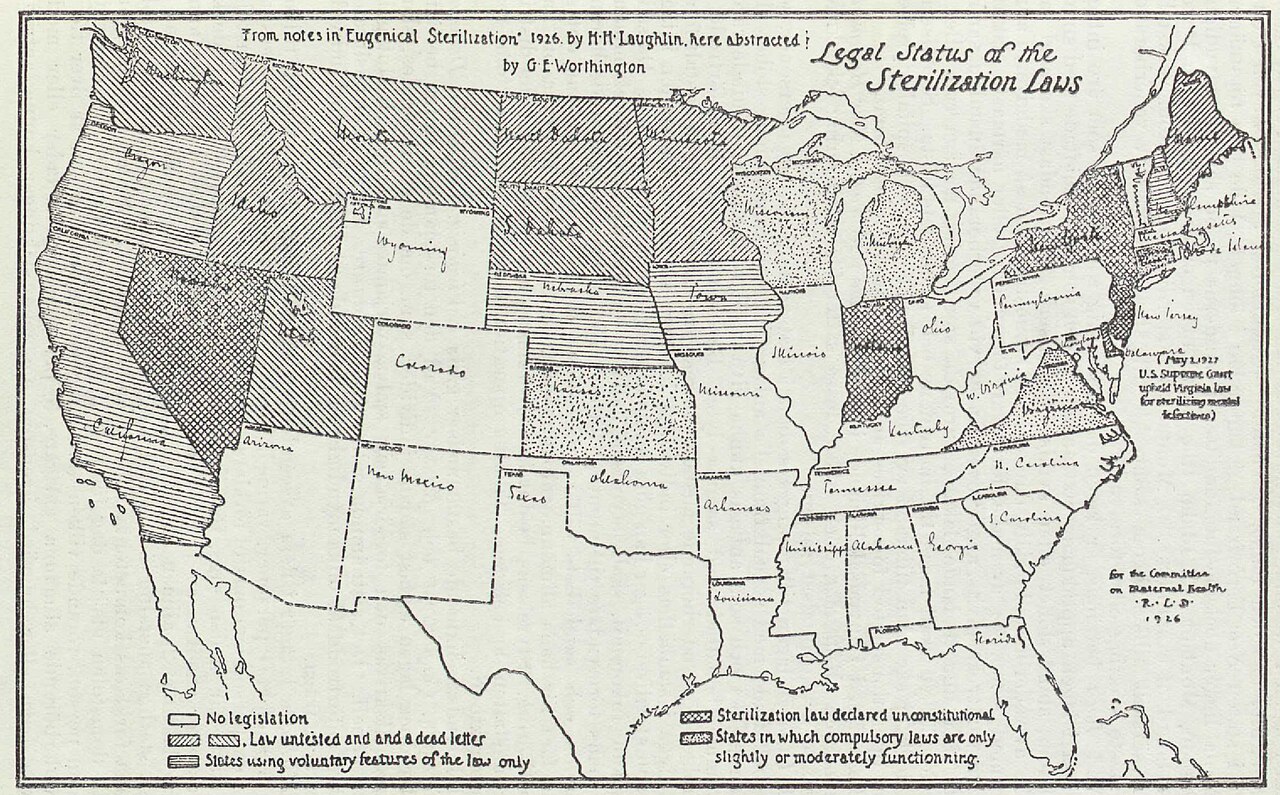
An American map of state sterilisation laws, drawn from Laughlin's notes in 1926, reprinted on page 57 of the Swedish sterilisation committee's report, SOU 1929:14. Public domain.
Germany
- 1920. The jurist Karl Binding and the psychiatrist Alfred Hoche publish Die Freigabe der Vernichtung lebensunwerten Lebens (Permitting the Destruction of Life Unworthy of Life) (Friedlander; Burleigh).
- 1932. A Prussian health council, under the Weimar Republic, drafts a law for voluntary eugenic sterilisation (Friedlander; Bock).
- 14 July 1933. The new government issues the Law for the Prevention of Hereditarily Diseased Offspring (Gesetz zur Verhütung erbkranken Nachwuchses), in force from 1 January 1934. Hereditary health courts can order sterilisation for listed conditions including "congenital feeble-mindedness", schizophrenia, hereditary epilepsy, deafness and blindness, and severe alcoholism. About 400,000 people are sterilised by 1945, and several thousand die from the operation, most of them women (Bock; Friedlander).
- From 1933. The NSDAP Office of Racial Policy (Rassenpolitisches Amt) publishes the monthly Neues Volk. A poster advertising it, c. 1938, shows a disabled man under the text: "60,000 Reichsmark is what this person suffering from hereditary illness costs the community in his lifetime. Fellow citizen, that is your money too" (USHMM; Bachrach). The office produces the film Erbkrank (The Hereditarily Ill, 1936) for party audiences (Burleigh).
- 1936. The University of Heidelberg gives Laughlin an honorary doctorate. German racial hygienists had cited American state laws and Laughlin's model law as precedents, and the Eugenical News, which Laughlin co-edited, reported on the German law approvingly (Kühl).
- 1939 to 1941. Hitler signs an order, backdated to 1 September 1939, empowering doctors so that the incurably ill may be granted a "Gnadentod" (mercy death). The programme, later called Aktion T4 after its office at Tiergartenstraße 4, operates through front bodies with welfare names, and families receive letters giving false causes of death. By its own count it kills 70,273 people in gas chambers by August 1941, after which killing continues by drugs and starvation. Staff from T4 later help run the Belzec, Sobibor and Treblinka death camps (Friedlander; Burleigh). The feature film Ich klage an (I Accuse, 1941), in which a doctor ends his sick wife's life at her request, is released while the killings are under way; the SS security service reports on how audiences react (Burleigh).
- 1946 to 1947. At the Nuremberg Doctors' Trial, the defence cites Buck v. Bell as an American precedent (Lombardo; Kühl).
How it works
- Glittering generalities: "better babies", "fitter families", "fittest family", "human betterment" and "race betterment" name a goal no one opposes, while the testable question (whose children count as better, and by what measure) sits in scorecards the audience never sees. The Fitter Families medal borrowed a psalm: "Yea, I have a goodly heritage."
- Transfer: the campaigns borrowed two kinds of prestige. The first was science and medicine: doctors' examinations, intelligence tests, percentage scores, the 1921 international congress's tree of "eugenics" drawing on genetics, medicine and statistics, and in Germany the courts and doctors who ran the law. The second was the state fair itself, where contests for babies and families ran beside the livestock judging and used scorecards adapted from it, so breeding people was presented as familiar farm sense.
- Fear appeal: each country turned heredity into a running bill. The 1926 sign flashed a $100 loss every 15 seconds; the German poster put 60,000 Reichsmark on one man's life; Holmes wrote of being "swamped with incompetence". None of them compared the figure with any other public cost or asked how much of it heredity actually explained.
- Scapegoating: poverty, crime and the cost of institutions were placed on a bounded group, "persons with bad heredity such as the insane, feeble-minded, criminals and other defectives", in the words of the U.S. sign. In Germany the same group became the "hereditarily ill" whose upkeep was "your money too". In Sweden the 1941 law's "asocial way of life" did similar work.
- Name-calling: "feeble-minded", "imbecile" and "defective" were used as official categories, but they worked as labels that ended inquiry. Laughlin called the Buck family "worthless" without meeting them, and Carrie Buck's daughter, labelled the third generation of "imbeciles", later made the honour roll.
- Euphemism / doublespeak: the Human Betterment Foundation said the operation "merely cuts and seals the tubes" and "is not a mutilation in any sense of the word"; Holmes called sterilisation one of the "lesser sacrifices, often not felt to be such by those concerned". In Sweden, operations were recorded as voluntary when the commission later found they had been made a condition of release or marriage. In Germany, killing was authorised as a "Gnadentod" (mercy death) and run through front bodies with welfare names.
- Testimonial: in The Black Stork (1917) the Chicago surgeon Harry Haiselden, who had let disabled newborns die, played himself, and advertisements presented "Dr. Harry J. Haiselden, the noted Chicago surgeon" as the guarantee of the film's case (Pernick).
- Overton window shifting: in Germany alone, the documented sequence runs from a 1920 book arguing for "the destruction of life unworthy of life", through compulsory sterilisation (1933) and cost posters, to films about "mercy" deaths (1941) released while a secret killing programme was running. Ich klage an showed a consenting patient; the programme did not ask for consent.
Then and now
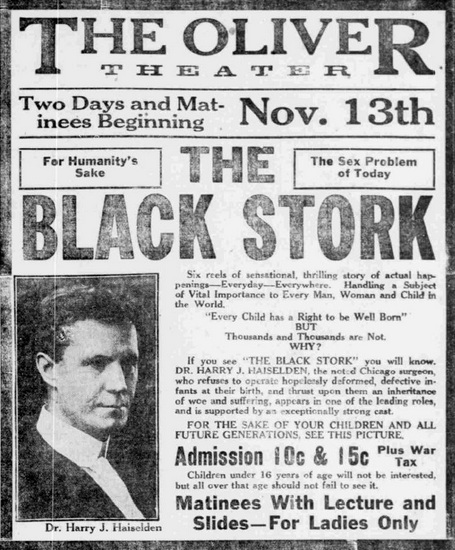
The Black Stork (cinema advertisement), a U.S. cinema advertisement, 1917. Public domain.
The idea of a film that makes a "mercy" death look humane did not start in Germany. The Black Stork played in American cinemas in 1917 under the slogan "Every Child has a Right to be Well Born", with a real surgeon arguing his own case. Twenty-four years later, Ich klage an made the same appeal to German audiences. The difference is what stood behind each film. The American film argued for a doctor's choice in single cases and no state programme followed. The German film appeared while the state was secretly killing tens of thousands of patients.
The cost signs show the same pattern. The 1926 Philadelphia sign ("$100 of your money") and the 1938 Neues Volk poster ("60,000 Reichsmark ... your money too") use the same arithmetic of blame. In the United States it supported sterilisation laws; in Germany it also prepared the ground for killing.
Content note: Pro-sterilisation pamphlet using "insane and feebleminded" for patients, with a disparaging remark about Catholics. This object is shown as it was published. Why 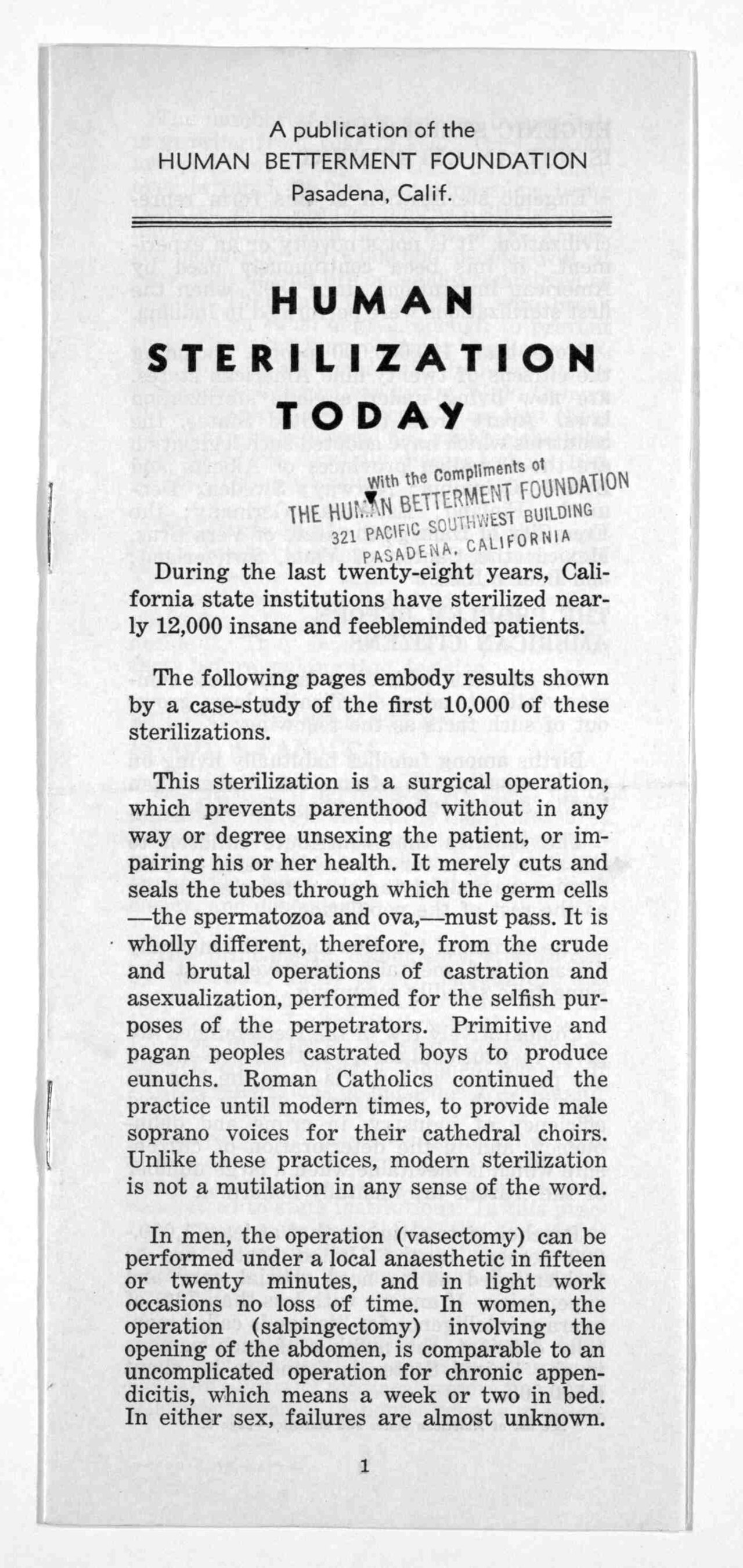
Human Sterilization Today: first page of a 1938 Human Betterment Foundation pamphlet. Library of Congress. Public domain.
Positions on the record
- Supporters at the time presented eugenics as applied science and public health: a way to cut the cost of institutions, reduce inherited disease and raise healthier children. Support crossed political lines. In the United States the Buck majority included Chief Justice William Howard Taft, a former Republican president, and Justice Louis Brandeis, a leading progressive. In Sweden the laws were passed and widened under Social Democratic governments, and the Myrdals argued for sterilisation as part of welfare policy. In Germany a voluntary law was drafted under the Weimar Republic before the National Socialists made sterilisation compulsory.
- Opponents at the time included the Catholic Church, whose 1930 encyclical Casti connubii condemned eugenic sterilisation, and Justice Butler in Buck. The Human Betterment Foundation's 1938 pamphlet answered that opposition by comparing sterilisation favourably with castration practised by "Roman Catholics" for choir voices.
- What is documented: the contests, exhibits, posters and films; the laws and the court record; about 60,000 sterilisations in the United States, about 63,000 in Sweden (1935 to 1975) and about 400,000 in Germany (1934 to 1945); the transfer of ideas from Laughlin's model law to German and Swedish debates; and the German killing programme.
- The later verdict: Sweden's commission found coercion and the state paid compensation from 1999. Germany's killing programme was tried at Nuremberg. Buck v. Bell has never been formally overruled, though Skinner (1942) limited sterilisation as punishment.
- What is not shown: that U.S. or Swedish eugenics led to a state killing programme. It did not. Nor does the record show that the fair contests themselves decided who was sterilised; they built public acceptance, while institutions, boards and courts made the orders.
Same-method test
The finding does not depend on which country ran the campaign. A Swedish poster that put a price on an institution patient's life, an American one, and a German one would all be scored as fear-appeal and scapegoating here, and the German poster is scored no more harshly for its method than an American sign that did the same arithmetic in 1926. What differs is the scale and the outcome: Germany sterilised several times as many people in about a tenth of the time, and then killed. That difference is stated as a fact of the record, not softened into equivalence.
How to spot it
- A prize, a percentage or a medal for "fitness" is a claim about a measuring rule. Ask who wrote the scorecard and what it counted.
- When a campaign prices a group of people ("$100 every 15 seconds", "60,000 Reichsmark"), ask what the figure is compared with and how much of it the stated cause explains.
- Watch for clinical labels doing a verdict's work. Check what evidence stood behind the label in the individual case, as Carrie Buck's shows.
- A word like "voluntary", "merely" or "mercy" next to an irreversible act is worth checking against what happened to the person.
Images
| Image | Source | Licence |
|---|---|---|
| Mechanism diagram (above) | Drawn for FRAME from this page's sourced facts (make_diagrams.py) |
CC BY 4.0, FRAME |
| Kansas Free Fair, Fitter Families staff at the "Eugenics Building", c. 1925 | Wikimedia Commons, American Philosophical Society | Public domain |
| Carrie and Emma Buck, 1924 | Wikimedia Commons, University at Albany | Public domain |
| "Legal Status of the Sterilization Laws" map in SOU 1929:14 | Wikimedia Commons, Swedish government report | Public domain |
| The Black Stork advertisement, 1917 | FRAME gallery (Commons) | Public domain |
| Human Sterilization Today, 1938 | FRAME gallery (Commons), Library of Congress | Public domain (no notice) |
| "Oregon babies make near-perfect scores at county eugenic tests", 1913 | Wikimedia Commons, Sunday Oregonian | Public domain |
| Eugenics Record Office field workers' conference, 1912 | Wikimedia Commons, American Breeders Magazine | Public domain |
| Logo of the Second International Congress of Eugenics, 1921 | Wikimedia Commons | Public domain |
| Harry H. Laughlin, c. 1929 | Wikimedia Commons, American Philosophical Society | Public domain |
| Herman Lundborg | Wikimedia Commons | Public domain (Swedish photograph) |
| Dekanhuset, Uppsala, 1940s | Wikimedia Commons, Swedish National Heritage Board | Public domain (Swedish photograph) |


.jpg)

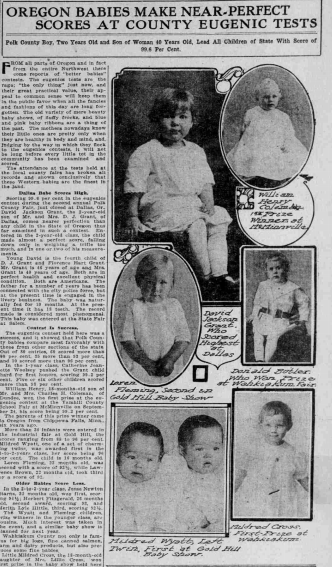
Sunday Oregonian, 5 October 1913. Public domain.
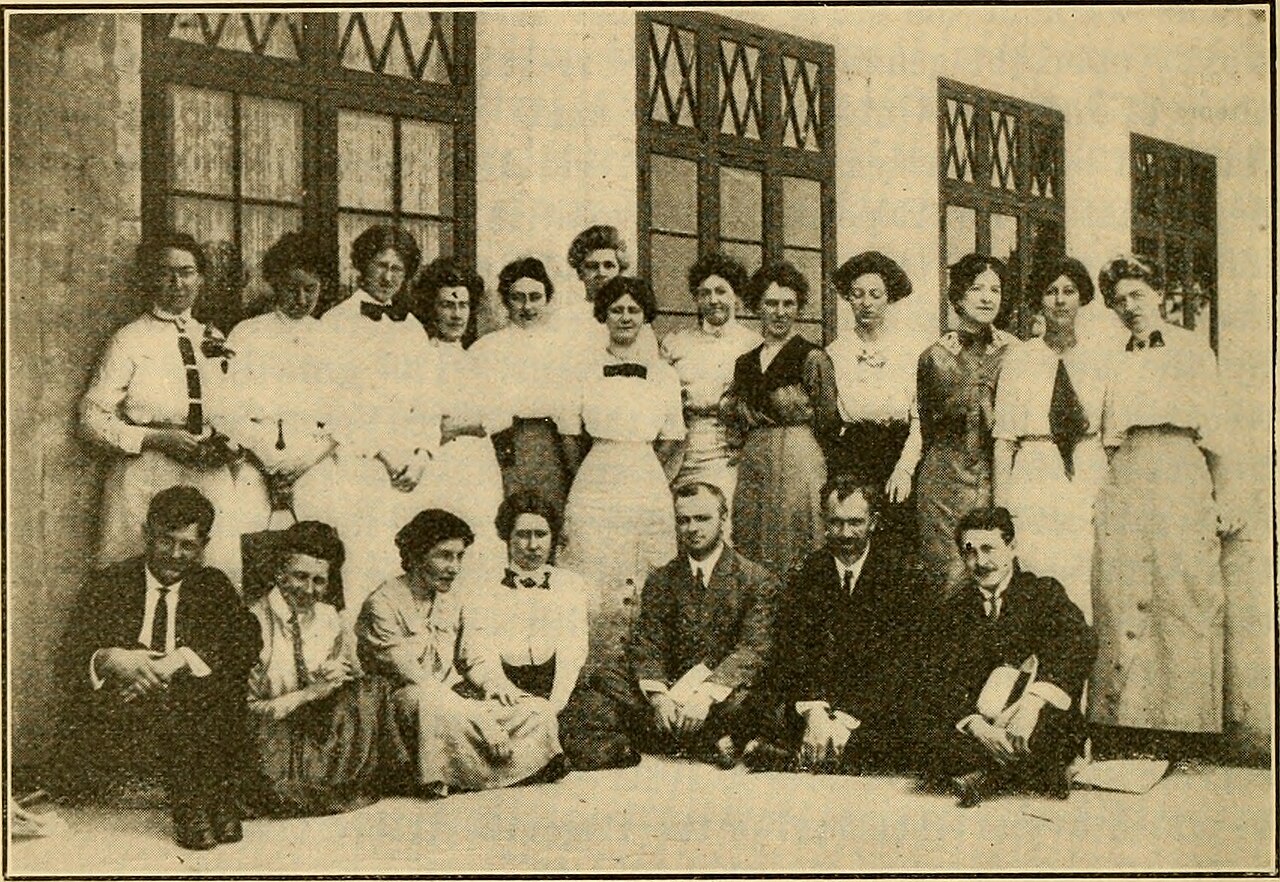
Eugenics Record Office field workers, Cold Spring Harbor, 1912. American Breeders Magazine. Public domain.
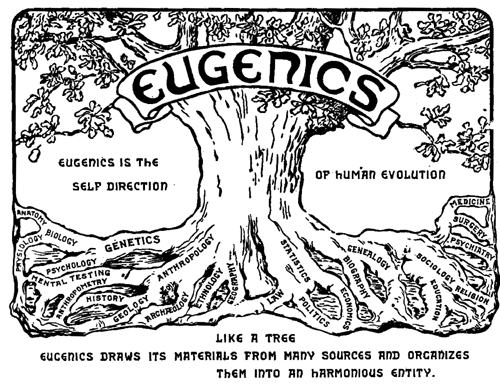
Logo of the Second International Congress of Eugenics, New York, 1921. Public domain.
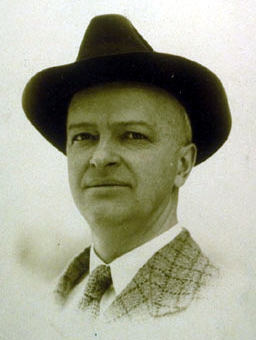
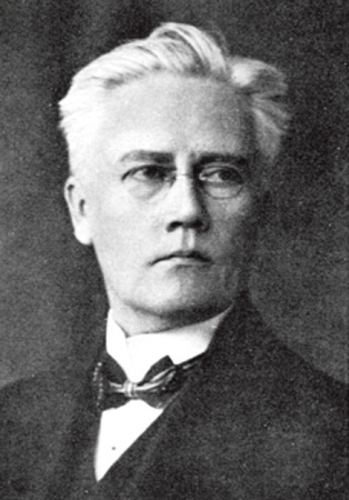
Harry H. Laughlin, c. 1929 (American Philosophical Society), and Herman Lundborg, first director of the Swedish State Institute for Racial Biology. Both public domain.
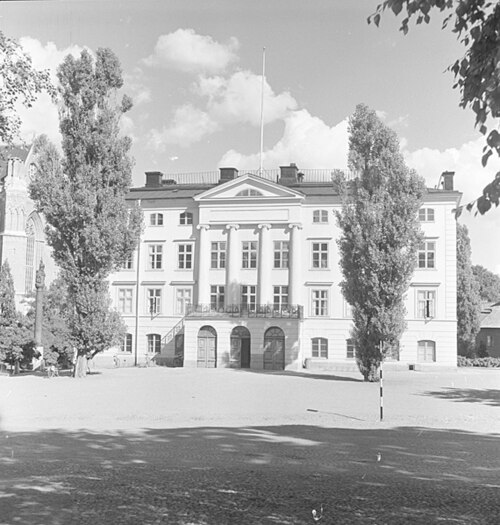
Dekanhuset in Uppsala, 1940s, which Wikimedia Commons files under the State Institute for Racial Biology. Swedish National Heritage Board. Public domain.
Image gaps
- Better Baby Contest broadside, Indiana State Fair, 1930. On Wikimedia Commons via the Indiana State Library, but its only rights statement is "No known copyright restrictions", not a public-domain or open-licence finding, so it is not hosted. Fillable if its copyright status is confirmed.
- The Neues Volk "60,000 Reichsmark" poster (c. 1938) and Neues Volk pages. Copies are on Wikimedia Commons, but their licence tags (PD-anon-70-EU, PD-GermanGov, PD-old-70) do not establish U.S. public-domain status, so under this archive's rule for German 1933 to 1945 material they are not hosted. They can be seen at the USHMM and the Deutsches Historisches Museum. Not fillable without a clear U.S. rights basis.
- Stills from Erbkrank (1936) and Ich klage an (1941), and Hitler's 1939 authorisation (Nuremberg document PS-630). Not hosted, for the same reason. Not fillable on current information.
- The 1926 Sesquicentennial flashing-light sign, a Fitter Families medal, and the American Eugenics Society display headed "Some people are born to be a burden on the rest". Photographs are held by the American Philosophical Society, and some were probably published before 1930, but no copy with a verifiable rights statement was found on Commons, and the APS site could not be reached from the environment used to build this page. Fillable from the APS digital library.
- Swedish public material (institute exhibitions, Lundborg's Svenska folktyper, the 1997 Dagens Nyheter series). The 1997 articles are in copyright. The older items may be public domain in Sweden, but no verified copy was found. Partly fillable.
Sources
- U.S. Reports: Buck v. Bell, 274 U.S. 200 (1927), Library of Congress (opinion text, including the 8 to 1 vote and Holmes's wording)
- U.S. Reports: Skinner v. Oklahoma, 316 U.S. 535 (1942), Library of Congress
- Human Betterment Foundation, Human Sterilization Today (Pasadena, 1938), Library of Congress copy via Wikimedia Commons
- Betänkande med förslag till steriliseringslag, SOU 1929:14 (Stockholm, 1929), p. 57 via Wikimedia Commons
- Harry H. Laughlin, Eugenical Sterilization in the United States (Psychopathic Laboratory of the Municipal Court of Chicago, 1922)
- Pius XI, Casti connubii (1930), Vatican
- Paul A. Lombardo, Three Generations, No Imbeciles: Eugenics, the Supreme Court, and Buck v. Bell (Johns Hopkins University Press, 2008)
- Philip R. Reilly, The Surgical Solution: A History of Involuntary Sterilization in the United States (Johns Hopkins University Press, 1991)
- Steven Selden, "Transforming Better Babies into Fitter Families: Archival Resources and the History of the American Eugenics Movement, 1908-1930", Proceedings of the American Philosophical Society 149:2 (2005) (cited as Selden 2005)
- Steven Selden, Inheriting Shame: The Story of Eugenics and Racism in America (Teachers College Press, 1999) (cited as Selden 1999)
- Laura L. Lovett, "'Fitter Families for Future Firesides': Florence Sherbon and Popular Eugenics", The Public Historian 29:3 (2007)
- Martin S. Pernick, The Black Stork: Eugenics and the Death of "Defective" Babies in American Medicine and Motion Pictures since 1915 (Oxford University Press, 1996)
- Stefan Kühl, The Nazi Connection: Eugenics, American Racism, and German National Socialism (Oxford University Press, 1994)
- Gunnar Broberg and Mattias Tydén, "Eugenics in Sweden: Efficient Care", in Gunnar Broberg and Nils Roll-Hansen (eds), Eugenics and the Welfare State: Sterilization Policy in Denmark, Sweden, Norway, and Finland (Michigan State University Press, 1996)
- Maija Runcis, Steriliseringar i folkhemmet (Ordfront, 1998)
- Alva Myrdal and Gunnar Myrdal, Kris i befolkningsfrågan (Bonniers, 1934)
- Maciej Zaremba, De rena och de andra: om tvångssteriliseringar, rashygien och arvsynd (DN, 1999), collecting his 1997 Dagens Nyheter series
- Steriliseringsutredningen (Swedish government sterilisation commission), Steriliseringsfrågan i Sverige 1935-1975, interim report SOU 1999:2 and final report (2000); Lag (1999:332) om ersättning till steriliserade i vissa fall
- Gisela Bock, Zwangssterilisation im Nationalsozialismus (Westdeutscher Verlag, 1986)
- Henry Friedlander, The Origins of Nazi Genocide: From Euthanasia to the Final Solution (University of North Carolina Press, 1995)
- Michael Burleigh, Death and Deliverance: "Euthanasia" in Germany c. 1900-1945 (Cambridge University Press, 1994)
- Susan Bachrach (ed.), Deadly Medicine: Creating the Master Race (United States Holocaust Memorial Museum, 2004)
- United States Holocaust Memorial Museum, Holocaust Encyclopedia: "Eugenics"
- United States Holocaust Memorial Museum, Holocaust Encyclopedia: "Euthanasia Program and Aktion T4"