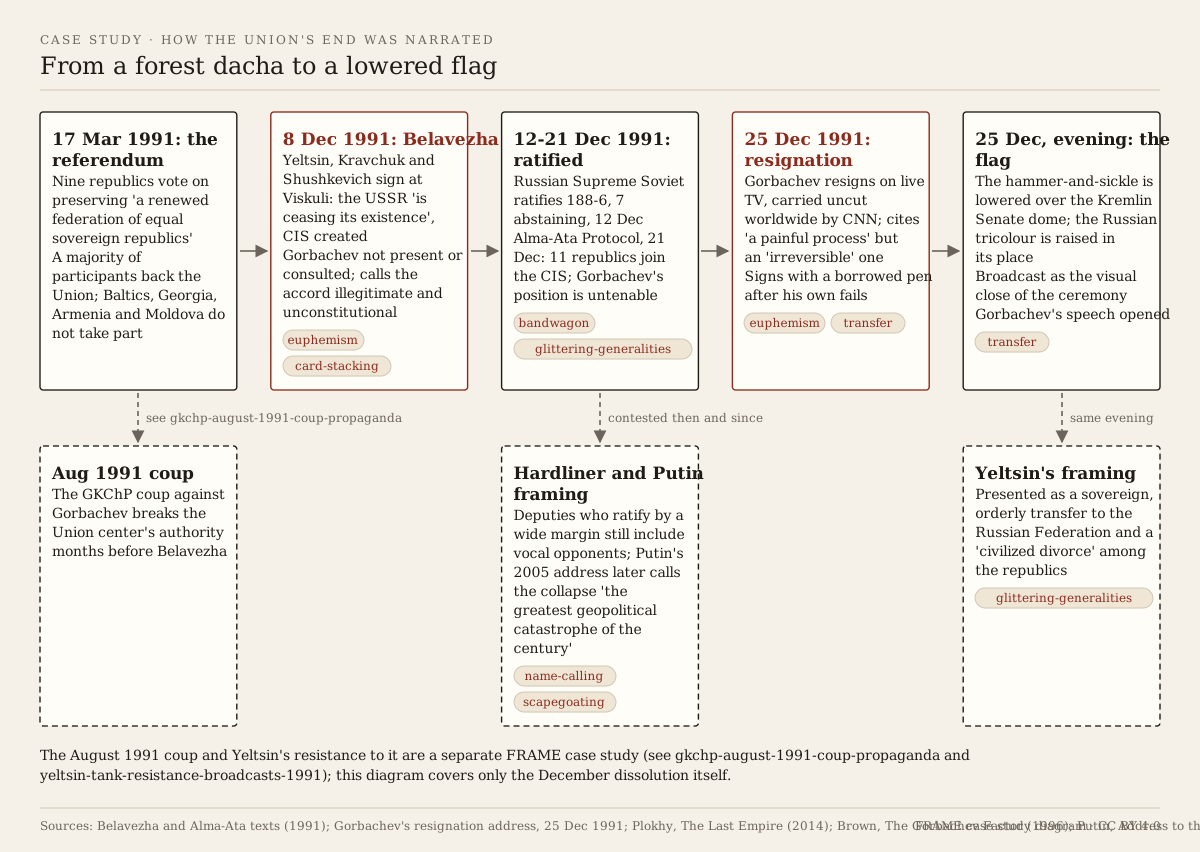
In one line: on 8 December 1991 the leaders of Russia, Ukraine and Belarus met without Mikhail Gorbachev at a government dacha in the Belavezha Forest and declared the USSR "ceasing its existence"; Gorbachev called the move illegitimate but, with the Union's republics falling in behind it, resigned on live television on 25 December, describing an "irreversible" if "painful" transition, and that evening the Soviet flag came down over the Kremlin and the Russian tricolour went up in its place; Gorbachev's camp, Yeltsin's camp and hardliners who called it catastrophe or betrayal have narrated that handover differently ever since.
What happened
- 17 March 1991: the all-Union referendum. Nine of the USSR's fifteen union republics take part in a referendum asking whether voters want to preserve "a renewed federation of equal sovereign republics"; the Baltic states, Georgia, Armenia and Moldova, already moving toward independence, do not put the question to their voters. Among those who do take part, a large majority backs preservation, a result later cited by both Gorbachev and hardliners as a standing mandate the December agreements never revisited (Brown 1996; Plokhy 2014).
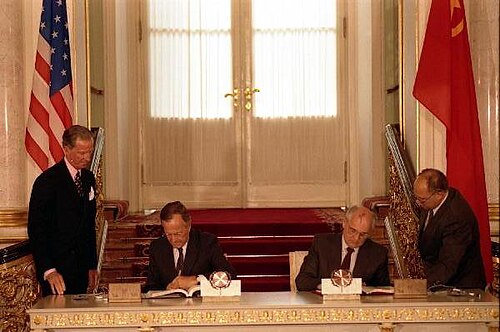
U.S. President George H. W. Bush and Soviet President Mikhail Gorbachev sign the START I treaty in Moscow, 31 July 1991, some three weeks before the August coup. Photograph by Susan Biddle, White House, George Bush Presidential Library. Public domain (work of a U.S. federal government employee), via Wikimedia Commons. - 19-21 August 1991: the GKChP coup. A group of senior Soviet officials places Gorbachev under house arrest in Crimea and attempts to seize power in Moscow; the coup collapses within three days against resistance organized around Boris Yeltsin at the Russian parliament building. The coup fatally weakens both Gorbachev's authority and the Communist Party's claim to run the Union; it is a separate FRAME case study in its own right and is not re-narrated here. See From 'ill health' to Swan Lake: the GKChP's case for its own coup, 19-21 August 1991 and Yeltsin on the tank: the broadcast image that framed the August 1991 coup's collapse. - Autumn 1991: the Novo-Ogaryovo process stalls. Gorbachev continues negotiating a new Union Treaty, reworked after the coup into a looser "Union of Sovereign States," with the republics that remain willing to talk. Ukraine's leadership declines to sign. - 1 December 1991: Ukraine votes for independence. In a referendum, Ukrainian voters back independence from the USSR by a large majority (widely reported at over 90 percent), removing the republic whose participation Gorbachev and most historians regard as indispensable to any renewed Union (Plokhy 2014). - 8 December 1991: the Belavezha Accords. Boris Yeltsin (with First Deputy Prime Minister Gennady Burbulis), Leonid Kravchuk (with Prime Minister Vitold Fokin) and Stanislav Shushkevich (with Prime Minister Vyacheslav Kebich) meet at the Viskuli government dacha in the Belavezha Forest, Belarus, without Gorbachev's knowledge or participation. They sign an agreement, drafted in large part by Burbulis, stating that "the Union of Soviet Socialist Republics, as a subject of international law and a geopolitical reality, is ceasing its existence," and announcing the creation of the Commonwealth of Independent States (CIS) in its place.
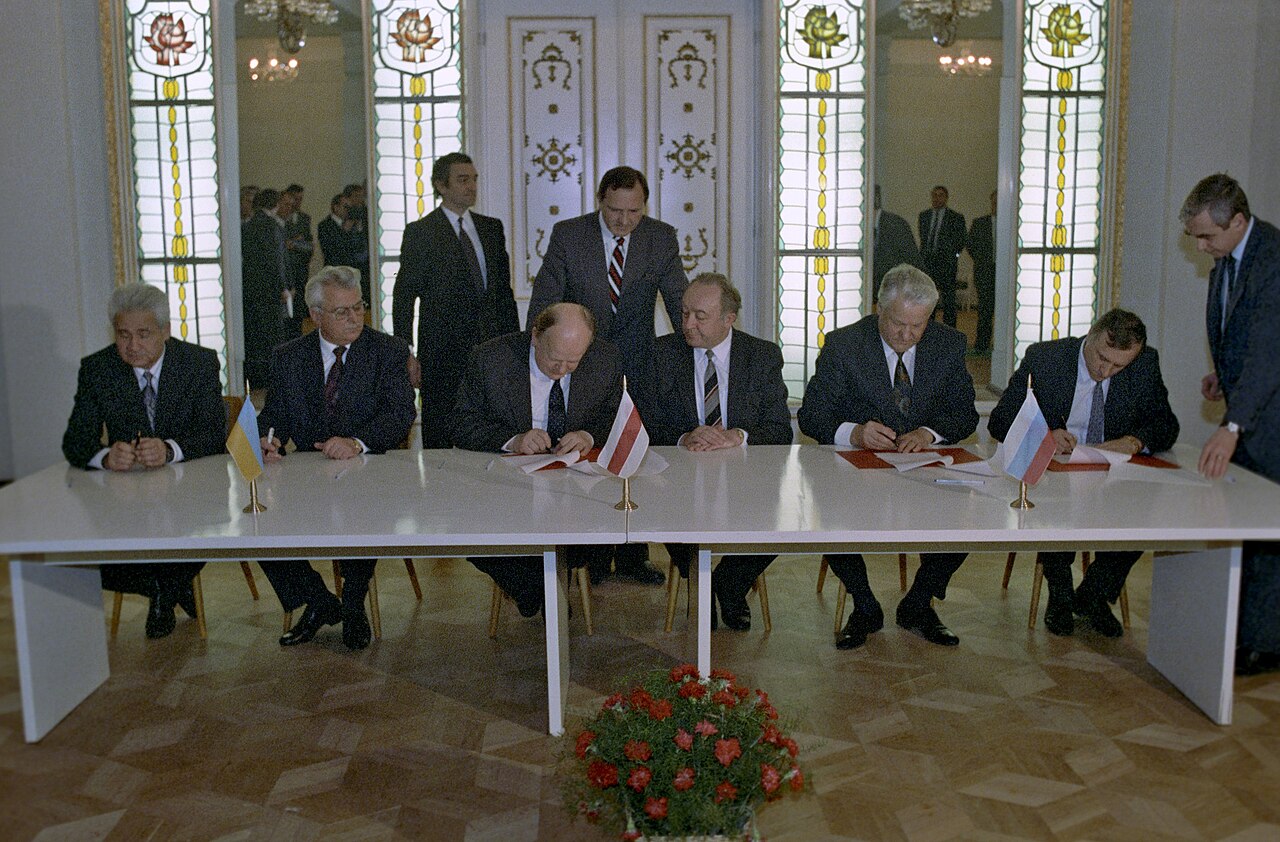
The signing of the agreement establishing the Commonwealth of Independent States at Viskuli, Belavezha Forest, Belarus, 8 December 1991; Leonid Kravchuk, Stanislav Shushkevich and Boris Yeltsin are among the signatories. Photograph by U. Ivanov, RIA Novosti archive #848095. CC BY-SA 3.0, via Wikimedia Commons. - 9 December 1991: Gorbachev's response. Gorbachev publicly calls the accord illegitimate, arguing that the fate of a state recognized by a recent nationwide referendum cannot be settled by three republican leaders meeting in private, and that the decision belongs to the Congress of People's Deputies or to a new referendum of citizens; he does not, at this point, resign (Brown 1996; Plokhy 2014). - 12 December 1991: ratification in Moscow. The Supreme Soviet of the Russian Soviet Federative Socialist Republic ratifies the Belavezha Accords by a vote of 188 in favor, 6 against and 7 abstaining. Sergei Baburin is among the deputies who vote against, disputing the accord's constitutionality; the vote nonetheless removes any realistic prospect of reversing it inside Russia's own parliament. - 21 December 1991: the Alma-Ata Protocol. Leaders of eleven of the twelve remaining Soviet republics (all but Georgia, which joins later) meet in Alma-Ata, Kazakhstan, and sign a declaration and protocol confirming the CIS and affirming, alongside Russia, Ukraine and Belarus, that the Union no longer exists. Gorbachev's position as president of a state whose republics have now all left it becomes untenable. - 25 December 1991, evening: Gorbachev's resignation address. Gorbachev delivers a televised resignation address from the Kremlin, broadcast on Soviet Central Television and carried live and uncut worldwide by CNN, a first for an address by a Soviet leader. He opens: "Due to the situation which has evolved as a result of the formation of the Commonwealth of Independent States, I hereby discontinue my activities at the post of President of the Union of Soviet Socialist Republics." He describes the preceding years' changes as necessary but costly: "radical changes in such a vast country, and a country with such heritage, cannot pass painlessly without difficulties and shake-up," and closes on a personal note: "I am leaving my post with apprehension, but also with hope, with faith in you, your wisdom and force of spirit." (Quotations from the widely circulated English-language wire translation of the address; other published translations render some phrases slightly differently.) - The pen. Signing the document transferring control of the Soviet nuclear arsenal moments after the broadcast, Gorbachev's own pen fails to write; he borrows a pen from CNN president Tom Johnson, who was in the room to supervise the network's feed, to complete the signature. Johnson asked for the pen back afterward and later gave it to a museum (O'Clery 2011). - 25 December 1991, evening: the flag. Shortly after the broadcast, the Soviet flag, the hammer and sickle on a red field, is lowered from the flagstaff over the Kremlin Senate building for the last time; the white-blue-red tricolour of the Russian Federation is raised in its place. Published accounts place the moment within minutes of one another, some giving 7:32 p.m. Moscow time and others giving 7:38 p.m.; the discrepancy reflects differing eyewitness and wire timings rather than a dispute about what happened. - 26 December 1991: the Council of Republics' declaration. The Soviet of the Republics, the surviving upper chamber of the USSR Supreme Soviet, meets and adopts Declaration No. 142-N, formally acknowledging the end of the Soviet Union's existence as a state and subject of international law, the closest the old Soviet constitutional order came to a legal act of self-dissolution.
How it works
- Euphemism / doublespeak: the Belavezha Accords' own text says the USSR "is ceasing its existence" rather than that it has collapsed, failed or been dissolved by force; Gorbachev's resignation address says he will "discontinue my activities" rather than that he has been removed or defeated. Across 1991 the process by which a nuclear superpower's constituent republics left it one after another was more often described in Soviet and Russian official language as "transformation" or "renewal" than as an end, until the closing weeks made softer language impossible to sustain.
- Transfer: lowering the hammer-and-sickle and raising the pre-revolutionary Russian tricolour borrowed centuries of Russian statehood's own legitimacy for the new Russian Federation in a single visual gesture, broadcast as the evening's closing image, without that specific transfer of symbols ever having been put to a vote of its own. CNN's live, uncut worldwide carriage of Gorbachev's address, the first time a Soviet leader's speech had been handled that way, lent the moment the additional authority of being watched, in real time, by the world.
- Card stacking: the Belavezha Accords' preamble describes the breakdown of talks on a new Union Treaty but does not mention, and the CIS's founding documents never put to a fresh vote, the outcome of the March 1991 referendum in which the republics that took part had backed preserving a renewed Union. A reader of the accord's own text saw one part of the year's record and not the other.
- Scapegoating: reform-minded officials and the press around Yeltsin folded the causes of seventy years of one-party rule's failure into a single actor, "the old system" or "the command-administrative system," leaving out Gorbachev's and Yeltsin's own long careers inside that same party apparatus. Hardliners ran the same device in the opposite direction, blaming "traitors" inside the leadership and pressure from the West for an economic and political crisis most historians trace in large part to decades of structural stagnation, the mid-1980s oil-price collapse and the cost of the war in Afghanistan.
- Name-calling: hardline and nationalist deputies branded the Belavezha signatories as having carried out an illegal seizure of state power, in Russian debate over the following years routinely rendered as a "coup" (perevorot) against the Union and the March referendum's mandate. Reform-aligned media, for its part, had spent the months since August 1991 calling the old Union apparatus and the coup's remaining defenders "putschists," a label this archive scores the same way regardless of which side is using it.
- Glittering generalities: "Commonwealth of Independent States," "sovereignty," "renewal" and, especially from Yeltsin's side, a "civilized divorce" stood in for a large set of unresolved, concrete questions, control of the nuclear arsenal and the army, the republics' shared debts, their new borders, that the December declarations did not settle and that took years, in some cases, to work out.
Then and now
Russia's own official commemoration of 1991 has moved since. In 2002 the Federal Assembly renamed the 12 June public holiday, originally adopted in 1992 as the Russian Federation's "Independence Day" (marking Russia's 1990 declaration of state sovereignty within the still-existing USSR), simply "Russia Day," dropping language many Russians found confusing or, to critics of the dissolution, uncomfortably close to celebrating a state's breakup. In 2005 a new public holiday, National Unity Day on 4 November, replaced 7 November's Soviet-era anniversary of the Bolshevik Revolution on the state calendar, giving the country an alternative date to mark without directly invoking either 1917 or 1991. Neither change rewrites the documented events of December 1991; both move the anniversary further from public ritual, consistent with the more critical framing of the Soviet collapse that has become dominant in official Russian discourse since the 2000s (see "Positions on the record" below).
Positions on the record
- Gorbachev's own framing. In the resignation address itself, Gorbachev presents the preceding six years as a necessary, historically overdue transition toward democracy, a market economy and openness, framing his own departure as the costly but necessary completion of that project rather than its defeat, and listing free elections, press freedom, religious freedom and a multi-party system among the changes he holds had already become irreversible facts. He separately, in the days after Belavezha, objected to the manner of the Union's dissolution, arguing such a decision required the Congress of People's Deputies or a popular vote, not three leaders acting alone.
- Yeltsin's camp's framing. Yeltsin and Burbulis, in accounts and interviews collected by Plokhy (2014) and other historians, presented Belavezha as a "civilized divorce," an orderly, negotiated transfer of sovereignty to the republics that avoided the violent breakups then under way in Yugoslavia, and as the final removal of a Communist Party apparatus that the March 1991 referendum's wording, in their reading, had never actually endorsed keeping in its existing form.
- Hardliner and nationalist framing. Deputies such as Sergei Baburin, who voted against ratification on 12 December, argued the Belavezha Accords were themselves an unconstitutional seizure of state power that ignored the referendum's result. This reading widened over the following decade into a broader current holding that the Union's end was a preventable catastrophe engineered or exploited by a small elite; President Vladimir Putin gave that current its best-known later phrase in an address to the Federal Assembly on 25 April 2005, saying, in the Russian government's own published English translation, that "the collapse of the Soviet Union was a major geopolitical disaster of the [20th] century," a line very widely quoted in English-language reporting as "the greatest geopolitical catastrophe of the century." Putin's fuller remarks in the same speech went on to describe the human costs, savings lost and families divided across new borders, rather than calling for the state's restoration.
- What is documented. The Belavezha Accords' and Alma-Ata Protocol's texts; the 12 December ratification vote and its count; Gorbachev's resignation address and its broadcast; the pen incident, reported by journalists present including Tom Johnson himself; the flag lowering, filmed and widely broadcast; the 26 December Declaration No. 142-N; and Putin's 2005 remarks, delivered on camera and published by the Kremlin.
- What is contested. Whether the Belavezha Accords were constitutionally valid under Soviet law in force at the time is disputed by historians and legal scholars to this day; no Soviet or Russian court ever ruled on the question before the state the question concerned had ceased to exist. Accounts differ on how close Gorbachev came, in the days after Belavezha, to attempting to use force to reverse it; Plokhy (2014) and Brown (1996) read the available evidence differently on how seriously that option was considered.
- Not ruled on here. Whether the Soviet Union's dissolution was, on balance, good or bad for the peoples who lived through it, and the wider historical debate over what caused the Soviet system's failure. This page scores how the end of the Union was narrated and staged, not that underlying political argument.
Same-method test
The same tags apply to another Communist state's officially narrated end, on a smaller stage.
- East Germany's "Wende," 1989-1990. After Erich Honecker was replaced as SED general secretary by Egon Krenz on 18 October 1989 and the Berlin Wall opened on 9 November, East German state television's evening news, Aktuelle Kamera, and the ruling party's own language described the unfolding collapse of one-party rule as die Wende, "the turn" or "the turning point," a euphemism that named a process without naming what it was a process away from. As in Belavezha's "ceasing its existence," the phrase let officials narrate the state's own end without using the words collapse, failure or defeat. The SED, renamed the Party of Democratic Socialism (PDS) in December 1989, attributed the crisis to individual leaders and "Stalinist deformations" of an otherwise sound system, a Scapegoating move that, like the Soviet reform camp's "old system" framing, left the party's own decades in power out of the account. When the German Democratic Republic formally acceded to the Federal Republic of Germany under Article 23 of the West German Basic Law on 3 October 1990, the GDR's flag was lowered for the last time and the Federal Republic's flag, never contested or replaced, simply continued flying, a quieter version of the Transfer the Kremlin ceremony performed with a genuinely new tricolour.
- Scale. The GDR's disappearance folded one state into an existing, internationally recognized neighbor with a shared language and, within a year, a shared currency and legal system; nothing in that process approached the scale of a nuclear superpower's fifteen republics separating into independent states with new armies, currencies and disputed borders, several of which fought wars over those borders in the following decades. The mechanism, softening language and moving blame while a one-party state narrates its own end for a domestic audience, scores the same regardless of that difference in scale.
How to spot it
- Read the operative sentence of any official declaration of an ending literally: does it say the thing failed, was defeated, or lost, or does it say only that something is "ceasing," "transforming" or "turning"?
- Check whether the outcome is announced as settled before the body legally empowered to decide it, a parliament, a court, a referendum, has actually acted, and note what happens to any earlier vote or mandate that pointed the other way.
- Watch for a symbolic ceremony, a flag, a signature, a broadcast, doing legitimizing work that a vote or a legal process did not do.
- Compare the vocabulary each rival camp uses for the same handover, "discontinue," "civilized divorce," "catastrophe," "coup", and ask what concrete, checkable claim each word is standing in for.
- Ask what happens to the state's own commemoration of the event in the years after: what gets renamed, downgraded or quietly moved, and what that says about which of the contemporaneous framings the state now prefers.
Images
| Image | Source | Licence |
|---|---|---|
| Mechanism diagram (above) | Drawn for FRAME from the sources below (make_diagrams_fall_ussr_dissolution.py) |
CC BY 4.0, FRAME |
| Bush and Gorbachev sign START I, Moscow, 31 July 1991 (Susan Biddle) | Wikimedia Commons, George Bush Presidential Library | Public domain (U.S. federal government work) |
| Signing of the Belavezha Accords, 8 December 1991 (U. Ivanov) | Wikimedia Commons, RIA Novosti archive #848095 | CC BY-SA 3.0 |


Image gaps
- A second Belavezha photograph. File:RIAN archive 52076 (RIA Novosti #52076, Yuriy Ivanov, CC BY-SA 3.0, licence checked on the Commons page) shows the three leaders after the signing; not hosted, since the signing photograph above already covers the event.
- The Kremlin flag ceremony itself, 25 December 1991. Widely broadcast and repeatedly reproduced in press and documentary footage (the CNN and Soviet Central Television feeds), but no still photograph of the moment with a confirmed open licence was located before the same rate limit cut the search short.
- Gorbachev delivering the resignation address, 25 December 1991. Photographs and video stills of the broadcast are widely reproduced but were not confirmed as openly licensed in this pass, for the same reason.
- Sergei Baburin or another hardliner deputy speaking in the 12 December 1991 Russian Supreme Soviet ratification debate. No openly licensed photograph of that specific session was located.
- Putin delivering the 25 April 2005 Federal Assembly address. Official Kremlin photographs of presidential addresses from this period are not consistently released under an open licence on Commons; none was confirmed in this pass.

Sources
- Agreement Establishing the Commonwealth of Independent States (Belavezha Accords), signed at Viskuli, Belarus, 8 December 1991.
- Alma-Ata Protocol, signed 21 December 1991.
- Declaration of the Soviet of the Republics of the Supreme Soviet of the USSR, No. 142-N, 26 December 1991.
- Mikhail Gorbachev, resignation address as President of the USSR, televised 25 December 1991; English-language text as circulated by wire services (UPI) and reproduced in multiple published collections.
- Archie Brown, The Gorbachev Factor (Oxford University Press, 1996).
- Serhii Plokhy, The Last Empire: The Final Days of the Soviet Union (Basic Books, 2014).
- Conor O'Clery, Moscow, December 25, 1991: The Last Day of the Soviet Union (PublicAffairs, 2011); see also his retrospective in The Irish Times, "Remembering the last day of the Soviet Union."
- Vladimir Putin, Address to the Federal Assembly of the Russian Federation, 25 April 2005, official English translation, President of Russia website (en.kremlin.ru).
- Results of the All-Union referendum on the preservation of the USSR, 17 March 1991, as reported by Soviet and international press.
- Results of the Ukrainian independence referendum, 1 December 1991, as reported by Soviet and international press.
- Egon Krenz's accession as SED general secretary, 18 October 1989, and the accession of the German Democratic Republic to the Federal Republic of Germany under Article 23 of the Basic Law, 3 October 1990, for the "Same-method test."
- Decree of the President of the Russian Federation renaming the 12 June holiday "Russia Day," 2002; Federal Law establishing National Unity Day on 4 November, 2004 (effective 2005), for "Then and now."