Content note. This page describes the deaths of three men on the night of 20-21 August 1991 and, in passing, the shelling of the same building in October 1993. It does not show images of the dead.
In one line: on 19 August 1991, hours after the State Committee on the State of Emergency (GKChP) announced it had taken power and cut Mikhail Gorbachev off in Crimea, Boris Yeltsin climbed onto a tank outside the Russian parliament in Moscow and read an appeal calling the takeover an unconstitutional coup; wire photographs of the moment reached the world within hours, crowds and barricades grew around the building over the next two days, and by 21-22 August the coup had collapsed.
What happened
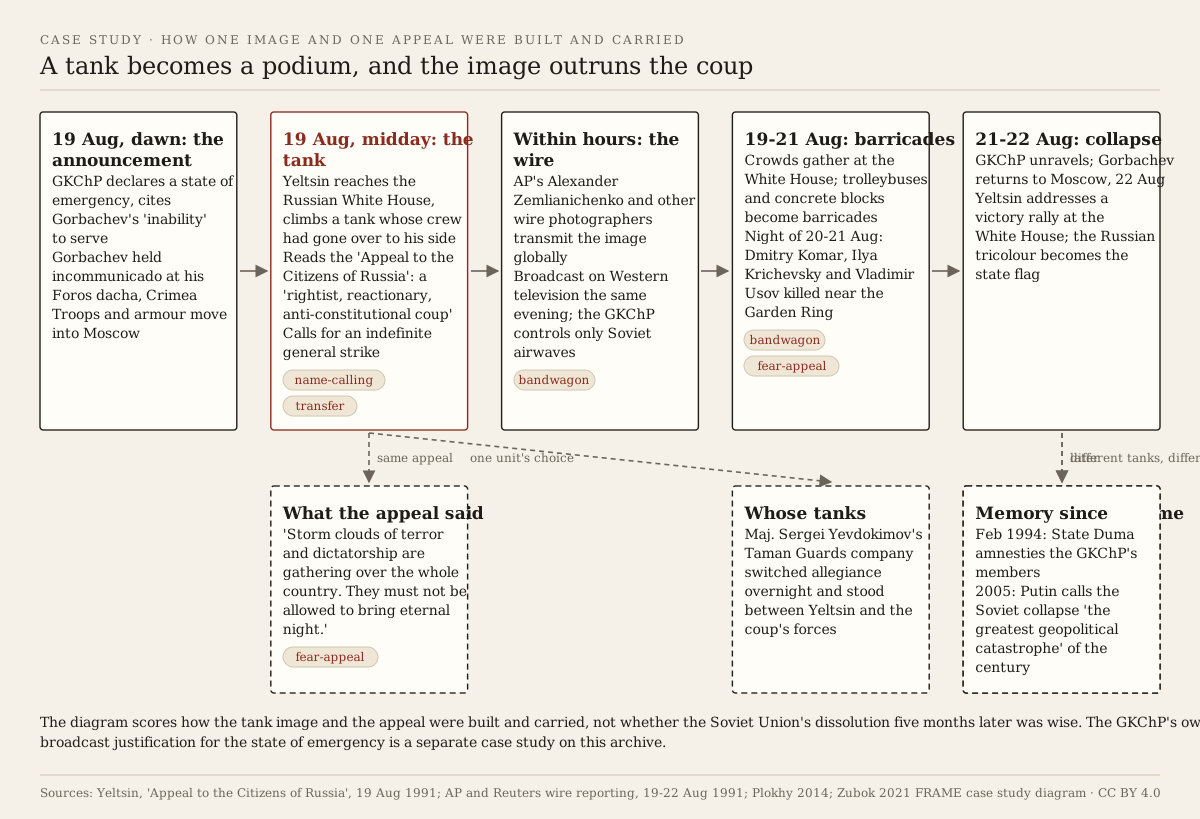
- Night of 18-19 August 1991. A group of Soviet officials forms the GKChP (Gosudarstvenny komitet po chrezvychainomu polozheniyu, State Committee on the State of Emergency), cites Mikhail Gorbachev's "inability, for health reasons, to perform his duties" and declares a state of emergency in parts of the USSR. Gorbachev, on holiday at his dacha in Foros, Crimea, is placed incommunicado; his phone lines are cut. Troops and armoured columns are ordered into Moscow. Soviet state television drops its schedule for continuous broadcasts of Swan Lake, a detail widely remembered since as the coup's own signature. The full text and framing of the GKChP's own announcements are covered on this archive's sibling case study, From 'ill health' to Swan Lake: the GKChP's case for its own coup, 19-21 August 1991.
- Morning, 19 August. Yeltsin, President of the Russian Soviet Federative Socialist Republic (RSFSR) since June 1991, learns of the takeover at his dacha outside Moscow and travels into the city to the Russian parliament building on the Krasnopresnenskaya Embankment — officially the House of Soviets of the RSFSR, nicknamed the "White House." Vice President Alexander Rutskoi, Prime Minister Ivan Silaev and Supreme Soviet chairman Ruslan Khasbulatov join him there to organise resistance.
- Around midday, 19 August. Outside the building, a company of tanks from the Taman Guards motor-rifle division, commanded by Major Sergei Yevdokimov, has gone over to the Russian government overnight. Yeltsin climbs onto one of the tanks and reads aloud an "Appeal to the Citizens of Russia." Its opening lines, in the U.S. State Department's contemporaneous translation: "Citizens of Russia: On the night of 18-19 August 1991, the legally elected president of the country was removed from power. Regardless of the reasons given for his removal, we are dealing with a rightist, reactionary, anti-constitutional coup d'etat." Further on: "Storm clouds of terror and dictatorship are gathering over the whole country. They must not be allowed to bring eternal night." It calls on citizens "to give a fitting rebuff to the putschists and to demand a return of the country to normal constitutional development," and calls for an indefinite general strike.
- Same afternoon and evening. Associated Press photographer Alexander Zemlianichenko and other wire photographers and camera crews on the scene transmit images of Yeltsin on the tank; they run on front pages and television bulletins worldwide within hours, at a speed the GKChP — which controlled Soviet television and radio but not international wire transmission — could not match. AP's coverage of the coup, including these images, later shares the 1992 Pulitzer Prize for Spot News Photography.
- 19-21 August. Crowds gather at the White House; barricades of trolleybuses, concrete blocks and scrap metal go up around it, and volunteers organise into defence groups. Contemporaneous press accounts describe the crowd as growing into the tens of thousands over these two days; no official count exists.
- Night of 20-21 August. In a clash as an armoured column tries to move along the Garden Ring near the White House, three men — Dmitry Komar, Ilya Krichevsky and Vladimir Usov — are killed. Gorbachev later awards all three the title Hero of the Soviet Union, posthumously.
- 21 August. The coup unravels. A GKChP delegation flies to Foros to see Gorbachev; he refuses to receive them on their terms. Military units around Moscow stand down. Over the following days several GKChP members are arrested; Interior Minister Boris Pugo dies by suicide as he is about to be arrested.
- 22 August. Gorbachev returns to Moscow. Yeltsin addresses a mass rally at the White House "in honour of the victory of Russian democracy over the reaction," in the words of the day's official photo caption; the Russian tricolour, flown by the building's defenders throughout the crisis, formally acquires the status of a Russian state symbol that day.
- 23 August. At a session of the Russian parliament, with Gorbachev present, Yeltsin has him read aloud to the deputies the transcript of a USSR Council of Ministers meeting that had backed the coup, and signs a decree suspending the Russian Communist Party's activities on Russian soil.
- 24 August. Gorbachev resigns as General Secretary of the Communist Party of the Soviet Union and calls on its Central Committee to dissolve itself.
- By December 1991. Soviet republics declare independence through the autumn; the Belovezha Accords, signed 8 December 1991, dissolve the USSR; Gorbachev resigns as Soviet president on 25 December 1991.
- October 1993. In a separate constitutional conflict with the same parliament, Yeltsin orders tanks to shell the White House he had defended in 1991.
- February 1994. The State Duma grants amnesty to the GKChP's members and, separately, to participants on both sides of the October 1993 events.
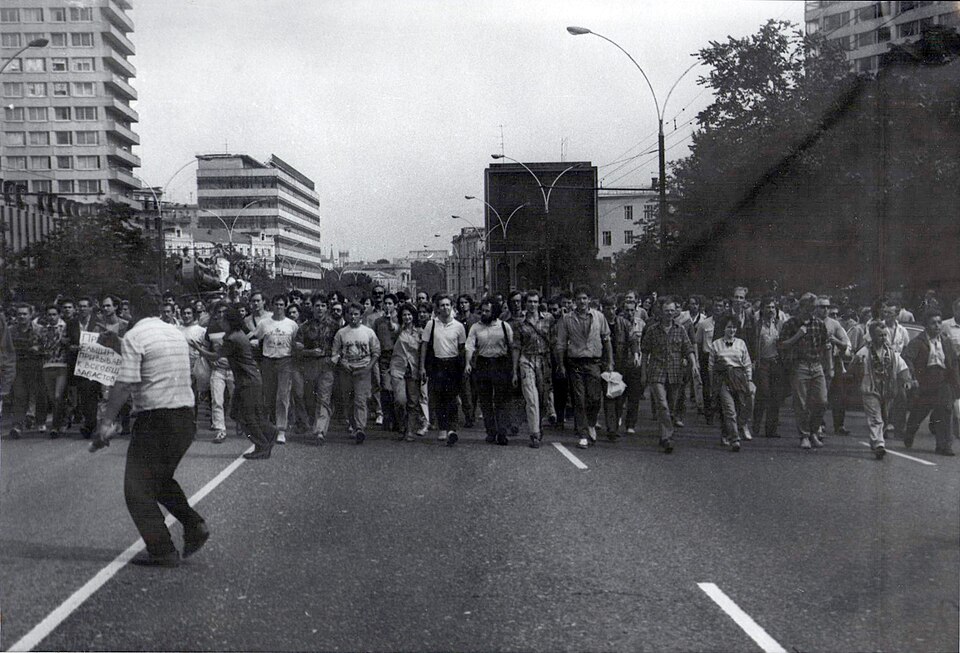
Marchers on Kalininsky Prospekt heading from the Kremlin toward the White House, 19 August 1991. Photo by Ivan Simochkin, CC BY-SA 3.0.
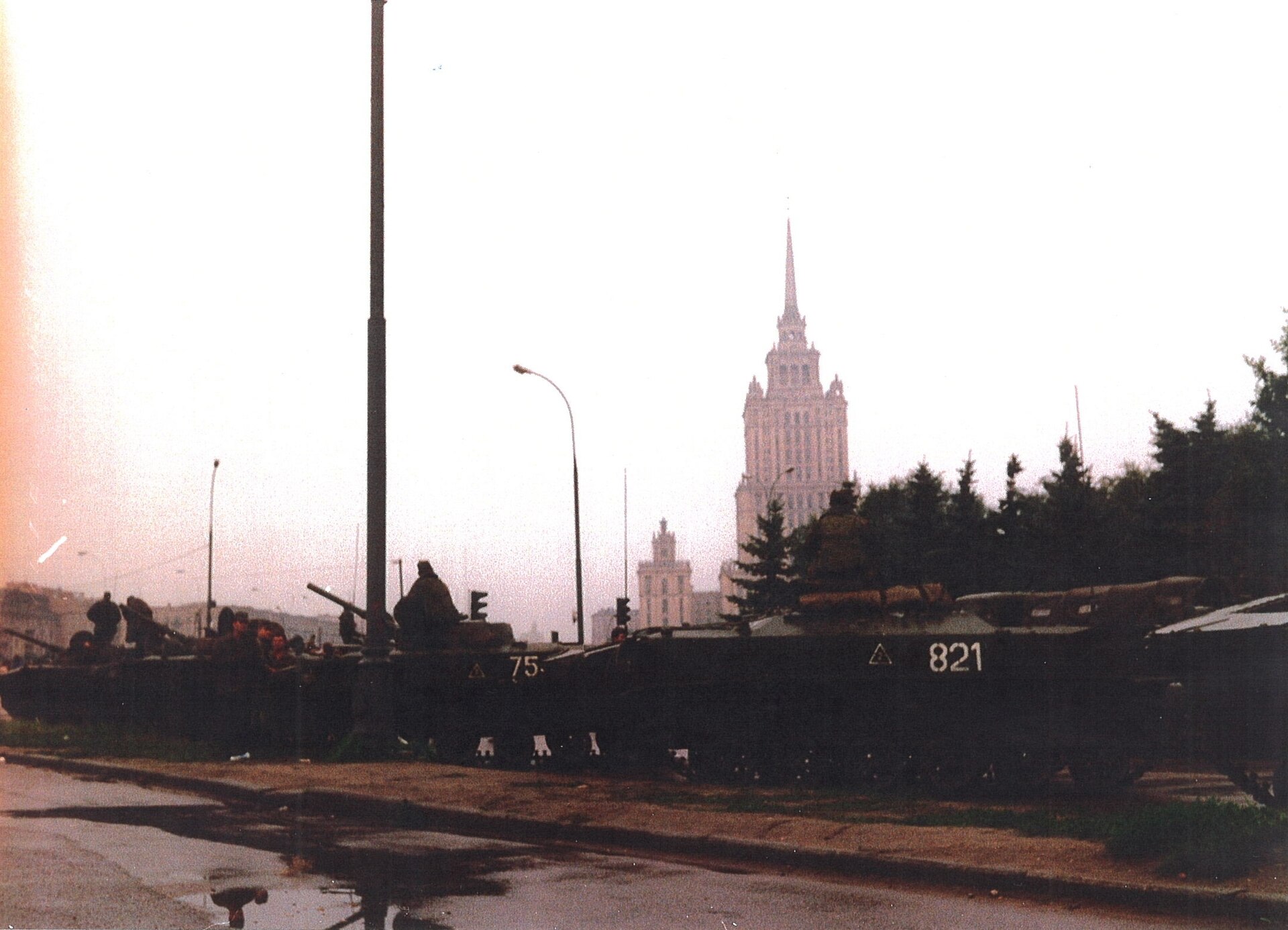
Tanks at the White House's Krasnopresnenskaya Embankment entrance, 20 August 1991. Photo by Ole Husby, CC BY-SA 2.0.
How it works
- Transfer: standing on an armoured vehicle — the Soviet state's own instrument of coercive force — carried the tank's symbolism of authority onto the side that had climbed on top of it rather than the side that had sent it. The same transfer ran through the Russian tricolour, a pre-Soviet flag, flown by the crowd throughout the crisis and formally adopted as a state symbol the moment the coup collapsed: an older legitimacy, borrowed for the new government.
- Name-calling: the Appeal calls the takeover "a rightist, reactionary, anti-constitutional coup d'etat" and its organisers "putschists" hours after the GKChP's own announcement and well before any court or legislature had ruled on the state of emergency's legality. The label did work a formal finding had not yet done — though in this case the record substantially bore it out: the coup did collapse within three days, and its members were later prosecuted before being amnestied by the State Duma in February 1994.
- Bandwagon: the Appeal, the growing crowds, and the repeated broadcast image together signalled that resistance was already winning, which could itself draw in units and citizens who had not yet chosen a side. Contemporaneous descriptions of "tens of thousands" outside the White House functioned as momentum whether or not any government or press organisation had actually counted them.
- Fear appeal: "Storm clouds of terror and dictatorship are gathering over the whole country. They must not be allowed to bring eternal night" frames the stakes in the most absolute terms available, on the first day, to justify an unprecedented ask — an indefinite general strike — before the GKChP's actual reach or intentions were established.
Considered and not tagged: Testimonial. Major Yevdokimov's tank company standing beside Yeltsin, visibly, functioned like an endorsement of his legitimacy, but the crew were principals in the event acting in their own right, not a separate, named voice vouching for someone else's claim, so this page does not tag it.
Then and now
A comparable standoff — civilians massed around armoured vehicles, ended by a broadcast appeal rather than by force — closed a different authoritarian crisis five and a half years earlier, covered on this archive's Marcos's martial law: the 'New Society' and the online contest over its memory page. On 22-25 February 1986, Cardinal Jaime Sin used the Catholic Church's Radio Veritas to ask Filipinos to bring food to the rebel officers at Camp Crame and block loyalist troops without violence; Ferdinand Marcos left for exile on 25 February.
The differences are real. Yeltsin was an elected head of a Soviet republic invoking his own two-month-old mandate against an unelected emergency committee; the Manila broadcast came from a church rather than a rival government official, aimed at a martial-law apparatus fourteen years old rather than a three-day committee. The Philippine crisis ran five days from a disputed election to Marcos's departure; the Soviet coup ran three days from announcement to collapse. In both cases the outcome turned on soldiers choosing, in public view, not to fire on the crowd in front of them.
Positions on the record
- Yeltsin's own framing, 19 August 1991. The Appeal calls the takeover unconstitutional, says Russia's "democratic process... is acquiring an increasingly broad sweep and an irreversible character," and calls for a general strike until Gorbachev is restored and able to address the country himself.
- The GKChP's framing. The Committee presented itself as rescuing the country from "chaos" and "anarchy," citing Gorbachev's health and invoking the results of the March 1991 referendum on preserving the union. Its declarations, and the criticism made of them at the time, are covered in full on the sibling page From 'ill health' to Swan Lake: the GKChP's case for its own coup, 19-21 August 1991.
- Scholarship. Serhii Plokhy's The Last Empire (2014) reads the tank appearance as the opening move in a contest Yeltsin went on to win against both the coup and, within months, Gorbachev himself. Vladislav Zubok's Collapse (2021) situates the three days inside a longer institutional unravelling of the Soviet state and cautions against treating the White House crowd's defiance as proof that the union's dissolution was either inevitable or broadly willed; opinion surveys from the period, he notes, had still shown majority support for preserving some form of the union. Leon Aron's Yeltsin: A Revolutionary Life (2000) treats the tank speech as the high point of Yeltsin's improvisational political courage, a judgment the same biography complicates when it turns to his later presidency.
- A celebratory retrospective. The Cato Institute's blog, marking an anniversary, calls the moment "Yeltsin's finest" and credits the defenders of the White House with ending seven decades of one-party rule.
- A critical retrospective. A Washington Examiner retrospective ties the same figure standing on the tank to what followed — the 1990s economic collapse, the war in Chechnya, and Yeltsin's own hand-picked successor, Vladimir Putin — arguing the moment's promise and Yeltsin's later record should be read together rather than separately.
- The same building, a different ending. In October 1993, in a separate conflict over constitutional powers with the same parliament, Yeltsin ordered tanks to shell the building he had defended in 1991. Commentators sympathetic to his 1991 stand and critics of his later record cite the same building for opposite points: the first as proof he saved constitutional government, the second as evidence the government he saved did not stay constitutional for long.
- A later official reframing. In his 25 April 2005 address to the Federal Assembly, President Vladimir Putin called the Soviet Union's collapse "the greatest geopolitical catastrophe" of the twentieth century — recasting an event celebrated at the time as a victory for democracy as a step toward a loss much of Russia's later political leadership has treated as regrettable.
- What is documented. The GKChP's announcement and Gorbachev's isolation at Foros; Yeltsin's presence and the Appeal's text; the tank crew's defection; the wire photographs and their rapid international distribution; the deaths of Komar, Krichevsky and Usov; the coup's collapse by 21-22 August; the October 1993 shelling of the same building; the February 1994 amnesty.
- What is contested or not established here. The exact size of the White House crowd on any given day in 1991 (contemporaneous estimates vary; this page adopts none). Whether more resolute military action could have carried the coup, and what would have followed if it had, are counterfactuals this archive does not attempt to resolve. Zubok's caution about how representative the crowd was of wider Soviet opinion is noted above, not adjudicated.
- Not ruled on here. Whether the Soviet Union's dissolution four months later was, on balance, good for the peoples who had lived in it, and whether Yeltsin's later presidency vindicated or squandered the moment on the tank. This page scores how one image and one appeal were built and carried, not that larger argument.
Same-method test
The same scoring applies whether or not the speaker turns out, in hindsight, to have been right. McCarthy's numbers: 205, 57, 81 and the move from 'card-carrying Communists' to 'security risks' (1950-54) shows the same pairing of name-calling and fear-appeal used toward a very different end: Joseph McCarthy's 9 February 1950 Wheeling speech named unspecified "members of the Communist Party" in the State Department and cast the moment as "a final, all-out battle between communistic atheism and Christianity," months before any of his figures were tested. Yeltsin's label was substantially borne out by events that followed within days and was issued by an official elected two months earlier on a real ballot; McCarthy's count shifted publicly from 205 to 57 to 81 unnamed "cases," and the Senate's own Tydings Committee, after investigating, called it "a fraud and a hoax." Same techniques, applied by two speakers the historical record has judged very differently.
A bandwagon effect built to look inevitable, at far greater scale and directed by a state rather than arising among a self-organised crowd, appears in Big-character posters: how the opening labels of China's Cultural Revolution did the work of charges (1966-68): the 1 June 1966 People's Daily editorial announced that "hundreds of millions" were already sweeping away China's "ox-demons and snake-spirits" within days of a single campus poster. The Moscow crowd of August 1991 organised itself and was never officially counted by the government it was defending; the Chinese claim was issued by the state itself, as settled fact, before any crowd had gathered at all.
How to spot it
- Check whether a claim to legitimacy made from atop military hardware rests on something a reader can verify independently — an election result, a court ruling — or only on the claim itself.
- Read doom language ("eternal night," "storm clouds of terror") as a call to act, not as a finding, and ask what facts, as of that hour, actually supported it.
- A unit shown switching sides on camera is a claim about that unit at that moment, not about the whole army or police force; ask who had not yet chosen.
- Track what a crisis-era label ("putschist," "illegal," "unconstitutional") is later confirmed or reversed by — a court, an amnesty, a parliamentary vote — rather than by how often it was repeated at the time.
Images
| Image | Source | Licence |
|---|---|---|
| Mechanism diagram (above) | Drawn for FRAME from this page's sourced facts (make_diagrams_fall_yeltsin_tank.py) |
CC BY 4.0, FRAME |
| Marchers on Kalininsky Prospekt, Moscow, 19 August 1991 | Wikimedia Commons, photo by Ivan Simochkin | CC BY-SA 3.0 |
| Tanks at the White House's Krasnopresnenskaya Embankment entrance, 20 August 1991 | Wikimedia Commons, photo by Ole Husby | CC BY-SA 2.0 |
| White House defenders, 20 August 1991 | Wikimedia Commons, photo by Oleg Klimov/Liberty.SU | CC BY-SA 4.0 |
| Yeltsin at the victory rally, 22 August 1991 | Wikimedia Commons, ITAR-TASS photo via kremlin.ru (First Russian President B.N. Yeltsin Presidential Library) | CC BY 4.0 (also offered under CC BY 3.0) |

.jpg)


Image gaps
- The photograph this page is about. Alexander Zemlianichenko's AP frame of Yeltsin standing on the tank, and the comparable Reuters and Sovfoto images used worldwide on 19-20 August 1991, are the actual iconic images of the moment. They are copyrighted (AP, Reuters) and no openly licensed copy was found, so none is hosted here — the same gap this archive notes for the "Tank Man" photographs on its China's Great Firewall and the June Fourth anniversary page.
- Yeltsin's reading copy of the Appeal, handwritten or typed, if it survives, was not found under an open licence.
- Yeltsin's 19 August ukase declaring the GKChP's actions illegal is on Wikimedia Commons (sourced to rusarchives.ru, tagged public domain as an official act of a Russian state body under Article 1259 of the Russian Civil Code), but repeated rate-limit errors from Wikimedia's servers prevented downloading it from the environment used to build this page. It remains at the Commons URL in Sources below and is fillable on a later pass.
- The barricades on the night of 20-21 August, and the underpass where Komar, Krichevsky and Usov were killed, were not found under an open licence.
- The October 1993 shelling of the same building has its own openly licensed photographs on Commons; none is used here, since this page's period is August 1991 and the 1993 event is treated only as a documented later fact, not illustrated.
Sources
- Boris Yeltsin, "Appeal to the Citizens of Russia" ("Obrashchenie k grazhdanam Rossii"), 19 August 1991; English translation (U.S. Department of State) as reprinted at web.viu.ca/davies/H102/Yelstin.speech.1991.htm; also reprinted in "Documents on Democracy," Journal of Democracy 2, no. 4 (Fall 1991): journalofdemocracy.org/articles/documents-on-democracy-84.
- Serhii Plokhy, The Last Empire: The Final Days of the Soviet Union (Basic Books, 2014).
- Vladislav Zubok, Collapse: The Fall of the Soviet Union (Yale University Press, 2021).
- Leon Aron, Yeltsin: A Revolutionary Life (St. Martin's Press, 2000).
- "As tanks rolled in 1991, AP photographer sprang into action," Associated Press, 19 August 2021, republished at wtop.com/europe/2021/08/as-tanks-rolled-in-1991-ap-photographer-sprang-into-action.
- "Russia's Brightest Moment: The 1991 Coup That Failed," The Moscow Times, 19 August 2016: themoscowtimes.com/2016/08/19/the-forgotten-coup-a55030.
- "Russia: A Chronology Of 1991 Failed Soviet Coup (Part 1)," Radio Free Europe/Radio Liberty: rferl.org/a/1097161.html.
- "25 years on, Russians tell of how they defeated a coup," Arab News, 2016: arabnews.com/node/971086.
- "Soviet hard-liners launch coup against Gorbachev," History.com: history.com/this-day-in-history/august-18/soviet-hard-liners-launch-coup-against-gorbachev.
- "Defense of Soviet state against coup, 1991," Global Nonviolent Action Database, Swarthmore College: nvdatabase.swarthmore.edu/content/defense-soviet-state-against-coup-1991.
- "Remembering Boris Yeltsin's Finest Moment," Cato at Liberty (Cato Institute blog): cato.org/blog/remembering-boris-yeltsins-finest-moment.
- "How a drunk old Russian maverick helped tank the USSR and give rise to Putin," Washington Examiner: washingtonexaminer.com/news/2327779.
- "Hardline coup set the stage for Soviet collapse 30 years ago," The Tribune (India), wire retrospective: tribuneindia.com/news/world/hardline-coup-set-the-stage-for-soviet-collapse-30-years-ago-298986.
- Wikipedia: Alexander Zemlianichenko; 1991 Soviet coup attempt; White House (Moscow); Timeline of the 1991 Soviet coup attempt.
- Vladimir Putin, Annual Address to the Federal Assembly of the Russian Federation, 25 April 2005 ("the greatest geopolitical catastrophe" remark).
- Wikimedia Commons: File:Vladimir Usov, Ilya Krichevsky, Dmitri Komar Stamps.png (posthumous Hero of the Soviet Union commemorative stamps); File:10-10-gkchp.jpg (Yeltsin's 19 August 1991 ukase, sourced to rusarchives.ru); Category:1993 Russian constitutional crisis.

