Content note: this page quotes the name of the 2017 "pussyhat", which refers to Donald Trump's recorded comment about groping women, and shows a photograph from the Capitol grounds on 6 January 2021.
In one line: between 2016 and 2021 supporters and opponents of Donald Trump built mass movements using hats, slogans, rallies, marches, town halls and social media; most of it was open, attributed advocacy, and each side also carried a claim that official findings did not support ("the steal" of 2020; a proven Trump-Russia conspiracy), with very different outcomes.
This page covers volunteer and movement organising. Paid campaign advertising is covered elsewhere.
What happened
MAGA
- 1980. Ronald Reagan's campaign issues buttons reading "Let's Make America Great Again" (Smithsonian).
- 2015-2016. Trump's campaign uses "Make America Great Again" and the red cap at rallies. Stanford's Symbolic Systems program names the hat its 2016 symbol of the year.
- 2016. Roger Stone's political action committee runs a "Stop the Steal" website and volunteer "vote protectors" project, first claiming the Republican nomination would be stolen from Trump, then the general election (CNN).
- 2016. r/The_Donald on Reddit works as a meme workshop whose images spread to other platforms (MIT Technology Review).
- 2020. Volunteers organise "Trump Train" car convoys and boat parades; a Facebook page for a 5 September boat parade on Lake Travis, Texas, says more than 2,600 people plan to attend (CNN). On 30 October a convoy surrounds a Biden-Harris campaign bus on Interstate 35; in 2024 a federal civil jury finds one of six defendants liable under the Ku Klux Klan Act of 1871 and clears five (Texas Tribune).
- 5 November 2020. Facebook removes a "Stop the Steal" group created by Women for America First, which had gained hundreds of thousands of members in two days, saying it was "organized around the delegitimization of the election process" and carried "worrying calls for violence" (NPR). Ali Alexander incorporates a new Stop the Steal entity on 10 November and holds rallies around the country (House January 6 committee).
- November 2020 to January 2021. Courts dismiss or rule against Trump and his allies in more than 60 election cases (Campaign Legal Center). CISA and election officials state: "There is no evidence that any voting system deleted or lost votes, changed votes, or was in any way compromised." Attorney General William Barr says he has "not seen fraud on a scale that could have effected a different outcome in the election" (NPR).
- 6 January 2021. Women for America First holds the permitted rally at the Ellipse, where Trump speaks (ABC News). Crowds then attack and breach the Capitol. More than 140 police officers are assaulted, and the Justice Department charges more than 1,500 people (U.S. Attorney, D.C.).
The Resistance
- 8-12 November 2016. #Resist and #NotMyPresident spread online, and marches under "Not my president" take place in many cities (NPR). In Portland, Oregon, police declare a riot on 10 November after property is damaged (NPR).
- November 2016. The Pussyhat Project designs a knitted pink hat for the Women's March "to make a unique collective visual statement" (Pussyhat Project).
- December 2016. Former congressional staffers publish the Indivisible guide, modelled on the Tea Party (Indivisible).
- 6 January 2017. House Democrats object to electoral votes from several states. No senator joins, and Vice President Biden rules the objections out of order (Roll Call).
- 6 January 2021. After the Capitol is cleared, Congress resumes counting. Members object to Arizona's and Pennsylvania's electoral votes; 6 and 7 senators respectively, and 121 and 138 representatives respectively, all Republicans, vote to sustain the objections, which fail (CNN; Forbes).
- 10 January 2017. BuzzFeed News publishes the Steele dossier, which it describes as unverified (CNN).
- 21 January 2017. The Women's March. Crowd counts by political scientists put U.S. turnout above 3 million (Britannica). D.C. police report no arrests; protests on inauguration day, the day before, ended in 230 arrests after windows were broken and a limousine set on fire (DCist).
- 2017. Local anti-Trump groups form in places of all sizes, through friendships and social media; most members and leaders are middle-class, college-educated white women (Gose and Skocpol, 2019).
- February 2017. Town halls fill with constituents opposing repeal of the Affordable Care Act; about 1,000 people attend Rep. Jason Chaffetz's in Utah (NBC News).
- 2017-2019. Anti-Trump social-media accounts forecast imminent charges. On 13 May 2017 Louise Mensch and Claude Taylor write that sources "with links to the intelligence and justice communities have stated that a sealed indictment has been granted against Donald Trump" (Snopes). No such indictment appears.
- April 2019. The Special Counsel's report documents Russian interference and many campaign contacts, and states that "the investigation did not establish that members of the Trump Campaign conspired or coordinated with the Russian government in its election interference activities" (Justice Department). In December 2019 the Justice Department Inspector General reports that Steele's primary sub-source told the FBI Steele "misstated or exaggerated" his statements, and that the FBI relied on Steele's reporting in surveillance applications on former Trump campaign adviser Carter Page without corroborating its specific allegations about him (CNN); the 2023 Durham report says the FBI could not corroborate the dossier's substantive allegations (CNN).
How it works
- Glittering generalities: "Make America Great Again" and signs such as "Love Trumps Hate" (New York, 12 November 2016, photo below) rest on a virtue word, "great" or "love". Swap in a measurable goal and the slogan no longer says anything specific. Both work as a banner, not as a claim.
- Name-calling: "Stop the Steal" names the result a theft. In 2016 Stone applied it to the Republican nomination and then to the general election before either result was known; in 2020 it was in use while ballots were still being counted, and stayed in use after courts dismissed or ruled against more than 60 of the post-election cases. The original Indivisible guide opens by saying Trump would reshape America "in his own racist, authoritarian, and corrupt image". Both put a verdict in the label. The difference is in what can be checked: a vote count can be tested in court, and was, repeatedly, against the fraud claims; a character judgment like "racist, authoritarian, and corrupt" is an argument, which this archive does not rule on and scores only as a label.
- Astroturfing: the Internet Research Agency in St Petersburg imitated both movements, promoting "Miners for Trump" rallies and a "Trump is NOT my President" rally in New York on 12 November 2016 through fake American accounts (see 'Miners for Trump' rally poster (Internet Research Agency) and 'Russian Ads on Facebook' (House Intelligence Committee exhibit)). Separately, each side called the other's crowds fake. In 2009 Nancy Pelosi said of anti-health-reform town hall protesters, "I think they're Astroturf" (ThinkProgress archive). In 2017 Trump posted: "The so-called angry crowds in home districts of some Republicans are actually, in numerous cases, planned out by liberal activists. Sad!" (X). Organised is not astroturf: Tea Party groups and Indivisible both organised openly under their own names, and reporters found no evidence for the 2017 claim that protesters were paid (VOA).
- Testimonial: the sealed-indictment claim rested on unnamed sources "with links to the intelligence and justice communities". The vouching replaced any document a reader could check.
- Sleeper effect: on both sides the claim outlived its correction, though at very different scales: the fraud claims kept a presidential rally and a Capitol breach going after dozens of court losses, while the collusion theories continued mainly in social-media commentary after the Mueller report. The dossier was published under an "unverified" label, and some #Resistance accounts kept building on collusion theories after the Mueller report (Daily Beast). Stop the Steal rallies continued through the weeks in which courts rejected the fraud claims, up to 6 January.
Plain open persuasion. Most of what both movements did is ordinary, attributed advocacy and not a technique in the taxonomy: wearing a hat, holding a rally or march, driving in a parade, calling or visiting a representative, attending a town hall, registering voters. Indivisible published its tactics under its own name. The pink hat and the red cap are both identity markers that wearers chose openly. A BuzzFeed News study of six large partisan Facebook pages in 2016 found false or misleading content in 38% of posts on three right-wing pages and nearly 20% on three left-wing pages (BuzzFeed News), so the problem appeared on both sides at different rates.
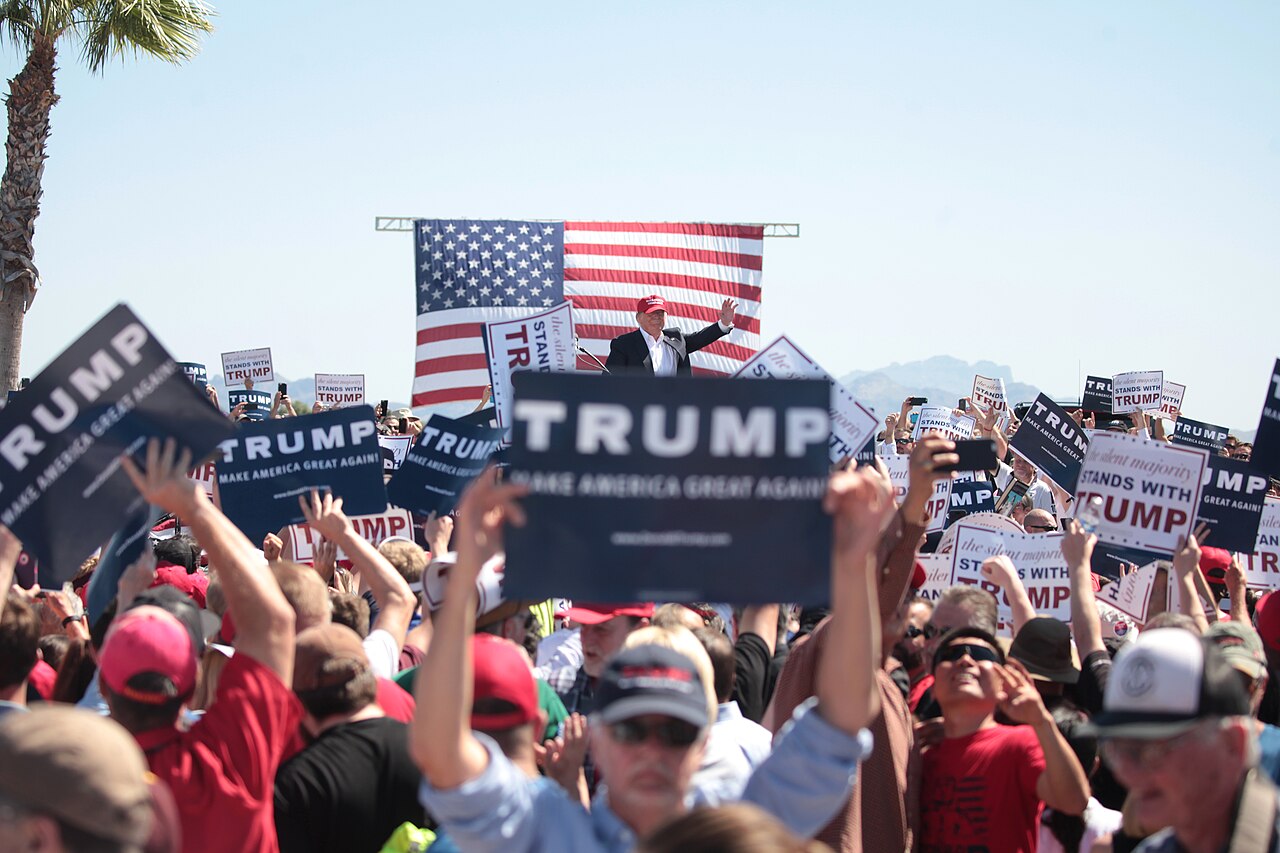
Trump rally, Fountain Hills, Arizona, 19 March 2016. Photo by Gage Skidmore, CC BY-SA 2.0.
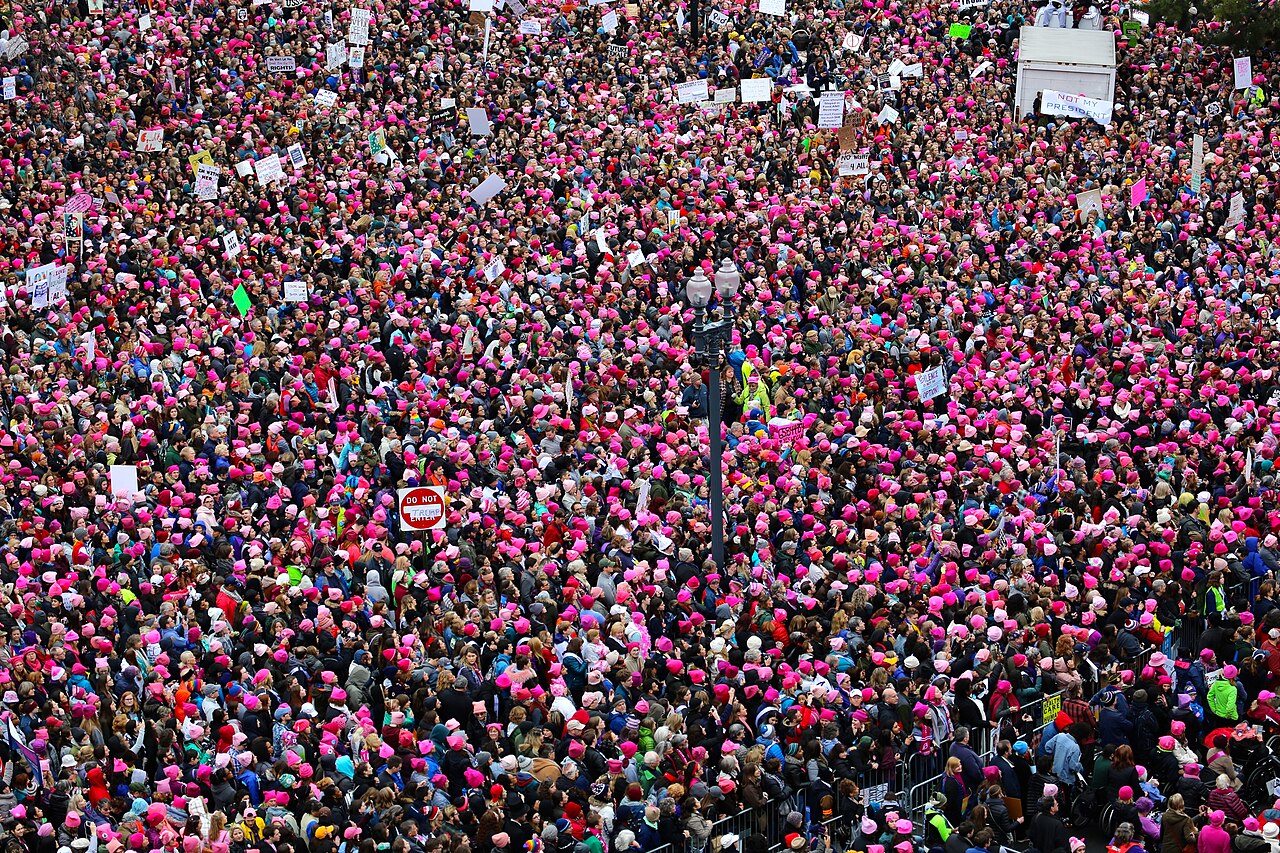
Women's March, Washington, 21 January 2017, from the roof of the Voice of America building. Voice of America, public domain.
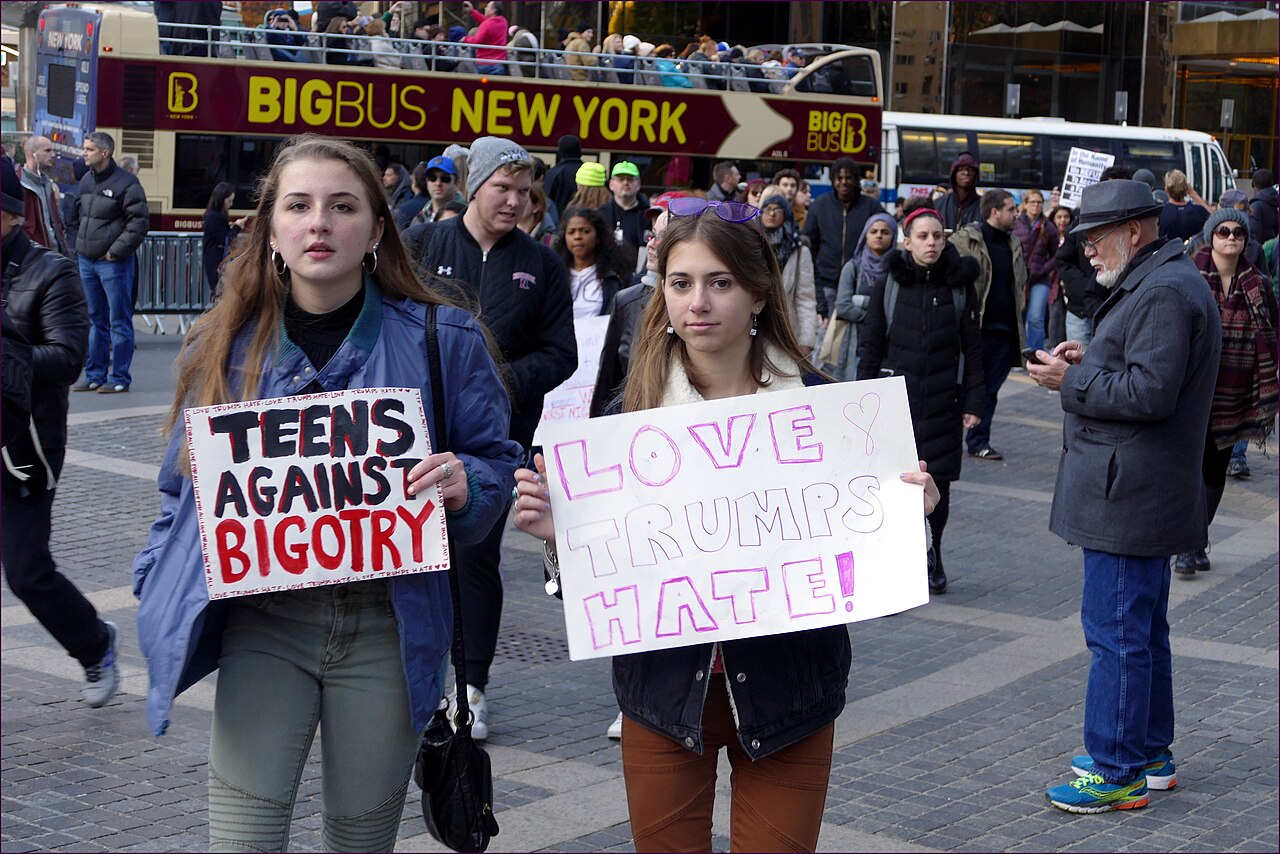
Anti-Trump march, Union Square, New York, 12 November 2016. Photo by The All-Nite Images, CC BY-SA 2.0. The record does not show any link between these marchers and the IRA-promoted event of the same day.
Then and now
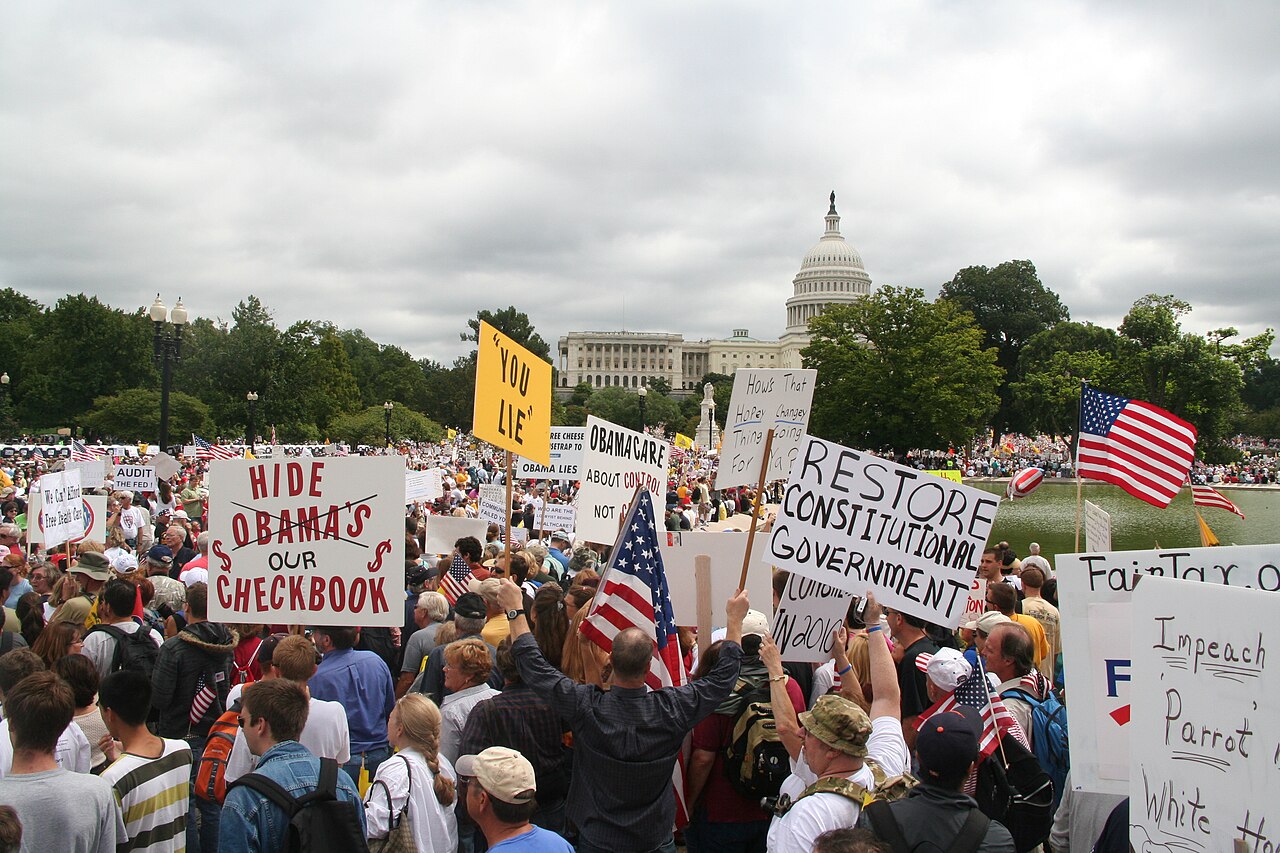
Taxpayer March on Washington, 12 September 2009. Photo by Patriot Room, CC BY 2.0.
The Resistance's town-hall method came from the right. Indivisible's authors wrote that they watched Tea Party activists "organize locally and convince their own MoCs to reject President Obama's agenda", judged "Their ideas were wrong, cruel, and tinged with racism", and set out "to replicate the Tea Party's success in getting Congress to listen to a small, vocal, dedicated group of constituents" (Indivisible guide). MAGA's slogan came from Reagan's 1980 campaign. Methods move between sides; the technique test stays the same.
The "Stop the Steal" frame and the collusion frame differ plainly in outcome. The Stop the Steal rally of 6 January was followed by the breach of the Capitol, in which more than 140 officers were assaulted; more than 1,500 people were charged. No comparable violence is recorded from the collusion messaging on social media; the violence recorded on the anti-Trump side in this period, such as Portland in November 2016 and the inauguration-day arrests, was smaller in scale and took place in city streets, not at the counting of electoral votes. Each frame also touched state power, on very different scales: the sitting president spoke at the 6 January rally that preceded the attack on the Capitol, while the FBI used dossier reporting in surveillance applications on one former campaign adviser, Carter Page.
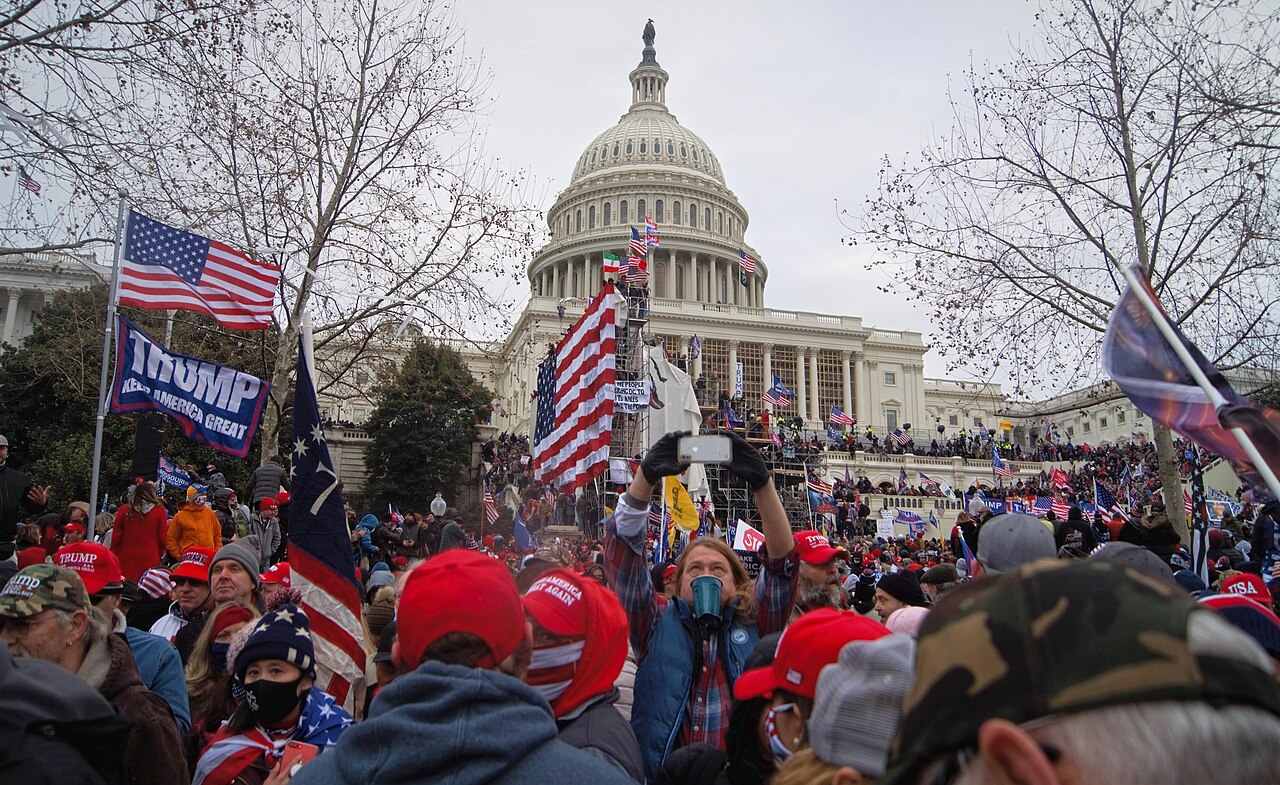
Capitol grounds, 6 January 2021. Photo by Tyler Merbler, CC BY 2.0.
Positions on the record
- MAGA's stated position: "Make America Great Again", on caps, signs and banners; Stop the Steal organisers said the 2020 election was stolen; Trump said the 2017 town-hall crowds were planned by liberal activists.
- The Resistance's stated position: Indivisible says Trump "has no mandate" and that "Together, we have the power to resist", and later wrote "In 2017, we made Congress listen" (Indivisible on Offense, 2018). Collusion-focused accounts said Trump conspired with Russia and would be charged.
- This archive's reading: documented are the rallies, marches, town halls, parades, the slogans and hats, the court rulings against the 2020 fraud claims, the Mueller finding that no conspiracy was established, and the violence of 6 January. Not shown: fraud that changed the 2020 result; a proven criminal conspiracy between the Trump campaign and Russia; paid protesters at the 2017 town halls. This page takes no position on Trump, his policies or his opponents.
Same-method test
Swap the sides. A left-wing movement that called a certified count "the steal" after courts dismissed or ruled against more than 60 of its cases would get the same Name-calling finding. A pro-Trump account that promised a sealed indictment of a Democratic president on the word of unnamed sources would get the same Testimonial finding. The record already contains a live swap: Pelosi in 2009 and Trump in 2017 each described an opposing town-hall wave as manufactured, and each is scored the same way here.
How to spot it
- Separate the symbol (a hat, a march) from the claim it travels with. The first is expression; only the second can be checked.
- For fraud or conspiracy claims, look for the ruling, the filed charge or the report's own wording, not a forecast of one.
- Note when a label ("steal", "collusion", "astroturf") arrives before the evidence, and whether it changes after.
- Ask who organised an event. A named group that publishes its tactics is organising; an account that hides who runs it is the thing to check.
Images
| Image | Source | Licence |
|---|---|---|
| Trump rally, Fountain Hills, 2016 | Wikimedia Commons, Gage Skidmore | CC BY-SA 2.0 |
| Women's March, Washington, 2017 | Wikimedia Commons, Voice of America | Public domain (U.S. government work) |
| "Not my president" march, Union Square, New York, 2016 | Wikimedia Commons, The All-Nite Images | CC BY-SA 2.0 |
| Taxpayer March on Washington, 2009 | Wikimedia Commons, Patriot Room | CC BY 2.0 |
| Capitol grounds, 6 January 2021 | Wikimedia Commons, Tyler Merbler | CC BY 2.0 |
.jpg)
.jpg)
.jpg)

_(retouched).jpg)
Image gaps
- Reagan's 1980 "Let's Make America Great Again" button. A photo is on Wikimedia Commons marked public domain, but Commons also flags it as trademarked and the photo comes from an auction house, so it is not hosted here. This gap can be filled after a rights check.
- The Indivisible guide pages. The 2018 follow-up guide is on Commons as CC BY-SA 4.0, but its own first page states CC BY-NC-SA 4.0; that conflict is unresolved, so it is linked, not hosted.
- Red MAGA caps and pink hats as products, campaign logos, and the Stop the Steal and Women's March logos. Trademarked designs; not hosted.
- Paid ads. Covered on another page.
- "Trump Train" convoys and boat parades. No openly licensed photo was found.

Sources
- MAGA side and official findings: Smithsonian, Reagan 1980 button; Stanford Symbolic Systems, 2016 symbol of the year; CNN on Stop the Steal, 2020; NPR on the Facebook group; House January 6 committee report, ch. 6; ABC News on the Ellipse permit; Campaign Legal Center, 2020 lawsuits; Brookings on the 2020 cases; Chris Krebs, Senate testimony, 16 December 2020; NPR on Barr; U.S. Attorney, D.C., 48 months; Texas Tribune, Trump Train verdict; CNN, Lake Travis parade; MIT Technology Review on political memes; Trump post, 21 February 2017.
- Resistance side and official findings: Indivisible, introduction to the guide; Indivisible guide (PDF); Indivisible on Offense (2018); Pussyhat Project; Britannica, Women's March; DCist on arrests; NBC News, Chaffetz town hall; VOA on 2017 town halls; NPR, November 2016 protests; NPR, Portland; CNN, 2021 objections to Arizona's and Pennsylvania's electoral votes; Forbes, House Republicans' vote on Pennsylvania and Arizona electors; Roll Call, 6 January 2017; CNN on BuzzFeed and the dossier; Snopes on the sealed-indictment claim; Daily Beast on #Resistance accounts after the report; Special Counsel's report, Vol. I; CNN on the Inspector General's report; CNN on the Durham report.
- Both sides and scholarship: ThinkProgress archive, Pelosi 2009; BuzzFeed News, partisan Facebook pages, 2016; Gose and Skocpol, "Resist, Persist, and Transform", Mobilization 2019.