Content note. This case describes a film that restages the torture of army officers, official labels applied to communists and their families, and mass killings. Labels and atrocity claims are quoted as evidence of the method, not as this archive's description of anyone.
In one line: Indonesia's New Order government kept one account of 30 September 1965 in daily life through a monument, an official history, a state-made film shown every 30 September and background checks on relatives, while the mass killings that followed stayed out of the frame; the compulsory screenings ended in 1998, and in 2017 the army ordered them again.
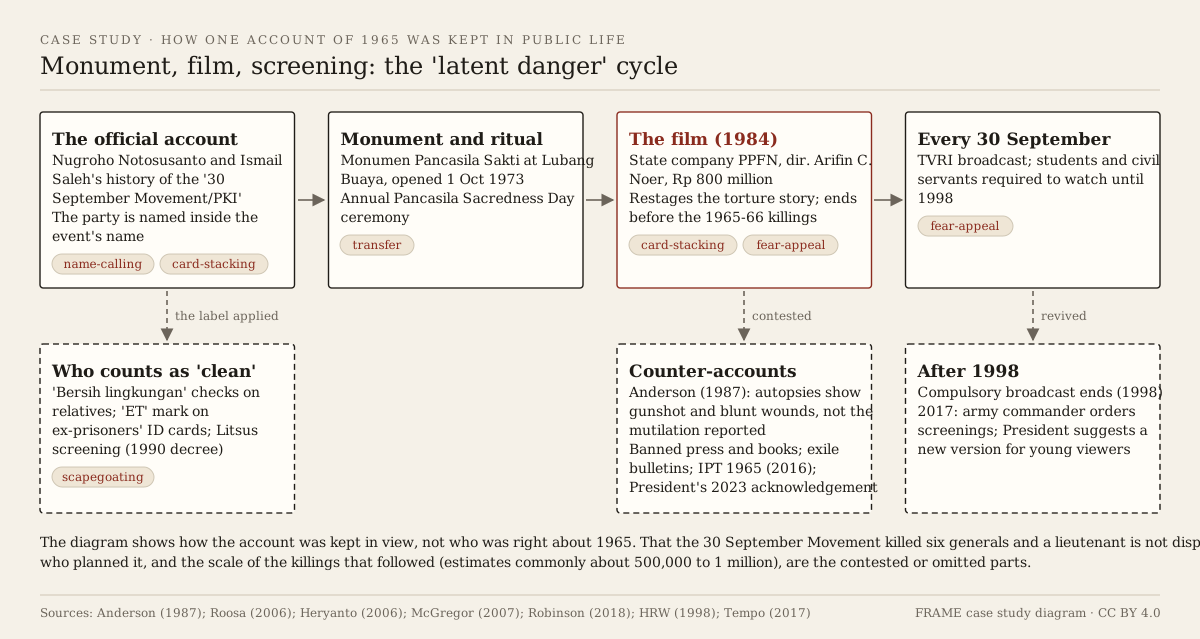
What happened
Background (1965-66, covered in depth in Lubang Buaya, 1965: the mutilation story the autopsies did not support).
- 30 September-1 October 1965. The 30 September Movement (G30S) kidnaps and kills six generals and a lieutenant in Jakarta; their bodies are put in a well at Lubang Buaya. The army under Major General Suharto blames the Indonesian Communist Party (PKI); who planned the movement is still disputed (Roosa 2006).
- 2 October 1965. The PKI daily Harian Rakjat runs an editorial supporting the movement, which it calls an internal army affair (Roosa 2006).
- October 1965. Army newspapers report that the officers were tortured and mutilated. The autopsies, ordered by Suharto, record gunshot and blunt-force wounds and no eye-gouging or genital mutilation (Anderson 1987).
- 1965-66. Army units and civilian groups kill communists and people accused of being communists. Estimates commonly run from about 500,000 to 1 million dead, with more than a million detained (Robinson 2018; Roosa 2006).
The government's account, 1966-1998.
- 1966. A decree of the Provisional People's Consultative Assembly (TAP MPRS XXV/1966) dissolves the PKI and bans the spread of communism and Marxism-Leninism. The ban is still in force.
- 1968. Nugroho Notosusanto, head of the armed forces history centre, and prosecutor Ismail Saleh publish the official account of the "G30S/PKI" coup attempt. Nugroho later edits volume VI of the school history Sejarah Nasional Indonesia and serves as education minister in 1983-85 (McGregor 2007).
- 1 October 1973. Suharto inaugurates the Monumen Pancasila Sakti (Sacred Pancasila Monument) at Lubang Buaya, with bronze statues of the seven dead officers by sculptor Edhi Sunarso. 1 October is marked each year as Hari Kesaktian Pancasila (Pancasila Sacredness Day), with a central ceremony at the site. The complex is run by the armed forces history centre (detik; Pusat Sejarah TNI).
- 1978. The People's Consultative Assembly (MPR) orders P4 courses (Guidelines for the Comprehension and Practice of Pancasila) for civil servants and students (Morfit 1981).
- 30 September 1984. Pengkhianatan G30S/PKI ("The Treachery of G30S/PKI") is released: produced by the state company PPFN, written and directed by Arifin C. Noer, budget Rp 800 million, based on the Nugroho and Ismail Saleh account. It restages the officers' torture at Lubang Buaya and ends with Suharto crushing the movement and urging Indonesians to remember the dead and fight communism. The 1965-66 killings are not shown. Arifin's widow later said he worked independently (Vice).
- Every 30 September, from 1984 to 1997. TVRI broadcasts the film, and students and civil servants are required to watch it (Tempo). A 2000 Tempo survey reported that 97 percent of 1,101 students had seen it, about 87 percent more than once (as cited on the film's Wikipedia page).
- Screening for "clean" records. Applicants for the civil service and the armed forces had to show they were bersih lingkungan ("clean environment"): not related to a former political prisoner. Former prisoners' identity cards carried the letters "ET" (eks tapol) (Heryanto 2006). A 1990 presidential decree set up Litsus ("special investigation") background checks for the civil service, the military and other professions. Former 1965-67 prisoners remained barred from teaching (HRW 1998).
- Other New Order messaging. The MPR titled Suharto Bapak Pembangunan (Father of Development) in 1983. Suharto's 1989 autobiography calls the 1983-85 petrus ("mysterious shootings") killings of suspected criminals "shock therapy" (Soeharto 1989; Wikipedia, "Petrus killings"). Indonesia described its 1975 invasion of East Timor as "integration"; Timor-Leste's truth commission later counted at least 102,800 conflict-related deaths in 1974-1999 (CAVR 2005).
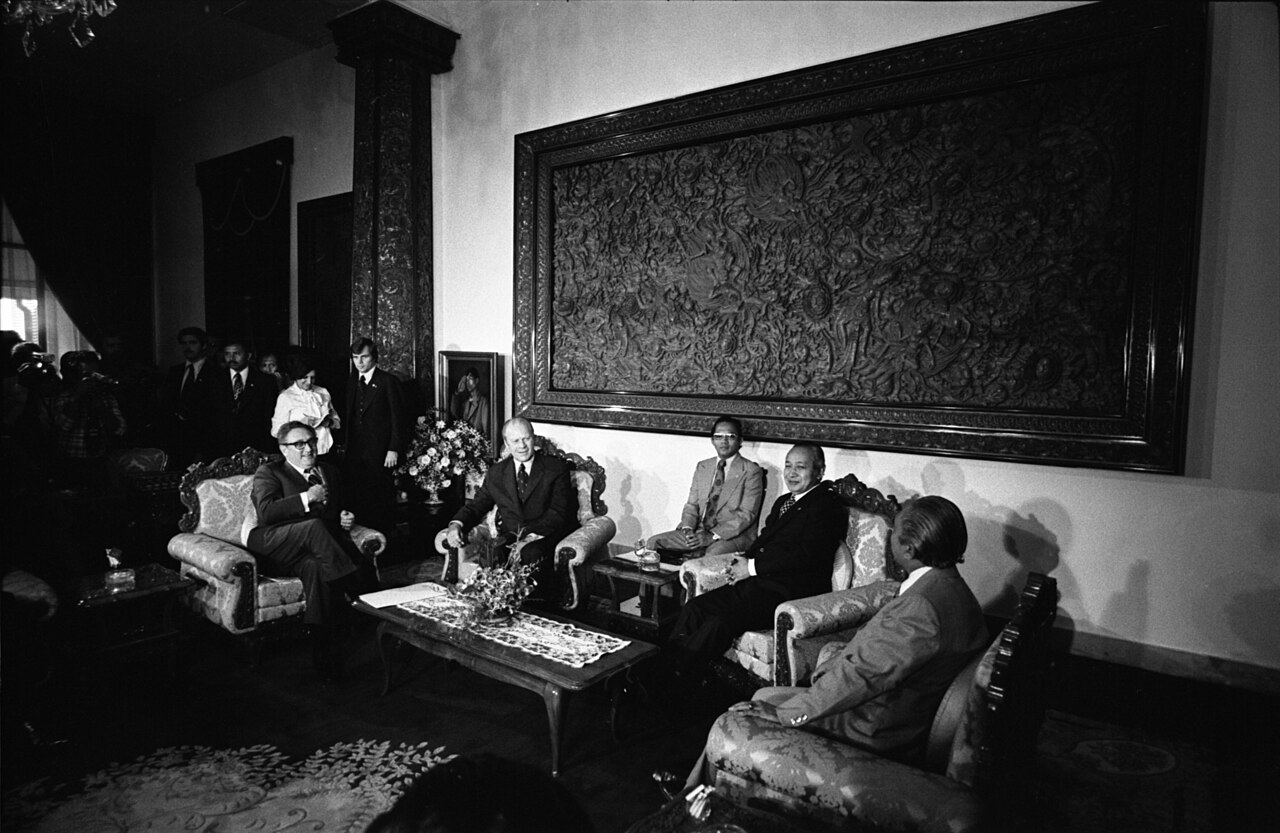
From left: Henry Kissinger, President Gerald Ford, a man not named in the archive caption, President Suharto and Foreign Minister Adam Malik at the Istana Merdeka, Jakarta, 6 December 1975, the day before Indonesian forces entered Dili. White House photo by David Hume Kennerly, Gerald R. Ford Library. Public domain (U.S. government work). Shown for the foreign-government side of the record. The U.S. record of the meeting, declassified and published by the National Security Archive in 2001, has Suharto raising "rapid or drastic action" on East Timor, Ford replying "We will understand and will not press you on the issue", and Kissinger adding "It is important that whatever you do succeeds quickly".
Foreign governments, 1965-68.
- 1965-66. Britain's Foreign Office Information Research Department (IRD), working from a unit in Singapore, produces black propaganda: material presented as the work of Indonesian patriots that calls for the PKI to be eliminated. It remained secret until 1998 (Lashmar and Oliver 1998; The Observer, 17 October 2021).
- 1965-66. U.S. embassy files declassified in 2017 show that embassy staff kept a record of which PKI leaders were being executed, and that U.S. officials supported the army's efforts to destroy the left-leaning labour movement (National Security Archive 2017).
- 1968. A CIA research study, Indonesia 1965: The Coup That Backfired, concludes that the PKI leadership planned the movement: the same account as the New Order's.
Opponents and counter-accounts.
- 1966-1971. Cornell scholars Benedict Anderson and Ruth McVey argue in a paper circulated privately in 1966 and published in 1971 that the movement began as an internal army affair. Anderson was later refused entry to Indonesia (Anderson and McVey 1971).
- 1980-81. Pramoedya Ananta Toer, held without trial on Buru Island from 1969 to 1979, publishes Bumi Manusia (This Earth of Mankind). The Attorney General bans it and the rest of the Buru Quartet as they appear. The London exile bulletin TAPOL publishes on political prisoners from 1973.
- 21 June 1994. Information Minister Harmoko revokes the licences of Tempo, Editor and DeTik. The ministry says the magazines ignored repeated government warnings (Washington Post). Journalists found the Alliance of Independent Journalists (AJI), and on 3 May 1995 the Jakarta Administrative Court rules against the ban (HRW 1995; Tempo).
- September 1998. Four months after Suharto resigns, Information Minister Yunus Yosfiah ends the compulsory broadcast. He says the film was out of step with the Reform era; he is also reported as calling it an attempt to manipulate history and build a cult around Suharto (Tempo; Wikipedia).
- 2012-2016. Joshua Oppenheimer's The Act of Killing (2012) and The Look of Silence (2014) film perpetrators re-enacting the killings. The International People's Tribunal 1965, a people's tribunal with no official mandate, sits in The Hague in November 2015 on nine counts, including "hate propaganda". In July 2016 its judges find the Indonesian state responsible for crimes against humanity (IPT 1965; Time).
The revival, 2017 onwards.
- September 2017. Armed forces commander General Gatot Nurmantyo orders units to hold joint screenings. He says the aim is to remind people of 1965 so it does not happen again (Tempo). President Joko Widodo says he has no objection, and suggests a newer version that would reach millennials so they understand the PKI and the dangers of communism. On 29 September he watches the film with about 1,000 people at the Bogor military command (Tempo English; Indoleft; Setkab; APSN).
- 11 January 2023. President Widodo acknowledges 12 past gross human-rights violations, starting with 1965-66, and says he "strongly regrets" them (Al Jazeera; UN News).
How it works
- Card stacking: the film and the official history begin with a PKI plot and end with the army crushing it and the dead officers honoured. The killings of 1965-66, which were far larger, are left out, and so is the historians' debate about who planned the movement. The violence the film dwells on is the violence done to the officers.
- Fear appeal: bahaya laten komunis, the "latent danger of communism". The annual broadcast, the 2017 order's stated aim of preventing a repeat, and the call for a remake so the young understand the dangers of communism keep a party banned since 1966 present as a hidden threat, with vigilance and the official account as the remedy.
- Name-calling: the event's official name, "G30S/PKI", puts the party into the name of the act, so saying the name repeats the verdict. "ET" on an identity card made a person's past visible at every official check.
- Scapegoating: blame for a national crisis was placed on a bounded group, communists, then extended to their relatives through bersih lingkungan and Litsus, whatever the relatives had done. British black propaganda in 1965-66 made the same move against the PKI under a false Indonesian byline.
- Transfer: the monument and the annual ceremony attach the sacred standing of Pancasila, the state ideology, to the army's account. The plaque at the well speaks for the dead officers as defenders of "the purity of Pancasila" (see photo below).
- Euphemism / doublespeak: "shock therapy" for the petrus killings, and "integration" for the invasion of East Timor, name the policy without naming the deaths.
The opponents' material (the court challenge, banned press and books, exile bulletins, scholars' papers, the tribunal) was tested against the same definitions. It makes contested claims, such as the internal-army-affair thesis, but in the items reviewed here these techniques were not found as a method. Who planned the movement remains disputed among historians (Roosa 2006): the CIA's 1968 study argues the same account as the New Order, and Anderson and McVey's paper argues the opposite. This page records both and rules on neither. The foreign governments' material was tested the same way: the British IRD output is tagged under Scapegoating above; the U.S. embassy files are internal records, not messaging.
Then and now
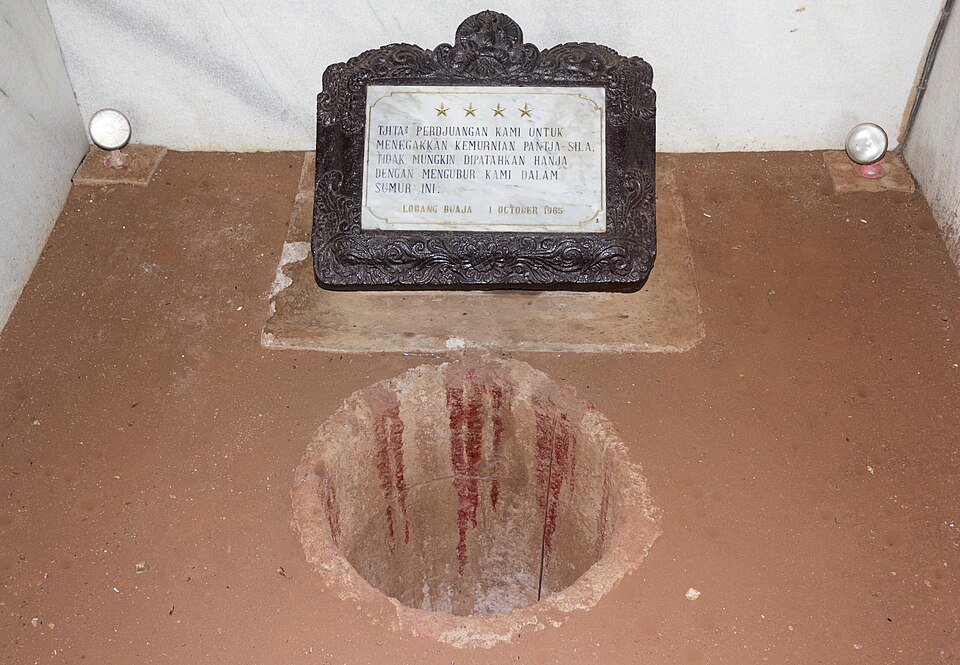
The well at Lubang Buaya inside the Monumen Pancasila Sakti complex, 2013. The plaque, dated "Lobang Buaja 1 October 1965", reads (translated from the old spelling): "The ideals of our struggle to uphold the purity of Pantja-Sila cannot be broken merely by burying us in this well." Photo by Chris Woodrich, CC BY-SA 3.0. The monument's statues are not shown (see Image gaps).
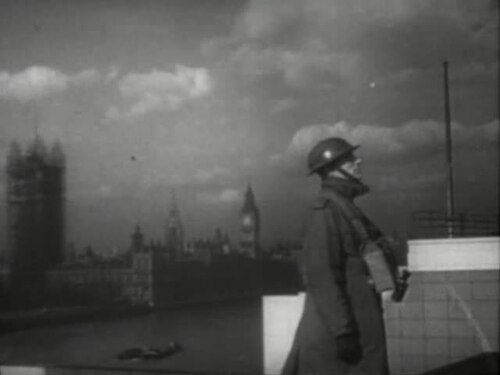
Why We Fight: The Battle of Britain (film frame), U.S. Army, 1943. Public domain.
The same move elsewhere. The U.S. Army showed Frank Capra's Why We Fight films to recruits as required viewing and measured how they changed opinions. Both are state-made films for audiences who had to watch. The differences are large: Why We Fight was wartime training for adult soldiers about foreign enemies; Pengkhianatan G30S/PKI was shown to schoolchildren every year for 14 years, about a domestic event whose named culprits and their families were killed, jailed or screened out of jobs.
The same film later. The 2017 revival shows the frame outlasting the government that made it. The president who attended a 2017 screening also acknowledged the 1965-66 violations in 2023. Both are on the record.
Positions on the record
- The New Order government's position: the PKI planned the 30 September Movement to seize power, the army saved the state and Pancasila, and communism remains a latent danger requiring vigilance. The PKI ban (TAP MPRS XXV/1966) has not been lifted.
- Post-1998 governments: the compulsory screening ended in 1998. In 2017 the armed forces command revived screenings and the president said he had no objection. In 2023 the president acknowledged the 1965-66 violations and expressed regret.
- Critics, survivors and scholars: the film restages torture the autopsies do not support and omits the killings; the tribunal found the state responsible for crimes against humanity.
- What is documented: the film's state production and compulsory screening until 1998; the monument and ceremony; the background checks; the 1994 press bans; the autopsy findings; the 2017 order; the 2023 acknowledgement.
- What is not shown / disputed: who planned the 30 September Movement (PKI leadership, a PKI faction, army officers, or a mix) remains disputed among historians. Death tolls for 1965-66 are estimates; the commonly cited range is about 500,000 to 1 million. The IPT's findings are those of a people's tribunal, not a court. This page makes no finding on the PKI's intentions in 1965.
Same-method test
A state film about a real attack, required viewing for schoolchildren every anniversary, that shows only the attack on its own side and omits far larger reprisals would be scored the same way under any flag. So would screening people by their relatives' politics: the People's Republic of China's class-background labels followed the relatives of "rightists" and "counter-revolutionaries" into schools and jobs, from the other side of the Cold War (Kraus 1981). The U.S. federal loyalty program of 1947 (Executive Order 9835), which counted "sympathetic association" with listed organisations against job applicants, would be scored the same way for that step, with plain differences: it screened applicants, not their relatives, and followed no mass killing.
How to spot it
- Ask what the film or monument leaves out: what happened after the scene it ends on, and how many people did it happen to?
- Check the name. When a disputed event's official name contains the verdict ("G30S/PKI"), the name is doing the arguing.
- Look for rules that punish relatives. A label that follows a family through identity cards and job applications is a method, not a finding about any individual.
Images
| Image | Source | Licence |
|---|---|---|
| Mechanism diagram (above) | Drawn for FRAME from the sources below (make_diagrams.py) |
CC BY 4.0, FRAME |
| Kissinger, Ford, Suharto and Malik, Jakarta, 6 Dec 1975 | Wikimedia Commons, David Hume Kennerly, Gerald R. Ford Library | Public domain (U.S. government work) |
| The well and plaque at Lubang Buaya (2013) | Wikimedia Commons, Chris Woodrich | CC BY-SA 3.0 |
| Why We Fight: The Battle of Britain (1943) | FRAME gallery | Public domain (U.S. government work) |


Image gaps
- Stills and the poster from Pengkhianatan G30S/PKI. Not included: the film is under copyright, and no openly licensed stills were found. Not fillable without permission from the rights holder.
- The Monumen Pancasila Sakti statues. Not included: Indonesia has no freedom of panorama for artworks (Commons, "Copyright rules by territory/Indonesia"), and the sculptor Edhi Sunarso died in 2016. Not fillable under current rules.
- The 1967 Indonesian stamps showing the Lubang Buaya monument design, and a 1982 Ministry of Information photo of Arifin C. Noer. Both are on Commons under the Indonesian government-works tag only, which does not establish public-domain status in the United States. Possibly fillable if a US rationale is confirmed.
- The CIA's 1968 study and the declassified U.S. embassy cables released in 2017. Both are U.S. government works and would be public domain, but no scan was found on Commons and the host sites could not be reached. Fillable.
- Banned Tempo, Editor and DeTik issues, and Pramoedya's banned books. Not included: copyrighted.
Sources
- National Security Archive: text of the Ford-Kissinger-Suharto discussion, Jakarta, 6 December 1975 (Embassy Jakarta telegram); East Timor Revisited, Electronic Briefing Book 62 (2001)
- Benedict Anderson, "How Did the Generals Die?", Indonesia 43 (April 1987): 109-134, Cornell Southeast Asia Program.
- Benedict R. O'G. Anderson and Ruth T. McVey, A Preliminary Analysis of the October 1, 1965, Coup in Indonesia (Ithaca: Cornell Modern Indonesia Project, 1971).
- John Roosa, Pretext for Mass Murder: The September 30th Movement and Suharto's Coup d'État in Indonesia (Madison: University of Wisconsin Press, 2006).
- National Security Archive, U.S. Embassy Tracked Indonesia Mass Murder 1965, Briefing Book, 17 October 2017.
- Paul Lashmar and James Oliver, Britain's Secret Propaganda War (Stroud: Sutton, 1998); Paul Lashmar, Nicholas Gilby and James Oliver, "Slaughter in Indonesia: Britain's secret propaganda war", The Observer, 17 October 2021.
- Geoffrey B. Robinson, The Killing Season: A History of the Indonesian Massacres, 1965-66 (Princeton: Princeton University Press, 2018).
- Katharine E. McGregor, History in Uniform: Military Ideology and the Construction of Indonesia's Past (Singapore: NUS Press; Honolulu: University of Hawai'i Press, 2007).
- Ariel Heryanto, State Terrorism and Political Identity in Indonesia: Fatally Belonging (London: Routledge, 2006).
- Michael Morfit, "Pancasila: The Indonesian State Ideology According to the New Order Government", Asian Survey 21, no. 8 (1981): 838-851.
- Soeharto, as told to G. Dwipayana and Ramadhan K.H., Soeharto: Pikiran, Ucapan dan Tindakan Saya (Jakarta: Citra Lamtoro Gung Persada, 1989).
- Richard Curt Kraus, Class Conflict in Chinese Socialism (New York: Columbia University Press, 1981).
- Executive Order 9835, "Prescribing Procedures for the Administration of an Employees Loyalty Program in the Executive Branch of the Government", 21 March 1947.
- Commission for Reception, Truth and Reconciliation in East Timor (CAVR), Chega! (final report, 2005).
- Central Intelligence Agency, Directorate of Intelligence, Indonesia 1965: The Coup That Backfired (research study, December 1968).
- Tempo: when the film stopped being compulsory viewing
- Tempo: Gatot Nurmantyo and the order to screen the film
- Tempo English, September 2017: Jokowi suggests an updated version of the film
- Indoleft, 18 September 2017: Jokowi wants new film so millennials can "understand dangers of communism"
- Sekretariat Kabinet, 29 September 2017: President Jokowi watches the G30S/PKI film at the Bogor military command
- APSN, 30 September 2017: President and 1,000 people watch the film in Bogor
- Vice: the film's creators reflect on its impact
- Wikipedia: Pengkhianatan G30S/PKI (production details, 1998 statement, 2000 Tempo survey)
- Wikipedia: Petrus killings
- detik: facts about the Monumen Pancasila Sakti
- Pusat Sejarah TNI: Monumen Pancasila Sakti
- Human Rights Watch, 1998: Academic Freedom in Indonesia: Dismantling Soeharto-Era Barriers
- Human Rights Watch, 1995: Press Closures in Indonesia One Year Later
- Tempo: chronology of the 1994 bans on Tempo, Editor and DeTik
- Washington Post, 22 June 1994: Indonesia bans magazines after 4 years of openness
- IPT 1965: Final Report
- Time, July 2016: Indonesia committed crimes against humanity in 1965 mass killings, judges say
- Al Jazeera, 11 January 2023: Indonesian president "strongly regrets" past rights abuses
- UN News, January 2023
- Wikimedia Commons: Copyright rules by territory/Indonesia