Content note. This case describes the killing of seven officers, false claims of sexual mutilation made against named women's organisations, and mass killings of 1965–66 estimated at 500,000 to 1,000,000 people. Labels used by the army press and by British covert propaganda are quoted as evidence of the method.
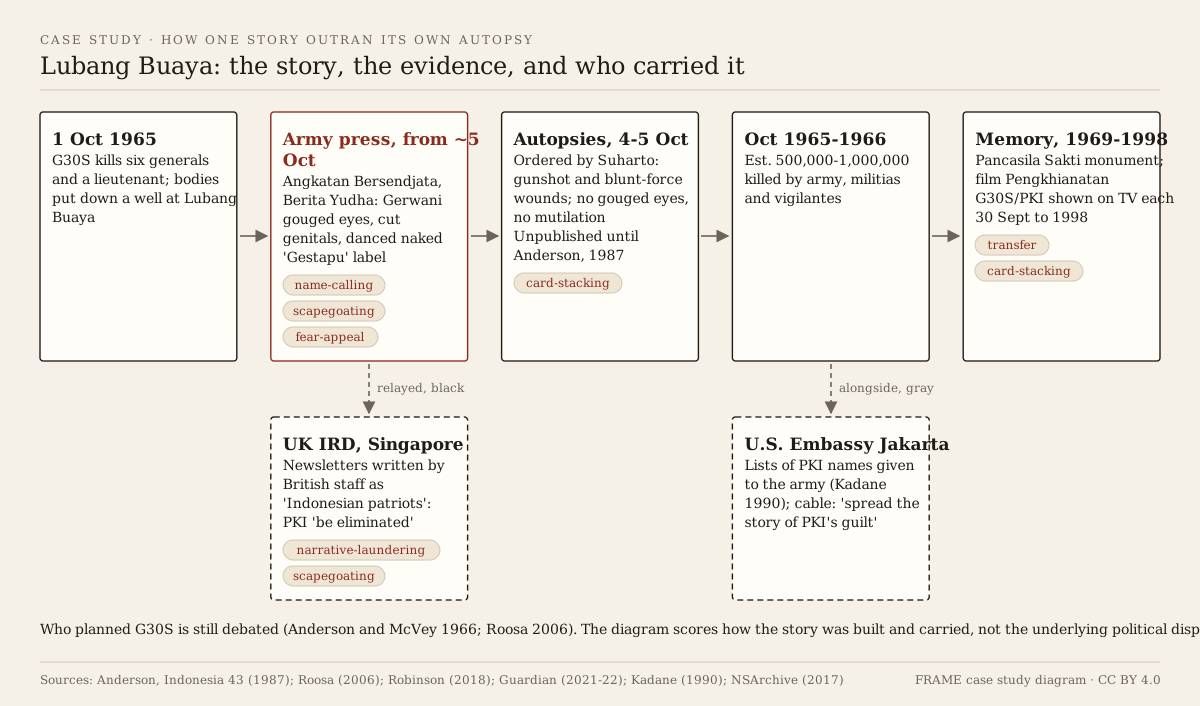
In one line: after seven officers were killed at Lubang Buaya on 1 October 1965, army newspapers reported that communist women had mutilated them, autopsies ordered by Suharto found no such wounds, the findings stayed out of public view for 22 years, British officials spread the story of PKI guilt under false names, and the U.S. ambassador proposed helping to spread it without identifying the U.S. as the source.
What happened
- Night of 30 September–1 October 1965. Troops of the group that called itself the 30 September Movement (G30S) seize six army generals and a lieutenant in Jakarta. Ahmad Yani, D. I. Pandjaitan and M. T. Haryono are killed at their homes; S. Parman, R. Suprapto, Sutoyo Siswomiharjo and Lt. Pierre Tendean are killed at Lubang Buaya, near Halim air base. The bodies are put down a disused well. Maj. Gen. Suharto takes command of the army and suppresses the movement within about a day.
- 4 October. The bodies are brought up from the well in front of press cameras. The same day Suharto orders autopsies (visum et repertum). A team of five doctors, two from the army and three from the University of Indonesia's forensic medicine faculty, examines the bodies at the Central Army Hospital.
- From about 5 October. The army-controlled dailies Angkatan Bersendjata and Berita Yudha (the other papers had been shut) report that members of Gerwani, the women's organisation linked to the PKI, gouged out the officers' eyes, cut off their genitals and danced naked around them, a scene later called the "Dance of the Fragrant Flowers" (Harum Bunga). The army calls the movement "Gestapu", an acronym that echoes "Gestapo". Printed "confessions" by young women follow.
- 13 October. IRD's Singapore office sends London a "special issue" of an Indonesian-language newsletter, Kenjataan2 ("Facts"), written by British staff but presented as the work of Indonesian émigré "patriots". IRD material of the period calls for "the PKI and all communist organisations" to "be eliminated".
- October 1965 to 1966. The army, militias and vigilantes kill an estimated 500,000 to 1,000,000 people and detain hundreds of thousands without trial. Many Chinese Indonesians are among those targeted.
- 1965 (reported 1990). U.S. embassy officer Robert Martens passes lists of PKI names, up to about 5,000 according to Kathy Kadane's States News Service report, to the army. Martens told Kadane: "It really was a big help to the army. They probably killed a lot of people, and I probably have a lot of blood on my hands, but that's not all bad."
- April 1987. Benedict Anderson publishes translations of the autopsy reports in the Cornell journal Indonesia, no. 43, as "How Did the Generals Die?". According to the reports, all seven died of gunshot wounds except one, who may have been bayoneted at his home, and some bodies also had blunt-force injuries. None records gouged eyes or cut genitals.
- 1984–1998. The state film Pengkhianatan G30S/PKI ("The Treachery of G30S/PKI", dir. Arifin C. Noer) shows the torture story on screen. State television broadcasts it every 30 September until 1998. The film, the Lubang Buaya monument and the annual screenings, including their revival in 2017, are covered in Pengkhianatan G30S/PKI: how Indonesia's New Order kept 1965 on screen.
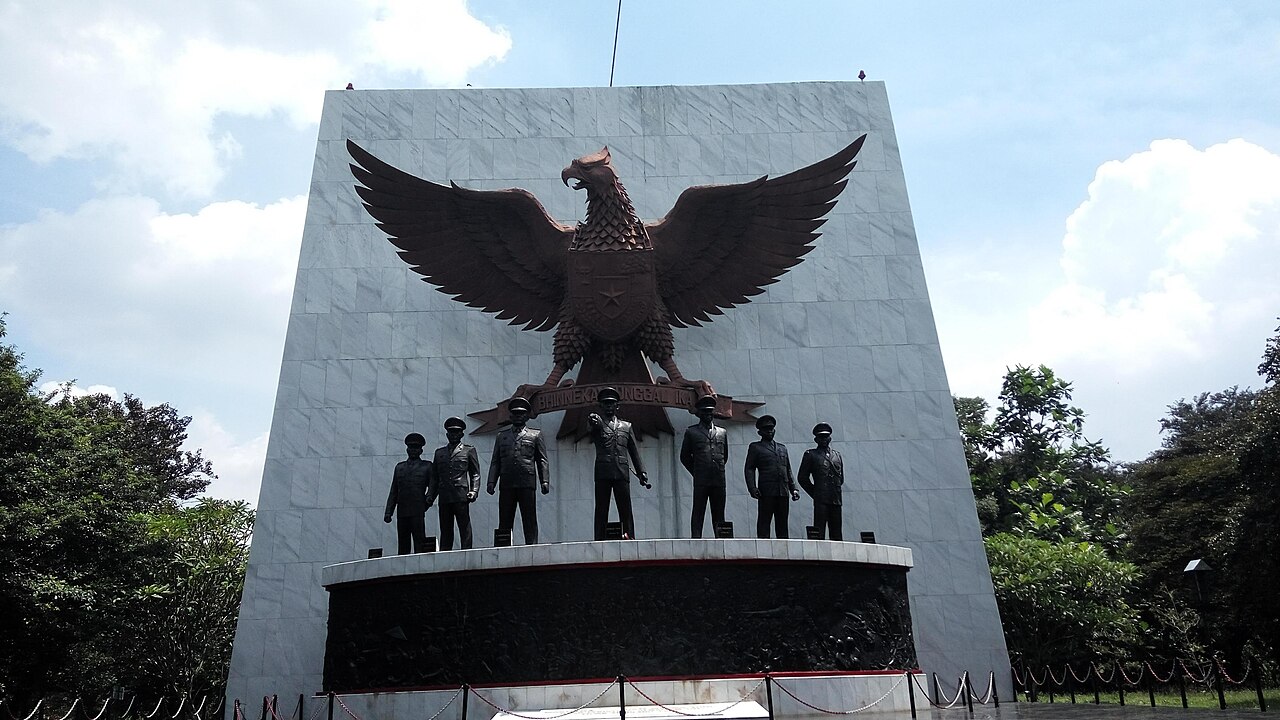
The Monumen Pancasila Sakti at Lubang Buaya: statues of the seven officers below the Garuda Pancasila state emblem. Photo by Si Gam, 2018, CC BY-SA 4.0.
How it works
- Name-calling: "Gestapu" ties the 30 September Movement to the Nazi secret police, and the Gerwani story recasts a mass women's organisation as sexual killers. The label arrived before the autopsy evidence, and it stayed in use afterwards.
- Scapegoating: a killing that historians still dispute (see below) is placed on the whole PKI, its mass organisations, and in the British material on Chinese Indonesians. IRD pamphlets reported by the Guardian in 2022 claimed that ethnic Chinese Indonesians deserved the violence meted out to them and urged prominent Indonesians to "cut out" the "communist cancer".
- Fear appeal: the mutilation story, and IRD calls for the PKI to "be eliminated", present the PKI as an imminent threat whose one remedy is removal. Army propaganda in 1965 also held that the murders of the generals were the first step in a PKI plan to kill its enemies, and presented pits as graves dug for them in advance, which recast attacks on PKI members as self-defence.
- Card stacking: the army held the autopsy reports from October 1965, and they did not match the story in its newspapers. The story stayed in print, and later in the state film, while the reports stayed out of public view until 1987.
- Transfer: the site is named for the "sacredness" of Pancasila, the state ideology, and 1 October is kept as Pancasila Sanctity Day. The plaque at the well speaks for the dead: "Tjita² perdjuangan kami untuk menegakkan kemurnian Pantja-Sila tidak mungkin dipatahkan hanja dengan mengubur kami dalam sumur ini" ("The ideals of our struggle to uphold the purity of Pancasila cannot be broken merely by burying us in this well"). The army's version takes on the authority of the state ideology.
- Narrative laundering: the IRD newsletters came from a British office in Singapore but were presented as the voices of Indonesian exiles. This is black propaganda: the stated source was false.
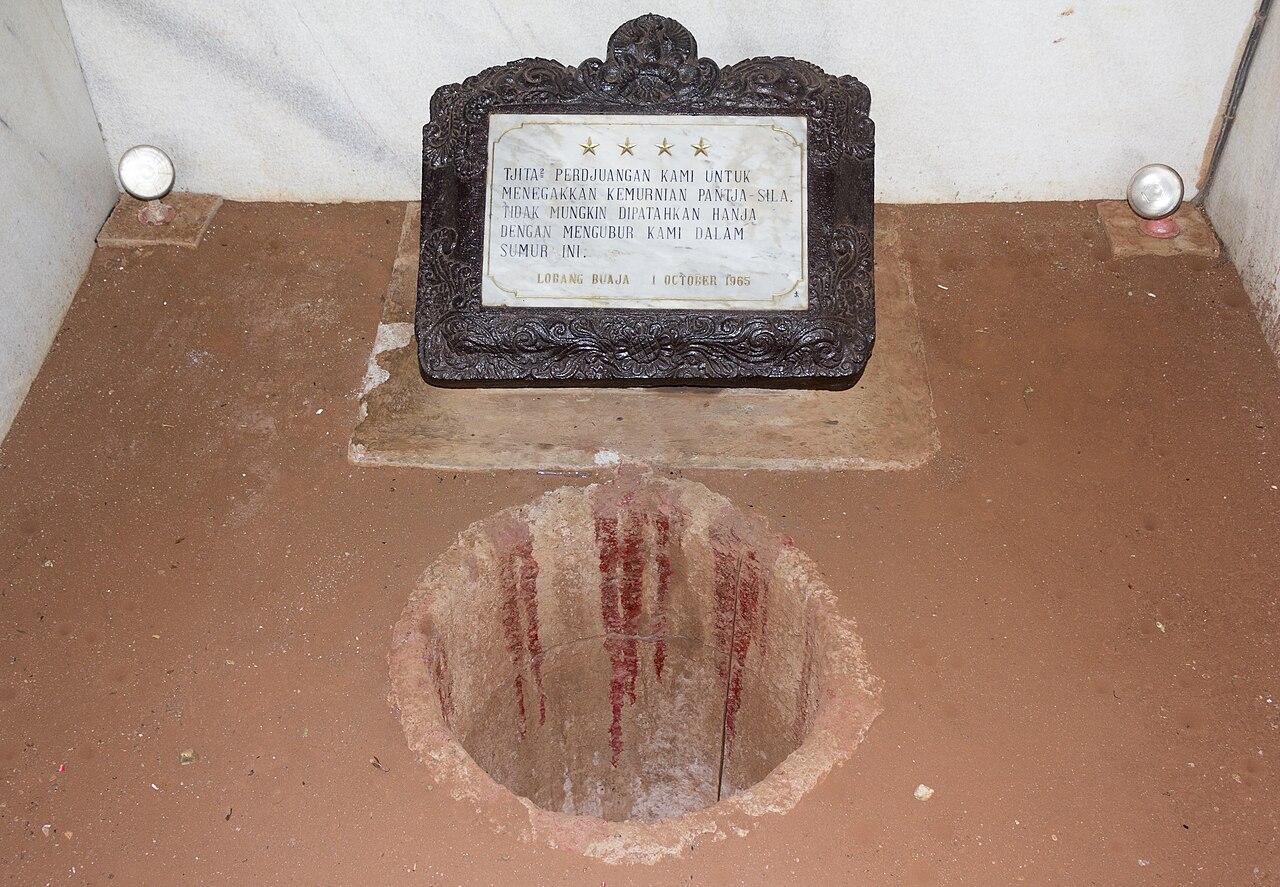
The well at Lubang Buaya, with red streaks on its inner wall and the plaque quoted above. Photo by Chris Woodrich, 2013, CC BY-SA 3.0.
Then and now
Content note: Dehumanizing caricature of Germans as an ape, implied sexual violence and partial nudity. This object is shown as it was published. Why 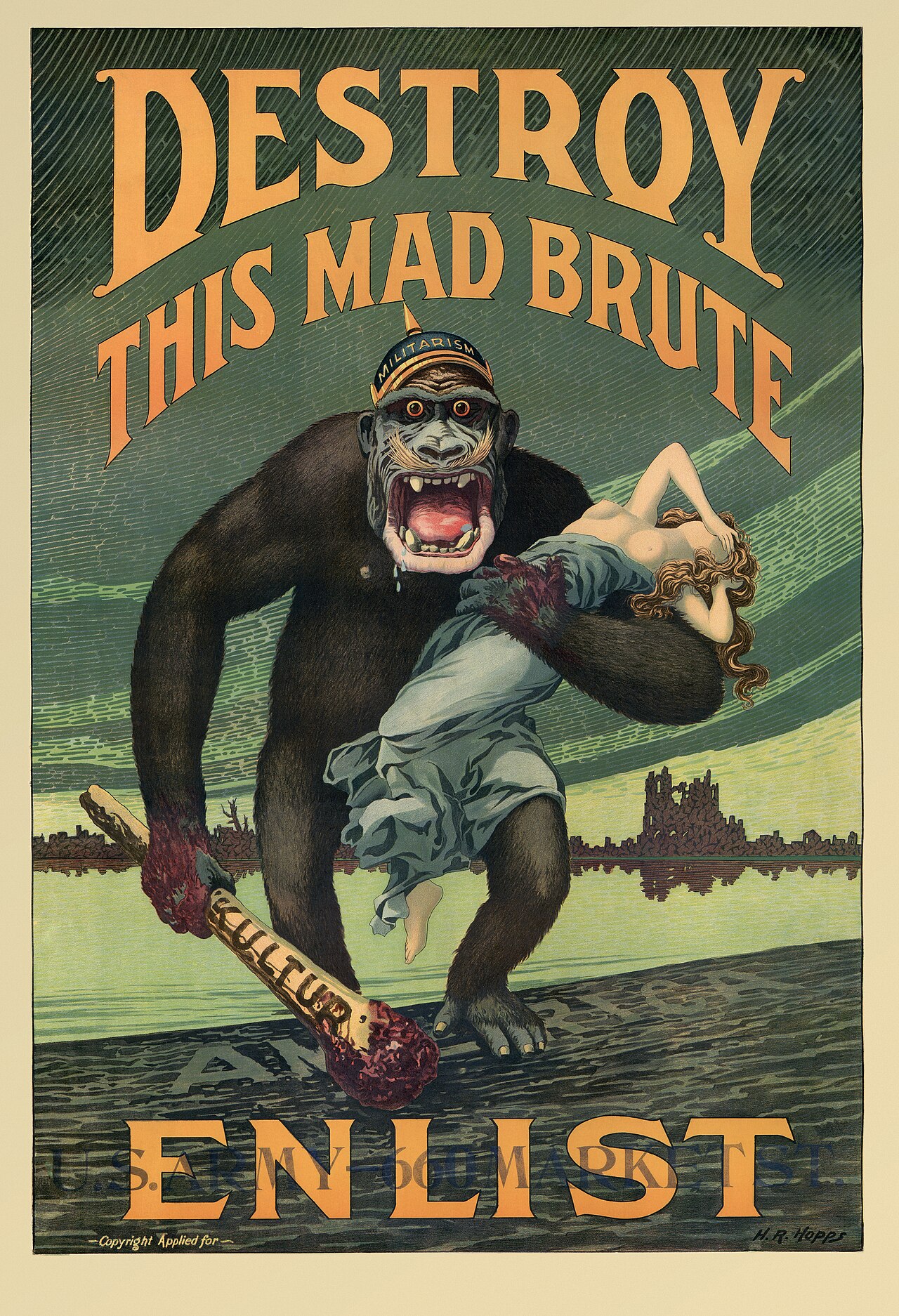
Destroy This Mad Brute — Enlist, U.S. Army recruiting poster by Harry R. Hopps, 1917. Public domain.
The 1917 poster and the 1965 army stories use the same device: the enemy is shown as a sexual threat to women and to the nation's body, so that fear leads straight to one remedy. In 1917 the remedy was to enlist. In 1965 it was action against a domestic party and everyone linked to it. Remember Belgium — Enlist To-Day shows a documented atrocity compressed into a single image. The differences: the 1917 poster was openly signed recruitment art in a war between states, a cartoon rather than a news report. The 1965 story was printed as news about named people, contradicted by autopsies the army already held, and it circulated as the killing of hundreds of thousands of Indonesian civilians began.
Positions on the record
- The New Order's position. The official histories (Nugroho Notosusanto and Ismail Saleh, 1968; the State Secretariat's 1994 "White Book") state that the PKI planned and led the coup, and that the army saved the nation and Pancasila. The monument, the museum at Lubang Buaya and the 1984 film present this version. In 2017 the army chief, Gen. Gatot Nurmantyo, encouraged renewed screenings of the film.
- Who planned G30S (contested). Anderson and Ruth McVey's 1966 "Cornell Paper" read it as an internal army affair. John Roosa (Pretext for Mass Murder, 2006) argues it was organised by PKI chairman D. N. Aidit and Sjam Kamaruzaman of the party's secret Special Bureau together with a group of officers, without the knowledge of the party's membership, and that the army leadership used it as a pretext. No single account is settled.
- The killings. Geoffrey Robinson (The Killing Season, 2018) and Jess Melvin (The Army and the Indonesian Genocide, 2018, drawing on army documents from Aceh) argue that the army leadership organised the killings rather than following spontaneous popular anger. In 2012 the national human rights commission, Komnas HAM, found gross human rights violations, including crimes against humanity, and passed its report to the Attorney General, who has not brought a case. The 2016 International People's Tribunal in The Hague, a civil-society body with no legal force, called the killings crimes against humanity and genocide, and found the U.S., UK and Australia complicit. In January 2023 President Joko Widodo acknowledged the 1965–66 events as one of twelve past gross human rights violations.
- Western roles. The 2017 release of U.S. Embassy Jakarta files, edited by Brad Simpson for the National Security Archive, shows the embassy tracking the killings as they happened. Declassified IRD files, reported by Paul Lashmar, Nicholas Gilby and James Oliver in 2021 and 2022, document the black newsletters. A critique published by Network Myanmar argues that the charge of UK complicity overstates what IRD's material could have achieved.
- What is documented: the seven killings, the autopsy findings, the army-press mutilation stories, the falsely attributed IRD newsletters, the lists given to the army, and the scale of the 1965–66 killings.
- What is not shown: who planned G30S; how far the IRD newsletters or the U.S. lists changed events rather than tracking what the army was already doing; and the exact death toll.
Same-method test
The same tags apply to the other side's messages that week. The G30S's first radio statement on 1 October said it had acted to forestall a coup by a CIA-backed "Council of Generals"; no evidence that such a council planned a coup has been produced (Roosa 2006). The PKI daily Harian Rakjat backed the movement in its 2 October editorial while calling it an internal army affair. Both put a hidden enemy's plot forward as the reason to act, which is the same Fear appeal and Scapegoating scored above. They would apply equally to a Soviet office writing leaflets as "Indonesian patriots". Within this case the test runs three ways. The army's newspapers ran the story under their own names (white). U.S. Ambassador Marshall Green cabled Washington on 5 October 1965 that the embassy should help "spread the story of PKI's guilt, treachery and brutality", and called this perhaps the most needed immediate help to the army "if we can find way to do it without identifying it as solely or largely US effort" (gray). IRD wrote its newsletters under false names (black). The label changes with the level of concealment. The technique ids do not.
How to spot it
- Check whether the atrocity story came before or after the forensic evidence, and whether anyone had the evidence and did not publish it.
- Look for an acronym or nickname that ties the enemy to an older, hated one.
- Ask who wrote a "patriotic exile" newsletter and who paid for it. Émigré voices are easy to forge.
Images
| Image | Source | Licence |
|---|---|---|
| Mechanism diagram (above) | Drawn for FRAME from the sources below (make_diagrams.py) |
CC BY 4.0, FRAME |
| Monumen Pancasila Sakti, Lubang Buaya (2018) | Wikimedia Commons, Si Gam | CC BY-SA 4.0 |
| The well at Lubang Buaya (2013) | Wikimedia Commons, Chris Woodrich (Crisco 1492) | CC BY-SA 3.0 |
| Destroy This Mad Brute (1917) | FRAME gallery | Public domain |


Image gaps
- Front pages of Angkatan Bersendjata and Berita Yudha, October 1965. No openly licensed copies found. Indonesian law exempts some government works, but these are newspapers and their U.S. status is unclear.
- Stills or the poster of Pengkhianatan G30S/PKI (1984). A state production whose U.S. copyright status is unclear. Not used.
- The 1967 Indonesian stamp series Monuments to Heroes of the Revolution. On Commons as
PD-IDGov, but that rests on an Indonesian exemption, and U.S. status is not clear. Dropped under the archive's image rule. - The Lubang Buaya museum diorama of S. Parman's interrogation. A CC BY-SA photo exists on Commons, but the diorama is a recent three-dimensional artwork, and the status of the underlying work was not checked.
- IRD's Kenjataan2 newsletter and the Martens lists. Held in the UK National Archives and U.S. files. No openly licensed scan was reachable from the build environment.
Sources
- Benedict Anderson, "How Did the Generals Die?", Indonesia 43 (April 1987): 109–134
- Benedict R. O'G. Anderson and Ruth T. McVey, A Preliminary Analysis of the October 1, 1965, Coup in Indonesia (Cornell Modern Indonesia Project, 1971; circulated 1966).
- Nugroho Notosusanto and Ismail Saleh, The Coup Attempt of the "September 30 Movement" in Indonesia (Jakarta: Pembimbing Masa, 1968).
- Saskia Wieringa, Sexual Politics in Indonesia (Palgrave Macmillan, 2002), on Gerwani and the Lubang Buaya story.
- John Roosa, Pretext for Mass Murder: The September 30th Movement and Suharto's Coup d'État in Indonesia (University of Wisconsin Press, 2006).
- Geoffrey B. Robinson, The Killing Season: A History of the Indonesian Massacres, 1965–66 (Princeton University Press, 2018).
- Jess Melvin, The Army and the Indonesian Genocide: Mechanics of Mass Murder (Routledge, 2018).
- David Easter, "'Keep the Indonesian pot boiling': Western covert intervention in Indonesia, October 1965–March 1966", Cold War History 5, no. 1 (2005): 55–73: Taylor & Francis.
- Paul Lashmar, Nicholas Gilby and James Oliver, "Slaughter in Indonesia: Britain's secret propaganda war", the Guardian, 17 October 2021
- Paul Lashmar, Nicholas Gilby and James Oliver, "UK's propaganda leaflets inspired 1960s massacre of Indonesian communists", the Guardian, 23 January 2022 (reproduced by APSN)
- The Diplomat, October 2021: declassified files and the UK role
- Network Myanmar: "The UK's supposed complicity in the mass killings in Indonesia in 1965" (critique of the IPT charge)
- Kathy Kadane, "U.S. Officials' Lists Aided Indonesian Bloodbath in '60s", States News Service in the Washington Post, 21 May 1990
- Foreign Relations of the United States, 1964–1968, vol. XXVI, Editorial Note 185 (on the lists); Green's cable of 5 October 1965 is document 147 in the same volume.
- National Security Archive, "U.S. Embassy Tracked Indonesia Mass Murder 1965", 17 October 2017; NARA National Declassification Center release note, 18 October 2017
- Komnas HAM statement on its 1965–66 inquiry (TAPOL translation); Human Rights First on the 2012 report
- Final Report of the IPT 1965 (2016); ABC News, 21 July 2016
- Pengkhianatan G30S/PKI (dir. Arifin C. Noer, PPFN, 1984).