Content note: this page shows 16th-century woodcuts that depict the pope as Antichrist and as a monster, soldiers defecating into the papal crown, and Luther as a seven-headed beast, and it describes Luther's 1543 anti-Jewish treatise and the medieval "Judensau" relief.
In one line: from 1518 the printing presses of the German lands carried a fight between Martin Luther's evangelical movement and the defenders of the papacy, and both sides used the same small set of moves: an insulting label, a borrowed sacred or monstrous image, and a selected pile of quotations.
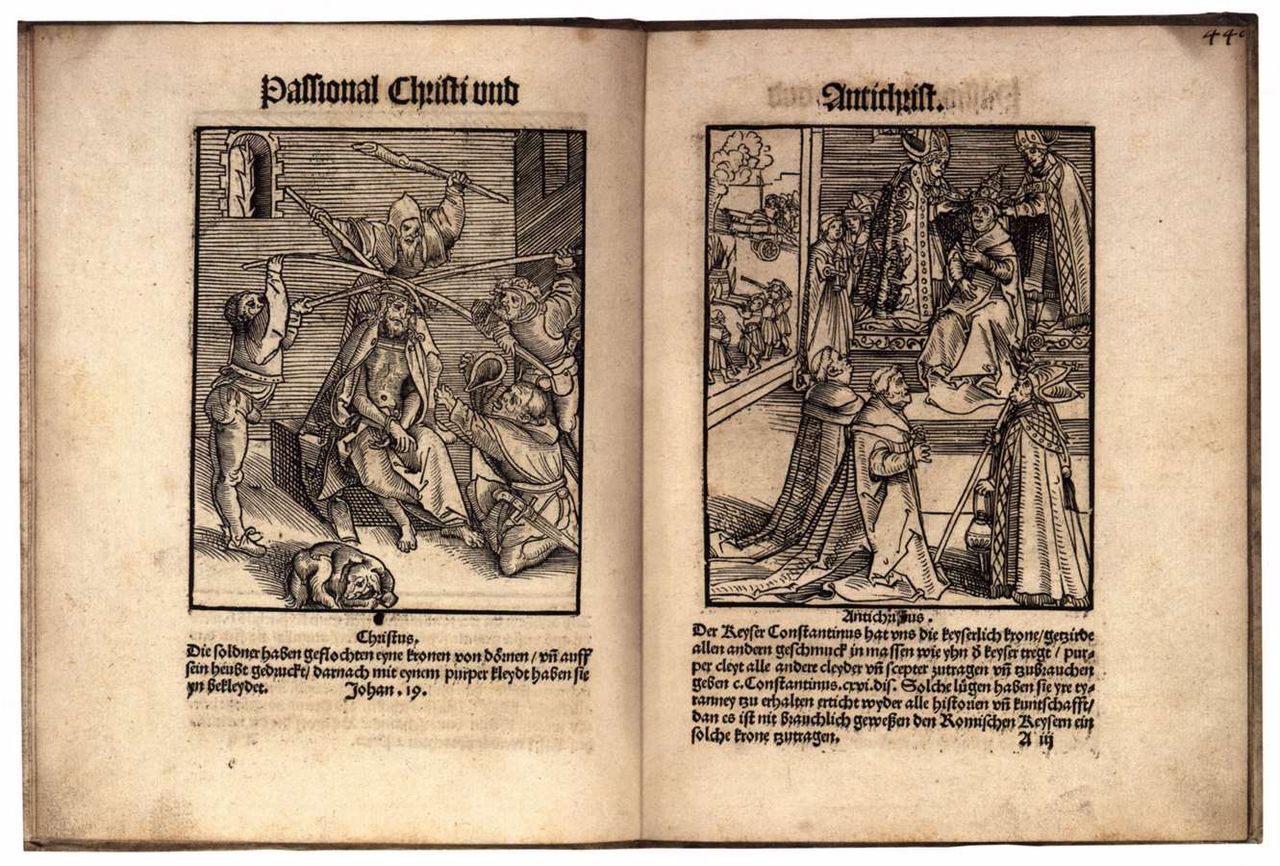
Facing pages from the Passional Christi und Antichristi (Wittenberg, 1521), woodcuts by Lucas Cranach the Elder's workshop: Christ crowned with thorns (John 19) beside the pope crowned with the tiara. The caption under the pope cites the Donation of Constantine from canon law and calls such claims lies invented to preserve their tyranny. British Library copy. Public domain.
What happened
- 31 October 1517. Luther sends his Ninety-five Theses on indulgences to Archbishop Albrecht of Mainz. Whether he also nailed them to a church door is contested; the letter is documented.
- 1518. Luther's short German Sermon von Ablass und Gnade goes through more than twenty editions in about two years, by Andrew Pettegree's count. Wittenberg, a small university town, becomes a publishing centre largely on Luther's output.
- 1518 onward. Mark U. Edwards Jr.'s edition counts show Luther's German printings outnumbering those of all his Catholic opponents combined by roughly five to one. Many Catholic controversialists wrote in Latin, for clergy and scholars; Luther wrote short, cheap German quartos that printers could sell.
- 15 June 1520. Leo X's bull Exsurge Domine opens with the psalm image of a wild boar loose in the Lord's vineyard, and condemns 41 propositions from Luther's writings. Luther answers in print with Adversus execrabilem Antichristi bullam (Against the Execrable Bull of Antichrist) and burns the bull at Wittenberg on 10 December.
- 1520-1521. Cranach engraves Luther as a gaunt Augustinian friar (1520). A 1521 Strasbourg woodcut by Hans Baldung Grien shows him with a halo and the dove of the Holy Spirit above his head.
- May 1521. The Edict of Worms outlaws Luther and bans his books. It describes him, in paraphrase, as the devil in human form wearing a monk's habit. The same month Wittenberg publishes the Passional Christi und Antichristi: 13 pairs of Cranach woodcuts contrasting Christ and the pope, with texts compiled by Philipp Melanchthon and the jurist Johann Schwertfeger.
- 1521. Hieronymus Emser of Leipzig, whose coat of arms bore a goat, attacks Luther; Luther replies An den Bock zu Leipzig (To the Goat at Leipzig), and Emser answers An den Stier zu Wittenberg (To the Bull at Wittenberg).
- 1522. Thomas Murner, a Strasbourg Franciscan, publishes Von dem grossen Lutherischen Narren (Of the Great Lutheran Fool), printed by Johann Grüninger. Luther's September Testament appears with Cranach's Revelation woodcuts, in which the Whore of Babylon and the beast wear the papal triple tiara; in the December reprint the tiaras are cut down to single crowns after Duke George of Saxony objects.
- 1523. Melanchthon and Luther publish Deuttung der zwo grewlichen Figuren (Interpretation of the Two Horrible Figures): a "Papal Ass" said to have been found dead in the Tiber in 1496, and a "Monk Calf" born at Freiberg in Saxony in late 1522.
- 1529. Johannes Cochlaeus publishes Sieben Köpffe Martini Luthers in Leipzig, with a woodcut of Luther as a seven-headed creature.
- 1543. Luther publishes Von den Juden und ihren Lügen (On the Jews and Their Lies) and Vom Schem Hamphoras (see below).
- March-May 1545. Luther publishes Wider das Papsttum zu Rom, vom Teufel gestiftet (Against the Papacy at Rome, Founded by the Devil). Cranach's workshop issues a series of about ten woodcuts, now known as the Abbildung des Papsttums (Depiction of the Papacy), with Latin titles and German verses by Luther. The Council of Trent opens that December.
- 1563 onward. Trent's decree on images (December 1563) sets rules for Catholic religious art. The Catholic visual answer moves from cheap broadsheets into churches, altarpieces and saints' cycles.
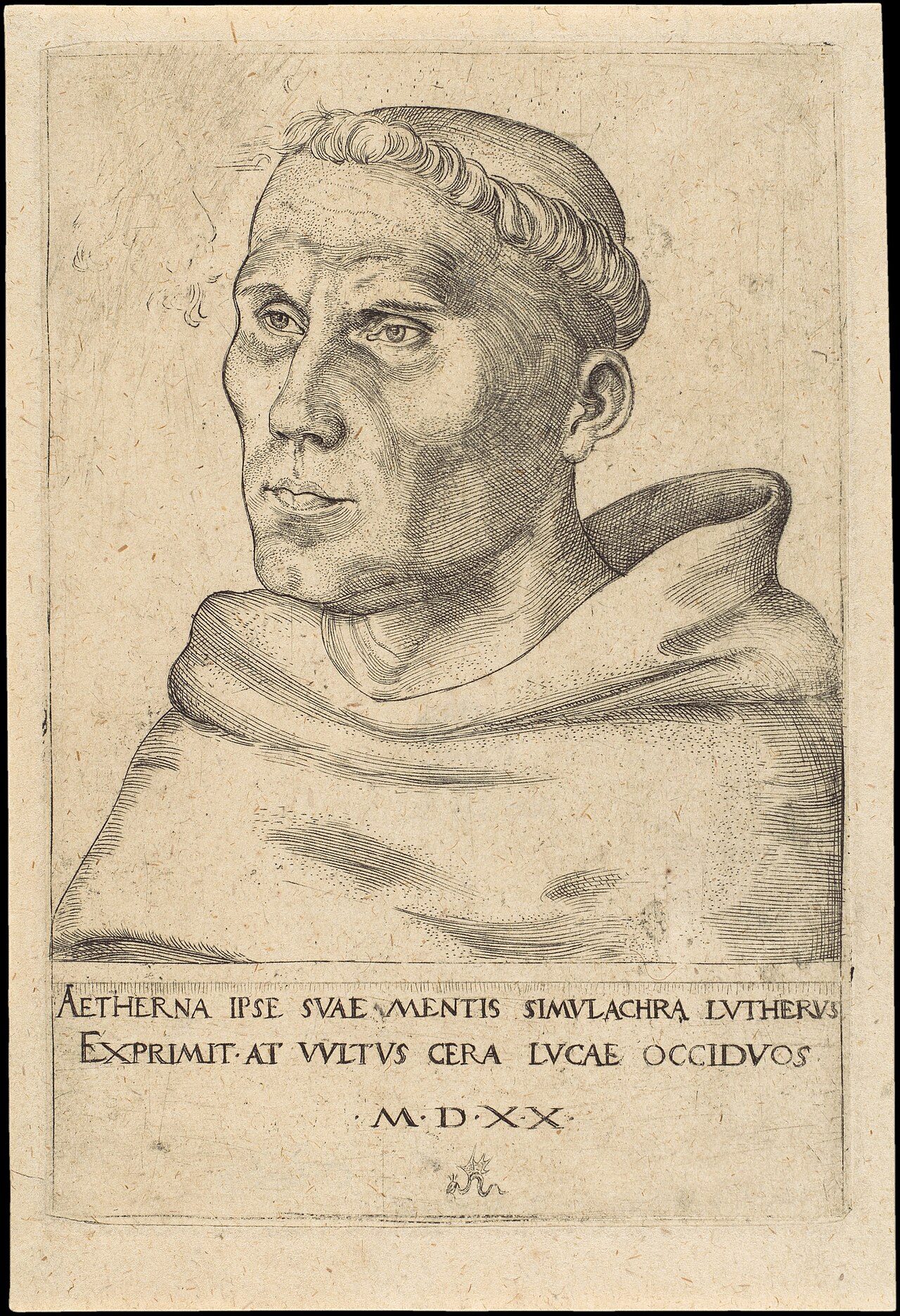
Lucas Cranach the Elder, Martin Luther as an Augustinian Monk, engraving, 1520. The Latin inscription says, in paraphrase, that Luther himself expresses the eternal image of his mind, while Lucas's hand shows his mortal face. Metropolitan Museum of Art, CC0.
How it works
- Name-calling: both sides reached for a label that settled the argument before it began. The papal bull called Luther a wild boar; the Edict of Worms, a devil in a cowl; Murner, a great fool; Cochlaeus's woodcut stamps one head "Barrabas" and another "Schwirmer" (fanatic). Luther called the pope Antichrist from 1520, called Emser a goat, and in 1545 declared the papacy founded by the devil. The Passional carries the Antichrist label into every one of its 13 pairs.
- Transfer: evangelical portraits gave Luther himself the marks of holiness: Baldung Grien's 1521 woodcut gives him a halo and the dove. The Passional borrows the authority of the Gospels. Each pope scene sits opposite a scene of Christ, so the Bible passage under Christ does the arguing. The 1523 pamphlet borrows the authority of portents: a monster born or found is read as a sign from God, with the papal keys flying over the Castel Sant'Angelo behind the Papal Ass. Catholic images borrowed in the other direction: Cochlaeus's woodcut puts one of Luther's heads in a Turkish turban, and Zapata's 1762 painting dresses the labelled reformers at Saint Ignatius's feet in turbans, the costume of the infidel in Christian art of the period.
- Card stacking: the Passional's captions quote canon-law texts on papal power chosen for the contrast they make with the Gospel, and the woodcut under the pope says outright that such claims are "lies" (lügen). Cochlaeus's Sieben Köpffe works by the same selection in reverse: it sets Luther's statements from different years against each other so that he appears to speak with seven mouths, without the context of when and why each was written.
- Scapegoating: Luther's 1545 tract and woodcuts assign the corruption of Christendom to one source, a papacy "founded by the devil". His 1543 treatise does the same to a far more vulnerable group, blaming the Jews of the German lands for blasphemy and usury and calling on princes to burn their synagogues. On the Catholic side, Johann Eck's 1541 Ains Judenbüechlins Verlegung defended the ritual-murder accusation against Jews, and Catholic writers including Cochlaeus laid the Peasants' War of 1524-1525 at Luther's door, although Luther had written against the rebels.
The Passional: one idea, thirteen times
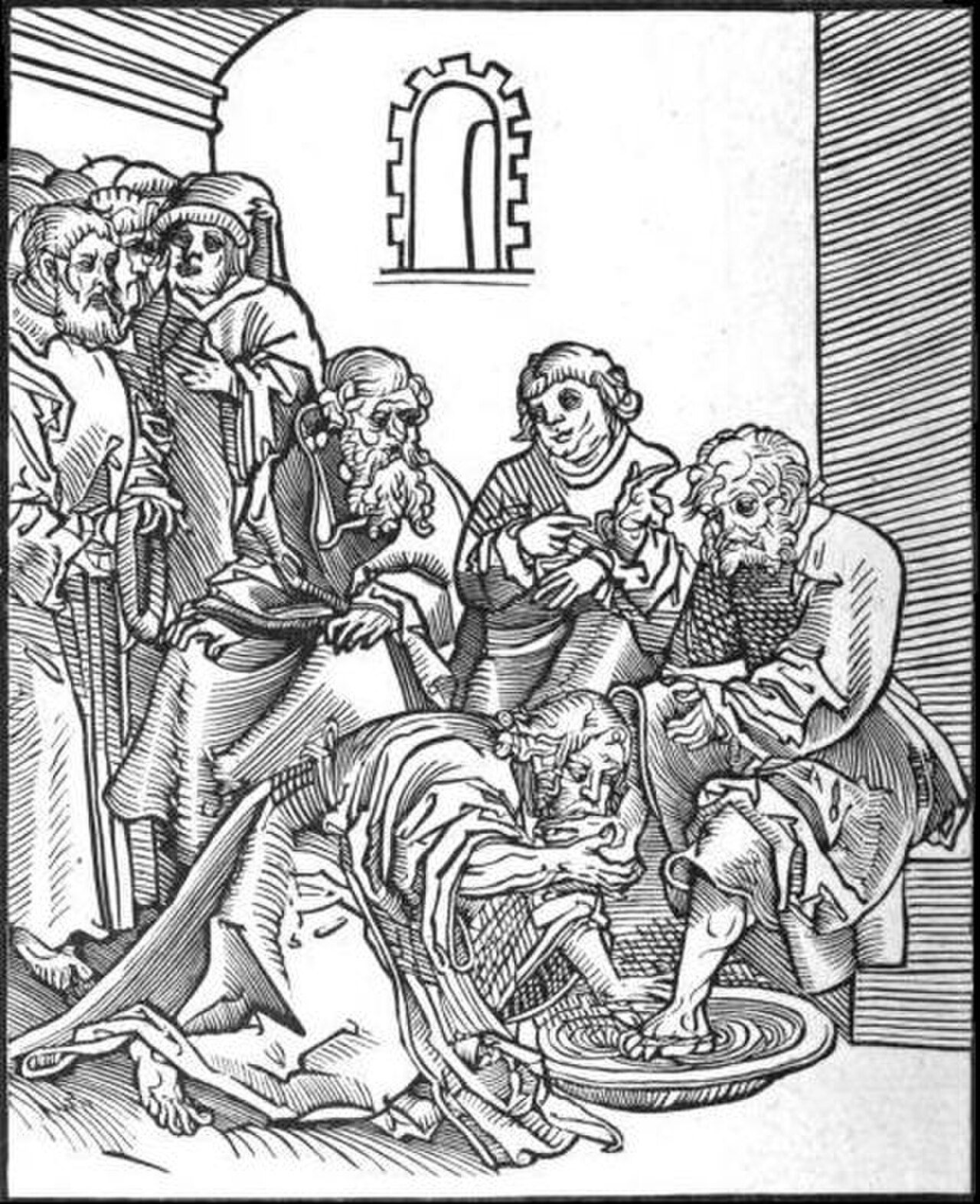
Christ washes the disciples' feet (John 13), from the Passional Christi und Antichristi, Cranach workshop, 1521. Public domain.
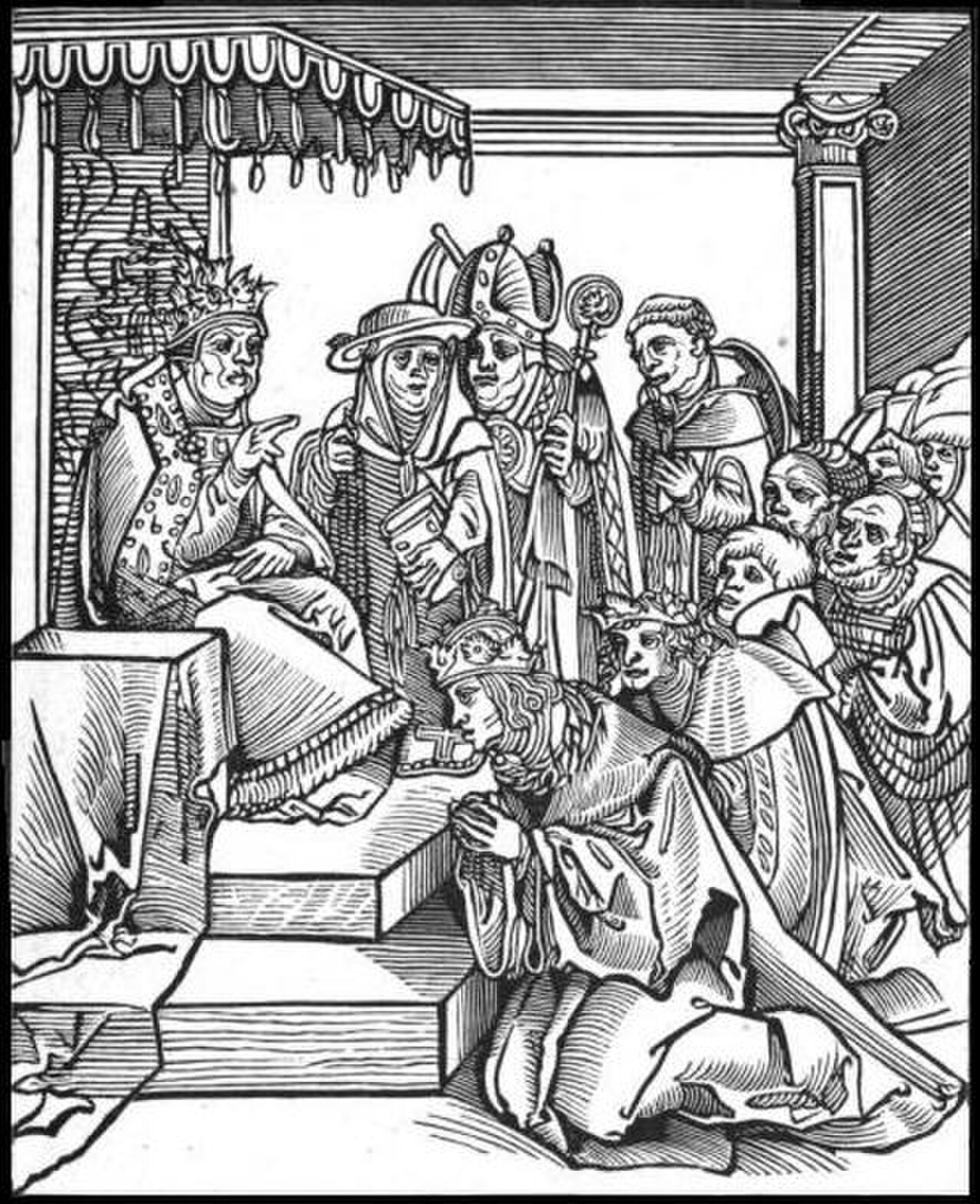
The facing "Antichrist" scene: a crowned ruler kisses the pope's foot. Cranach workshop, 1521. Public domain.
The format needs no reading beyond a short caption: the viewer compares two pictures and the contrast delivers the verdict. Robert Scribner's For the Sake of Simple Folk (1981) treats this antithesis as a main device of evangelical visual propaganda, suited to an audience in which most people could not read and heard pamphlets read aloud. The Passional's title page named no author.
The Papal Ass and the Monk Calf
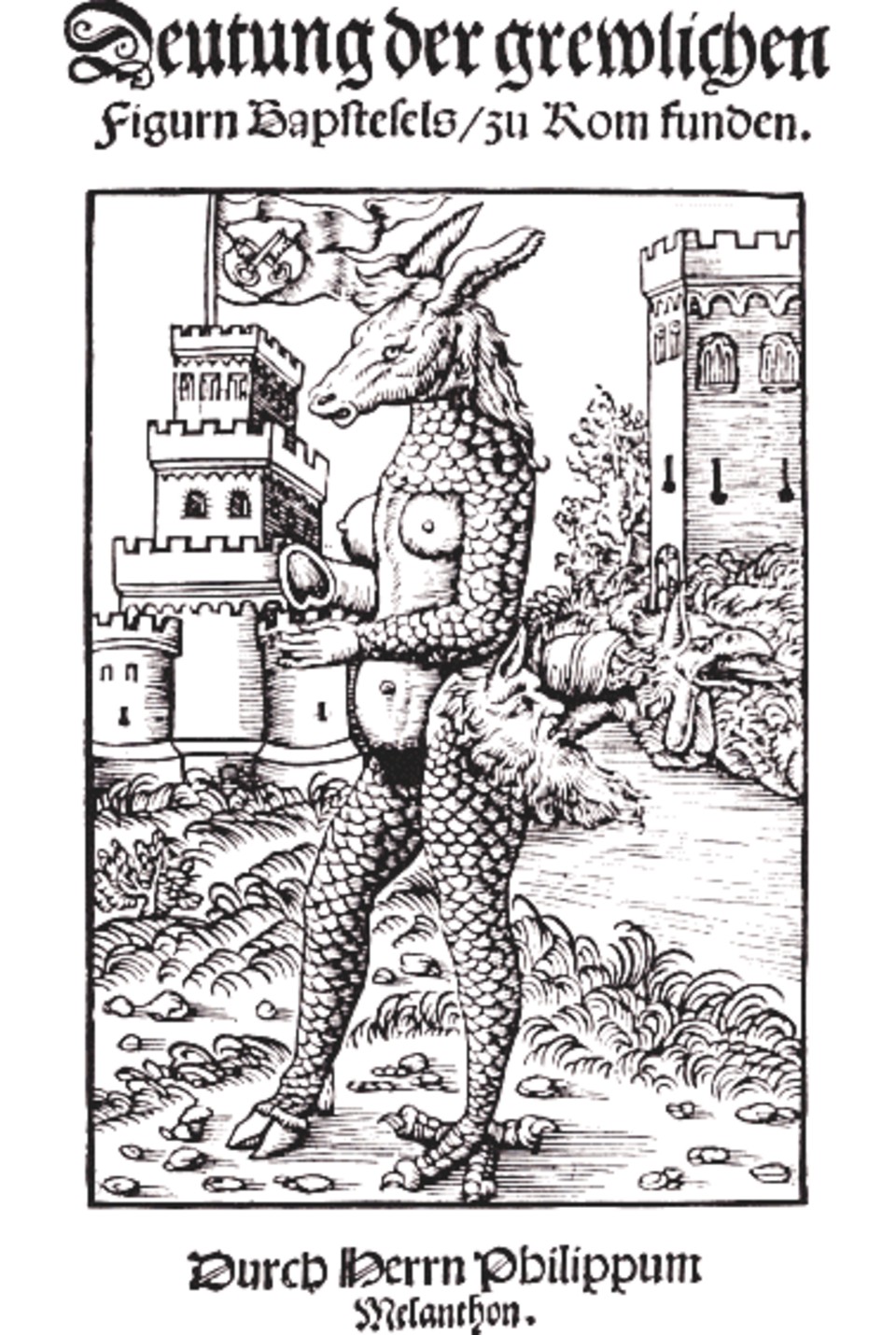
The Papal Ass (Bapstesel), title woodcut of Melanchthon's interpretation, Wittenberg, 1523, Cranach workshop. GFDL scan of a public-domain woodcut.
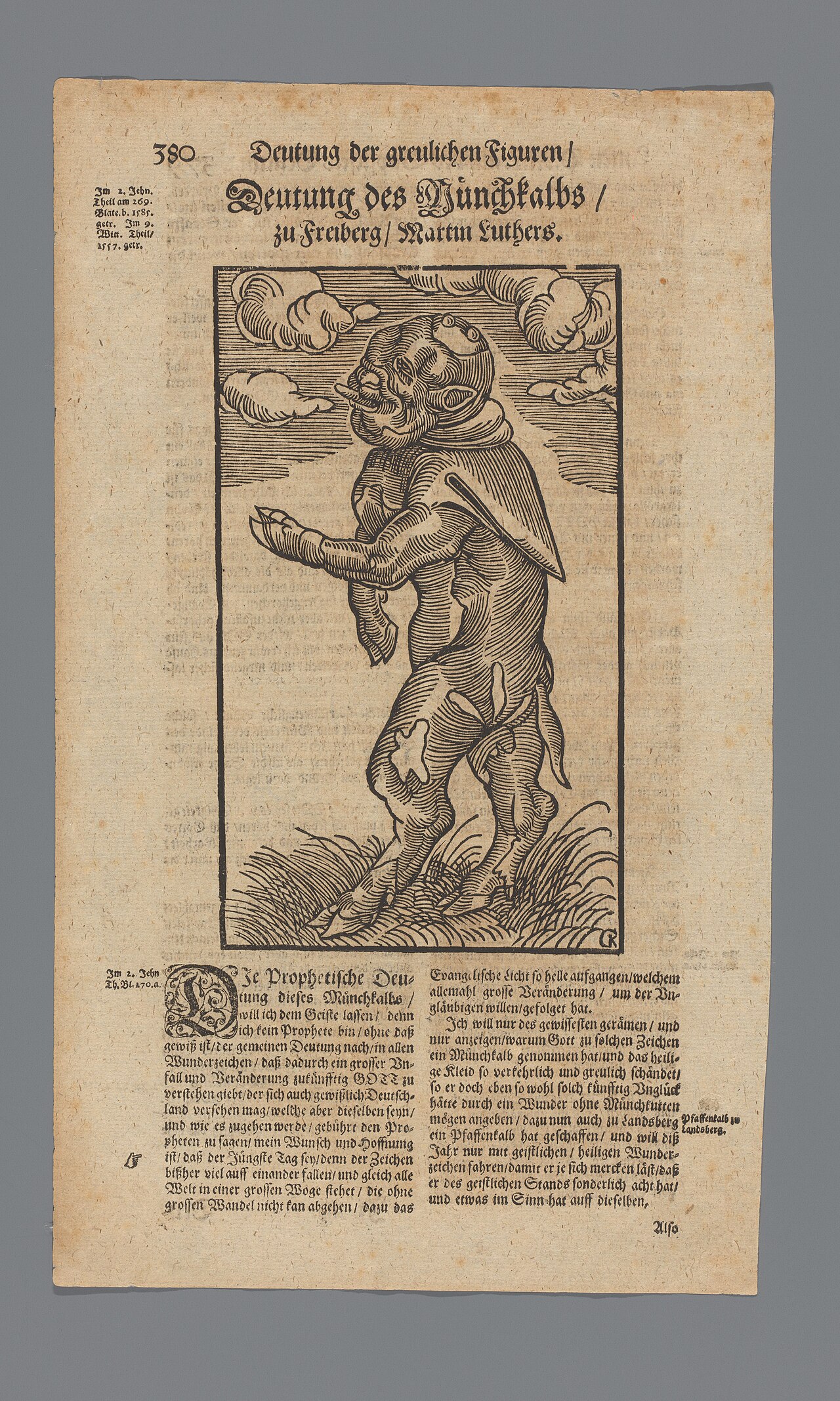
The Monk Calf with Luther's interpretation, as reprinted in a 17th-century collected edition of his writings (mirror-image copy after Cranach by the monogrammist GK; Rijksmuseum dates the sheet to about 1661). CC0, Rijksmuseum.
The Papal Ass was not a Wittenberg invention. The creature had already circulated in print in the 1490s, and Melanchthon reinterpreted an existing portent rather than drawing a new one. Each body part gets a meaning: the ass's head for the pope as head of the church, the scaly body for secular princes bound to him, the old man's face on the rump for the papacy's approaching end. Luther's text on the Monk Calf, visible in the reprint above, opens by saying he will leave the prophetic meaning "to the Spirit, for I am no prophet", and then reads the calf, cowl and all, as a picture of monasticism.
The Catholic reply
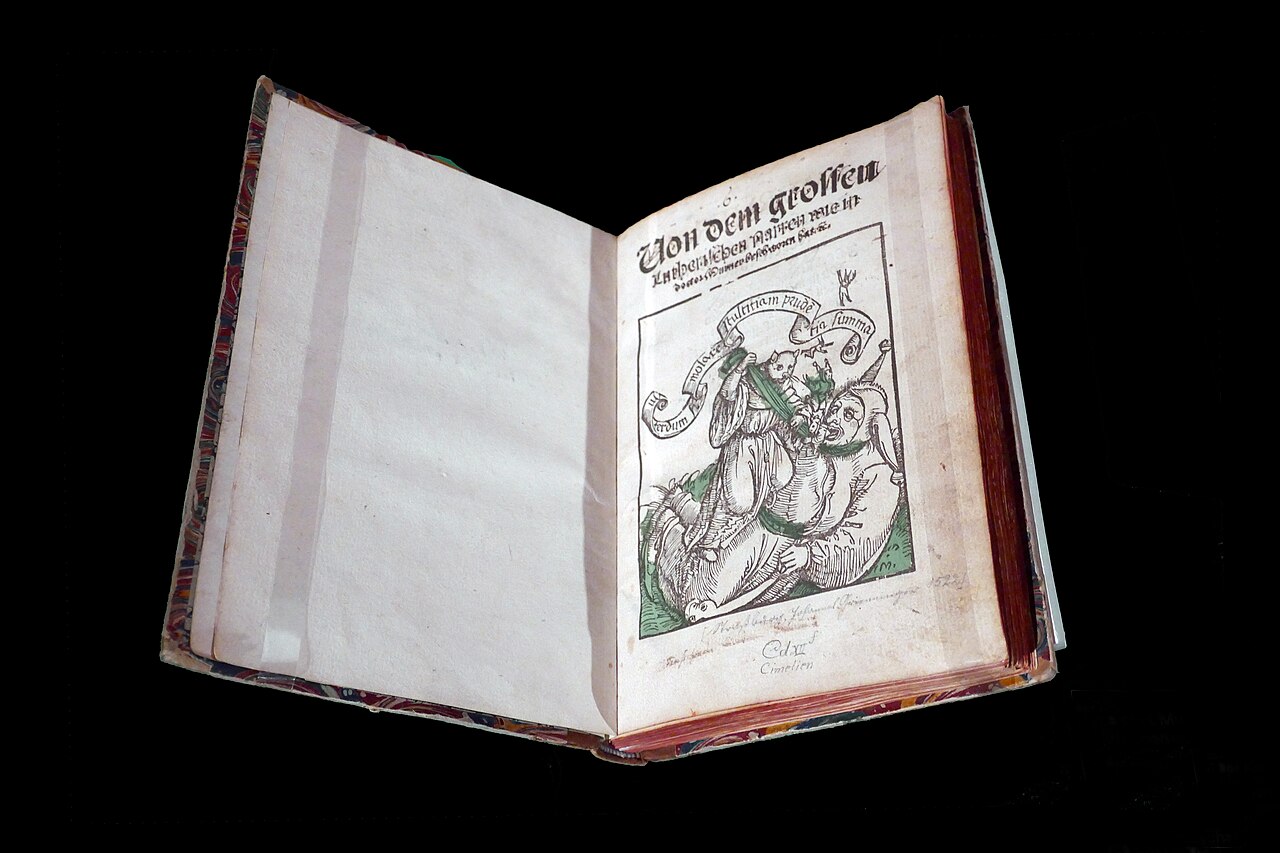
Thomas Murner, Von dem grossen Lutherischen Narren (Strasbourg: Johann Grüninger, 1522), title woodcut. Bibliothèque nationale et universitaire de Strasbourg. Photo by Ji-Elle, CC BY-SA 4.0.
Murner's opponents had already mocked him as "Murr-narr" and drawn him with a tomcat's head. His title page takes the insult over: the cat-headed friar strangles the great Lutheran fool, and in the verse satire he conjures smaller fools out of the big one. It is the same name-calling device the evangelicals used, pointed back at them.
Content note: Sectarian caricature of Luther as a seven-headed beast. This object is shown as it was published. Why 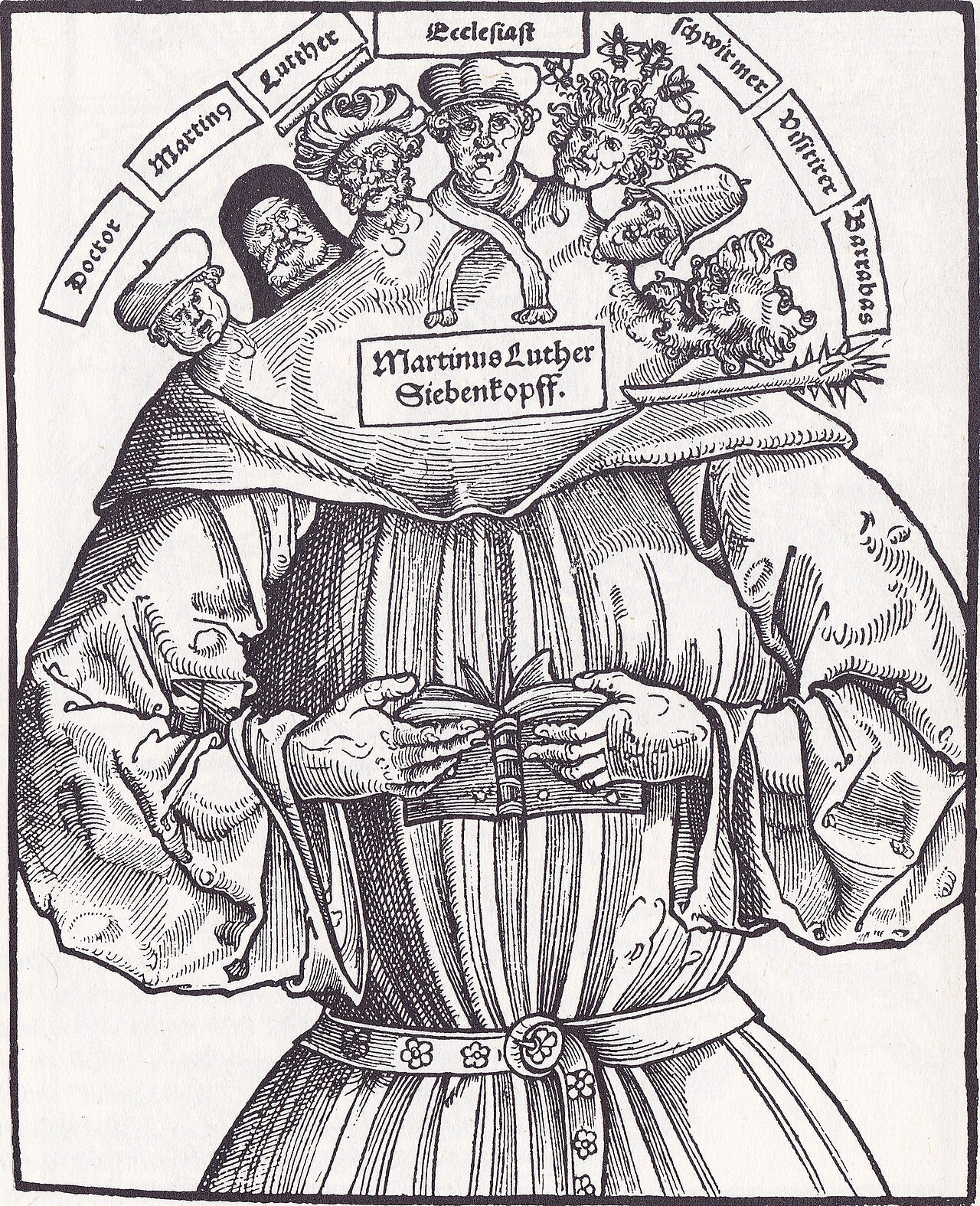
Title woodcut of Johannes Cochlaeus, Sieben Köpffe Martini Luthers (Leipzig, 1529), attributed to Hans Brosamer. Public domain.
The seven heads recall the seven-headed beast of Revelation, the same apocalyptic source Luther's side used to crown the Whore of Babylon with the tiara. Cochlaeus's label for each head names a role he says Luther played: doctor, monk, preacher, fanatic, visitor of churches, and the robber released instead of Christ. Cochlaeus went on to write the Commentaria de actis et scriptis Martini Lutheri (Mainz, 1549), which shaped Catholic accounts of Luther for centuries.
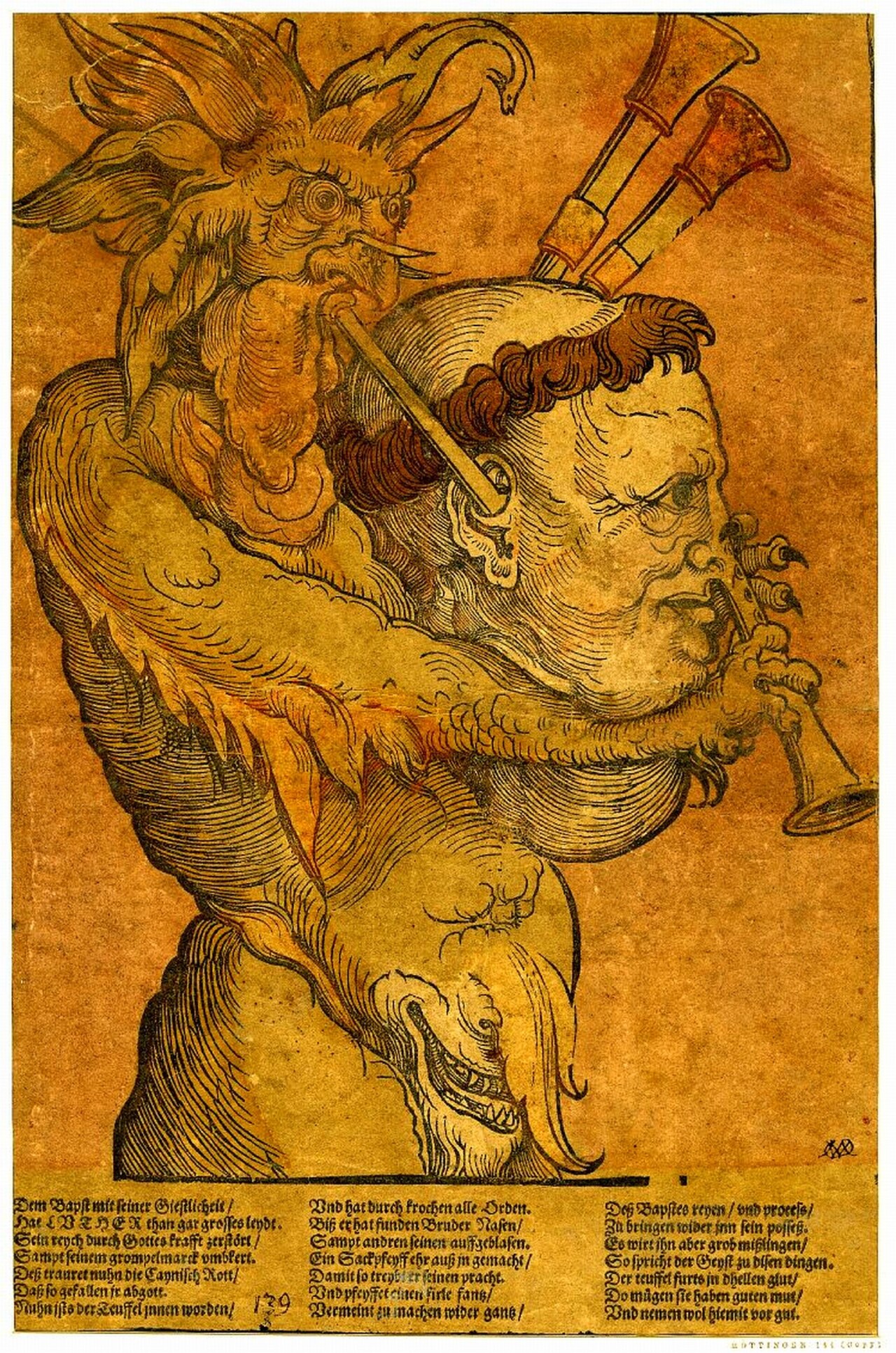
A monk as the devil's bagpipe, woodcut after a design associated with Erhard Schön, British Museum impression dated to about 1570. Public domain.
On the "Luther as the devil's bagpipe" attribution. This sheet is often reproduced online as a Catholic caricature of Luther. Its own verses say the opposite. They state that Luther, by God's power, destroyed the pope's kingdom, and that the devil then searched the religious orders until he found "Bruder Nasen" (Johannes Nas, a Franciscan who wrote against the Lutherans from the 1560s) and made a bagpipe of him to pipe the pope back in. The sheet is Lutheran, and the monk is its target. No Catholic broadsheet showing Luther himself as the devil's bagpipe was found for this page. The idea that the devil spoke through Luther does appear on the Catholic side in words, as in the Edict of Worms.
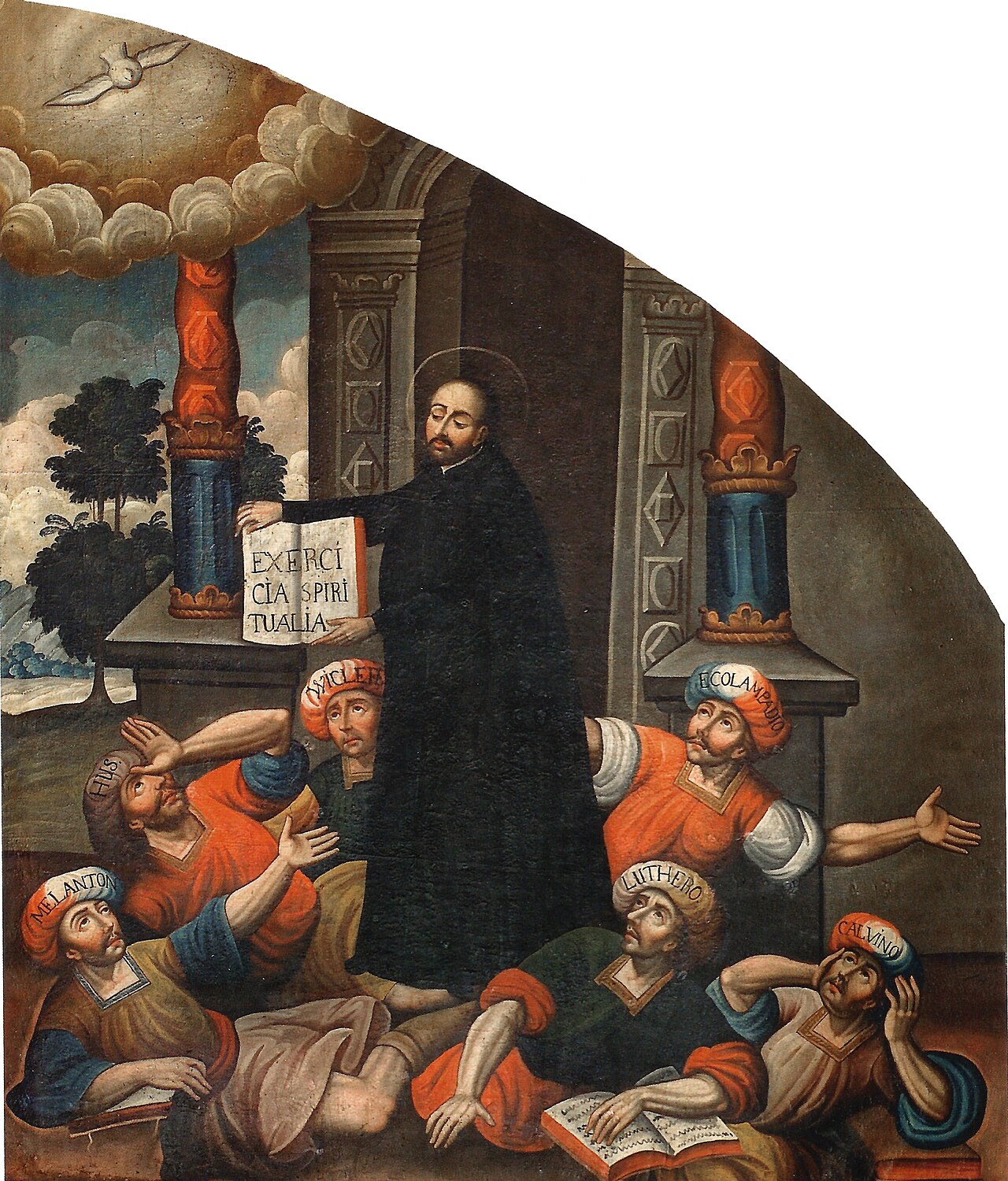
Marcos Zapata, Saint Ignatius of Loyola Defeating the Heretics, 1762, Church of the Compañía de Jesús, Cusco. Public domain.
Scribner found far fewer Catholic pictorial broadsheets than evangelical ones, and the record here reflects that. Catholic authorities relied more on sermons, Latin treatises, the courts and, after Trent, church art. Zapata's painting, made in Peru more than two centuries after Luther's death, uses a device close to the Passional's, a holy figure set against labelled opponents, in oil on a church wall instead of on a broadsheet.
1545: the Depiction of the Papacy
Content note: Anti-papal woodcut with scatological imagery. This object is shown as it was published. Why 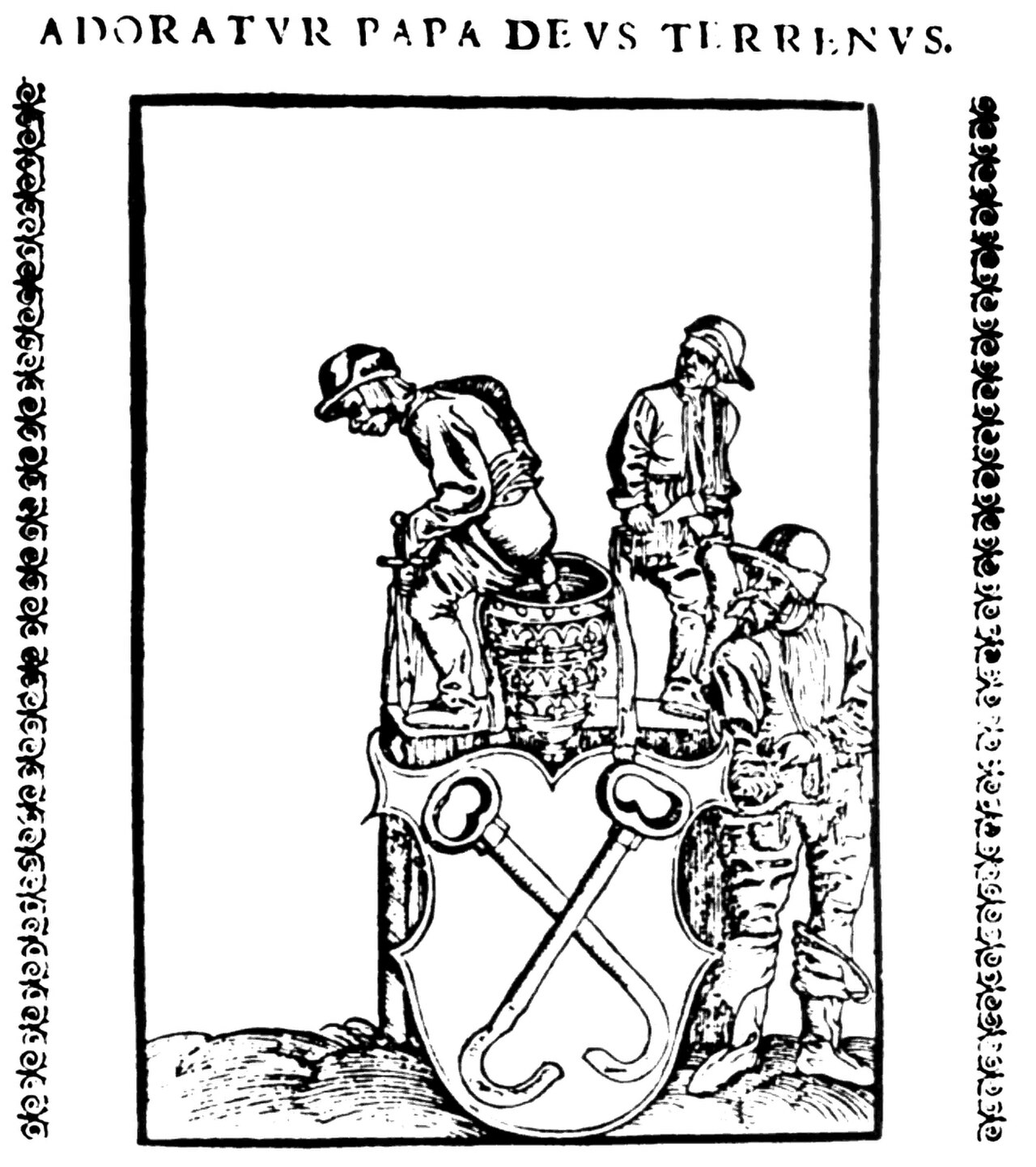
"Adoratur papa deus terrenus" ("The pope is adored as an earthly god"), from the Cranach workshop's 1545 Abbildung des Papsttums. Public domain.
The 1545 series is Luther's most openly scatological print campaign. Other sheets show the pope and cardinals born from a she-devil's backside, the pope riding a sow, and peasants baring their buttocks at a papal bull under the caption "the papal Belvedere". Historians including Heiko Oberman and Lyndal Roper treat the coarseness as deliberate: Luther used the language of the body and the devil as a weapon, and wrote verses for the pictures himself. The series appeared while Pope Paul III was convening the Council of Trent, which Luther's tract of the same year attacked.
1543: the anti-Jewish treatises
In On the Jews and Their Lies (Wittenberg, 1543) Luther urged princes to set fire to synagogues and schools, destroy Jewish homes, confiscate prayer books and the Talmud, forbid rabbis to teach, withdraw safe-conduct on the roads and put Jews to forced labour. It is a sharp turn from his 1523 That Jesus Christ Was Born a Jew, which had urged kinder treatment in the hope of conversion. Vom Schem Hamphoras, the same year, opens with a description of the "Judensau" sculpture on Wittenberg's town church, a medieval relief (about 1305) of Jews suckling at a sow, and uses it for further mockery. The relief is still on the church; in June 2022 Germany's Federal Court of Justice ruled that it need not be removed, given the memorial and explanatory panel installed beneath it. Anti-Jewish polemic was not one confession's: Eck's 1541 Judenbüechlin answered a Lutheran pamphlet (attributed to Andreas Osiander) that had rejected the ritual-murder charge, and defended the charge. These treatises are included here for their technique; the page makes no wider claim about their later use.
Then and now
Content note: Dehumanizing caricature of Germans as an ape, implied sexual violence and partial nudity. This object is shown as it was published. Why 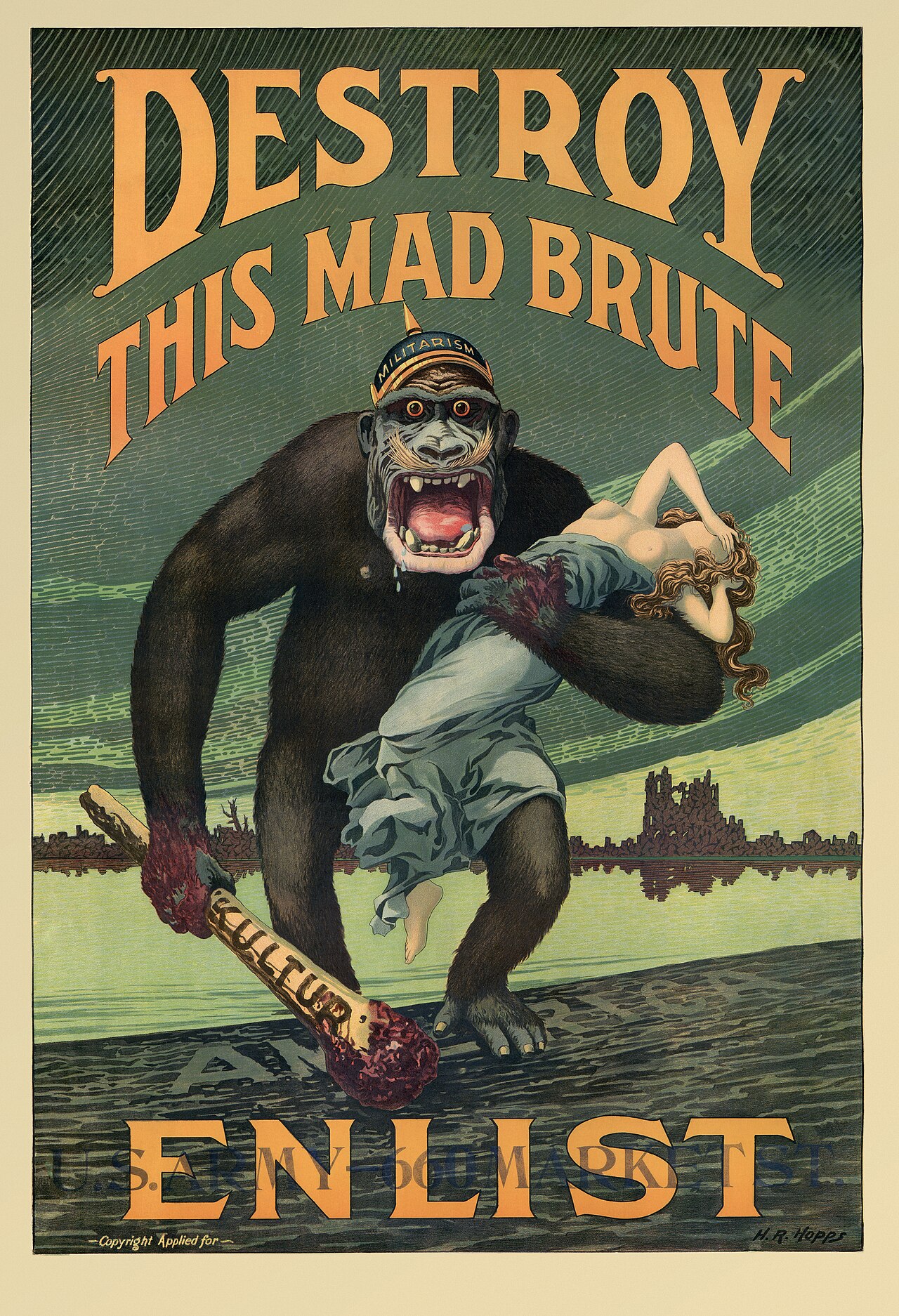
Destroy This Mad Brute — Enlist, U.S. Army recruiting poster by Harry Ryle Hopps, 1917. Public domain.
The Papal Ass and the 1917 "mad brute" do the same thing: they draw an institution or a nation as one monstrous body, so that the viewer feels revulsion before any argument is offered. Both use a recognisable emblem (the papal keys; a spiked helmet lettered "Militarismus") to fix the monster to its target. The differences are large. The 1523 pamphlet was a theological tract by two named scholars, sold by private printers in a divided empire; the 1917 poster was a state recruitment appeal for a mass army. The 1523 monster came with a page of text explaining each body part; the 1917 poster offered a single word. The WWII series This Is the Enemy shows the same label-plus-monster move in a later war. The Catholic institution whose name gave the word "propaganda", founded a century after Worms to direct missionary work, is covered in Propaganda Fide, 1622: where the word comes from. The next great English-language pamphlet war, in which fear of "popery" was again a main theme, is The English Civil War pamphlet war, 1641-1649.
Positions on the record
- The evangelical side's stated position: Luther and his colleagues said they were exposing false teaching and restoring the Gospel, and that the papacy's claims to power had no basis in scripture. Luther defended religious images for teaching and memory (against Karlstadt, in Against the Heavenly Prophets, 1525) and treated pictures as a way to reach people who could not read.
- The Catholic side's stated position: the papacy and the emperor held that Luther was a condemned heretic who had broken with the church's teaching authority and stirred disorder, a charge Catholic writers repeated after the Peasants' War. Murner, Emser and Cochlaeus wrote that they were defending the sacraments and the church against a divisive and self-contradicting teacher.
- What historians say: Pettegree argues that Luther's skill with short German print, and Wittenberg's printers' commercial interest in him, drove the movement's early spread. Edwards shows how heavily evangelical titles outnumbered Catholic ones, and cautions that most people met the Reformation through sermons and conversation, not reading. Scribner argues that images reinforced preaching and the spoken word rather than converting people on their own, and that the effect of any single print cannot be measured.
- This archive's reading: documented: the titles, dates and named authors above; the text visible on the woodcuts; the difference in volume between the two sides. Most items here name their authors and are white; the Passional and the bagpipe sheet name none and are gray. Not shown: that any single woodcut changed a particular town's allegiance. The record is lopsided in survival as well as in output. Evangelical pictorial broadsheets were produced in much greater number, and Wittenberg's output was collected and reprinted for centuries (as the 17th-century Monk Calf page shows), so the Catholic reply can look smaller than its sermons and treatises were. On the underlying theological dispute, this page takes no side.
Same-method test
The Passional's method, pairing a holy scene with a scene of the opponent and captioning the pair, would get the same Transfer and Name-calling tags if a Catholic printer had drawn Christ beside Luther taking a wife; Zapata's painting gets them for putting a saint over labelled reformers. Cochlaeus's quotation-setting gets Card stacking, and so would a Lutheran pamphlet quoting popes against each other out of context. Luther's 1545 blame of the papacy and his 1543 attack on the Jews get Scapegoating; Eck's 1541 defence of the ritual-murder charge gets it too.
How to spot it
- Look for the pair. When two pictures are set side by side, ask who chose the pairing and what a different pair would show.
- Read the small print on the monster. A portent "explained" part by part is an argument dressed as a sign.
- Check quotations for dates. A speaker set against himself may have changed his mind, or been quoted from two different contexts.
- Ask who is holding the bagpipe. The caption a later book or website gives an old print may reverse its meaning; read the print's own text.
- Count what survives, not only what was said. The side that printed more, and was collected more, will look louder.
Images
| Image | Source | Licence |
|---|---|---|
| Passional Christi und Antichristi, Christ crowned with thorns and pope crowned (1521) | Wikimedia Commons, British Library copy, Lucas Cranach the Elder | Public domain (PD-Art) |
| Passional, Christ washing feet (1521) | Wikimedia Commons, Lucas Cranach the Elder | Public domain (PD-old) |
| Passional, pope's foot kissed (1521) | Wikimedia Commons, Lucas Cranach the Elder | Public domain (PD-US) |
| Papal Ass title woodcut (1523) | Wikimedia Commons, Cranach workshop | GFDL (as tagged on Commons; the 1523 woodcut itself is public domain) |
| Monk Calf, 17th-century reprint page (c. 1661) | Wikimedia Commons, Rijksmuseum RP-P-2019-53, monogrammist GK after Cranach | CC0 (Rijksmuseum) |
| Murner, Von dem grossen Lutherischen Narren (1522) | Wikimedia Commons, photo by Ji-Elle, BNU Strasbourg | CC BY-SA 4.0 (photograph); book public domain |
| Cochlaeus, Sieben Köpffe Martini Luthers (1529) | Wikimedia Commons, attributed to Hans Brosamer | Public domain (PD-Art, PD-old-100) |
| A monk as the devil's bagpipe (c. 1570) | Wikimedia Commons, British Museum 1870,0625.560, after Erhard Schön | Public domain (PD-Art) |
| Marcos Zapata, Saint Ignatius Defeating the Heretics (1762) | Wikimedia Commons | Public domain (PD-US-expired) |
| "Adoratur papa deus terrenus", Abbildung des Papsttums (1545) | Wikimedia Commons, Lucas Cranach the Elder | Public domain (PD-old-100) |
| Cranach, Martin Luther as an Augustinian Monk (1520) | Wikimedia Commons, Metropolitan Museum of Art 20.64.21 | CC0 (The Met) |
| Destroy This Mad Brute (1917) | FRAME gallery | Public domain |


_(1).jpg)

.jpg)


Image gaps
- The other 1545 sheets (the pope's birth from a she-devil, the pope riding a sow, the "papal Belvedere", the hanging of the pope and cardinals). Public domain; the Commons copies checked for this build were a low-quality crop or taken from a stock-photo agency's scan, so they were left out. Fillable from a museum scan.
- Baldung Grien's 1521 Luther with halo and dove, and the September Testament's tiara-crowned Whore of Babylon. Public domain; not fetched for this build. Fillable. (A Library of Congress item catalogued as "The Whore of Babylon" from the 1535 Luther Bible was checked but shows the fall of Babylon instead, so it was not used.)
- The Passional's other pairs, including the pope selling indulgences and the pope falling into hell. Commons holds them (Rijksmuseum series RP-P-2019-29 to RP-P-2019-51, among others). Fillable.
- Luther's 1543 title pages and the Wittenberg Judensau relief. Title pages are public domain and fillable; a photograph of the relief needs a freely licensed photo, which was not checked for this build.
- Emser's goat arms and the Bock/Stier pamphlets. Not searched for this build.
Sources
- Passional Christi und Antichristi (Wittenberg: Johann Rhau-Grunenberg, 1521).
- Philipp Melanchthon and Martin Luther, Deuttung der zwo grewlichen Figuren (Wittenberg, 1523), on the Papal Ass and the Monk Calf.
- Thomas Murner, Von dem grossen Lutherischen Narren (Strasbourg: Johann Grüninger, 1522).
- Johannes Cochlaeus, Sieben Köpffe Martini Luthers (Leipzig, 1529) and Septiceps Lutherus (1529); Commentaria de actis et scriptis Martini Lutheri (Mainz, 1549).
- Martin Luther, Von den Juden und ihren Lügen and Vom Schem Hamphoras (Wittenberg, 1543); Wider das Papsttum zu Rom, vom Teufel gestiftet (Wittenberg, 1545); all in D. Martin Luthers Werke: Kritische Gesamtausgabe (Weimar, 1883-2009).
- Johann Eck, Ains Judenbüechlins Verlegung (1541).
- Leo X, Exsurge Domine (15 June 1520); Edict of Worms (May 1521).
- Council of Trent, Session 25, decree on the invocation of saints and sacred images (December 1563).
- R. W. Scribner, For the Sake of Simple Folk: Popular Propaganda for the German Reformation (Cambridge: Cambridge University Press, 1981).
- Mark U. Edwards Jr., Printing, Propaganda, and Martin Luther (Berkeley: University of California Press, 1994).
- Andrew Pettegree, Brand Luther: How an Unheralded Monk Turned His Small Town into a Center of Publishing, Made Himself the Most Famous Man in Europe, and Started the Protestant Reformation (New York: Penguin Press, 2015).
- Lyndal Roper, Martin Luther: Renegade and Prophet (London: Bodley Head, 2016).
- Heiko A. Oberman, Luther: Man between God and the Devil (New Haven: Yale University Press, 1989).
- Thomas Kaufmann, Luther's Jews: A Journey into Anti-Semitism (Oxford: Oxford University Press, 2017).
- Bundesgerichtshof, judgment of 14 June 2022, VI ZR 172/20 (Wittenberg "Judensau" relief).