Content note. This page quotes the Horst-Wessel-Lied, the SA's marching anthem, whose second line names political opponents killed in street fighting, and describes political violence including at least 33 deaths in Berlin in 1929 and at least 18 in Altona in 1932. The quoted words are the movement's own, kept as evidence of its method. They are not this archive's description of anyone.
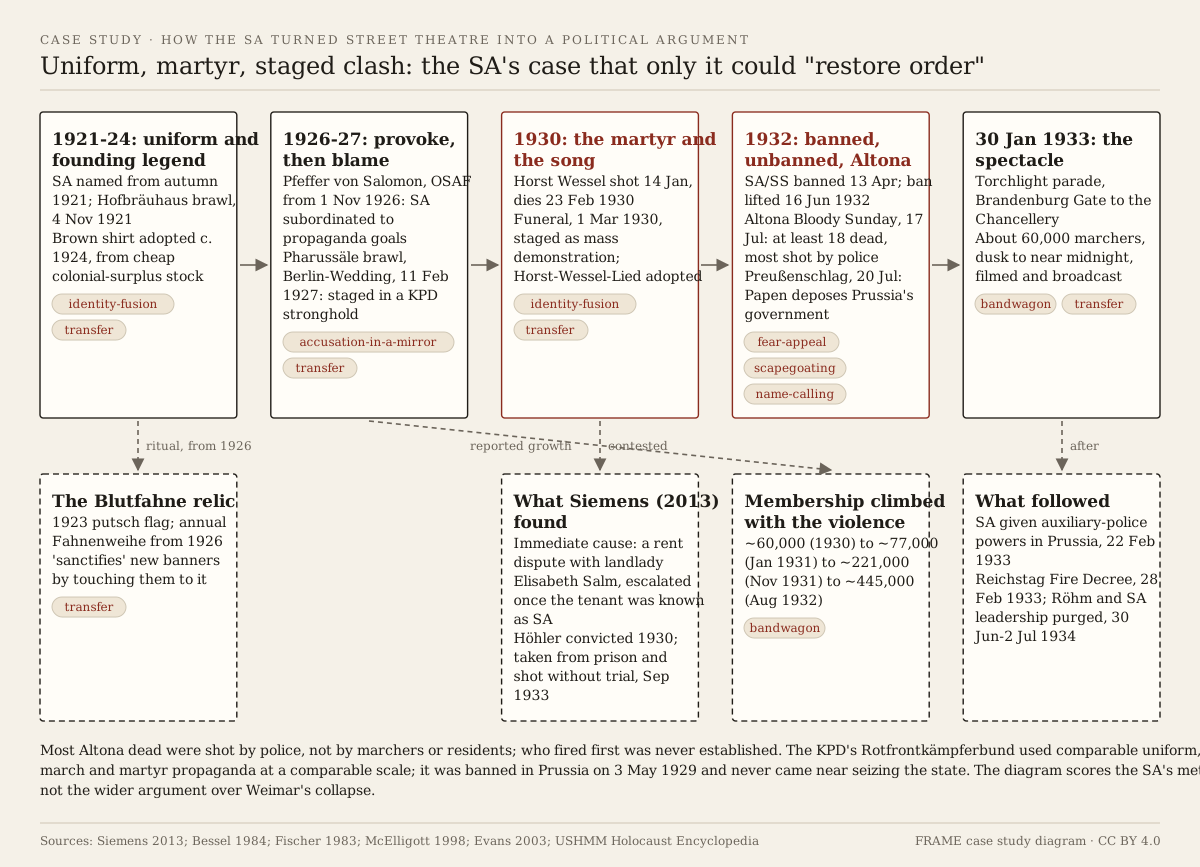
In one line: From 1921 the NSDAP's brownshirted Sturmabteilung built a single, repeated argument out of a uniform, a manufactured martyr (Horst Wessel, killed in 1930 in what the standard modern biography traces to a dispute over unpaid rent, and remade by Goebbels into a purely political sacrifice) and a rising toll of street clashes with the Communist Rotfrontkämpferbund: that only the SA could restore the order its own marches helped to break, a claim staged at every scale from a 1921 beer-hall brawl to a 60,000-strong torchlight march past the Chancellery on 30 January 1933.
What happened
- 3 August 1921. Hitler places the NSDAP's hall-guard squads under a "Gymnastics and Sports Section" (Turn- und Sportabteilung); by autumn the unit is using the name Sturmabteilung (SA, "storm detachment").
- 4 November 1921. About 46 SA men hold a beer-hall meeting at Munich's Hofbräuhaus against several hundred hecklers from rival parties in a chair-and-glass brawl. The party's own account treats the "Hofbräuhaus battle" as the SA's founding legend: proof that a small, disciplined squad could dominate a much larger crowd.
- From about 1924. The SA adopts the brown shirt as its uniform, cut from a stock of tan-brown shirts originally manufactured for German colonial troops in German East Africa and sold off cheaply after Germany lost its colonies under the Treaty of Versailles. The uniform gives members of very different backgrounds a shared, visible identity before the party has much of a shared programme to sell.
- 1 November 1926. Franz Pfeffer von Salomon is confirmed Oberster SA-Führer (Supreme SA Leader) and reorganises the SA along military lines, subordinating it explicitly to the party's political and propaganda goals rather than treating it as a pure hall-defence force. SA units (Stürme, Standarten) exist from this point to be seen marching, not only to fight.
- From 1926. At the annual party rally, the SA and party begin the Fahnenweihe ("flag consecration"): new unit banners are "sanctified" by touching them to the Blutfahne, the swastika flag carried in the failed Munich putsch of 9 November 1923, on which SA man Andreas Bauriedl bled to death after being shot beside it. Hitler personally performs the ritual at Nuremberg through 1938, giving a paramilitary a few years old the trappings of a much older relic cult.
- 11 February 1927. Berlin Gauleiter Joseph Goebbels, in the post since November 1926, stages an NSDAP meeting in the Pharussäle, a hall in the working-class Wedding district that is, in his own later telling, "the uncontested domain" of the KPD. The meeting turns into a mass brawl; Nazi reports claim roughly 85 Communist supporters injured against about 12 to 15 on the Nazi side. Goebbels published the episode in his book Kampf um Berlin ("The Battle for Berlin") as a chapter of deliberate strategy: march into the opponent's own ground, force a fight, and use the resulting notoriety as proof the SA can go anywhere.
- 1-3 May 1929 ("Blutmai"). Berlin's SPD police president, Karl Zörgiebel, bans May Day marches; when KPD supporters march regardless, police open fire in working-class districts. At least 33 people, mostly bystanders, are killed and roughly 200 injured over three days. On 3 May 1929 Prussia bans the KPD's paramilitary wing, the Rotfrontkämpferbund (RFB, founded 1924), a ban extended across the Reich on 14 May. The SA did not cause Blutmai, but NSDAP propaganda cites it afterward as proof of a standing Communist threat.
- 14 January 1930. SA-Sturmführer Horst Wessel, a 22-year-old law student who leads an SA unit in Berlin-Friedrichshain, is shot in the face in his rented room by Albrecht "Ali" Höhler, part of a Communist circle. Daniel Siemens's 2013 study, the standard modern biography, traces the immediate cause to a personal dispute: Wessel's landlady, Elisabeth Salm, asked a local Communist cell to give her tenant a "proletarian drubbing" over unpaid rent, and the group escalated once it learned the tenant was a known SA leader.
- 23 February 1930. Wessel dies of blood poisoning from the wound. Goebbels's paper Der Angriff runs the death as a purely political assassination, omitting the rent dispute. Wessel's own lyrics, published in Der Angriff in September 1929 under the title "Der Unbekannte SA-Mann" ("The Unknown SA-Man"), are republished under his name and begin to be sung at party events as the "Horst-Wessel-Lied."
- 1 March 1930. Wessel's funeral becomes a mass NSDAP demonstration through Berlin; Goebbels delivers the eulogy and records in his diary that Communist bystanders jeered the procession. Wessel's SA unit is renamed Sturm 5 "Horst Wessel." Within months the song is standard at SA and party gatherings nationwide; the NSDAP adopts it as the party anthem, and after January 1933 it becomes Germany's co-official anthem, played after the first verse of the Deutschlandlied at state occasions.
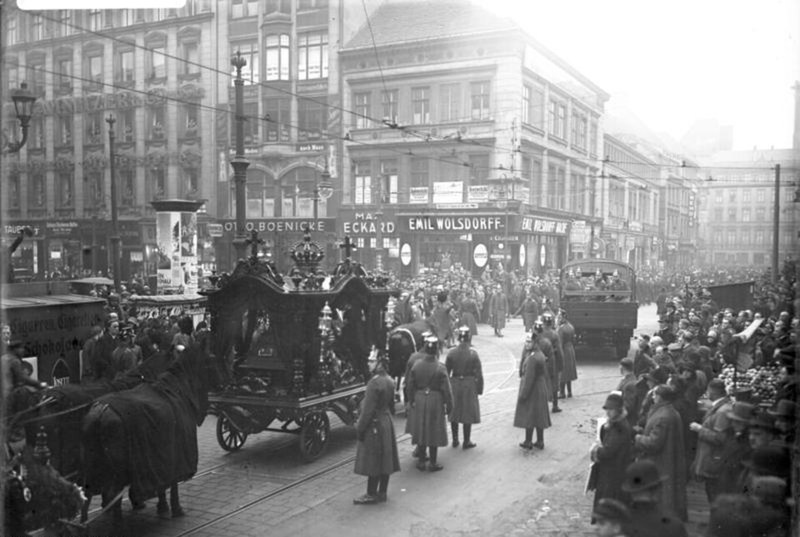
The funeral cortege of Horst Wessel passing through central Berlin (Jüdenstraße) with a police escort and crowds on the pavements, March 1930. Bundesarchiv, Bild 102-09303, CC BY-SA 3.0 DE; a 1930 photograph, public domain in the U.S.
Content note: Photograph of SA members giving the Nazi salute under swastika flags at a 1930 funeral. This object is shown as it was published. Why 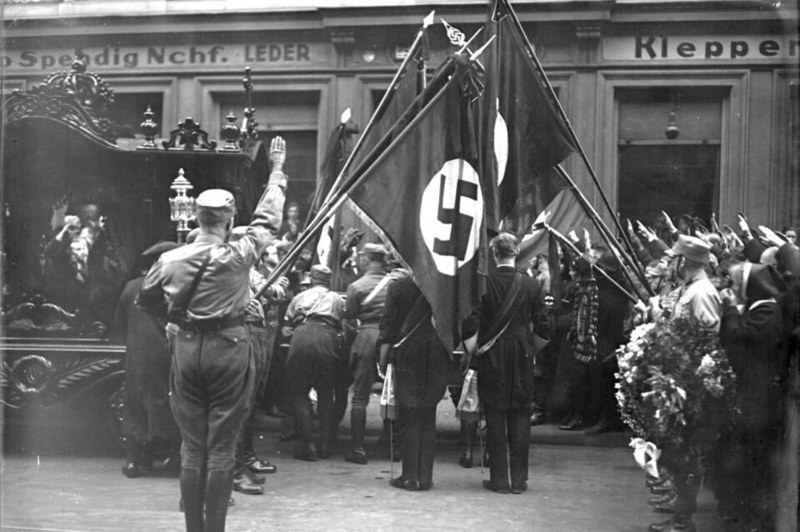
Men in SA and civilian dress raising their right arms beside the hearse under dipped party flags, one bearing the swastika, at the funeral of Horst Wessel, Berlin, March 1930. Bundesarchiv, Bild 102-09302, CC BY-SA 3.0 DE; a 1930 photograph, public domain in the U.S.
- 13 April 1932. Reich Chancellor Heinrich Brüning, with President Hindenburg's backing, bans the SA and SS by emergency decree, citing state police reports on the paramilitaries' readiness for civil war.
- 16 June 1932. Brüning's successor, Franz von Papen, lifts the ban as part of the arrangement under which the NSDAP tolerated his government and backed new Reichstag elections.
- 17 July 1932 ("Altonaer Blutsonntag," Altona Bloody Sunday). About 7,000 SA and SS men march with a police escort through the Große Freiheit district of Altona, a KPD stronghold near Hamburg. Shots are fired; who fired first has never been established, and historians (notably Anthony McElligott, 1998) note that most of the at least 18 people killed were shot by police rather than by marchers or residents. Dozens more are wounded.
- 20 July 1932 ("Preußenschlag"). Citing the Prussian state government's inability to keep public order, of which Altona was the bloodiest recent episode, Papen uses presidential emergency powers to depose the elected SPD-led Prussian government and install himself Reich Commissioner, without a shot fired against the takeover itself.
- 1930 to August 1932. SA membership, as reported by the party and cited by historians, rises from about 60,000 (1930) to about 77,000 (January 1931), about 221,000 (November 1931) and about 445,000 (August 1932). Over the same stretch political violence involving the SA, the RFB, the SPD's Reichsbanner and the police ran into the hundreds of deaths a year nationwide.
- 30 January 1933. Hours after Hindenburg names Hitler chancellor, the SA, SS and the war-veterans' league Stahlhelm stage a torchlight parade through the Brandenburg Gate and past the Reich Chancellery. Estimates put the column at about 60,000 men; it runs from dusk to near midnight, filmed and carried live on radio, staged to look like the nation itself turning out rather than one party's celebration.
Content note: Photograph of the 1933 Nazi torchlight procession in Berlin. This object is shown as it was published. Why 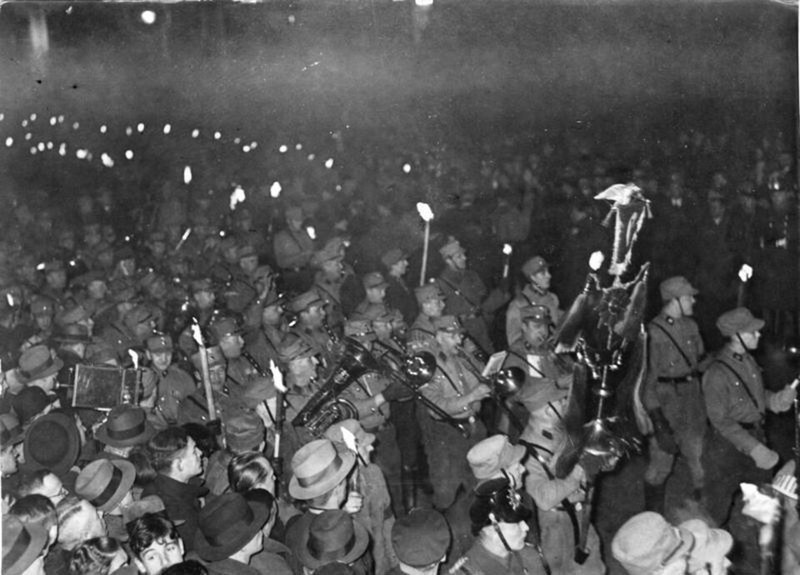
The torchlight procession on the evening of 30 January 1933 in Berlin's Wilhelmstraße, after Hitler's appointment as chancellor: marchers in caps and uniform with torches, a brass band and a standard, watched by spectators in the foreground (Bundesarchiv caption). Bundesarchiv, Bild 102-02985A, CC BY-SA 3.0 DE.
- September 1933. Albrecht Höhler, convicted in 1930 for Wessel's killing, is taken from Wohlau prison under a false transfer order and shot dead — an extrajudicial killing generally attributed to Reinhard Heydrich's security service, ending the life of the man the martyr cult had named as its central villain.
How it works
- Identity fusion: the brown shirt gave members of very different backgrounds one shared, visible identity before the party had much of a programme to sell, and the Horst-Wessel-Lied made that fusion explicit: "Kameraden, die Rotfront und Reaktion erschossen, marschieren im Geist in unsern Reihen mit" ("Comrades shot by the Red Front and reaction march in spirit within our ranks"). Singing it folded the dead into the marching column and made the SA's own casualties, not just its living members, part of who "we" were; renaming Wessel's unit "Sturm Horst Wessel" and dozens of German streets and squares after him extended the fusion from song into everyday geography.
- Transfer: the uniform itself borrowed the standing of wartime military discipline and the "front soldier" myth for men who, in most cases, had never served; the Blutfahne ritual, begun in 1926, borrowed the gravity of a relic cult for a three-year-old flag; and the 30 January 1933 torchlight parade borrowed a much older German tradition of student and military torchlight processions to dress a party militia's evening march in inherited legitimacy.
- Bandwagon: SA membership figures (60,000 in 1930 to about 445,000 by August 1932) were publicised as proof of unstoppable momentum, and the scale of set-piece marches, culminating in the roughly 60,000-strong, hours-long 30 January 1933 procession, was the argument: a display of numbers and uniform discipline standing in for any case about policy.
- Scapegoating: NSDAP and SA messaging routed the diffuse disorder of the late Weimar Republic — a collapsing economy, a fragmented parliament, and real street violence involving several armed formations and the police — onto one bounded target, "Rotfront," collapsing a many-actor crisis into a single enemy whose defeat is offered as the whole remedy.
- Name-calling: labels such as "Rotmord" (red murder) and "Bolschewik" were attached to the KPD and RFB as a class, doing the condemning before any specific act was described, while the same press rarely applied equivalent labels to the SA's own documented killings.
- Fear appeal: NSDAP messaging treated Communist revolution as a constant, imminent threat — citing Blutmai (1929) and the RFB's own paramilitary display — with the SA offered as the one remedy, "restoring order," without comparing the actual death toll the SA's own marches were adding to, or naming any alternative such as ordinary policing or a parliamentary majority.
- Accusation in a mirror: Goebbels's own account of the 1927 Pharussäle meeting, and the historians who have studied SA tactics since (Bessel 1984; Fischer 1983), describe a deliberate practice of marching into KPD and RFB strongholds specifically to provoke a fight, including the escorted march into Altona in July 1932. NSDAP and SA propaganda then presented the resulting casualties as unprovoked Communist aggression that only a stronger hand could stop, projecting onto the target the initiative the SA's own leadership had engineered.
Then and now
The same pairing — a movement identified by a colour of clothing, staged street violence, and a claim that only that movement can restore the order its own presence disrupts — appears far from 1930s Germany. On the night of 21 July 2019 in Hong Kong, men in white T-shirts, some later shown in court to have gang affiliations, attacked anti-government protesters, journalists and commuters at Yuen Long MTR station; at least 45 people were injured. Hong Kong's Independent Police Complaints Council later found no evidence of active police collusion but documented a roughly 39-minute gap before police arrived, and pro-government commentary and parts of the mainland press described the white-shirted men as residents restoring order against black-shirted "rioters," reproducing the same colour-coded, order-versus-chaos frame the SA had used against the "Rotfront."
The differences are large and should be stated plainly. Yuen Long was a single night's attack, not a formation of hundreds of thousands built over a decade; no political party used it to seize the machinery of a national government, let alone to dissolve parliament or abolish other parties; and several attackers were later tried and, in a 2021 verdict, convicted and sentenced to prison by an ordinary court, a process the German state never applied to the SA before 1945. Whether Yuen Long's organisers had any standing state backing, as opposed to sympathetic coverage after the fact, remains disputed and is not resolved on this page.
Positions on the record
- The NSDAP's position at the time. Goebbels's Der Angriff and the party press described SA marches as national self-defence against a Communist threat and Wessel's death as a political assassination pure and simple; after 1933 this became the state's own position, formalised in the Blutorden medal for early "fighters," the renaming of streets and squares after Wessel, and annual commemorations.
- The KPD's position at the time. Die Rote Fahne and other Communist papers described Wessel's death as the settling of a personal, criminal dispute involving unpaid rent, not a political killing, and described SA marches into working-class districts, including Altona, as calculated provocations dressed up afterward as self-defence.
- Scholarship. Daniel Siemens's The Making of a Nazi Hero: The Murder and Myth of Horst Wessel (2013), based on police, court, Nazi and Communist party records, concludes that both the Nazi "martyr" account and simple Communist denial oversimplify a case with real personal and criminal elements entangled with real political hostility. Richard Bessel's Political Violence and the Rise of Nazism (1984) and Conan Fischer's Stormtroopers (1983) document the SA's turn toward staged confrontation as deliberate strategy rather than spontaneous brawling. Anthony McElligott's Contested City (1998) is the standard study of Altona and leaves the question of who fired first unresolved, while establishing that police bullets caused most of the deaths.
- What is documented. The founding dates, the 1924 uniform adoption, the 1926 reorganisation and the Blutfahne ritual; the dates and content of the Pharussäle brawl, Wessel's shooting and death, his funeral and the song's adoption; the 1932 ban and its lifting; the Altona death toll of at least 18; the 30 January 1933 parade's scale; Höhler's 1930 conviction and 1933 extrajudicial killing.
- What is contested. Precise SA membership figures at any given date, since the party's own reporting had an incentive to round up; the overall balance of who initiated more of Weimar's street violence in aggregate, on which historians differ; and who fired the first shot at Altona, which McElligott's research leaves open.
- Not ruled on here. Whether the Weimar Republic's collapse was inevitable, and who bears the larger share of responsibility for it among the NSDAP, the KPD, the SPD-led Prussian government and the conservative elites around Papen and Hindenburg. This page scores how the SA built and used its street-level propaganda, not that wider argument.
Same-method test
The same identity-fusion, bandwagon and transfer tags apply to the KPD's own paramilitary, the Rotfrontkämpferbund. Founded in 1924 and banned in Prussia on 3 May 1929, the RFB used ranks, a raised-fist salute, mass funerals for members killed by police or the SA (several of the 33 dead of Blutmai became its own commemorated dead), and print runs in Die Rote Fahne presenting its own paramilitary numbers as proof of an unstoppable current, a mirror image of the SA's claim. This page's focus on the SA's method is not a finding that the KPD's paramilitary was less propagandistic; it existed first and used comparable devices at a comparable scale of a few tens of thousands. What differs is documented outcome: the RFB never came near seizing the German state, was banned years before the NSDAP took power, and its members became targets rather than beneficiaries of 1933.
Name-calling, bandwagon and fear-appeal also apply, on the same terms, to the second Ku Klux Klan in the contemporaneous United States (see the companion case study on that movement). Its white-robed uniform gave a diffuse membership an instant shared identity; its 1925 march of an estimated 25,000 to 50,000 members down Pennsylvania Avenue in Washington, D.C., staged scale itself as the argument, the way the SA's torchlight marches did; and its recruiters sold "100% Americanism" as the remedy for a diffuse set of anxieties routed onto Black Americans, Catholics, Jews and immigrants. The outcomes differed by orders of magnitude: the Klan never controlled a state government or a national army, and it collapsed within a decade under press exposure, the 1925 murder conviction of its Indiana leader David Curtis Stephenson, and federal and state tax and fraud prosecutions — a democracy's ordinary institutions eventually working, rather than a movement that had captured those institutions from within.
How to spot it
- Ask whether a march or parade argues anything, or only displays numbers, uniforms and formation to make scale itself feel like proof.
- Check who marched into whose neighbourhood first. A movement that routes its own columns through a rival's stronghold and then presents the resulting clash as unprovoked aggression by that rival is using its own provocation as evidence.
- When a member's death is folded into a slogan or anthem ("marches in spirit with us") before the facts of the death are established, treat the martyrdom claim and the factual claim as two separate things to check.
- Compare a movement's published membership or turnout figures against any independently kept record; an organisation counting its own members has a standing incentive to round up.
- Ask what "restoring order" would concretely require, and whether the group offering to restore it is also supplying a share of the disorder.
Images
| Image | Source | Licence |
|---|---|---|
| Mechanism diagram (above) | Drawn for FRAME from the sources below (make_diagrams_rtp_sa.py) |
CC BY 4.0, FRAME |
| Berlin, Beisetzung von Horst Wessel (1930-03) | Wikimedia Commons; Bundesarchiv, Bild 102-09303 / o.Ang. / CC-BY-SA 3.0 | Public domain (U.S., published before 1931); Bundesarchiv also offers CC BY-SA 3.0 DE |
| Berlin, Beisetzung von Horst Wessel (1930-03) | Wikimedia Commons; Bundesarchiv, Bild 102-09302 / o.Ang. / CC-BY-SA 3.0 | Public domain (U.S., published before 1931); Bundesarchiv also offers CC BY-SA 3.0 DE |
| Berlin, Fackelzug zur Machtergreifung Hitlers (January 30, 1933) | Wikimedia Commons; Bundesarchiv, Bild 102-02985A / o.Ang. / CC-BY-SA 3.0 | CC BY-SA 3.0 DE |


Image gaps
- Horst Wessel portraits and Wessel's grave. The funeral is now shown above (Bundesarchiv Bild 102-09302 and 102-09303, CC BY-SA 3.0 DE, published 1930). Not hosted: portraits of Wessel and Bild 102-02306A (Hitler and Goebbels at Wessel's grave), whose dates and publication history were not checked. See Wikimedia Commons, Category:Horst Wessel.
- SA standards and the Blutfahne ritual. Commons holds Bundesarchiv Bild 102-03016 ("Berlin, SA Standarte 'Horst Wessel'", dated 1933) and Nuremberg rally photographs of the flag-consecration ceremony. Not hosted: none was checked for this page beyond the licence tag, and no pre-1931 photograph of the ceremony was found. See Wikimedia Commons, Category:Sturmabteilung.
- Altona Bloody Sunday, 17 July 1932. No openly licensed photograph of the march or its aftermath with clear US copyright status was identified in this session.
- The Rotfrontkämpferbund. No openly licensed photograph of RFB marches, funerals or its raised-fist salute with clear US copyright status was identified in this session.
- A contemporaneous US-origin image. Unlike some other FRAME pages on Nazi Germany, no US government (and therefore clearly public-domain) wartime poster or photograph depicting the SA specifically was located in this session's searches of loc.gov.
Sources
- Daniel Siemens, The Making of a Nazi Hero: The Murder and Myth of Horst Wessel (I.B. Tauris/Yale University Press, 2013).
- Richard Bessel, Political Violence and the Rise of Nazism: The Storm Troopers in Eastern Germany 1925-1934 (Yale University Press, 1984).
- Conan Fischer, Stormtroopers: A Social, Economic and Ideological Analysis, 1929-35 (George Allen & Unwin, 1983).
- Sven Reichardt, Faschistische Kampfbünde: Gewalt und Gemeinschaft im italienischen Squadrismus und in der deutschen SA (Böhlau, 2002).
- Anthony McElligott, Contested City: Municipal Politics and the Rise of Nazism in Altona, 1917-1937 (University of Michigan Press, 1998).
- Eve Rosenhaft, Beating the Fascists? The German Communists and Political Violence, 1929-1933 (Cambridge University Press, 1983).
- Ian Kershaw, Hitler 1889-1936: Hubris (W. W. Norton, 1998).
- Richard J. Evans, The Coming of the Third Reich (Penguin, 2003).
- Eric D. Weitz, Weimar Germany: Promise and Tragedy (Princeton University Press, 2007).
- Peter Fritzsche, Germans into Nazis (Harvard University Press, 1998).
- Peter Longerich, Goebbels: A Biography, trans. Alan Bance, Jeremy Noakes and Lesley Sharpe (Random House, 2015).
- Joseph Goebbels, Kampf um Berlin (Franz Eher Nachfolger, 1932), for his own account of the Pharussäle meeting of 11 February 1927.
- George L. Mosse, ed., Nazi Culture: A Documentary History (Grosset & Dunlap, 1966), for the Horst-Wessel-Lied text and other party song material in English translation.
- United States Holocaust Memorial Museum, Holocaust Encyclopedia, "The SA": ushmm.org, and "Adolf Hitler and the Nazi Rise to Power, 1918-1933": ushmm.org.
- Wikimedia Commons, Category:Horst Wessel and Category:Sturmabteilung, for the Bundesarchiv image inventory, including the two Wessel funeral photographs shown above and the items listed under Image gaps.
- New York Public Library Digital Collections, photograph of the 30 January 1933 torchlight parade at the Brandenburg Gate: digitalcollections.nypl.org.
- Hong Kong Independent Police Complaints Council, Thematic Study Report: Incident Day - Sunday 21 July 2019, Yuen Long (2020): ipcc.gov.hk (PDF).
- Hong Kong Free Press, "From 'violent attack' to 'gang fight': How the official account of the Yuen Long mob attack changed" (21 July 2021): hongkongfp.com.