Content note. This page describes a white-supremacist movement and quotes short passages from its own publications and leaders as evidence of its method. The quoted words are the movement's, not this archive's description of anyone.
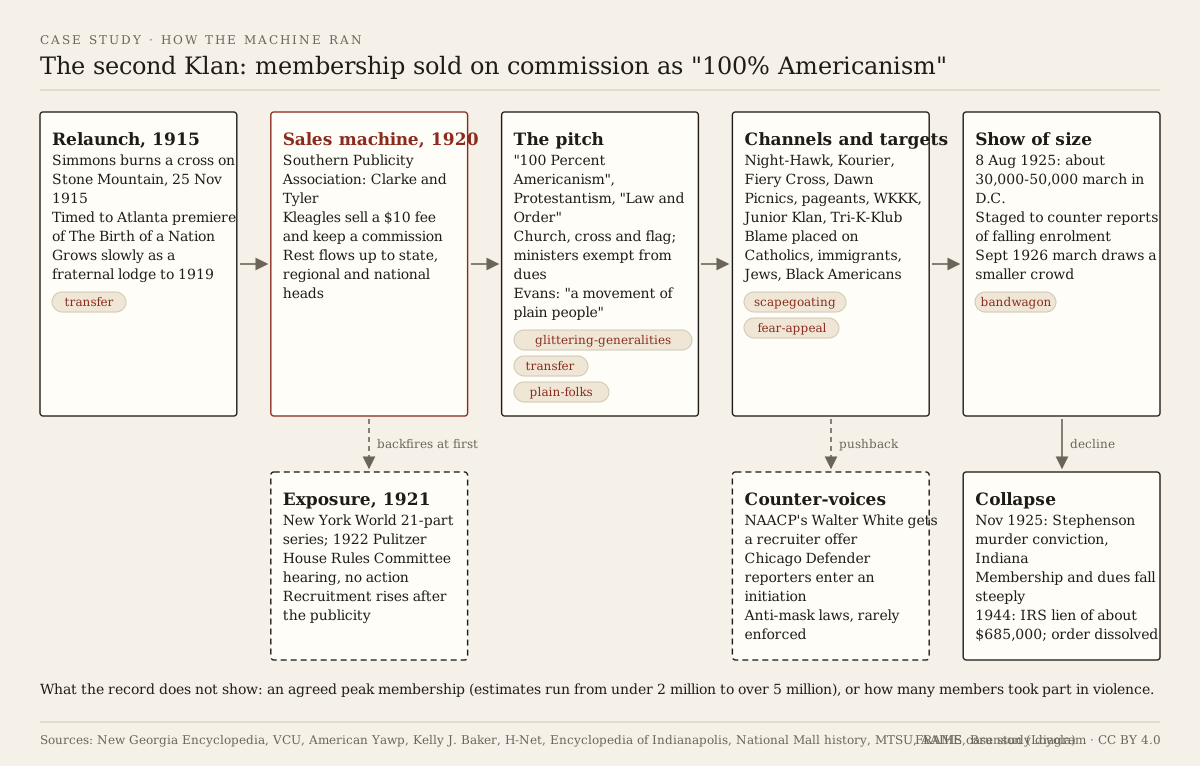
In one line: a small Atlanta fraternal order, relaunched in 1915 around a film premiere, became a mass movement after 1920 when a publicity firm turned membership into a commission sale, and it sold that membership through church networks, family picnics, its own newspapers and very large parades, all under the banner of "100% Americanism".
What happened
- 25 November 1915. William J. Simmons and a small group climb Stone Mountain outside Atlanta, burn a cross and proclaim a new Knights of the Ku Klux Klan. The New Georgia Encyclopedia quotes Simmons saying he chose the date because an event in Atlanta the next week would give the order "a tremendous popular boost": the local premiere of D. W. Griffith's film The Birth of a Nation, which portrayed the Reconstruction-era Klan as heroes.
- 1915-1919. The order grows slowly as a fraternal lodge, according to the same encyclopedia.
- 1920. Simmons hires the Southern Publicity Association of Edward Young Clarke and Elizabeth Tyler, a fund-raising firm whose earlier clients included the Anti-Saloon League and the Red Cross. The firm turns recruitment into a sales network. Local recruiters ("Kleagles") collect a $10 initiation fee (the "Klectoken"), keep a commission, and pass the rest up a chain of state and regional sales managers to Clarke, Tyler and Simmons. Clarke takes the title "Imperial Kleagle".
- The press. The national Imperial Night-Hawk (Atlanta, 1923-1924) is followed by the monthly The Kourier (1924-1936). The Fiery Cross starts in Indianapolis in 1922 as an independent Klan paper, claims more than 100,000 circulation within a year, and is then taken over by the Klan and copied as a string of state editions. Chicago's Dawn publishes open attacks on Catholic and immigrant Americans. The VCU "Mapping the Second Ku Klux Klan" project catalogues these papers.
- Membership. No authoritative count exists. McVeigh's summary gives "up to five million members" in about four thousand chapters. Reviewers of Linda Gordon's 2017 book report four to six million. Other scholars give lower figures. Kathleen Blee estimates about half a million women joined the Women of the Ku Klux Klan (WKKK), including about 250,000 in Indiana alone, 32 percent of that state's white, native-born women.
- Politics. In Indiana in 1924, Grand Dragon D. C. Stephenson backs a slate that wins the governorship and, by the Klan's own claim, more than half the seats in the state legislature.
- 8 August 1925. Between roughly 30,000 and 50,000 robed Klan members march unmasked down Pennsylvania Avenue in Washington, D.C., as a D.C. ordinance required. A second march on 13 September 1926 draws a smaller crowd.
- 1925-1944. Membership falls steeply after the Stephenson conviction (see below). In 1944 the Internal Revenue Service files a lien of about $685,000 for unpaid taxes on 1920s income, and Imperial Wizard James Colescott dissolves the national order.
Content note: Ku Klux Klan members marching in robes. This object is shown as it was published. Why 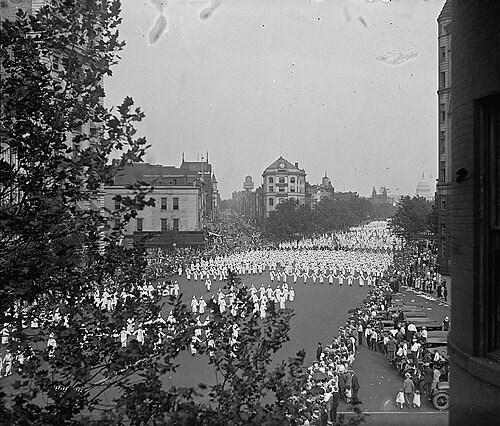
The Klan's march on Pennsylvania Avenue, Washington, D.C., 8 August 1925. National Photo Company Collection, Library of Congress, public domain.
Content note: Ku Klux Klan members marching in robes, as reported by the newspaper. This object is shown as it was published. Why 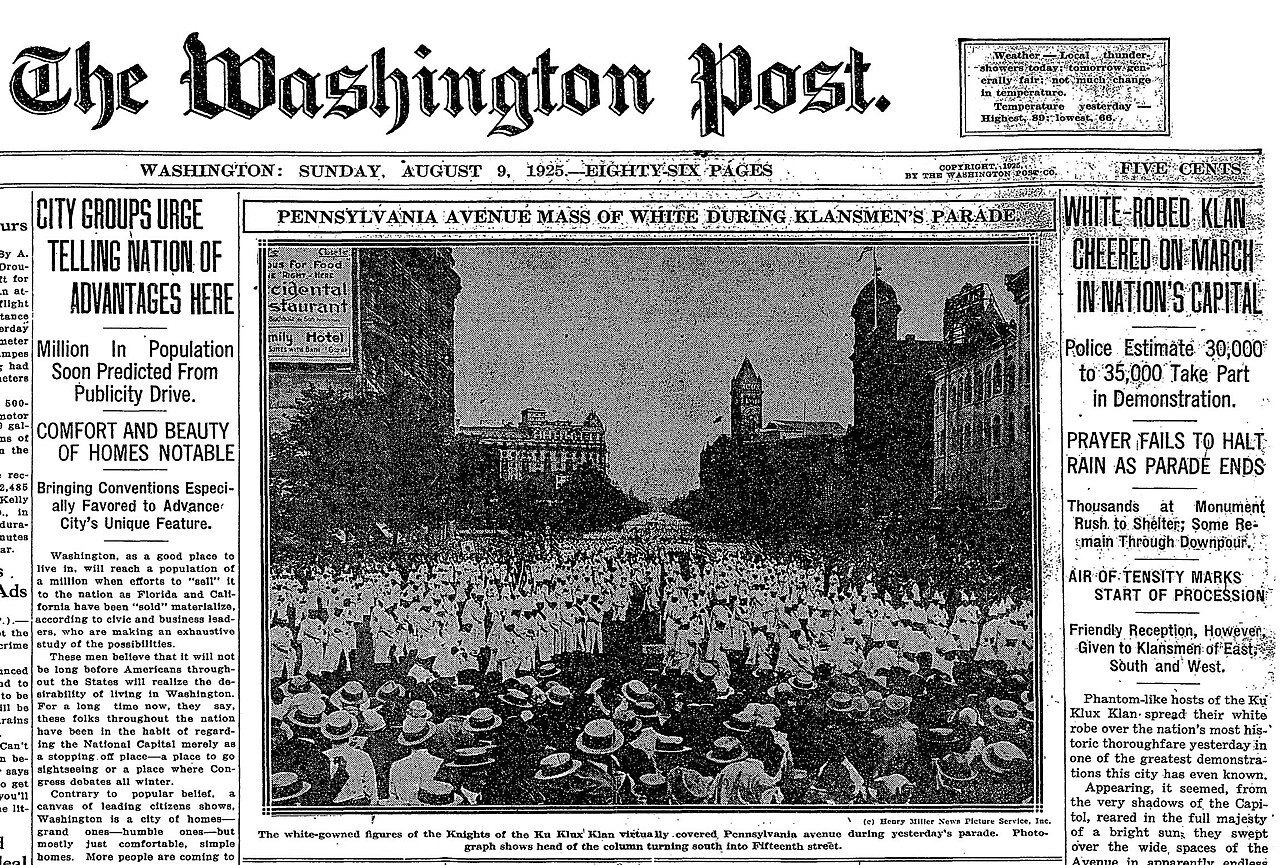
The Washington Post front page the next morning, 9 August 1925, reporting police estimates of 30,000 to 35,000 marchers. Public domain (U.S. publication before 1929).
How it works
- Glittering generalities: the Klan's headline promise was "100 Percent Americanism", alongside "Protestantism", "Law and Order" and, openly, the "eternal maintenance of white supremacy". "Americanism" was not defined as a policy anyone could test. It worked as a virtue word that made joining feel like patriotism and made the exclusions look like a defence of the country.
- Transfer: the movement borrowed the prestige of the church and the flag. Ministers could join without paying dues, spoke at rallies and received public donations from Klansmen, and meetings were often held in churches, according to Gordon's reviewers. Kelly J. Baker, a historian of Klan religion, documents how robes, the fiery cross and the American flag served as the movement's "gospel". She quotes a 1926 Kourier article: "We love Jesus because He shed his blood for us, and we love the Flag because it represents the blood shed for our freedom." At the 1925 Washington event, members laid wreaths at the Tomb of the Unknown Soldier.
- Plain folks: Imperial Wizard Hiram Evans opened his 1926 essay "The Klan's Fight for Americanism" with: "We are a movement of plain people." He asked for power to return to "the average citizen of the old stock". The public face matched the words: Klan-run Independence Day "Americanism" pageants with fireworks, children's games and women's bake-offs, plus baseball teams, baby contests and christenings. The Junior Ku Klux Klan (teenage boys), the Tri-K-Klub (teenage girls) and the WKKK extended the family format.
- Scapegoating: sociologist Rory McVeigh reads the Klan's own publications as a response by white Protestants to real economic change, including large manufacturers and chain stores squeezing small businesses and farms, and cities gaining power. The Klan placed the blame for that change on bounded groups: Catholics, immigrants, Jews and Black Americans. Evans framed the "old stock" as a "Nordic race" under threat.
- Fear appeal: in Indiana, Klan messaging presented Catholicism as a foreign force taking orders from the Vatican. The offered protection was the Klan itself, as an enforcer of "law and order" and public morals. The same period's record includes whippings and other vigilante violence against people the Klan targeted, reported in the New York World series and raised in the 1921 House hearing. That violence is a documented fact, but the fear-appeal tag here refers only to the messaging.
- Bandwagon: size was the argument. According to the National Mall history project, the 1925 Washington march was organised to counter reports that enrolment was falling. The Klan's papers and pageants repeated large numbers; the recruiter commission system also rewarded high counts, one reason historians treat the Klan's own membership claims with caution.
- Audience and spread. The pitch was aimed at white, native-born Protestants, mostly outside the South. Kenneth T. Jackson's 1967 study showed that it was strong in cities such as Chicago and Denver, not only in small towns. It moved through paid recruiters, existing Protestant congregations and fraternal lodges, a chain of weekly papers, and open-air events that whole families attended.
How it was countered
- The press. From 6 September 1921 the New York World ran a 21-day series on the Klan's rituals, finances, recruiting and violence, carried by at least eighteen other papers. It won the 1922 Pulitzer Prize for Public Service. Historians of the exposé note a side effect: the national attention coincided with a surge in recruitment.
- Congress. The House Rules Committee held hearings in October 1921. Simmons testified that the Klan was a fraternal order and called the press charges slanders. The committee made no recommendations.
- Black press and organisations. NAACP official Walter White wrote to Klan headquarters posing as a prospective member and received a letter from Clarke inviting him to organise in New York. White and James Weldon Johnson passed information to Catholic and Jewish organisations and to New York police. The Chicago Defender sent two reporters into a Klan initiation in disguise and editorialised against the Klan throughout the decade.
- Anti-mask laws. Several states, including Louisiana in 1924, passed mask bans aimed at the Klan. The First Amendment Encyclopedia reports that states often passed them to signal repudiation of the Klan but rarely enforced them. Such laws have since been challenged on free-speech grounds, because they apply to any masked protester, not only Klansmen.
- Courts. In November 1925 an Indiana jury convicted D. C. Stephenson of second-degree murder in the death of Madge Oberholtzer, a state employee he had abducted and assaulted. Historians treat the case as the event that ended the Klan as a political force in Indiana and badly damaged its "law and order" image nationally.
- Tax enforcement. The 1944 IRS lien ended the national organisation. Colescott said afterwards that the Klan had to sell its assets and "go out of business".
- What research says. Exposure alone did not stop growth in 1921-1924. The record points to several causes acting together: scandal among leaders, above all the Stephenson case; fights over money and control, including Hiram Evans's displacement of Simmons in 1922; and falling dues income once recruitment slowed.
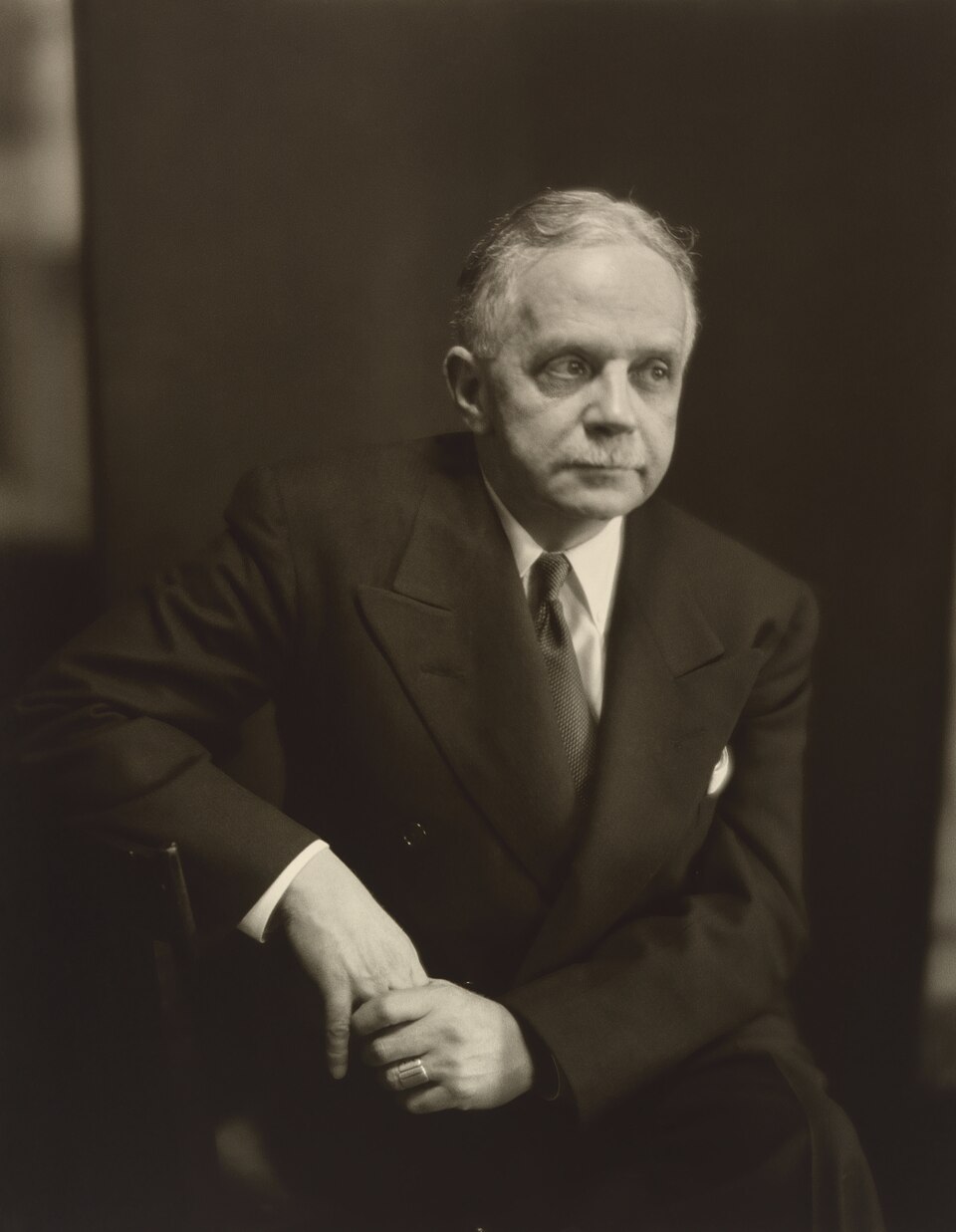
Walter White of the NAACP, who wrote to Klan headquarters posing as a prospective recruiter. Portrait by Clara Sipprell, about 1950, National Portrait Gallery, released under CC0.
Then and now
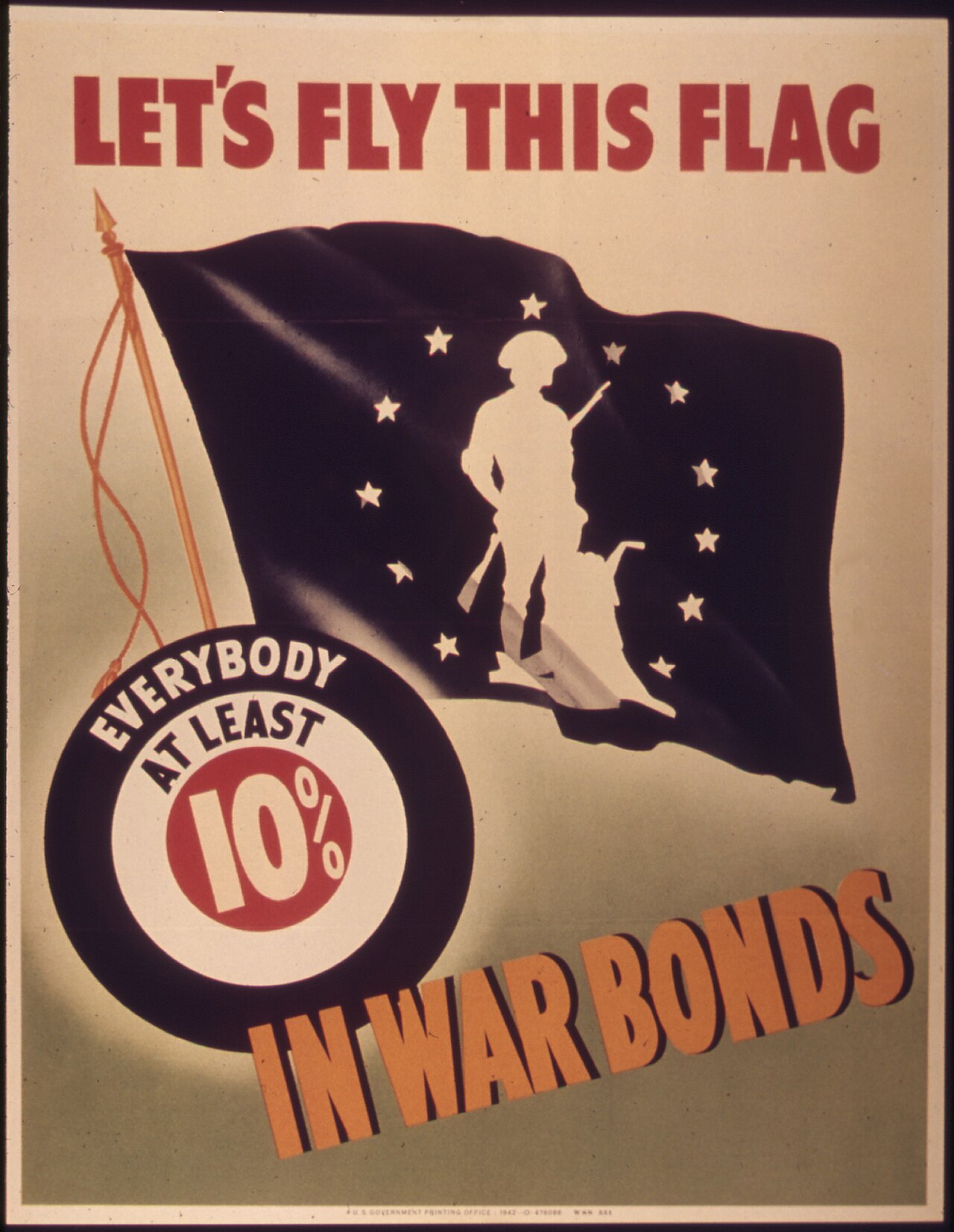
Let's Fly This Flag: Everybody at Least 10 Percent in War Bonds, U.S. Treasury Department, 1943. Public domain.
The 1943 Treasury poster asks a workplace to raise a flag once everyone buys bonds. The flag stands for belonging, and the reason to join is that everyone else already has. The 1920s Klan used the same two devices: the national flag as a badge of loyalty, and visible participation (a 30,000-strong march, a full picnic ground) as proof that joining is normal. The differences are large and should be stated plainly. The poster came from an elected government raising lawful war finance, it named no group of fellow citizens as enemies, and the pressure it applied to non-buyers was social rather than violent. The Klan was a private, secret, fee-charging movement whose stated aim was the "maintenance of white supremacy", and its members committed documented acts of violence. The comparison is about method only.
Positions on the record
- The movement's own position: Evans described the Klan as "a movement of plain people" defending the "old stock" and "Americanism". Simmons told Congress it was a fraternal and patriotic order and that reports of violence were slanders.
- What is documented: the 1915 relaunch and its timing, the 1920 commission system, the national and state papers, the auxiliaries, the 1925 and 1926 marches, the Indiana election results of 1924, the Stephenson conviction and the 1944 lien. The Klan's founding rules limited membership to white, native-born Protestants.
- What is contested: peak membership (estimates run from under two million to more than five million), how far ordinary members took part in violence rather than social events, and how much the Klan decided elections rather than riding existing currents. In Indiana, the Klan-backed legislature passed little of the Klan's programme.
Same-method test
The finding would be the same for a movement of any other politics that recruited through fraternal lodges, family events and member insurance. The International Workers Order (1930-1954) was a Communist-affiliated fraternal benefit society. Its general secretary sat on the Communist Party's Political Bureau, and it offered cheap insurance, clinics, children's camps and foreign-language papers to nearly 200,000 members at its peak. Using a fraternal network and family life to carry a political line would be scored the same way here. The counter-measure also has a parallel, and the same scrutiny applies to it: after the IWO was placed on the U.S. Attorney General's list of subversive organisations in 1947, New York State used insurance law to liquidate it, a process completed in 1954. That was a state using insurance law to close a lawful insurer over its political links. The record does not show the IWO running a campaign of vigilante violence, so the parallel covers the recruiting method, not the Klan's violence.
How to spot it
- A virtue word ("Americanism" here; in other movements "the people", "progress" or "values") that is never defined but is used to decide who belongs.
- Religious and national symbols carried by a private group that claims to speak for the whole faith or the whole nation.
- Family events, sports and charity used as the front door, with the political programme arriving after people have joined.
- Crowd sizes and membership totals offered as the reason to join, especially when recruiters are paid per head.
Images
| Image | Source | Licence |
|---|---|---|
| Mechanism diagram (above) | Drawn for FRAME from the sources below (make_diagrams_extremist.py) |
CC BY 4.0, FRAME |
| Klan march, Washington (8 Aug 1925) | Wikimedia Commons | Public domain (National Photo Company, Library of Congress) |
| Washington Post front page (9 Aug 1925) | Wikimedia Commons | Public domain (U.S. publication before 1929) |
| Walter White, by Clara Sipprell (c. 1950) | Wikimedia Commons | CC0 (National Portrait Gallery) |
| Let's Fly This Flag (1943) | FRAME gallery (NARA 514865 via Wikimedia Commons) | Public domain (U.S. government work) |


Image gaps
- The September 1926 march. A National Photo Company view of the smaller 1926 march is also on Wikimedia Commons (public domain) and could be added beside the 1925 photograph. This gap can be filled.
- Klan newspapers, recruiting leaflets and robes. Not hosted. Much of this material is now public domain, but it is recruitment content, so it is cited through the scholarship above rather than reproduced.
Sources
- New Georgia Encyclopedia: Ku Klux Klan in the Twentieth Century
- Virginia Commonwealth University, Scholars Compass: the New York World's exposé of 1921 and the history of the second Ku Klux Klan
- VCU Libraries: Mapping the Second Ku Klux Klan, 1915-1940, bibliography and press
- American Yawp Reader: Hiram Evans, "The Klan's Fight for Americanism" (1926)
- Kelly J. Baker, University of Chicago Religion & Culture Forum, 2017: The Artifacts of White Supremacy
- H-Net review of Rory McVeigh, The Rise of the Ku Klux Klan (2009)
- VCU Scholars Compass: review of Kathleen M. Blee, Women of the Klan (1991)
- Inside Higher Ed, 2017: review of Linda Gordon, The Second Coming of the KKK
- American Historical Review, 1968: review of Kenneth T. Jackson, The Ku Klux Klan in the City, 1915-1930
- Histories of the National Mall: Ku Klux Klan Rally, 1925
- Encyclopedia of Indianapolis: Ku Klux Klan
- The First Amendment Encyclopedia (MTSU): Anti-Mask Laws
- African American Intellectual History Society: The Black Press and the Ku Klux Klan
- Samuel D. Brunson, Loyola University Chicago: Addressing Hate: Georgia, the IRS, and the Ku Klux Klan
- Cornell University Library: Guide to the International Workers Order Records, 1915-2002