Content note. This page describes killings, public punishments and mutilation, and quotes the labels both the insurgents and their opponents used against people. The labels are quoted as evidence of the method, not as this archive's description of anyone.
In one line: a Maoist party in Peru built its message around one man, "Presidente Gonzalo", staged violence as instruction, and turned prisons into stages, while the state answered with emergency rule, a caged captive shown to the press and, later, a paid tabloid press; the Truth and Reconciliation Commission found grave abuses on both sides.
What happened
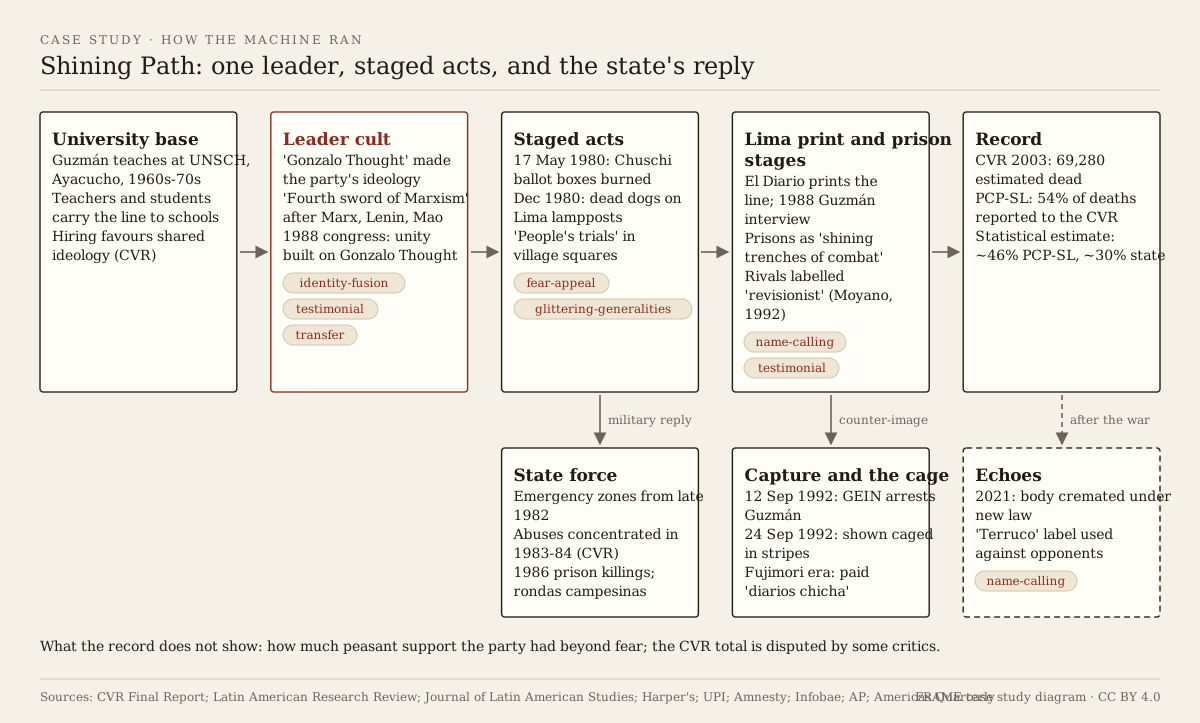
- 1960s-1970s, Ayacucho. Abimael Guzmán, a philosophy professor at the Universidad Nacional de San Cristóbal de Huamanga (UNSCH), builds a faction there. The CVR's chapter on the university says he held posts including director of personnel and director of the teacher-training programme, and that hiring came to favour shared ideology. Carlos Iván Degregori, a former UNSCH lecturer and later a CVR commissioner, traces the party's growth to teachers and students from newly educated rural families.
- 17 May 1980, Chuschi. On the eve of Peru's first election after twelve years of military rule, a small group of party members burns the ballot boxes and voter register in the Ayacucho village of Chuschi. The party calls it the start of the armed struggle.
- 26 December 1980, Lima. Residents find dead dogs hung from lampposts in the city centre, some with signs attacking Deng Xiaoping. The target is China's post-Mao leadership, which the party calls a betrayal of Maoism.
- 1980s, the countryside. The party holds "people's trials" in village squares. Research in the Journal of Latin American Studies describes a ladder of warnings, forced haircuts and beatings, then executions. The CVR states the party used torture and mutilation "to set intimidating examples" for the population it sought to control.
- Late 1980s, Lima. El Diario, a daily sold openly in Lima and edited by Luis Arce Borja, prints the party's line. In July 1988 it publishes a long interview with Guzmán, billed as the "interview of the century", run by sympathetic editors with no challenge to his answers. It was his only interview before capture.
- 1980s-1992, prisons. The party calls its prison wings "shining trenches of combat". At Canto Grande, women prisoners in uniform line up and salute a wall mural of Guzmán; songs, plays and paintings in his honour are produced inside, and journalists are invited to watch.
- Leader cult. Members adopt "Gonzalo Thought" as the party's guiding ideology and describe Guzmán as the "fourth sword of Marxism" after Marx, Lenin and Mao.
- 15 February 1992. A party squad kills María Elena Moyano, a United Left community leader in the Lima district of Villa El Salvador, and blows up her body. The party had denounced her as a "revisionist".
- 12 September 1992. The police special intelligence group GEIN arrests Guzmán in a house in Surquillo, Lima.
- 24 September 1992. The state shows Guzmán to the press in an iron cage at police headquarters, dressed in a striped prison uniform. He raises a fist and gives a speech saying the war goes on.
- 2003. The CVR's Final Report estimates 69,280 dead. It names the party the main perpetrator, responsible for 54 percent of the deaths reported to the commission; its statistical estimate attributes about 46 percent of the total to the party and about 30 percent to state agents.
How it works
- Identity fusion: the party tied loyalty to the revolution to acceptance of "Gonzalo Thought". In the 1988 interview Guzmán says the party's first congress "established the basis of party unity" on that thought. Once unity is defined as agreeing with the leader, doubting the leader reads as splitting the party. A 2023 study in the Latin American Research Review shows that dissent did exist inside the party between 1982 and 1992, which the cult's own material hid.
- Testimonial: the leader's authority was meant to settle questions. Paintings, poems, tapestries and songs presented "Presidente Gonzalo" as the source of the correct line. Prisoners staged plays in his honour. The vouching figure was also the one who set the line, so checking it had nowhere to go.
- Transfer: "the fourth sword of Marxism" borrows the standing of Marx, Lenin and Mao and places Guzmán in their line. The dead dogs worked the other way, pasting contempt onto Deng Xiaoping to mark the party as the true heir of Mao.
- Name-calling: "revisionist" was the label for rival leftists such as Moyano, arriving before any argument about what she had done. The same device later ran in the other direction: after the war, "terruco" (slang for terrorist) came to be applied to left-wing politicians, rights groups, protesters and Indigenous people, a practice Peruvians call terruqueo; critics say the label is used without evidence.
- Fear appeal: exemplary violence carried a message to everyone who saw it. Killings of officials and public punishments told villagers what disloyalty cost, and the offered safety was compliance. The dogs in Lima worked as a warning that the party was present in the capital.
- Glittering generalities: "people's war", "people's trials" and "new power" put the word "people" where proof of popular consent would go. The Journal of Latin American Studies research finds that Andean villagers often approved of non-lethal punishments but did not agree to killings, and that support fell away once executions began.
- Audience and spread. In villages the channels were meetings, trials, graffiti and killings. Among students and teachers they were study circles at UNSCH and schools. In Lima they were El Diario, wall slogans, and prison yards opened to the press. Abroad, support committees and later an exile edition of El Diario carried the line.
How it was countered
- Emergency zones and military rule. From late 1982 large parts of the Andes were placed under states of emergency with political-military commands. The CVR found that many of the extrajudicial executions, disappearances, torture cases and massacres reported to it were concentrated in 1983-1984, after the armed forces took charge in Ayacucho. Amnesty International documented state massacres such as Accomarca (1985) and Cayara (1988). The CVR concluded that at certain times and places state agents committed systematic or generalised abuses.
- Prisons. In June 1986, after party-led riots in Lima prisons, state forces killed more than 200 inmates at El Frontón and Lurigancho. The CVR found that many were summarily executed after they had surrendered. In May 1992 police and army units retook Canto Grande in an operation in which dozens of prisoners were killed; the Inter-American Court of Human Rights later held Peru responsible.
- Rondas campesinas. Peasant night patrols, some older than the war and many later organised with the army as self-defence committees, became a front line. Orin Starn's research describes them as a grassroots movement that helped defeat the party in the countryside at heavy cost; the party attacked them, including the 1983 Lucanamarca massacre, which the CVR attributes to it.
- Police intelligence. GEIN, a small police unit, tracked Guzmán through surveillance rather than mass sweeps. His arrest in 1992 is widely treated as the turning point in the party's decline.
- The cage. The press display of 24 September 1992 was the state's counter-image to the Gonzalo cult: a leader shown as a convict in stripes behind bars. It also gave him a live platform for a speech that his supporters abroad still circulate.
- Media control. Under President Alberto Fujimori, adviser Vladimiro Montesinos paid media owners and directed a set of tabloids, the diarios chicha, that praised the government and attacked opponents. Videos Montesinos had recorded of these payments came out in 2000. A 2015 court convicted Fujimori and Montesinos over the tabloids; in 2016 the Supreme Court acquitted Fujimori on that charge.
- 2021, the body. Guzmán died in prison on 11 September 2021. Congress passed a law that let the state cremate his body instead of handing it to his wife, also a prisoner, and his ashes were scattered in an undisclosed place. Supporters of the law argued that a grave could become a place of homage; critics raised the rights of the family.
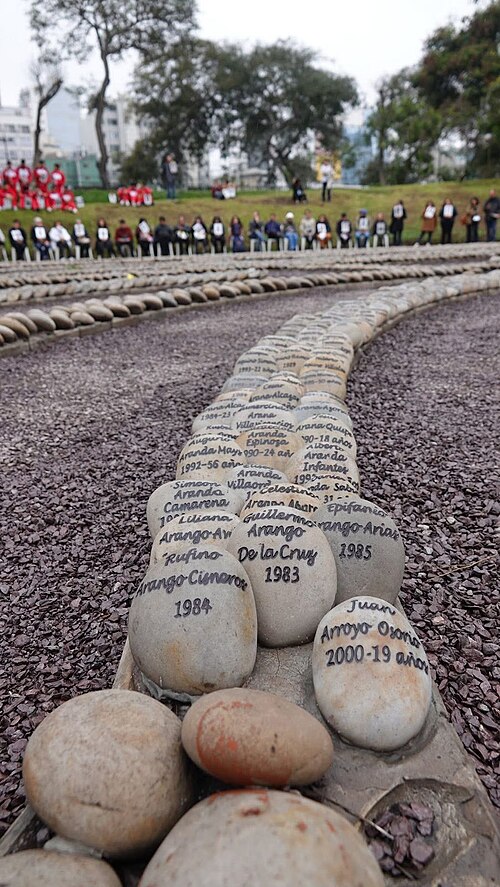
*El Ojo que Llora (The Eye That Cries), a memorial in Lima to those killed in the internal armed conflict: a spiral of stones, many inscribed with a victim's name and year. Photo by Jennifer de la Cruz, CC BY-SA 4.0.*
Then and now
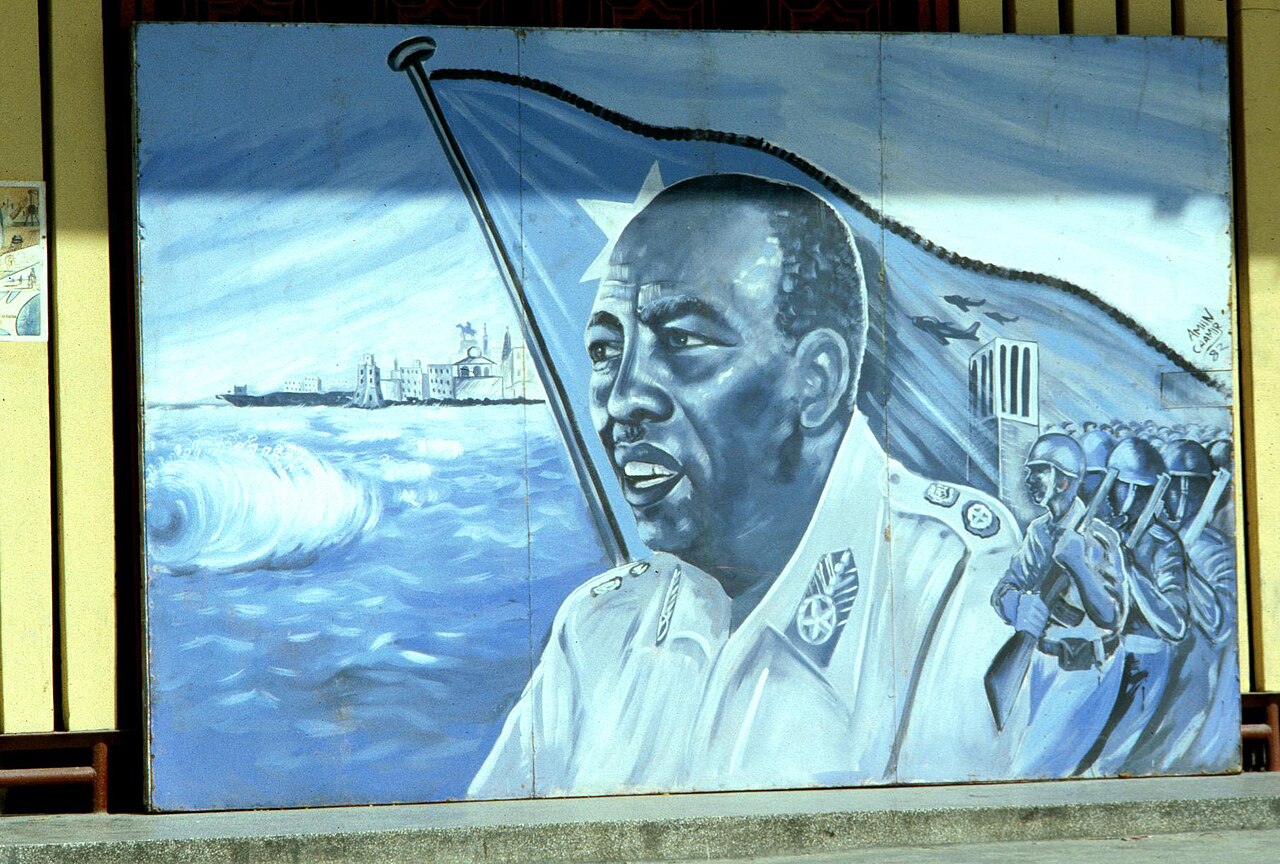
Barre Cult of Personality Mural, Somali Democratic Republic government, 1976. Public domain.
The Mogadishu mural fuses Siad Barre's face into the national flag, so questioning the man reads as attacking the nation. The Guzmán mural on a Canto Grande wall did the same inside a smaller world: the party, not the nation, was fused with the leader, and prisoners saluted it in formation. The differences are large. Barre's mural was the work of a sitting government with an army, a treasury and the whole country as audience. Guzmán's was painted by prisoners of a state that was fighting his party, and its audience was fellow militants and visiting journalists. The method, a face standing in for the collective, is the same.
Positions on the record
- The party's stated position: its armed struggle was a "people's war" to destroy the old state and build a new one, guided by "Gonzalo Thought", which it called the only correct application of Marxism to Peru.
- What is documented: the Chuschi ballot burning, the Lima dogs, people's trials and exemplary killings, the Moyano killing, the Gonzalo cult in prisons and print, and the CVR's attribution of the largest share of deaths to the party. Equally documented: state massacres, prison killings and emergency-zone abuses, the caged display, and the Montesinos payments to media.
- What is contested: the size of the CVR's total estimate, which some critics in Peru say is too high; how much peasant support the party ever had beyond fear; and whether a given use of the terruco label today points to real armed-left links or is a smear. This page makes no finding on any living person accused of either.
Same-method test
A leader cult that fuses the movement with one man, labels rivals as traitors to the true line, and uses staged killings as lessons would score the same way whatever its ideology. The Liberation Tigers of Tamil Eelam, an ethno-nationalist movement, built a comparable cult around Velupillai Prabhakaran (see The Tamil Tigers' martyr cult, and the state's 'humanitarian operation'). The same rule applies to the state side here: the "terruco" label is scored as Name-calling exactly as "revisionist" is, because in both cases the label arrives before any evidence.
How to spot it
- Watch for a movement whose doctrine carries its leader's name. When the thought is the man, disagreement becomes disloyalty.
- Ask who actually consented when a group says it acts for "the people". Look for votes, surveys or independent testimony, not the group's own word.
- Treat a label ("revisionist", "terruco", "traitor") that arrives before any stated act as a signal to look for the act.
- When a state displays a captured enemy, notice that it is also making propaganda, and read the display as a message, not only as news.
Images
| Image | Source | Licence |
|---|---|---|
| Mechanism diagram (above) | Drawn for FRAME from the sources below (make_diagrams_extremist.py) |
CC BY 4.0, FRAME |
| El Ojo que Llora memorial, Lima | Wikimedia Commons | CC BY-SA 4.0, Jennifer de la Cruz |
| Barre Cult of Personality Mural (1976) | FRAME gallery, University of Wisconsin Libraries via Wikimedia Commons | Public domain (CC0) |
.jpg)
Image gaps
- Party murals, paintings and prison drawings of Guzmán. Made by the movement and still circulated as tributes, so cited, not hosted. Researchers' photographs of prison art are copyrighted.
- The 24 September 1992 cage display. Press photographs from that day are held by news agencies and photographers under copyright.
- Chuschi and the UNSCH campus. Openly licensed photographs of the places may exist on Wikimedia Commons; one Chuschi candidate turned out to be a museum display, whose panels are the museum's copyright, so it was not used. This gap can be filled.
- CVR Final Report pages and the Yuyanapaq photo exhibition. The report text is a public document; the exhibition's photographs belong to their photographers and archives.
Sources
- CVR, 2003: Informe Final, Conclusiones generales
- CVR, 2003: Informe Final, Anexo 2, ¿Cuántos peruanos murieron?
- CVR, 2003: 2.18 La Universidad Nacional San Cristóbal de Huamanga
- CVR, 2003: 2.67 Las ejecuciones extrajudiciales del penal de El Frontón y Lurigancho
- Latin American Research Review, 2023: Beyond the Gonzalo Mystique: Challenges to Abimael Guzmán's Leadership inside Peru's Shining Path, 1982-1992
- Journal of Latin American Studies: Gendered Atrocity and Haircut Punishment by the Shining Path in Peru
- Journal of Latin American Studies: review of Carlos Iván Degregori, How Difficult It Is to Be God (2012)
- Duke University Press, Orin Starn: Nightwatch: The Politics of Protest in the Andes
- Harper's, July 2019: A Jagged Scrap of History
- Age of Revolutions, 21 June 2021: The Dogs of War: The Animals of the Internal Armed Conflict in Peru
- UPI, 24 September 1992: Shining Path leader presented to media in cage
- Amnesty International via Refworld, 1997: Women's Human Rights, In Memory of María Elena Moyano
- Infobae, 11 September 2024: El "imperio chicha" de Alberto Fujimori
- The Washington Post (AP), 24 September 2021: Body of Shining Path leader Abimael Guzmán cremated in Peru
- Americas Quarterly: "Terruqueo" and Peru's Fear of the Left