
In one line: in 1965 a sugar-industry trade group paid two Harvard nutrition scientists $6,500 to review the evidence on diet and heart disease; their 1967 New England Journal of Medicine review pointed to fat and cholesterol, did not name the sponsor, and, according to Kearns, Schmidt and Glantz (2016), played down the evidence on sucrose. The funding and letters are documented; those authors call the evidence that the industry shaped the conclusions circumstantial.
What happened
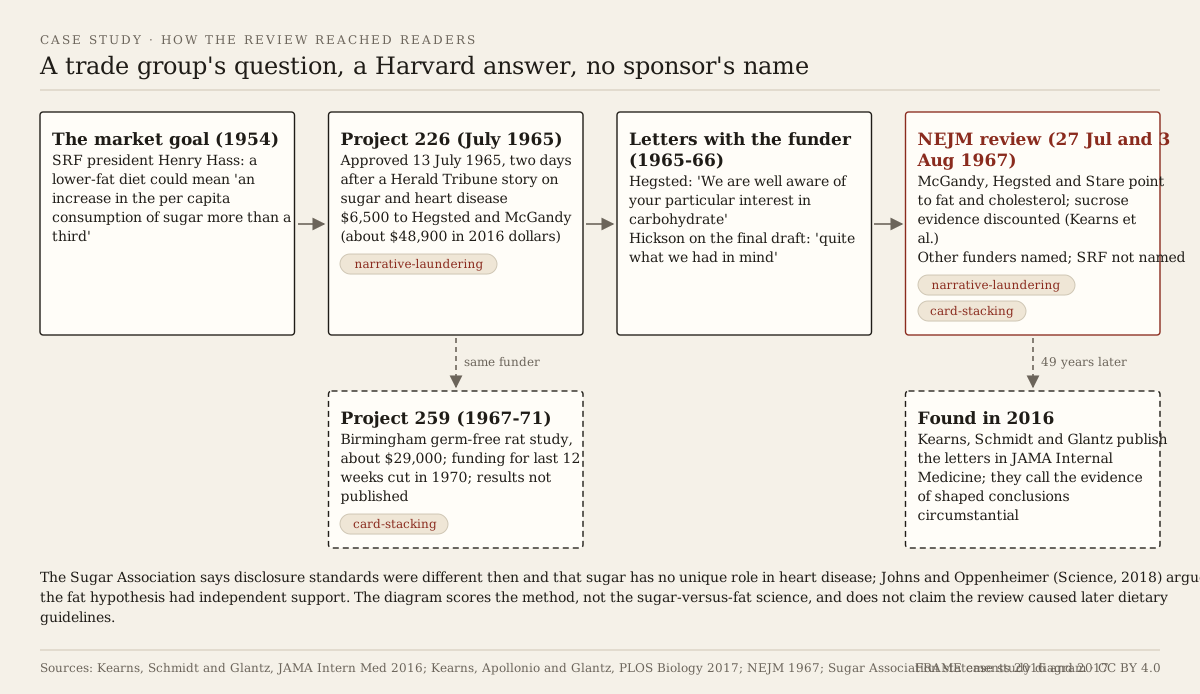
- 1954. Henry Hass, president of the Sugar Research Foundation, speaks to the American Society of Sugar Beet Technologists ("What's New in Sugar Research"). According to Kearns et al., he said that if Americans could be moved to a lower-fat diet and the carbohydrate industries recaptured those calories, this would mean "an increase in the per capita consumption of sugar more than a third".
- 11 July 1965. The New York Herald Tribune runs a story on research linking sugar to heart disease (as described by Kearns et al.).
- 13 July 1965. SRF's executive committee approves Project 226, a literature review on "Carbohydrates and Cholesterol Metabolism", to be written by D. Mark Hegsted and Robert McGandy of Harvard's Department of Nutrition, under department chair Fredrick Stare.
- 1965 to 1966. John Hickson, SRF's vice-president and director of research, writes to Hegsted that SRF's particular interest is in claims that sucrose makes an "inordinate contribution" to metabolic conditions until then ascribed to fat metabolism. Hegsted replies: "We are well aware of your particular interest in carbohydrate and will cover this as well as we can." Hickson sends articles and receives drafts. SRF pays $6,500 in all (about $48,900 in 2016 dollars), for "a review article of the several papers which find some special metabolic peril in sucrose and, in particular, fructose."
- 1966. After reading a final draft, Hickson writes: "Let me assure you this is quite what we had in mind and we look forward to its appearance in print."
- 27 July and 3 August 1967. McGandy, Hegsted and Stare publish "Dietary Fats, Carbohydrates and Atherosclerotic Vascular Disease" in two parts in the New England Journal of Medicine (277:186-192 and 277:242-247). The review names other industry and non-industry funding of the authors' experimental work. It does not name SRF's funding of the review. NEJM did not require conflict-of-interest disclosure at the time; it began asking for it in 1984.
- 1967 to 1971. SRF (renamed the International Sugar Research Foundation during the project) funds Project 259, "Dietary Carbohydrate and Blood Lipids in Germ-Free Rats", led by W. F. R. Pover at the University of Birmingham, UK, with about $29,000 (about $187,000 in 2016 dollars). According to Kearns, Apollonio and Glantz (2017), preliminary results suggested that gut bacteria played a part in how sucrose raised blood fats, and that sucrose-fed rats had raised levels of beta-glucuronidase, an enzyme then associated with bladder cancer. In 1970 Hickson described the project's value as "nil" and funding for its final 12 weeks was stopped. The results were not published.
- 1976. The Sugar Association wins the Public Relations Society of America's Silver Anvil award for a public relations campaign run during a U.S. Food and Drug Administration review of sugar's safety status. Kearns, Glantz and Apollonio analysed its rhetoric in 2019.
- 1977. The U.S. Senate Select Committee on Nutrition and Human Needs publishes Dietary Goals for the United States. Hegsted helped draft it, and he later led nutrition work at the U.S. Department of Agriculture (1978 to 1982). The Goals recommended cutting fat and also cutting refined and processed sugar.
- 12 September 2016. Kearns, Schmidt and Glantz publish "Sugar Industry and Coronary Heart Disease Research: A Historical Analysis of Internal Industry Documents" in JAMA Internal Medicine (176(11):1680-1685), with a commentary by Marion Nestle. The Sugar Association responds the same day.
- 21 November 2017. Kearns, Apollonio and Glantz publish the Project 259 documents in PLOS Biology. The Sugar Association responds that the study ended because it was delayed, over budget and overlapped with a reorganisation.
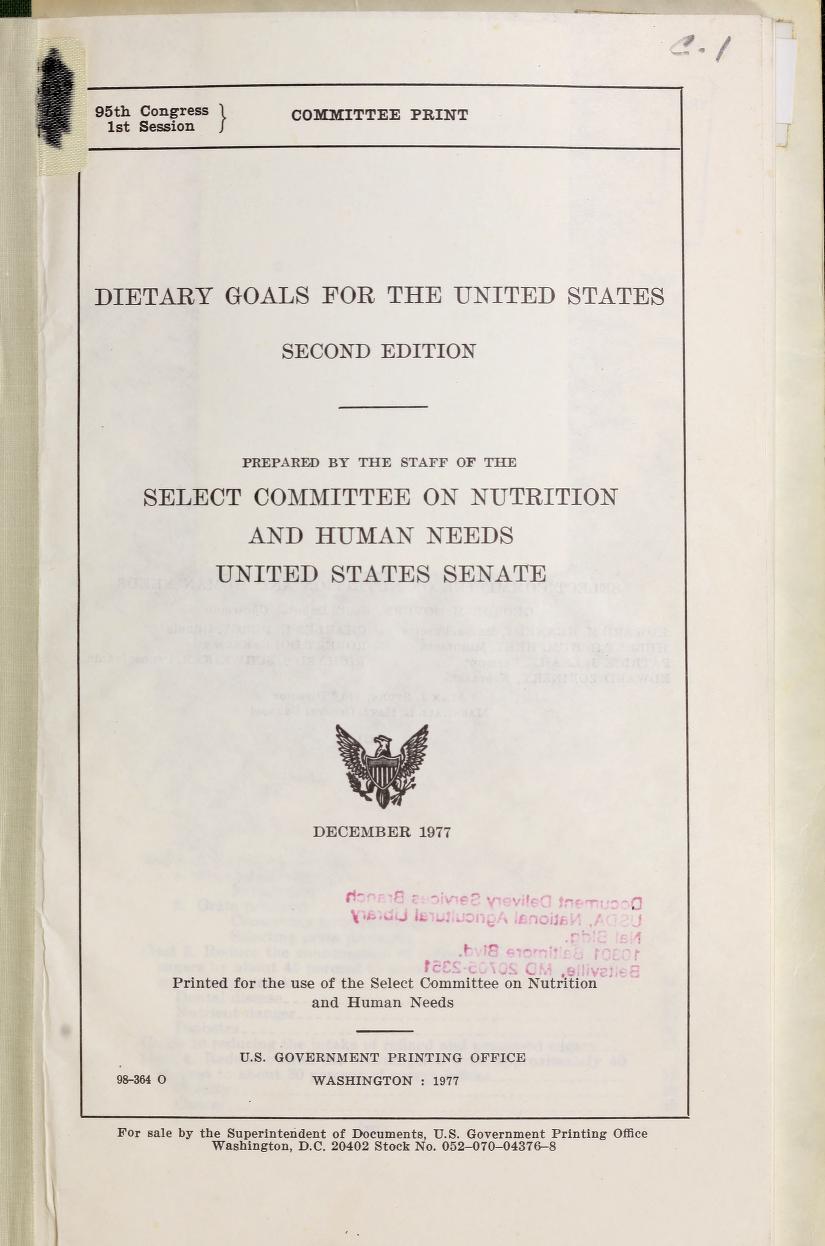
Title page of Dietary Goals for the United States, Second Edition, prepared by the staff of the Senate Select Committee on Nutrition and Human Needs (committee print, December 1977; the first edition appeared in February 1977). U.S. Government Printing Office, public domain (U.S. government work); scan from the USDA National Agricultural Library via the Internet Archive.
How it works
- Narrative laundering: the documents show a trade group's commercial interest (Hass's 1954 goal; Hickson's stated "particular interest") paid for a review that reached physicians under the names of Harvard scientists and a leading medical journal. The sponsor's name did not appear. A reader in 1967 saw an academic review, not an industry-funded one. This is the documented part. Whether the funding changed what the authors concluded is the contested part: Kearns et al. write that "there is no direct evidence that the sugar industry wrote or changed the NEJM review manuscript; the evidence that the industry shaped the review's conclusions is circumstantial."
- Card stacking: Kearns et al. argue that the review singled out fat and cholesterol as the dietary causes of heart disease and downplayed evidence that sucrose was also a risk factor. They report that it discounted studies showing that sucrose raised blood triglycerides, on the basis that serum cholesterol was the relevant marker of risk. At the programme level, Kearns, Apollonio and Glantz argue that stopping and not publishing Project 259 kept unfavourable preliminary results out of the record. The Sugar Association gives a different reason for ending the project (see below).
- Why no other tags. Disclosure theater does not fit: there was no disclosure of SRF's role to travel or not travel with the review. Transfer and Testimonial describe part of the same move (Harvard's and NEJM's standing) and are folded into narrative-laundering here. Manufactured consensus is not tagged: this is one review, not a set of apparently independent voices. The 1976 Silver Anvil campaign is recorded but not tagged, because this page has not examined its materials directly.
Then and now
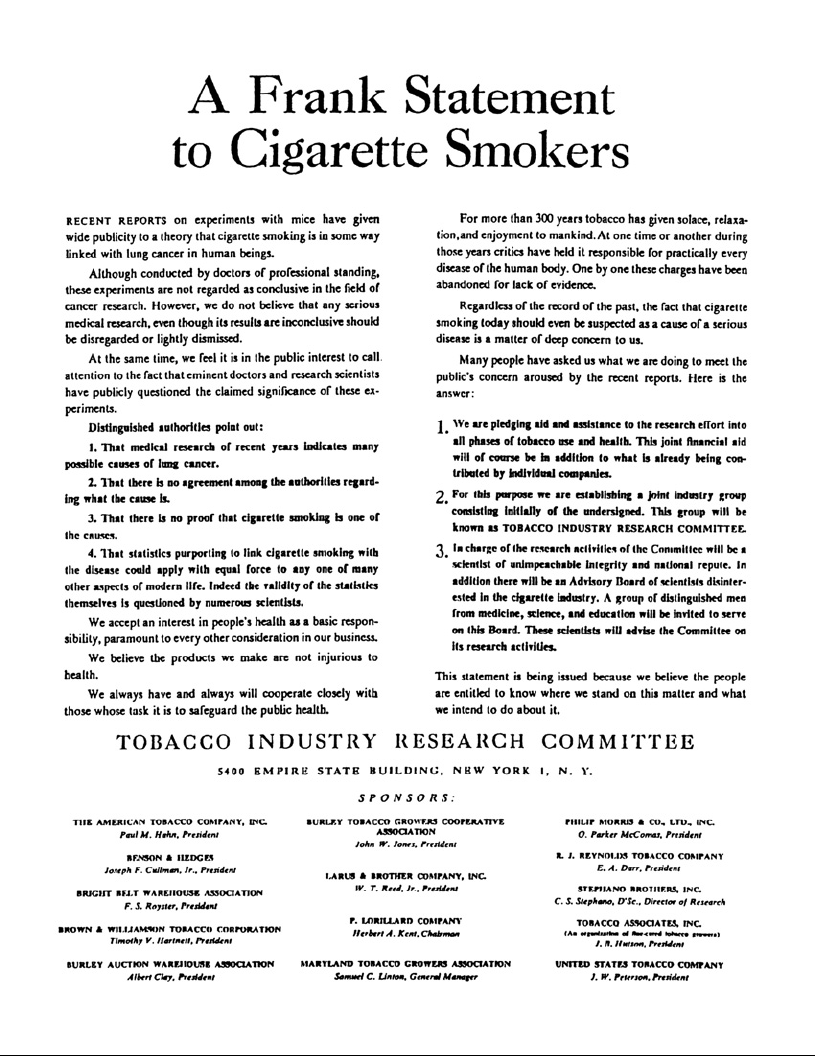
A Frank Statement to Cigarette Smokers, Tobacco Industry Research Committee, January 1954. Public domain.
The Frank Statement ran in the same year as Hass's speech. Both industries answered health research by funding research. The differences matter. The tobacco advertisement was signed by the companies and argued openly in their name; in United States v. Philip Morris (2006) a federal court found it part of a decades-long effort to maintain doubt. The SRF review was the reverse in form: no advertisement, no industry signature, a single academic review, and no court finding. Its link to the industry became public only when historians found the letters, nearly fifty years later. The companion page The tobacco industry's smoking-and-health doubt campaign, 1953 to 1998 covers the tobacco case in full.
Positions on the record
- The Sugar Association (2016): "We acknowledge that the Sugar Research Foundation should have exercised greater transparency in all of its research activities, however, when the studies in question were published funding disclosures and transparency standards were not the norm they are today." It also said it was hard to comment on "documents we have never seen", questioned "this author's continued attempts to reframe historical occurrences to conveniently align with the currently trending antisugar narrative", and said that decades of research "have concluded that sugar does not have a unique role in heart disease."
- The Sugar Association (2017), on Project 259: it called the PLOS Biology paper "a collection of speculations and assumptions about events that happened nearly five decades ago" and said the study ended because it was delayed, over budget and overlapped with the split of SRF into two organisations.
- Kearns, Schmidt and Glantz (2016): the documents suggest the industry sponsored research that cast doubt on the hazards of sucrose while promoting fat as the dietary culprit. They propose that policymaking committees "should consider giving less weight to food industry-funded studies". Their own paper lists university, foundation and U.S. National Institutes of Health funding.
- Marion Nestle (commentary, 2016): the case is relevant to present-day debates; she asked researchers, peer reviewers, editors and journalists to weigh the effect of food-industry funding on the credibility of nutrition science.
- Critics of the Kearns account: David Merritt Johns and Gerald Oppenheimer (Science, 2018) argue that industry funding was common on all sides of the diet-heart debate, that Hegsted's earlier dairy-funded work had already found that saturated fat raised cholesterol while sugar had little effect, and that the evidence does not show a "sugar conspiracy". Johns told BuzzFeed News that the review was cited fewer than 100 times by 2016 and that Hegsted "was regarded as a very data-driven scientist who was very scrupulous." A 2016 guest article in FoodNavigator called the Kearns paper an attempt "to rewrite nutrition history" and objected to the treatment of three deceased scientists.
- This archive's reading. Documented: the 1954 speech, the Project 226 payment, the Hickson-Hegsted letters, the absence of SRF's name from the 1967 review, and the termination of Project 259 without publication. Argued, not settled: that the funding shaped the review's conclusions (Kearns et al. call their own evidence circumstantial), and why Project 259 was stopped. Not shown: that the 1967 review caused later U.S. dietary advice. Kearns et al. argue the industry helped shift attention toward fat; Johns and Oppenheimer argue the fat hypothesis had independent support; the 1977 Dietary Goals that Hegsted helped draft advised cutting sugar as well as fat. The relative roles of sugar and fat in heart disease are a scientific question this page does not decide.
Same-method test
The method is paying for a review or study through a channel the reader cannot see, so that an interested party's conclusion arrives under an independent name. The sector does not change the score. In 2010 the UK General Medical Council found that Andrew Wakefield had not disclosed to The Lancet his funding from the Legal Aid Board for litigation against MMR vaccine makers (see The MMR scare: from a 1998 press conference to Vaxxed, and its 1802 ancestors). A union, an environmental group, a government agency or a litigant that funded an academic review without disclosure would be scored the same way here.
How to spot it
- Look for who paid for the specific paper, not only who funds the authors' lab. The 1967 review listed other funders and still left out the sponsor of the review itself.
- Check the disclosure rules of the journal and year. Absence of a disclosure before 1984 at NEJM is normal and proves nothing by itself; the letters are what establish the link here.
- Compare how a review treats evidence on each side: is the same standard (same biomarker, same study design) applied to both?
- Ask what was funded and not published. A sponsor that ends a study early can shape the record as much as one that funds a review.
- Keep "the sponsor paid for it" apart from "the conclusion is wrong". Funding is a reason to check, not a verdict.
Images
| Image | Source | Licence |
|---|---|---|
| Mechanism diagram (above) | Drawn for FRAME from the sourced facts on this page (make_diagrams.py) |
CC BY 4.0, FRAME |
| A Frank Statement to Cigarette Smokers (1954) | FRAME gallery, from Wikimedia Commons | Public domain (U.S., published 1954 without a copyright notice) |
| Dietary Goals for the United States, 2nd ed., title page (1977) | Internet Archive, USDA National Agricultural Library scan | Public domain (U.S. government work) |

Image gaps
- The Hickson-Hegsted letters and the Hass speech. These are the core evidence. They are held in university archives and reproduced in part in the 2016 and 2017 papers, whose figures are published under the journals' licences. The PLOS Biology paper is CC BY, but its Figure 1 carries a third-party Shutterstock rat icon, so it was not hosted; the JAMA figures cannot be reused without permission.
- The 1967 NEJM review pages. Copyrighted by the Massachusetts Medical Society; not reproduced.
- Portraits of Hegsted, McGandy, Stare or Hickson. No openly licensed portrait was found in this search. A USDA-era photo of Hegsted (1978 to 1982) would be a U.S. government work if one can be located.
- 1976 Silver Anvil campaign materials. Published after 1930 and not confirmed as public domain; not reproduced.
Sources
- Kearns CE, Schmidt LA, Glantz SA. Sugar Industry and Coronary Heart Disease Research: A Historical Analysis of Internal Industry Documents. JAMA Intern Med. 2016;176(11):1680-1685 (open-access copy, PMC5099084)
- Nestle M. Food Industry Funding of Nutrition Research: The Relevance of History for Current Debates. JAMA Intern Med. 2016 (PubMed 27618496)
- McGandy RB, Hegsted DM, Stare FJ. Dietary Fats, Carbohydrates and Atherosclerotic Vascular Disease. N Engl J Med. 1967;277:186-192 and part 2, 277:242-247
- Kearns CE, Apollonio D, Glantz SA. Sugar industry sponsorship of germ-free rodent studies linking sucrose to hyperlipidemia and cancer. PLOS Biology. 2017
- Kearns CE, Glantz SA, Apollonio DE. In defense of sugar: a critical analysis of rhetorical strategies used in The Sugar Association's award-winning 1976 public relations campaign. BMC Public Health. 2019
- Sugar Association statement on the Kearns JAMA study, September 2016
- Sugar Association response to the 2017 study, as reproduced by U.S. Sugar
- CNN, 21 November 2017: Controversial sugar industry study on cancer uncovered
- STAT, 12 September 2016: Sugar industry secretly paid for favorable Harvard research
- UCSF news release, September 2016
- Johns DM, Oppenheimer GM. Was there ever really a "sugar conspiracy"? Science. 2018;359:747-750 and Columbia Mailman School summary
- BuzzFeed News profile of Cristin Kearns, with David Merritt Johns's comments
- FoodNavigator guest article, 19 September 2016: Sugar review: Rewriting history to expose a non-existent conspiracy
- Oppenheimer GM, Benrubi ID. McGovern's Senate Select Committee on Nutrition and Human Needs versus the meat industry on the diet-heart question (1976-1977). Am J Public Health. 2014
- Dietary Goals for the United States (1977), Internet Archive record
- 1 Crown Office Row: GMC findings of fact on Dr Wakefield, 5 February 2010