In one line: after studies linked cigarettes to lung cancer, the major U.S. tobacco companies hired a public-relations firm, funded a research body they presented as impartial, and for four decades said in public that the health question was still open, while a federal court found in 2006 that this was part of a decades-long scheme to defraud the public.
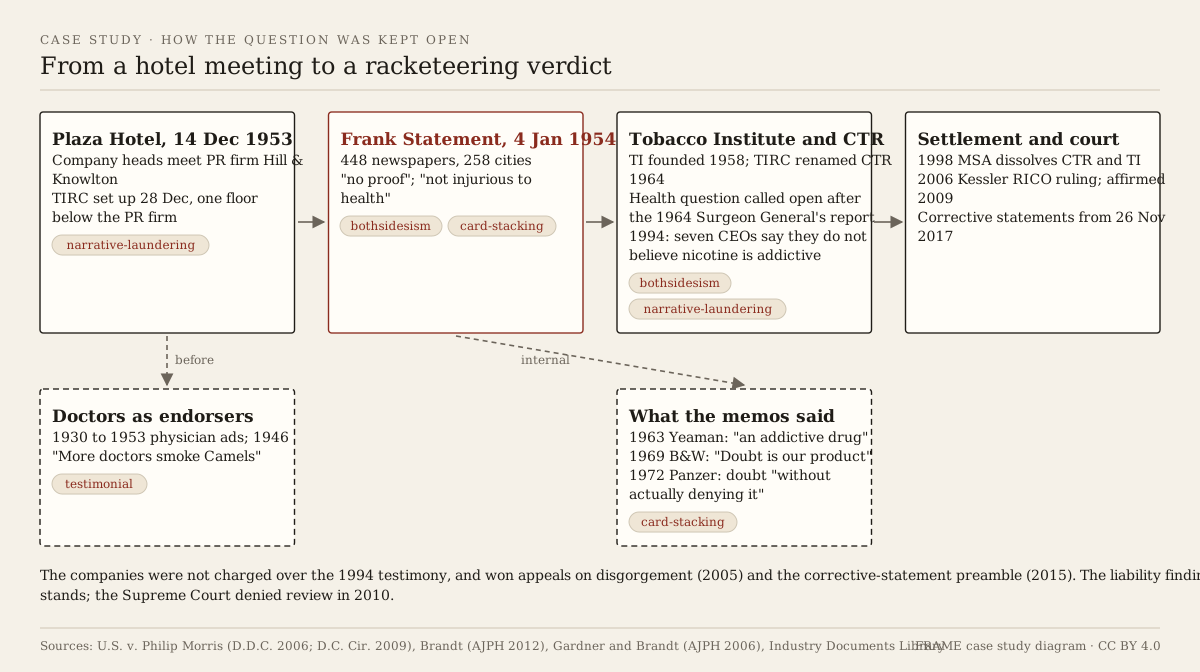
What happened
The page date is the Plaza Hotel meeting, where the joint program began. The ad that made it public ran three weeks later.
- 1930s to 1953. Cigarette makers run ads built on physicians. Reynolds' Camel ads from 1946 say "More doctors smoke Camels than any other cigarette", citing surveys of 113,597 doctors. Historians Gardner and Brandt (2006) report that the surveys were taken at medical conventions where Reynolds handed out free Camels.
- 14 December 1953. Paul M. Hahn of the American Tobacco Company convenes the heads of the largest cigarette makers at the Plaza Hotel in New York with the public-relations firm Hill & Knowlton, to plan a response to new studies linking smoking and lung cancer (Brandt, 2012).
- 28 December 1953. The Tobacco Industry Research Committee (TIRC) is set up. It is housed in the Empire State Building, one floor below Hill & Knowlton's offices.
- 4 January 1954. "A Frank Statement to Cigarette Smokers" runs in 448 newspapers in 258 cities. It says "there is no proof that cigarette smoking is one of the causes" and "We believe the products we make are not injurious to health." It announces the TIRC as the industry's answer.
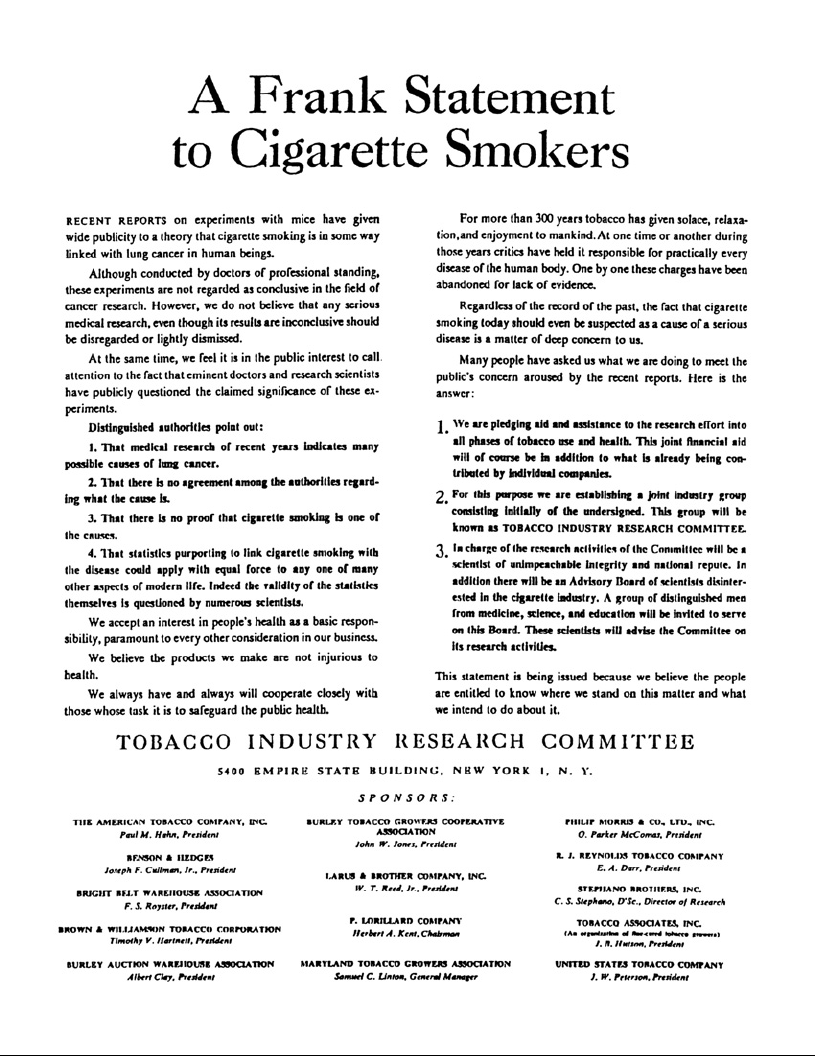
A Frank Statement to Cigarette Smokers, signed by U.S. tobacco manufacturers and growers' groups, 1954. Public domain (published without a copyright notice).
- 1958. The industry founds the Tobacco Institute as their trade and public-relations body, alongside the TIRC.
- 17 July 1963. Brown & Williamson general counsel Addison Yeaman writes in a confidential memo: "We are, then, in the business of selling nicotine, an addictive drug effective in the relief of stress mechanisms."
- 11 January 1964. Surgeon General Luther Terry releases Smoking and Health. His advisory committee reviewed more than 7,000 articles and concluded that "cigarette smoking is causally related to lung cancer in men." The same year the TIRC is renamed the Council for Tobacco Research (CTR).
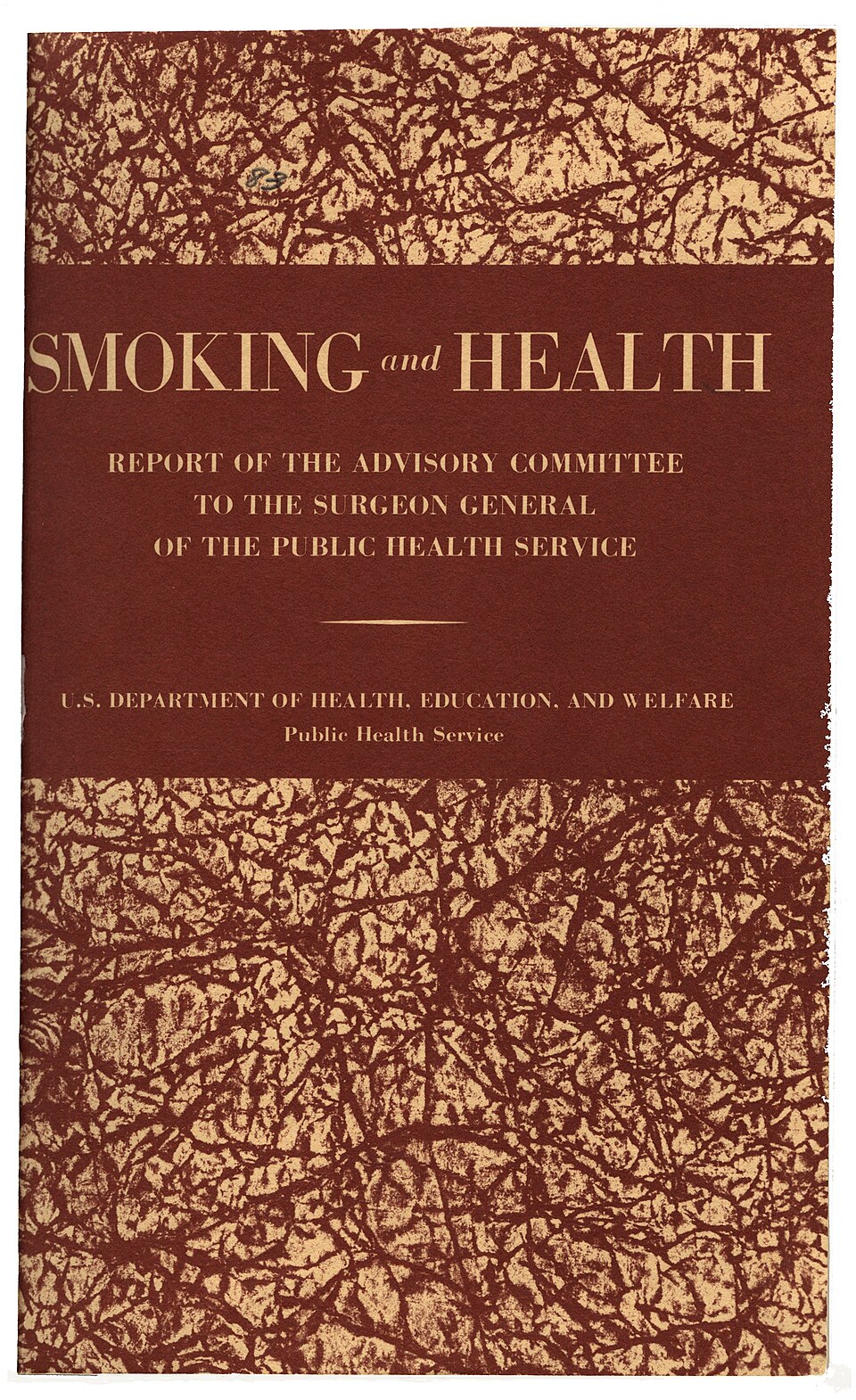
Cover of the 1964 Surgeon General's report. U.S. Public Health Service, public domain (U.S. government work).
- 1969. A Brown & Williamson paper titled "Smoking and Health Proposal" says: "Doubt is our product since it is the best means of competing with the 'body of fact' that exists in the mind of the general public." (Industry Documents Library, Bates 690010951-0959.)
- 1 May 1972. Tobacco Institute vice-president Fred Panzer describes the industry's strategy as "creating doubt about the health charge without actually denying it."
- May 1988. Surgeon General C. Everett Koop's report concludes that cigarettes are addicting. The Tobacco Institute replies that claims that cigarettes are addictive "contradict common sense."
- 14 April 1994. The heads of seven tobacco companies testify under oath to the House Subcommittee on Health and the Environment, chaired by Henry Waxman. Each says he does not believe nicotine is addictive. The Justice Department opens a perjury inquiry that July. No executive is charged.
- 20 March 1997. Liggett, in a settlement with 22 states, states that smoking causes lung cancer and other diseases and that nicotine is addictive.
- 23 November 1998. The Master Settlement Agreement between 46 states and the four largest manufacturers commits at least $206 billion over 25 years and dissolves the CTR, the Tobacco Institute and the Center for Indoor Air Research.
- October 1999. Philip Morris's website says there is "an overwhelming medical and scientific consensus that cigarette smoking causes lung cancer, heart disease, emphysema and other serious diseases in smokers."
- 17 August 2006. In United States v. Philip Morris USA, 449 F. Supp. 2d 1 (D.D.C.), a civil RICO case filed in 1999, Judge Gladys Kessler issues a 1,683-page opinion holding the companies liable. She writes that they "marketed and sold their lethal product with zeal, with deception, with a single-minded focus on their financial success."
- 22 May 2009. The D.C. Circuit affirms the liability finding (566 F.3d 1095). The Supreme Court denies review on 28 June 2010.
- 26 November 2017. Court-ordered corrective statements begin in the Sunday editions of more than 50 newspapers, then run on major TV networks for a year.
How it works
- Bothsidesism: the Frank Statement said "there is no agreement among the authorities" when the evidence was large and growing. The Tobacco Institute kept this framing after the 1964 report. Panzer's 1972 memo names the aim: doubt "without actually denying".
- Card stacking: the Frank Statement cited only the doubters, and later statements left out what the companies' own researchers wrote. Yeaman's 1963 memo on nicotine and the 1994 testimony are thirty-one years apart and say opposite things. Judge Kessler found that the companies coordinated their public relations, research and marketing to deny the health effects and addictiveness of smoking.
- Narrative laundering: the TIRC and CTR carried the name of research, which gave the industry's position a scientific surface. According to Tobacco Tactics (University of Bath), Judge Kessler called the TIRC "a sophisticated public relations vehicle", "based on the premise of conducting independent scientific research", whose purpose was "to deny the harms of smoking and reassure the public." The committee began one floor below the PR firm that set it up.
- Testimonial: before 1954 the physician was the endorser. Gardner and Brandt document how cigarette ads from 1930 to 1953 used doctors' authority to reassure smokers that a brand was safe. The Camel surveys asked doctors who had been given free Camels.
Then and now

The Real Cost — "Your Skin", U.S. Food and Drug Administration, 2014. Public domain (U.S. government work).
The FDA's campaign aims at the same product from the other direction. It uses Fear appeal: a teen's skin peels away to stage a slow harm as an instant one. The archive scores that method the same way it would score it for anyone. The similarity is that both are one-sided by design: neither presents the other side's case. The differences are plain. The FDA ad is openly attributed and argues from the medical consensus, while the 1954 ad argued against a growing body of evidence. The FDA ad aims to cut sales; the Frank Statement aimed to protect them. The court-ordered corrective statements of 2017 add a third form: the companies' own names on a message a judge required them to publish.
Positions on the record
- The companies at the time: "We believe the products we make are not injurious to health" (1954); the health charge is unproven; addiction claims "contradict common sense" (Tobacco Institute, 1988); each of seven chief executives said in 1994 that he did not believe nicotine was addictive.
- Later acknowledgements: Liggett in 1997; Philip Morris in 1999 on its website. A study in Tobacco Control notes that Philip Morris later told shareholders that a resolution "mischaracterizes the Company's web site as constituting a public admission that cigarettes cause illness."
- Outcomes in the companies' favor: the Justice Department brought no perjury charge over the 1994 testimony. In 2005 the D.C. Circuit ruled that RICO did not allow the government's $280 billion disgorgement claim. In 2015 it held that the district court could not order the corrective statements to open with the words that the companies "deliberately deceived the American public", as that exceeded the court's power under RICO to prevent future violations.
- Critics and the court: historian Allan Brandt argues that the industry created a scientific controversy through a program that depended on industry-academic conflicts of interest. Judge Kessler found a decades-long scheme to defraud, affirmed on appeal.
- This archive's reading: documented: the meeting, the ad, the research committee, the memos quoted here, the 1994 testimony, the RICO findings and the settlement terms. Not claimed here: that the causal question was closed in January 1954. The formal verdict from a U.S. government body came in 1964. The court's finding covers the gap between what the companies said in public and what their documents showed over the following decades.
Same-method test
The method is "keep the question open": treat a strong or growing body of evidence as a live debate, which can slow a policy response. It would be scored the same way whoever uses it:
- A government. In 2000 South African President Thabo Mbeki convened a Presidential AIDS Advisory Panel of about half mainstream scientists and half dissidents who disputed that HIV causes AIDS, including Peter Duesberg and David Rasnick. South Africa's Constitutional Court ruled on 5 July 2002 that the government must make nevirapine available to prevent mother-to-child transmission. Chigwedere et al. (JAIDS, 2008) estimate that more than 330,000 lives were lost because an antiretroviral program was not carried out in time.
- A political consultant. A 2002 memo on climate by consultant Frank Luntz to Republican leaders, released in 2003 by the Environmental Working Group, said: "you need to continue to make the lack of scientific certainty a primary issue in the debate." In July 2019 Luntz told the Senate Democrats' Special Committee on the Climate Crisis: "I was wrong in 2001."
Neither case involves a firm selling a product, and the scale and outcomes differ. The move is the same, and so are the technique ids.
How to spot it
- Ask who is saying "the science is not settled", and who pays them. A research body set up by the parties to a dispute is a party, whatever its name.
- Compare the public statement with what the same actor says in internal documents, court filings or later admissions.
- Look for a hedge that protects the speaker: "we believe", "no proof", "creating doubt without actually denying".
- Count the evidence on each side, not the number of voices. Two quoted experts do not make a tie against a review of more than 7,000 articles.
- Doctor, scientist or "institute" endorsements in an ad: check who ran the survey and how.
Images
| Image | Source | Licence |
|---|---|---|
| Mechanism diagram (above) | Drawn for FRAME from the sourced facts on this page (make_diagrams.py) |
CC BY 4.0, FRAME |
| A Frank Statement to Cigarette Smokers (1954) | FRAME gallery, from Wikimedia Commons | Public domain (published without a copyright notice) |
| The Real Cost, "Your Skin" (2014) | FRAME gallery, from Wikimedia Commons | Public domain (U.S. government work) |
| Smoking and Health report cover (1964) | Wikimedia Commons, National Library of Medicine | Public domain (U.S. government work) |


Image gaps
- "More Doctors Smoke Camels" ads. A 1948 Ladies' Home Journal version is on Commons, but only under a Flickr "no known restrictions" note, with no confirmed lapse of copyright. Not included. Can be filled if a copy with a verified PD-no-notice or PD-not-renewed status turns up.
- The 1969 "Smoking and Health Proposal" and the 1963 Yeaman memo. Internal company papers, held in the UCSF Industry Documents Library. Their copyright status is unclear, so they are quoted, not shown.
- The 14 April 1994 hearing. Widely used photos are news-agency work under copyright. A House recording or a government photo would be public domain. Can be filled if one is found.
- The 2017 corrective statements. Newspaper and TV placements paid for by the companies; copyright status not checked. Not included.
Sources
- United States v. Philip Morris USA, Inc., 449 F. Supp. 2d 1 (D.D.C. 2006), CourtListener
- United States v. Philip Morris USA Inc., 566 F.3d 1095 (D.C. Cir. 2009)
- D.C. Circuit opinion on corrective-statement preambles, May 2015
- Washington Post, 5 February 2005: Court rejects $280 billion tobacco penalty
- U.S. Department of Justice, Civil Division: litigation against tobacco companies
- Public Health Law Center: corrective statements take effect, October 2017
- National Cancer Institute, Cancer Currents: tobacco corrective statements, 2017
- A Frank Statement to Cigarette Smokers (1954), Wikisource text
- Brandt, "Inventing Conflicts of Interest: A History of Tobacco Industry Tactics", AJPH 102(1), 2012, doi:10.2105/AJPH.2011.300292
- Gardner and Brandt, "The Doctors' Choice Is America's Choice", AJPH 96(2), 2006, doi:10.2105/AJPH.2005.066654
- Tobacco Tactics (University of Bath): Tobacco Industry Research Committee
- Tobacco Tactics: Tobacco Institute (Panzer memo; 1988 response)
- SourceWatch: Smoking and Health Proposal (1969), with Bates reference
- National Library of Medicine: the 1964 Report on Smoking and Health
- UCSF Academic Senate: Tobacco CEOs' statement to Congress, 1994
- PBS Frontline: criminal investigation timeline
- PBS Frontline: 1997 Liggett settlement timeline
- Public Health Law Center: Master Settlement Agreement
- "Tobacco manufacturers' defence against plaintiffs' claims of cancer causation", Tobacco Control (Philip Morris 1999 website statement)
- Chigwedere et al., "Estimating the Lost Benefits of Antiretroviral Drug Use in South Africa", JAIDS, 2008
- Minister of Health v Treatment Action Campaign (No 2), Constitutional Court of South Africa, 5 July 2002
- HIV/AIDS denialism in South Africa (overview, including the 2000 advisory panel)
- Bulletin of the Atomic Scientists, July 2019: Luntz testimony to the Senate climate committee
- Frank Luntz (overview, including the 2002 memo)
- Related case studies: Fossil-fuel industry climate doubt campaigns, 1977 to the 2000s, The Sugar Research Foundation and the 1967 heart disease review, Ethyl: how leaded petrol was named, defended and kept on sale, Torches of Freedom: the 1929 Easter Parade cigarette march.