Also called False balance, He-said-she-said
Force symmetry between unequal evidence piles so the audience treats the question as a tie.
The tell
Equal airtime for a documented record and a rumor, sold as fairness.
Not this
Steel-manning a real opposing argument.
History and effect
Grew out of a journalistic norm — presenting "both sides" of a story — that becomes a distortion once the sides no longer carry comparable evidence.
It trains the audience to read a documented record and an unsupported claim as equally provisional.
Lineage: False balance; journalistic 'he said / she said'
How it works
Bothsidesism takes a real journalistic and civic value, hearing more than one side, and applies it where the evidence is lopsided. The structure is a format that implies parity: one guest for and one against, a quote from each camp, a headline reading "experts divided" or "the debate continues". Nothing in the format has to be false. The distortion lies in the ratio: a position held by a small minority of specialists, or unsupported by the available evidence, receives the same space, standing and framing as a position backed by most of the evidence and most qualified specialists. The audience reads the layout as a statement about the state of knowledge.
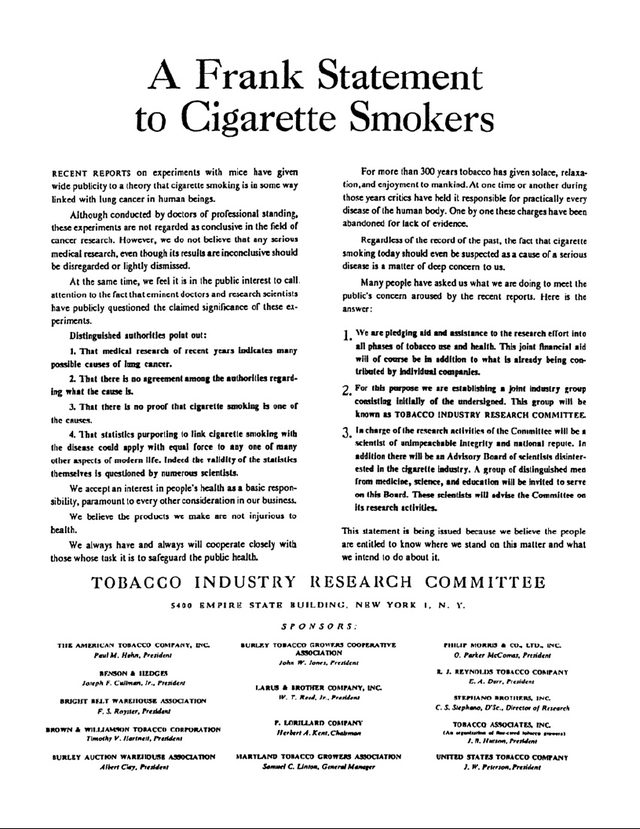
It arises in two ways that should be kept apart. The first is procedural: reporters working to deadline, without the training to judge a technical dispute and wary of appearing partisan, fall back on quoting both sides. Maxwell and Jules Boykoff (2004) described this as adherence to the journalistic norm of balance producing biased coverage, with no intent to mislead required. The second is strategic: a party with an interest in delay identifies, promotes or funds the second side, then appeals to editors' fairness norms to win it equal time. The tobacco industry supplies the documented template. Its 1954 advertisement A Frank Statement to Cigarette Smokers said there was "no agreement among the authorities"; a 1969 Brown & Williamson internal memo stated "Doubt is our product"; and in United States v. Philip Morris (2006) a federal court found that the companies used industry-funded research bodies as part of a long effort to keep public doubt alive. Naomi Oreskes and Erik Conway (Merchants of Doubt, 2010) trace how some of the same scientists and methods reappeared in later disputes over acid rain, the ozone layer, second-hand smoke and climate change.
The strategic form usually runs in sequence: find or fund credentialed dissenters; frame the question as an open scientific or factual debate; invoke fairness, free inquiry or "teach both sides" to claim equal airtime; then draw the policy conclusion that nothing should be done until the "debate" is settled. Variants include the public panel or hearing composed half-and-half, the curriculum demand to present "the controversy", and, in political coverage, what critics call false equivalence: describing unequal conduct by two parties as the same.
Why it works
Audiences use the structure of a report as a cue to the state of knowledge. If two people get equal time, the natural inference is that the question is roughly open. Experiments support this. Graham Dixon and Christopher Clarke (2013) found that readers of a news story presenting both sides of the vaccine-autism claim were less certain that vaccines are safe than readers of a story reporting only the evidence of no link. Derek Koehler (2016) found that pairing one dissenting expert with one mainstream expert led readers to underestimate how one-sided expert opinion actually was, even when they had been given information about its true distribution. Sander van der Linden and colleagues (2015) describe perceived scientific consensus as a "gateway belief" that shapes whether people accept a finding and support action on it, which is why the appearance of a tie can change whether and how quickly that action happens.
Two further features help. Doubt is cheap and asymmetric: one dissenting voice can establish uncertainty, while conveying a consensus requires the audience to learn about many studies it will never read. And fairness is a strong norm in its own right: journalists and audiences alike treat evenhandedness as a virtue, so objecting to the format can look like objecting to fairness. Once the source of a dissenting claim is forgotten, the doubt it planted can persist (see Sleeper effect).
Examples across eras and sides
- Tobacco and "doubt" (1954-1969, United States, tobacco companies). The Frank Statement (A Frank Statement to Cigarette Smokers) answered new lung-cancer studies by stating that authorities disagreed and announcing an industry research committee; the 1969 Brown & Williamson memo "Smoking and Health Proposal" named doubt as the product. The technique shows in the effort to keep a question open in public after most of the medical evidence had moved, a point the 1964 Surgeon General's report made official (Oreskes and Conway, Merchants of Doubt, 2010; United States v. Philip Morris USA, D.D.C. 2006).
- Climate coverage in the US prestige press (1988-2002, United States, national newspapers). Maxwell and Jules Boykoff analysed global-warming coverage in The New York Times, The Washington Post, the Los Angeles Times and The Wall Street Journal and found that a majority of articles gave roughly equal attention to the view that humans contribute to warming and to the view that natural variation explains it. Over the same period the Intergovernmental Panel on Climate Change stated in 1995 that the balance of evidence suggested a discernible human influence, and in 2001 that most warming of the previous 50 years was likely due to greenhouse gases (Boykoff and Boykoff, Global Environmental Change, 2004).
- MMR vaccine coverage (1998-2003, United Kingdom, national press and broadcasters). After Andrew Wakefield's 1998 Lancet paper, much UK coverage presented the suggested MMR-autism link and the evidence against it as two comparable positions. A Cardiff University study found that about half of the public surveyed assumed that because both sides received equal coverage there was equal evidence for each (Ian Hargreaves, Justin Lewis and Tammy Speers, Towards a Better Map, 2003; Speers and Lewis, Communication & Medicine, 2004). The Lancet retracted the paper in 2010.
- Presidential AIDS Advisory Panel (2000, South Africa, national government). President Thabo Mbeki's government convened a panel that seated scientists who questioned whether HIV causes AIDS alongside mainstream researchers, presented as an open inquiry. More than 5,000 scientists responded with the Durban Declaration (Nature, 2000) restating the evidence. Nicoli Nattrass documents how the staged debate accompanied delays in providing antiretroviral treatment, and Pride Chigwedere and colleagues estimated that those delays cost more than 330,000 lives (Nattrass, Mortal Combat, 2007; Chigwedere et al., Journal of Acquired Immune Deficiency Syndromes, 2008).
- "Teach the controversy" (2000s, United States, Discovery Institute and school boards). The Seattle-based Discovery Institute urged schools to present evolution alongside its critics, describing this as academic freedom. In Kitzmiller v. Dover Area School District (2005), Judge John E. Jones III, after hearing expert testimony, found that intelligent design is not science and that the Dover board's policy of presenting it to biology students violated the Establishment Clause. The court's finding turned on whether the two "sides" had comparable scientific standing.
- BBC science impartiality review (2011-2018, United Kingdom, public broadcaster). An independent assessment by geneticist Steve Jones for the BBC Trust (2011) found an over-rigid application of impartiality rules that gave undue attention to marginal opinion on settled science. In 2018 Ofcom found that a 2017 Today programme interview with Lord Lawson breached accuracy rules because his climate claims were not sufficiently challenged, and BBC News guidance issued later that year told staff that impartiality did not require including people who deny that climate change is happening. This is the rare case of a broadcaster documenting the technique in its own output.
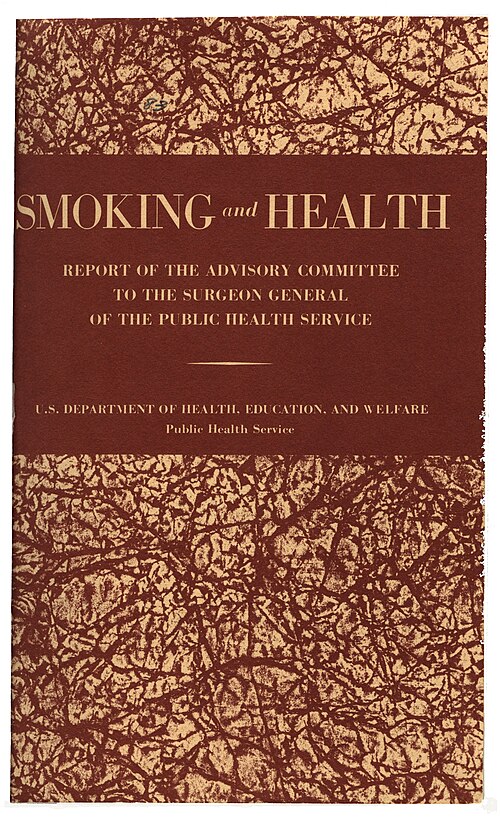
Cover of Smoking and Health: Report of the Advisory Committee to the Surgeon General of the Public Health Service, released on 11 January 1964, ten years after the Frank Statement. The report concluded that cigarette smoking is causally related to lung cancer in men. U.S. Public Health Service, via the National Library of Medicine and Wikimedia Commons. Public domain (U.S. government work).
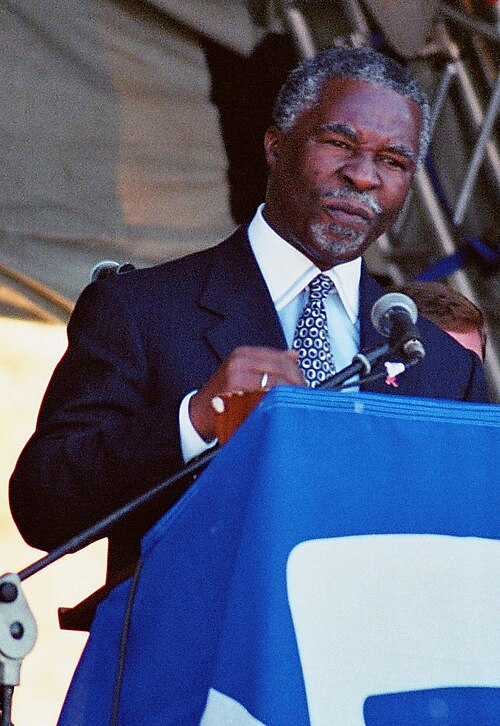
Thabo Mbeki, President of South Africa from 1999 to 2008, speaking at a ceremony in District Six, Cape Town, in 2001, the year after the presidential AIDS advisory panel described above. Photograph by Henry Trotter, released by him into the public domain (Wikimedia Commons).
How to spot it
- Does the piece say how evidence or expert opinion is actually distributed, or only that "some disagree"?
- Who represents each side: what is their field, and who funds them or their organisation?
- Was the one-for-one format chosen because the question is genuinely open, or out of habit?
- What do the major review bodies say (national academies, systematic reviews, courts that heard the evidence), and does the piece mention them?
- Who gains if the audience concludes "nobody knows yet", and did that party supply the dissenting side?
- The reverse check keeps the test fair: is the "consensus" side shown with its evidence, or asserted by authority alone?
Where it ends: edge cases and legitimate persuasion
- When qualified people with evidence genuinely divide, giving both sides is accuracy, not distortion; steel-manning a real opposing argument is not this technique (see Not this). The legitimate form is weight-of-evidence reporting: include the minority view if it is newsworthy, but tell the audience where most of the evidence and specialists stand, which is what the BBC's "due impartiality" standard asks for.
- Critics argue the label can also be misapplied in the other direction. In February 2020 a Lancet statement by a group of scientists condemned "conspiracy theories suggesting that COVID-19 does not have a natural origin", and several outlets described lab-origin hypotheses as debunked. In May 2021 Facebook stopped removing posts saying the virus was man-made and President Biden ordered an intelligence review; later public US assessments showed agencies divided. Some journalists and scientists argue that early coverage treated an unresolved question as settled; others reply that at the time the hypothesis had little direct supporting evidence. For this archive the test is the state of the evidence when the report was made and how openly it was described, not which view was in the majority.
- In political reporting, Thomas Mann and Norman Ornstein (It's Even Worse Than It Looks, 2012) argued that balance norms led the press to describe asymmetric conduct by the two US parties as symmetric; critics of that argument reply that charges of "false equivalence" can license reporters to drop views they disagree with. Whether symmetry is accurate is an empirical question, case by case.
- Neighbouring techniques: Card stacking selects the evidence, while bothsidesism keeps both piles and weighs them as equal. Whataboutism answers an accusation with a counter-accusation to suggest the two wrongs cancel. Bandwagon and Manufactured consensus err the opposite way, presenting a crowd or an apparent unanimity in place of evidence.
Sources
- Boykoff, Maxwell T., and Jules M. Boykoff. "Balance as Bias: Global Warming and the US Prestige Press." Global Environmental Change 14(2), 2004.
- Brandt, Allan M. The Cigarette Century. Basic Books, 2007.
- Brown & Williamson Tobacco Corporation. "Smoking and Health Proposal." Internal memorandum, 1969.
- Calisher, Charles, and colleagues. "Statement in Support of the Scientists, Public Health Professionals, and Medical Professionals of China Combatting COVID-19." The Lancet 395, 2020.
- Chigwedere, Pride, George R. Seage, Sofia Gruskin, Tun-Hou Lee and M. Essex. "Estimating the Lost Benefits of Antiretroviral Drug Use in South Africa." Journal of Acquired Immune Deficiency Syndromes 49(4), 2008.
- Dixon, Graham N., and Christopher E. Clarke. "Heightening Uncertainty Around Certain Science: Media Coverage, False Balance, and the Autism-Vaccine Controversy." Science Communication 35(3), 2013.
- "The Durban Declaration." Nature 406, 2000.
- Hargreaves, Ian, Justin Lewis and Tammy Speers. Towards a Better Map: Science, the Public and the Media. Economic and Social Research Council, 2003.
- Intergovernmental Panel on Climate Change. Second Assessment Report (1995) and Third Assessment Report (2001).
- Jones, Steve. Independent assessment for the BBC Trust in BBC Trust Review of Impartiality and Accuracy of the BBC's Coverage of Science. BBC Trust, 2011.
- Kitzmiller v. Dover Area School District, 400 F. Supp. 2d 707 (M.D. Pa. 2005).
- Koehler, Derek J. "Can Journalistic 'False Balance' Distort Public Perception of Consensus in Expert Opinion?" Journal of Experimental Psychology: Applied 22(1), 2016.
- Mann, Thomas E., and Norman J. Ornstein. It's Even Worse Than It Looks. Basic Books, 2012.
- Nattrass, Nicoli. Mortal Combat: AIDS Denialism and the Struggle for Antiretrovirals in South Africa. University of KwaZulu-Natal Press, 2007.
- Ofcom. Broadcast and On Demand Bulletin, ruling on BBC Radio 4 Today (interview with Lord Lawson), 2018.
- Oreskes, Naomi, and Erik M. Conway. Merchants of Doubt. Bloomsbury Press, 2010.
- Speers, Tammy, and Justin Lewis. "Journalists and Jabs: Media Coverage of the MMR Vaccine." Communication & Medicine 1(2), 2004.
- Tobacco Industry Research Committee. "A Frank Statement to Cigarette Smokers." Newspaper advertisement, 4 January 1954.
- United States v. Philip Morris USA Inc., 449 F. Supp. 2d 1 (D.D.C. 2006).
- van der Linden, Sander L., Anthony A. Leiserowitz, Geoffrey D. Feinberg and Edward W. Maibach. "The Scientific Consensus on Climate Change as a Gateway Belief: Experimental Evidence." PLOS ONE 10(2), 2015.
Case studies
- The Armenian genocide, 1915-1923: the wartime 'internal enemy' frame, the rival record, and a century of state denial — The Armenian genocide, 1915-1923, and a century of state denial
- The tobacco industry's smoking-and-health doubt campaign, 1953 to 1998 — The tobacco industry's smoking-and-health doubt campaign, 1953 to 1998
- Fossil-fuel industry climate doubt campaigns, 1977 to the 2000s — Fossil-fuel industry climate doubt campaigns, 1977 to the 2000s
- The MMR scare: from a 1998 press conference to Vaxxed, and its 1802 ancestors — The MMR scare: from a 1998 press conference to Vaxxed, and its 1802 ancestors
Images
| Image | Source | Licence |
|---|---|---|
| Cover of the 1964 Surgeon General report | Wikimedia Commons, Smoking and Health 1964 report cover.jpg (National Library of Medicine) | Public domain (U.S. government work) |
| Thabo Mbeki, District Six, 2001 | Wikimedia Commons, Thabo-mbeki-district-six.jpg (Henry Trotter) | Public domain (released by the photographer) |