Content note. This page describes forced and slave labour and mass death at a Nazi concentration camp (Mittelbau-Dora), including hangings of prisoners for sabotage and the state of unburied bodies found by liberating US troops. It states documented death figures and dates; it does not narrate individual deaths for effect.
In one line: from June 1944, as the Reich's armies collapsed on every front, Goebbels's ministry sold a flying bomb, a ballistic missile and a jet fighter as proof Germany could still win, while the ballistic missile alone was assembled by concentration-camp prisoners in a tunnel factory where an estimated 20,000 died — more than the roughly 9,000 people the finished weapon killed.
What happened
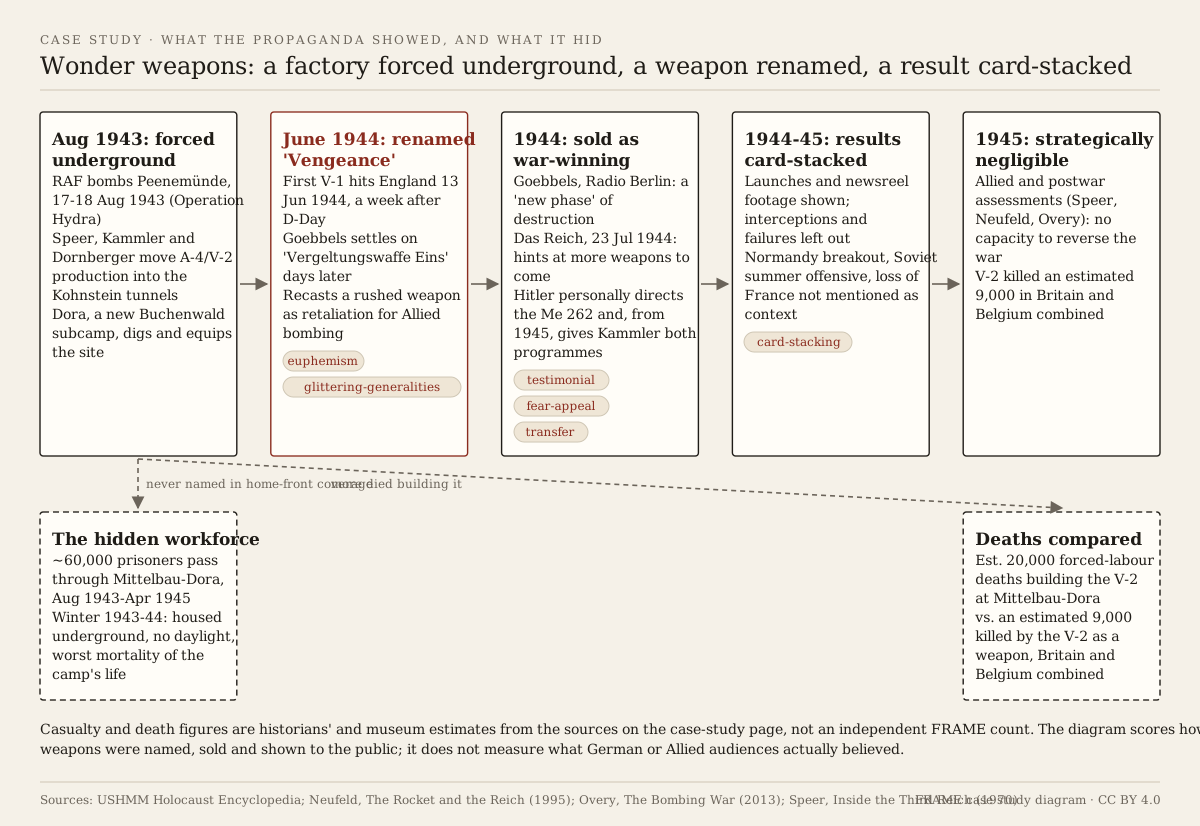
- 17-18 August 1943. RAF Bomber Command's Operation Hydra bombs the Peenemünde Army Research Centre on the Baltic coast, killing rocket engineer Walter Thiel and setting the A-4 (V-2) programme back by weeks. The raid convinces German planners the project needs a bomb-proof home.
- 26 August 1943. Armaments minister Albert Speer meets SS-Brigadeführer Hans Kammler, Army rocket-programme chief Walter Dornberger, and production officials Gerhard Degenkolb and Karl-Otto Saur to move A-4 mass production into the Kohnstein tunnels near Nordhausen, in the Harz mountains, originally dug for fuel storage. Mittelwerk GmbH is formed to run the new underground factory; Buchenwald concentration camp sends prisoners to a new subcamp, "Dora," to finish excavating and equipping it.
- Winter 1943-44. For the tunnels' first months, prisoners are housed underground in the unfinished workings themselves, without daylight, sanitation or fixed bunks, working and sleeping in rock dust and machine noise. The United States Holocaust Memorial Museum's Holocaust Encyclopedia and historian Michael Neufeld both describe this phase's mortality as among the worst recorded anywhere in the concentration-camp system.
- 21 March-May 1944. The Gestapo arrests rocket engineer Wernher von Braun, his brother Magnus, and colleagues Klaus Riedel and Helmut Gröttrup, after an informant reports remarks at a private party that the war was going badly and that the engineers' real ambition was spaceflight, not weapons. Held for two weeks in a Gestapo cell in Stettin without being told the charge, von Braun is released only after Speer personally intervenes with Hitler, arguing he is irreplaceable to the V-2 programme.
- 13 June 1944. The first operational flying bomb hits Swanscombe, Kent — a week after the D-Day landings of 6 June. Within days Goebbels settles on a public name for what the military had designated the Fi 103 (and, for secrecy, the anti-aircraft target drone "FZG 76"): Vergeltungswaffe Eins, "Vengeance Weapon One," recasting a rushed weapon as retaliation for Allied bombing of German cities. Declaring the new weapon on Radio Berlin, Goebbels says it has brought "unique destruction, enormous conflagration, stopping of work in factories and office-panic" to England.
- 23 July 1944. Goebbels publishes an article in the weekly Das Reich built around the theme of Vergeltung — retribution — tied to the V-1 campaign, and, according to later accounts of the piece, hints at further, unnamed weapons still to come.
- June-August 1944. The V-1 campaign peaks at up to 100 launches a day. Over the full campaign to March 1945, Germany fires 6,725 V-1s at Britain; roughly half of those that cross the coast are destroyed by fighters, anti-aircraft fire or barrage balloons before reaching a target. Of the 2,340 that hit London, an estimated 5,475 people are killed and around 16,000 injured.
- 8 September 1944. The first operational V-2 hits Paris and, hours later, Chiswick in west London. Goebbels withholds public confirmation of the new weapon for close to two months: the V-1 campaign's own exaggerated propaganda had already produced disillusionment once its real limits became visible, and the ministry is wary of repeating the mistake.
- September 1944-March 1945. Germany fires 1,115 V-2s at Britain; 517 hit London and 378 fall short in Essex. An estimated 2,754 people are killed in London and 6,523 injured. Belgium, and above all the port of Antwerp — the Allies' critical supply line after its capture in September 1944 — draws more V-weapons than London. The single deadliest strike of the whole campaign hits the Rex cinema in Antwerp on 16 December 1944, killing 567 people (271 civilians, 296 Allied servicemen). Historians commonly put the V-2's total kill count, combining Britain and the continent, at around 9,000.
- October 1944. The world's first operational jet fighter, the Messerschmitt Me 262, forms its first unit, Kommando Nowotny. It had flown under jet power since July 1942; Hitler's 1943 order that it be built first as a fast bomber (Schnellbomber) delayed the pure fighter version by some weeks, though historians including Richard Overy find the Junkers Jumo 004 engine's own production problems — not Hitler's order alone — the larger bottleneck. Publicised as proof of unmatched German engineering, only a few hundred of the roughly 1,400 built ever reach combat, held back by fuel shortages, the time needed to train jet pilots, and Allied bombing of factories and airfields.
- August 1944-February 1945. Kammler's authority grows. The SS officer who had overseen Mittelwerk's construction takes over the whole V-2 programme from the Army in August 1944, and in February 1945 Hitler additionally places him in charge of all German jet-aircraft production, consolidating the regime's "wonder weapon" programmes under the SS.
- December 1944-February 1945. The V-3 "supergun" (Hochdruckpumpe, "high-pressure pump," a cover name), a multi-charge cannon built into bunkers at Mimoyecques in northern France to bombard London, is put out of action by Allied bombing before completion. Two shortened versions are used against Luxembourg between December 1944 and February 1945 without notable military effect.
- 11 April 1945. Troops of the US 3rd Armored Division enter Nordhausen and the Mittelwerk tunnels, finding rows of unfinished V-2s inside and, at the nearby Boelcke-Kaserne site, unburied bodies of prisoners who had died of starvation, disease and the final days' chaos. Days earlier, as US forces approached, SS guards had evacuated most of Dora-Mittelbau's remaining prisoners on forced marches and in open rail cars; on 13 April 1945 more than 1,000 evacuated prisoners, many from Dora subcamps, are burned and shot by SS men and local personnel in a barn at Gardelegen. US Army Signal Corps photographs and film of Nordhausen and Boelcke-Kaserne become key evidence at postwar trials.
- Over the camp's roughly twenty months, August 1943 to April 1945. About 60,000 prisoners from twenty-one countries pass through Mittelbau-Dora. An estimated 20,000 die — about 9,000 from exhaustion and physical collapse, around 350 hanged (roughly 200 of them for sabotage), and the remainder mainly from disease and starvation.
- 7 August-30 December 1947. A US Army tribunal at the former Dachau camp, the Dora Trial, tries 19 men for war crimes committed running Mittelbau-Dora, its subcamps and the Mittelwerk plant. The trial ends in 15 convictions, including one death sentence, and 4 acquittals.
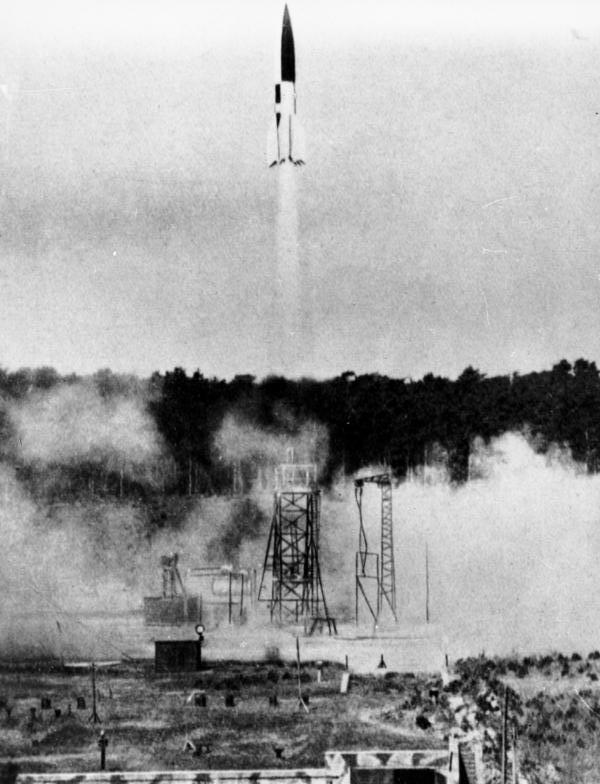
A V-2 (A-4) rocket four seconds after launch from Test Stand VII, Peenemünde, 21 June 1943 — a test firing, before Mittelwerk existed and before operational use began the following year. Bundesarchiv, Bild 141-1880, via Wikimedia Commons, CC BY-SA 3.0 DE.

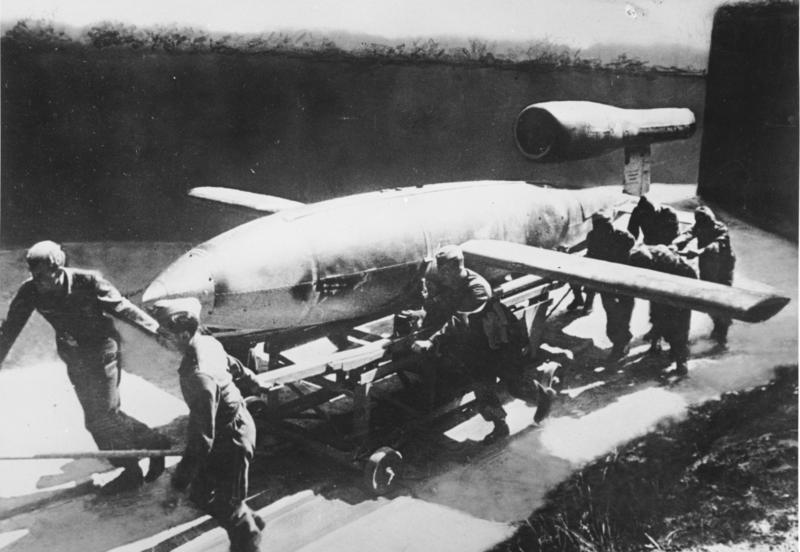
A V-1 flying bomb (Marschflugkörper, officially Fieseler Fi 103) prepared for launch. Bundesarchiv, Bild 146-1973-029A-24A, via Wikimedia Commons, CC BY-SA 3.0 DE.

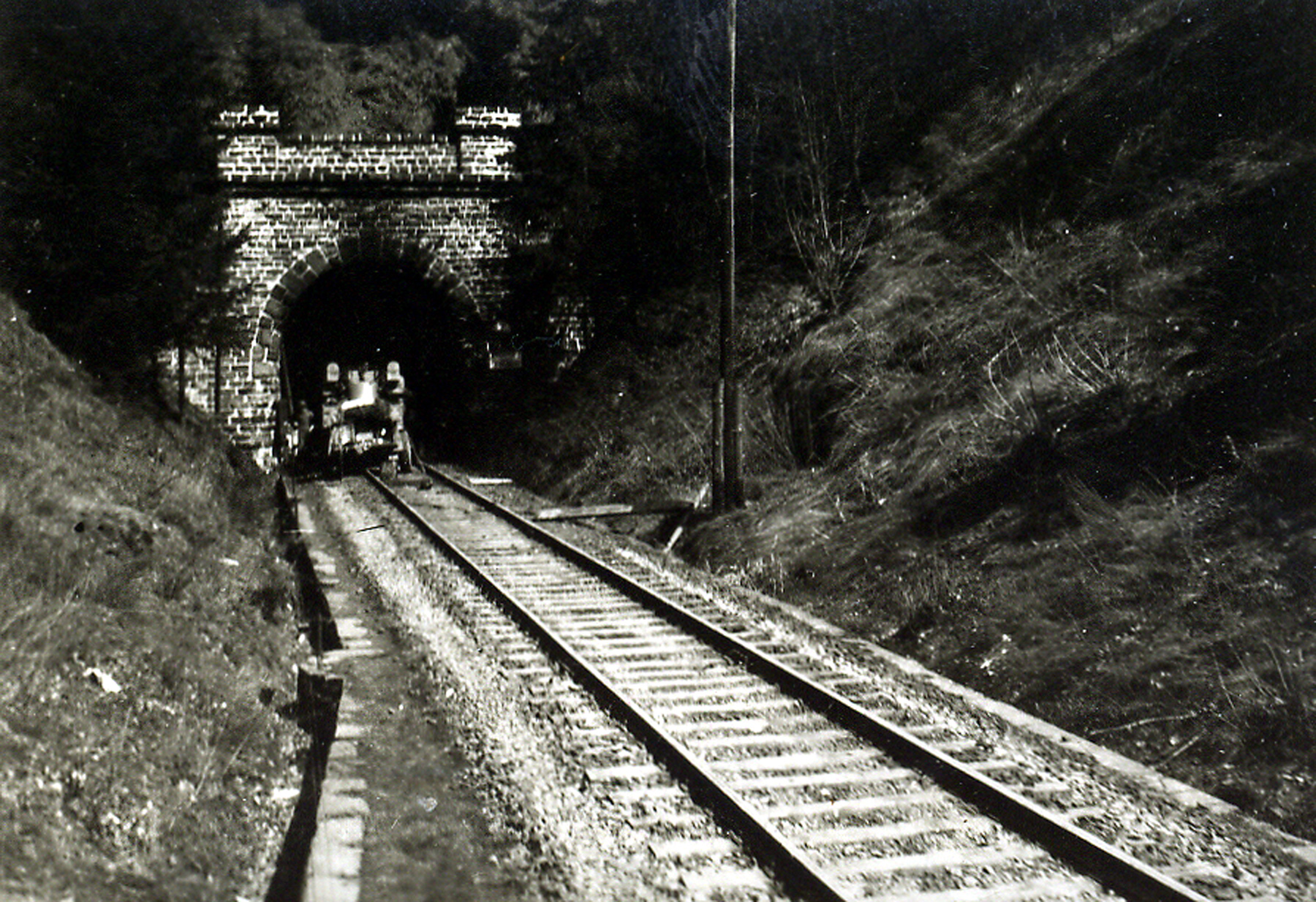
A tunnel entrance to a storage area for V-weapon components at the Mittelwerk complex in the Kohnstein, near Nordhausen, photographed after its capture. The tunnels were dug and equipped by prisoners of the Dora subcamp, and the finished V-2s inside them were assembled by forced labourers from the same camp system. US Army photograph, public domain, via Wikimedia Commons.

How it works
- Glittering generalities: "Wunderwaffe" — "wonder" or "miracle" weapon, the term Goebbels popularised — promises transformation without specifying what the weapon does, by when, or against what problem. It lets the regime keep promising into 1945 without ever naming a weapon that could deliver.
- Euphemism / doublespeak: "Vergeltungswaffe" — "vengeance weapon" — recasts a flying bomb rushed into service a week after D-Day, and a ballistic missile built by dying prisoners, as righteous payback for Allied bombing rather than what German and Allied planners alike understood it to be: a terror weapon with no capacity to reverse the military situation. The same silence ran deeper: no German home-front broadcast, newsreel or newspaper coverage of the V-2 named the tens of thousands of concentration-camp prisoners who built it or the conditions they built it in.
- Card stacking: propaganda coverage showed launches, dramatic newsreel footage and claims of "unique destruction," never the roughly half of V-1s intercepted before reaching Britain, nor the military catastrophe underway elsewhere in the same months — the Allied breakout from Normandy, the Soviet summer offensive that destroyed Army Group Centre, the loss of France — that the "wonder weapons" were being sold as an answer to.
- Fear appeal: the campaign ran in two directions at once. Toward Britain and Belgium it was built to terrorise: Goebbels's own words called the V-1 a new phase of "office-panic." Toward Germans it promised the Allied bombing campaign would soon be repaid in kind, tying continued endurance of Allied raids to the promise of vengeance already in motion.
- Transfer: the V-1, V-2 and Me 262 were presented as proof of a long national narrative of German engineering supremacy — rocketry and jet propulsion, still recognisable as world-firsts today — with that prestige transferred onto the regime's own claim to still be capable of winning.
- Testimonial: Goebbels's own on-air declarations, and Hitler's repeated personal interventions in the V-2 and jet-fighter programmes (the Schnellbomber order, elevating Kammler over both programmes in 1945), lent the war's two most senior figures' personal authority to the claim that these weapons could still change the outcome.
Then and now
Regimes touting a breakthrough weapon as proof of continued strength, while concealing its real military limits and human cost, did not end in 1945. On 1 March 2018, President Vladimir Putin's address to Russia's Federal Assembly unveiled a suite of new strategic weapons — including the Burevestnik, a nuclear-powered cruise missile — presented as restoring Russian strategic dominance and rendering existing missile defences obsolete. On 8 August 2019, an explosion during a weapons test at a naval site near Nyonoksa, in Arkhangelsk region, killed at least five nuclear engineers employed by the state nuclear agency Rosatom and caused a measurable radiation spike in the nearby city of Severodvinsk; Russian officials gave contradictory and incomplete public accounts for days, and Western governments and independent researchers concluded the accident occurred during a test of the Burevestnik itself. Both cases show a state publicising a weapons programme as proof it can still out-build or out-fight an adversary, while its own record of the programme's failures and casualties stays outside what the public is told. The scale and character differ sharply: the 2019 deaths were Russia's own weapons personnel in peacetime testing, not forced labourers building a weapon already killing enemy civilians in wartime, and no forced-labour system parallels Mittelbau-Dora. The device — a state weapon programme's real limits and real cost held separate from its public presentation as decisive — is the one this page scores the same way regardless of the flag involved.
Positions on the record
- As stated by the propaganda itself. Goebbels and Hitler presented the V-1, V-2 and Me 262 as proof Germany retained the capacity to reverse the war, framed the V-weapons explicitly as deserved retaliation for Allied bombing, and — in Goebbels's July 1944 Das Reich piece and later statements — hinted at further, unnamed weapons still to come.
- What the regime's own senior figures later acknowledged. Albert Speer's postwar memoir, Inside the Third Reich, treats the "wonder weapon" claims as propaganda rather than a real prospect of reversing the strategic outcome, and describes favouring anti-aircraft and air-defence priorities over the V-2 for exactly that reason. Walter Dornberger, the V-2 programme's military director, made a similar postwar argument distinguishing the weapon's technical achievement from any claim it could change the war's course.
- What postwar and scholarly assessment found. Michael Neufeld's The Rocket and the Reich (1995) and Richard Overy's The Bombing War: Europe 1939-1945 (2013) both conclude the V-weapons campaign diverted German resources and personnel without altering the war's outcome, while killing thousands of civilians and costing far more lives to produce than it took as a weapon.
- Not shown. This page does not quantify how far ordinary Germans actually believed the wonder-weapon claims, as opposed to performing belief in public — a question historians (Overy, Ian Kershaw and others) continue to weigh differently — and it does not attribute any individual German's continued support for the war to this propaganda specifically.
Same-method test
The same standard applied here would score Imperial Japan's Imperial General Headquarters communiqués (Daihon'ei happyō) the same way: as Imperial Japan's wartime propaganda at home: the Information Bureau, the neighbourhood associations and the war communiqués documents, those communiqués used Card stacking, Euphemism / doublespeak and Glittering generalities to inflate victories and disguise catastrophic losses through 1944-45, sustaining a claim the war could still be won even as Japan's own naval and military leadership understood otherwise. Japan's kamikaze (special-attack) units, introduced from October 1944 and publicly framed as a war-turning new strategy, were adopted at a point senior naval commanders already doubted conventional forces could still reverse the Pacific war — the same structure as Germany's wonder-weapon propaganda, under a different flag and against a different enemy.
How to spot it
- Ask what the weapon did against the stated military problem, not what it looked like on newsreel. A launch photograph answers a different question than a strategic one.
- Watch for a name that answers a question no one asked about function. "Vengeance weapon" describes a grievance, not a capability.
- Check whether the state's own military planners acted as if they believed the claim. Resource allocation, not rhetoric, shows what a regime's insiders actually expected a weapon to do.
- Ask who built it and under what conditions. A propaganda campaign built around a weapon's power rarely mentions the workforce that assembled it — the question to ask next is what that silence is covering.
Images
| Image | Source | Licence |
|---|---|---|
| Mechanism diagram (above) | Drawn for FRAME from the sources below (make_diagrams_fall_wunderwaffen.py) |
CC BY 4.0, FRAME |
| V-2 rocket, four seconds after launch, Peenemünde, 21 June 1943 | Bundesarchiv, Bild 141-1880, via Wikimedia Commons | CC BY-SA 3.0 DE |
| V-1 flying bomb prepared for launch | Bundesarchiv, Bild 146-1973-029A-24A, via Wikimedia Commons | CC BY-SA 3.0 DE |
| Mittelwerk tunnel entrance, Kohnstein, near Nordhausen | US Army photograph, via Wikimedia Commons | Public domain (PD-USGov-Military-Army) |
Image gaps
- Dora-Mittelbau prisoners and the tunnel interior during operation. The photographs used above of the Mittelwerk site were taken after liberation and show an entrance and storage area, not prisoners at forced labour; no openly licensed photograph of prisoners working inside the tunnels during 1943-45 was confirmed from this environment. Wikimedia Commons and the USHMM photo archive hold liberation-era images (April 1945) of prisoners and the dead at Nordhausen and Boelcke-Kaserne, but their exact licensing could not be confirmed against the source directly from this environment. Could be filled if a specific file's US Army or public-domain status is confirmed.
- Wernher von Braun, Walter Dornberger or Hans Kammler. No openly licensed portrait was confirmed from this environment; most circulating photographs of the V-2 programme's leadership are Bundesarchiv- or NASA-sourced images whose exact file and licence were not verified here.
- The Gardelegen barn massacre site (13 April 1945). US Army Signal Corps photographs of the aftermath exist and are widely reproduced, but a specific file's licence was not confirmed from this environment.
- The V-3 cannon site at Mimoyecques. No openly licensed wartime or postwar photograph was confirmed from this environment; the site is now a French museum, and Commons hosts modern photographs of unclear licence status that were not verified here.
- A Goebbels Das Reich front page or the 1944-45 Reich press coverage of the V-weapons. No openly licensed scan was confirmed from this environment.
Sources
- United States Holocaust Memorial Museum, Holocaust Encyclopedia: "Dora-Mittelbau: Overview"
- United States Holocaust Memorial Museum, Holocaust Encyclopedia: "Mittelbau (Dora) / Main Camp"
- Michael J. Neufeld, The Rocket and the Reich: Peenemünde and the Coming of the Ballistic Missile Era (New York: Free Press, 1995)
- Richard Overy, The Bombing War: Europe 1939-1945 (London: Allen Lane, 2013)
- Albert Speer, Inside the Third Reich, trans. Richard and Clara Winston (New York: Macmillan, 1970)
- Imperial War Museums: "V-Weapons"
- "Failure of Hitler's Terror Weapons," Warfare History Network (Goebbels's Radio Berlin declaration and the naming of the V-1)
- German Propaganda Archive, Calvin University: Joseph Goebbels, 1933-1945
- Wikipedia: "Mittelbau-Dora concentration camp" (used for the 60,000/20,000 figures and their USHMM/Neufeld-sourced breakdown, and the Dora Trial)
- Wikipedia: "Mittelwerk"
- Wikipedia: "Dora trial"
- Wikipedia: "V-1 flying bomb" and "V-2 rocket"
- Wikipedia: "V-3 cannon"
- Wikipedia: "Operation Hydra (1943)" and "Bombing of Peenemünde in World War II"
- Wikipedia: "Hans Kammler"
- Bundesarchiv, via Wikimedia Commons, image file descriptions and licensing for Bild 141-1880 and Bild 146-1973-029A-24A
- Wikimedia Commons: "Mittelwerk V-2 complex tunnel.jpg" (US Army photograph, public domain)