Content note: this page quotes the wartime slogan "Kichiku Bei-Ei" ("demonic Americans and British") and the U.S. wartime slur "Japs" as they were used, and shows a Japanese leaflet with a graphic image of a dead soldier.
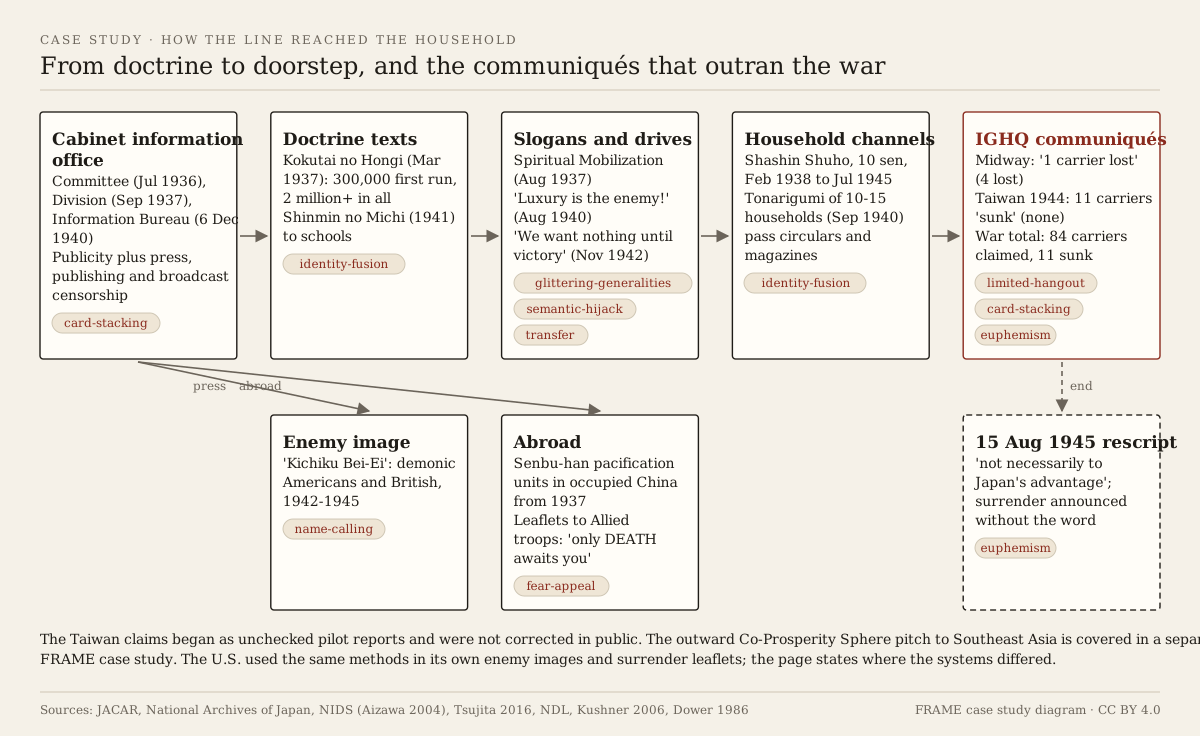
In one line: between 1937 and 1945 the Japanese state built a single chain from doctrine to doorstep: the Ministry of Education wrote what a subject was, a cabinet information office (a Division from 1937, a Bureau from December 1940) set the line, censored the press and published its own photo weekly, slogans and savings drives reached every household through neighbourhood associations, and Imperial General Headquarters announced war results that, from mid-1942, increasingly departed from what had happened.
What happened
- 1 July 1936. Cabinet Information Committee (Naikaku Jōhō Iinkai). A coordinating committee of officials from the ministries and the armed services, set up under the Cabinet secretariat (Japan Center for Asian Historical Records, JACAR glossary; National Archives of Japan).
- March 1937. Kokutai no Hongi (Cardinal Principles of the National Entity). A 156-page Ministry of Education text defining Japan as a family-state centred on an emperor of divine descent, with loyalty and filial piety as one, and setting this against Western individualism and liberalism. Its first run was 300,000 copies; more than two million were eventually distributed in Japan and the empire, through schools, teachers' editions and study groups (Columbia University, Asia for Educators). An English translation by J. O. Gauntlett, edited by R. K. Hall, was published by Harvard University Press in 1949.
- 24 August 1937. National Spiritual Mobilization Movement (Kokumin Seishin Sōdōin). Six weeks after the Marco Polo Bridge incident, the first Konoe cabinet adopted implementation guidelines under three slogans: kyokoku itchi (the whole nation united), jinchū hōkoku (utmost loyalty, service to the nation) and kennin jikyū (endurance and perseverance). A Central League, chaired by Admiral Arima Ryōkitsu, followed in October 1937 with prefectural committees of local notables. The movement began with ceremonies and moral exhortation and moved into savings, bond buying and metal collection. From September 1939 the first of every month was Kōa Hōkō Bi (Serve-Asia Day): one soup and one side dish, the "rising-sun lunch" of rice with a single pickled plum, no alcohol (Japanese National Diet Library, Research Navi; Japanese reference accounts).
- 25 September 1937. Cabinet Information Division (Naikaku Jōhōbu). The committee was upgraded and given unified collection of foreign information and foreign publicity (National Archives of Japan). In 1938 it curated the Thought War Exhibition at the Takashimaya department store in Tokyo, which presented the war in China as part of a world "thought war" against communism (Critical Asian Studies 47:3, 2015; Kushner, The Thought War, University of Hawai'i Press 2006).
- 20 November 1937. Imperial General Headquarters (Daihon'ei). Set up four months into the war with China. Its Army and Navy press sections issued the official war communiqués, the Daihon'ei happyō (Aizawa Kiyoshi, National Institute for Defense Studies, 2004).
- 16 February 1938. Shashin Shūhō (Photographic Weekly Report). The Division's own photo magazine: about 20 A4 pages, 10 sen a copy, sold at station kiosks, bookshops and camera shops. It ran until No. 374/375 on 11 July 1945, about 370 issues in all (JACAR, A Window into the Early Shōwa Period). Japanese sources give peak print runs of 200,000 to more than 300,000 copies a week, and readers were urged to pass copies around the neighbourhood associations, so readership was higher than sales. A 1943 back cover (below) asks readers to send the copy on to the front once read.
- 7 July and 1 August 1940. "Luxury is the enemy." A ban on making and selling luxury goods (the shichi-shichi kinrei, 7 July 1940) was followed on 1 August by about 1,500 standing signs across Tokyo reading "Zeitaku wa teki da!" ("Luxury is the enemy!") and "Nihonjin nara zeitaku wa dekinai hazu da" ("If you are Japanese you surely cannot indulge in luxury"), put up under the National Spiritual Mobilization headquarters (Japanese reference accounts). See 'Zeitaku wa teki da!' (Luxury Is the Enemy!) street sign, Tokyo.
- 11 September 1940. Neighbourhood associations (tonarigumi) formalised. A Home Ministry order organised households into units of roughly ten to fifteen families under town and hamlet councils. They handled fire drills and civil defence, rationing, savings and bond drives, and passed circulars (kairanban) from door to door; the Spiritual Mobilization Movement held discussion meetings through them (JACAR, Shashin Shūhō topic page on the tonarigumi). In October 1940 the Imperial Rule Assistance Association (Taisei Yokusankai) absorbed the Spiritual Mobilization organisation, and the associations became the bottom tier of its structure.
- 6 December 1940. Cabinet Information Bureau (Jōhōkyoku). The Division was reorganised into a Bureau that combined information gathering and publicity with guidance, censorship and control of speech and the press, taking over functions from the Home Ministry, the Foreign Ministry and the services (National Archives of Japan, Nihon no ayumi). It had five divisions: planning; news (newspapers, publishing, broadcasting); external propaganda; censorship; and culture (film, theatre, the arts). Japanese reference works give a staff of about 550 at its height in 1943. It remained the publisher of Shashin Shūhō (see the cover of No. 223 below: "情報局編輯", "edited by the Information Bureau", "十セン", "ten sen").
- July-August 1941. Shinmin no Michi (The Way of Subjects). Issued by the Ministry of Education's Bureau of Education and Learning and distributed to schools. It told readers what was expected of them as subjects, rejected individualism, liberalism and materialism as Western, and presented Japan's war as building a new world order on moral lines.
- 1937 onward. Pacification units in occupied China. North China Area Army "pacification units" (senbu-han), staffed at first largely by South Manchuria Railway employees, worked in occupied districts to explain Japan's aims, counter Chinese anti-Japanese propaganda and keep order, either moving with the troops or from fixed offices (Japanese National Institute for Defense Studies papers; Ōta Izuru, Hokushi senbukan, reviewed in Tokyo Shimbun). From late 1941 the Army also drafted writers and journalists into propaganda units that followed the invasion of Southeast Asia, and in November 1943 Tokyo hosted the Greater East Asia Conference, whose Joint Declaration pledged respect for the "sovereignty and independence" of Asian states six months after a secret 31 May 1943 decision to make Malaya and the Indonesian islands Imperial territory. That outward pitch, the 3A Movement in Java and the conference are covered in FRAME's case study of the Co-Prosperity Sphere ('Asia for the Asiatics': Japan's Co-Prosperity Sphere and the movements that used it); this page stays with the home front.
- 1942 onward. Leaflets to Allied troops. Japanese leaflets dropped on Australian and American soldiers in New Guinea and the Pacific played on death, homesickness and sexual jealousy. One sheet in the Library of Congress shows an American in Melbourne telling an Australian at the front, "Take your sweet time at the front, Aussie ... I got my hands full right now with your sweet tootsie at home" (Library of Congress, item 96503341). See 'BUT if you continue to resist...' (Japanese leaflet to Australian troops).
- 10 June 1942. The Midway communiqué. Imperial General Headquarters announced that Japanese forces had sunk two American carriers, of the Enterprise and Hornet classes, and gave Japan's losses as one carrier sunk, one carrier heavily damaged, one cruiser heavily damaged and 35 aircraft not returned. Japan had in fact lost four fleet carriers (Akagi, Kaga, Sōryū, Hiryū) and the cruiser Mikuma; the United States lost one carrier, Yorktown. Newspapers reported a victory (Aizawa, NIDS 2004; Kyoto Shimbun retrospective).
- November 1942. "We want nothing until victory." The Imperial Rule Assistance Association and the Asahi, Tokyo Nichi Nichi and Yomiuri newspapers ran a five-day contest for "slogans of national resolve" that drew more than 320,000 entries. "Hoshigarimasen katsu made wa" ("We shall want nothing until we win"), credited to a fifth-grade schoolgirl, was among the winners announced on 27 November 1942. In 1977 the children's author Yamanaka Hisashi reported that her father had written it and entered it in her name (Kyoto Shimbun; imidas).
- 1943. New words for defeat. The withdrawal from Guadalcanal was announced in February 1943 as tenshin ("turning to advance elsewhere"); the annihilation of the Attu garrison in May 1943 was announced as gyokusai ("shattering like a jewel").
- 1942-1945. "Kichiku Bei-Ei." From 1942 the press called the enemy kichiku (demons and beasts), and "Kichiku Bei-Ei" ("demonic Americans and British") became a stock slogan by 1943-1944, used on street signs such as a "鬼畜米英撃滅" ("annihilate the demonic Americans and British") board held by the Shōwakan museum. John Dower, War Without Mercy (Pantheon, 1986), traces how Japanese cartoons gave Roosevelt and Churchill horns, fangs and claws, drawing on the folk figure of the oni. Late-war women's and general magazines carried kill-the-enemy slogans (Japanese secondary accounts; the exact wording of individual pages was not checked for this page).
- 19 October 1944. The Taiwan air battle communiqué. After the air battles of 12-16 October off Taiwan, Imperial General Headquarters announced 11 carriers, 2 battleships, 3 cruisers and 1 cruiser or destroyer sunk, and 8 carriers, 2 battleships and 1 cruiser damaged. No U.S. ship was sunk; two cruisers, Canberra and Houston, were heavily damaged, and Japan lost several hundred aircraft. A national celebration rally followed, at which Prime Minister Koiso Kuniaki reported the victory (Japanese reference accounts; Gendai Business). The inflated figures came from pilots' reports that were not checked, rather than from an invented press release, but the Navy did not publicly correct them. Across the Pacific war, Tsujita Masanori's count finds that the communiqués claimed 84 enemy carriers and 43 battleships sunk, against an actual 11 carriers and 4 battleships (Tsujita, Daihon'ei happyō, Gentōsha Shinsho, 2016).
- 14-15 August 1945. The end of the war. The Imperial Rescript on the Termination of the War, dated 14 August and broadcast in the Emperor's voice at noon on 15 August, said that "the war situation has developed not necessarily to Japan's advantage" and that "the enemy has begun to employ a new and most cruel bomb", and told subjects to "endure the unendurable". It announced acceptance of the Allied Joint Declaration without using the word "surrender" (National Diet Library, Birth of the Constitution of Japan; The World and Japan database). The radio broadcast itself and wartime programmes such as Zero Hour ("Tokyo Rose") are covered in FRAME's wartime radio and film case studies (Wartime radio voices: open and hidden broadcasts aimed at the enemy, 1939-1945).
- After the war. Shashin Shūhō had already stopped in July 1945. The Information Bureau was abolished at the end of 1945 under the Allied occupation, and the occupation's own press code replaced its censorship.
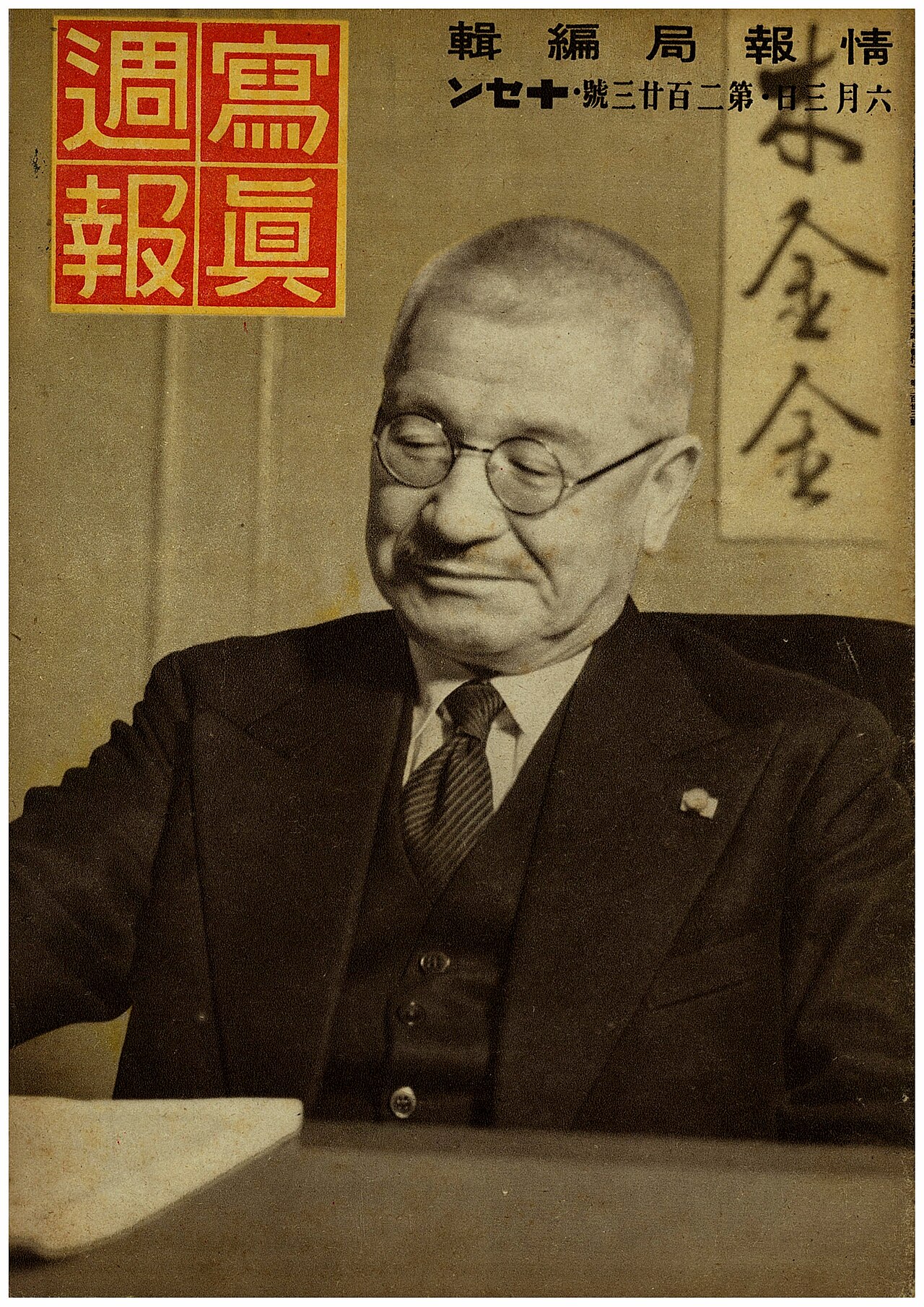
Shashin Shūhō No. 223, 3 June 1942, the week of the Battle of Midway. The masthead credits the Information Bureau as editor; the price is ten sen. Photographer unknown. Public domain (PD-Japan-organization; PD-1996).
How it works
- Limited hangout: the 10 June 1942 Midway communiqué admitted one carrier lost and one damaged. The admission was true as far as it went and served to cover the loss of four carriers, the core of the carrier force.
- Card stacking: the communiqués set Japan's claimed kills (two U.S. carriers at Midway; eleven at Taiwan) next to understated losses. By Tsujita's count the gap over the whole war was 84 carriers claimed against 11 actually sunk. In the Taiwan case the error began with unchecked pilot reports, not a deliberate lie, but it was not corrected in public.
- Euphemism / doublespeak: tenshin ("turning to advance elsewhere") for the Guadalcanal withdrawal, gyokusai ("shattering like a jewel") for the destruction of a garrison, senbu ("pacification") for propaganda work in occupied China, and the 1945 rescript's "not necessarily to Japan's advantage" for defeat, announcing surrender without the word.
- Semantic hijacking: "Zeitaku wa teki da!" takes teki, the word for the opposing army, and stretches it to cover silk, rings and restaurant meals, so a shopping choice becomes a side taken in the war ('Zeitaku wa teki da!' (Luxury Is the Enemy!) street sign, Tokyo).
- Identity fusion: Kokutai no Hongi and Shinmin no Michi define being Japanese as loyalty to the throne. The companion sign "If you are Japanese you surely cannot indulge in luxury" makes the purchase a test of nationality, and the label hikokumin ("non-citizen", "un-Japanese") was used against those who fell short.
- Glittering generalities: the Spiritual Mobilization slogans kyokoku itchi ("the whole nation united"), jinchū hōkoku ("utmost loyalty, service to the nation") and kennin jikyū ("endurance and perseverance") are virtue words with no testable content; they stood in for an account of what the war in China was for and what it would cost.
- Name-calling: "Kichiku Bei-Ei" ("demonic Americans and British") reduces two enemy nations to demons and beasts, and Dower documents the matching cartoons with horns and claws.
- Fear appeal: the "BUT" leaflet to Australian troops offers "only DEATH ... Bullet-holes in your guts---agonizing death!" or surrender and a return to a lover ('BUT if you continue to resist...' (Japanese leaflet to Australian troops)).
- Transfer: the "bullet stamps" (dangan kitte) advertised on the back of Shashin Shūhō in 1943 draw a 2-yen savings lottery ticket as a rifle round, so buying one is presented as firing at the enemy ('Dangan kitte' (Bullet Stamps) war-savings lottery advertisement, back cover of Shashin Shūhō).
Then and now
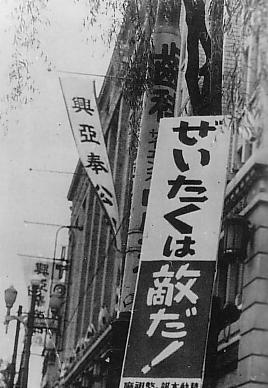
'Zeitaku wa teki da!' (Luxury Is the Enemy!) street sign, Tokyo, National Spiritual Mobilization headquarters, Tokyo, August 1940. Public domain (PD-Japan-oldphoto).
The U.S. Office of War Information and Treasury also turned consumption into a war act: "Use it up, wear it out, make it do, or do without", and the War Bond drives covered in FRAME's The U.S. Office of War Information and the Writers' War Board: a 'strategy of truth' meets the advertising men page. The shared method is attaching a war word to a household choice. The differences are large. The Tokyo signs followed a legal ban on luxury goods issued by an unelected cabinet, and they reached households through neighbourhood associations that were also used for rationing, civil defence and neighbours keeping watch on one another. American conservation posters ran alongside legal rationing too, but in a country with an elected Congress, a press that could criticise the campaigns, and no compulsory household-level organisation. Japan's campaign also carried a moral claim, that self-denial was what being Japanese meant, that U.S. thrift posters generally did not make.
Positions on the record
- The government's stated position. Officials presented the Spiritual Mobilization Movement and the Information Bureau as "thought war" defences: national unity against communism and against Western individualism and liberalism, and, in Asia, the liberation of colonised peoples from Western rule. The 1943 Joint Declaration put the pitch to occupied Asia in its own words.
- Contemporaries. Allied governments published the gap between Japanese claims and actual losses; the U.S. Navy publicised the Third Fleet's intact return after the Taiwan claims. In Japan the phrase Daihon'ei happyō became, after 1945, a byword for official announcements that cannot be trusted.
- Historians. Kushner (The Thought War, 2006) argues that wartime propaganda was not only imposed from above: advertisers, journalists and entertainers took part willingly, and the public was an active audience. Dower (War Without Mercy, 1986) sets the Japanese kichiku imagery beside the racial language of U.S. propaganda. Tsujita (2016) traces how the communiqués moved from broadly accurate in 1941-1942 to fabricated after Coral Sea and Midway, which he attributes to rivalry between the Army and Navy and a press that had merged with the state.
- This archive's reading. Documented: the chain of institutions and dates above; the texts of Kokutai no Hongi, Shinmin no Michi, the 1943 Joint Declaration and the 1945 rescript; the figures in the Midway and Taiwan communiqués against the losses recorded by both navies; and the slogans and their campaigns. Not shown on this page: how far the public believed the communiqués (diaries and police reports suggest scepticism grew from 1944, but this page has not measured it), exact circulation figures for Shashin Shūhō, and whether the October 1944 claims were known to be false when first announced. Those are open questions, not findings.
Same-method test
Swap the flag and the scoring stays the same. The U.S. government also produced an enemy image of the Japanese: This Is the Enemy belongs to a U.S. home-front series that reduces the enemy to a single menacing figure; the U.S. Army's exclusion orders ('Instructions to All Persons of Japanese Ancestry' (exclusion order posted in San Francisco)) called the forced removal of about 120,000 people of Japanese ancestry "evacuation" and called U.S. citizens "non-aliens"; and Admiral William Halsey's billboard at Tulagi read "Kill Japs, kill Japs, kill more Japs" (Evan Thomas, Sea of Thunder, Simon & Schuster, 2006). By the same definitions these score as Name-calling, Scapegoating and Euphemism / doublespeak, exactly as Kichiku Bei-Ei and tenshin do. U.S. leaflets to Japanese soldiers used the same methods in reverse: Attention American Soldiers! I Cease Resistance (surrender pass, leaflet 17-J-1) was a surrender pass that avoided the word "surrender", scored as Euphemism / doublespeak just as the 1945 rescript is.
The differences should be stated just as plainly. The United States had no single agency that both censored the press and published its own weekly, no compulsory neighbourhood organisation, and no state doctrine text that defined citizenship as loyalty to a ruler. U.S. communiqués were also censored and delayed (Pearl Harbor losses were not given in full at first), but they did not claim eight times the enemy carriers actually sunk. On the other side, the U.S. exclusion policy was carried out against the government's own citizens on grounds of ancestry, which a 1983 federal commission attributed to "race prejudice, war hysteria and a failure of political leadership". The Japanese methods are closer in structure to Germany's Reich Ministry for Popular Enlightenment and Propaganda (The Reich Ministry of Public Enlightenment and Propaganda, 1933-1945) and to the Chinese Nationalist and Communist propaganda systems (Chinese wartime propaganda, 1937-1945: Chongqing, Yan'an and Wang Jingwei's Nanjing) than to the U.S. Office of War Information, but none of them is identical.
How to spot it
- Compare an official casualty figure with what the other side recorded, and with what the same office said later. A communiqué that admits a small loss can still hide a large one.
- Watch for new words for retreat and defeat (tenshin, gyokusai, "not necessarily to our advantage"). A new euphemism often marks a fact the speaker cannot yet state.
- When a purchase, a meal or a hairstyle is labelled "the enemy", ask what law or shortage lies behind the slogan and who enforces it at the door.
- Check who "wrote" a popular slogan. A contest winner, a letter from a child or a spontaneous rally can be arranged.
Images
| Image | Source | Licence |
|---|---|---|
| Mechanism diagram (above) | Drawn for FRAME from this page's sourced facts (make_diagrams.py) |
CC BY 4.0, FRAME |
| Shashin Shūhō No. 223 cover, 3 June 1942 | Wikimedia Commons, Cabinet Information Bureau | Public domain (PD-Japan-organization; PD-1996 in the U.S.) |
| "Luxury is the enemy!" sign, Tokyo, 1940 | FRAME gallery, 'Zeitaku wa teki da!' (Luxury Is the Enemy!) street sign, Tokyo | Public domain (PD-Japan-oldphoto) |
| Dangan kitte back cover, Shashin Shūhō, 1943 | FRAME gallery, 'Dangan kitte' (Bullet Stamps) war-savings lottery advertisement, back cover of Shashin Shūhō | Public domain (PD-Japan-organization; PD-1996) |
| "BUT if you continue to resist" leaflet, 1942 | FRAME gallery, 'BUT if you continue to resist...' (Japanese leaflet to Australian troops) | Public domain (PD-Japan-organization; PD-1996) |
| "I cease resistance" U.S. surrender pass, c. 1945 | FRAME gallery, Attention American Soldiers! I Cease Resistance (surrender pass, leaflet 17-J-1) (Library of Congress) | Public domain (U.S. government work) |
| This Is the Enemy (1943), U.S. exclusion order (1942) | FRAME gallery | Public domain (U.S. government works) |

Image gaps
- Kokutai no Hongi and Shinmin no Michi title pages. Ministry of Education works published before 1946 and so likely public domain, but no Commons file with both a Japanese and a U.S. rationale was found, and the National Diet Library's digital collection was not reachable from the build environment. Fillable.
- A newspaper front page carrying the Midway or Taiwan communiqué. Not found on Commons with a verified licence in the time available. Fillable.
- A "Kichiku Bei-Ei" poster or cartoon. The August 1943 Manga cover caricaturing Roosevelt is on Commons tagged as an organisational work, but covers of that magazine were drawn by named artists, so the tag is doubtful and it was not hosted. The Shōwakan museum's photo of a "鬼畜米英撃滅" sign is not openly licensed.
- "That goes double -- The slick yank" leaflet (Library of Congress 96503341). The record carries no rights statement, so it is cited but not hosted.
- Occupation propaganda in Southeast Asia. Out of scope here; see FRAME's case study of the Co-Prosperity Sphere ('Asia for the Asiatics': Japan's Co-Prosperity Sphere and the movements that used it) and its image gaps.
- Tonarigumi circulars (kairanban). The Hoover Institution holds a 1941 Tonarigumi item, but its reuse terms were not checked. Maybe fillable.
- The 15 August 1945 broadcast and Zero Hour. Left to FRAME's wartime radio and film case studies.
Sources
- Japan Center for Asian Historical Records (JACAR), A Window into the Early Shōwa Period: Shashin Shūhō, 1938-1945 and its neighbourhood association topic page.
- National Archives of Japan, Nihon no ayumi: the Cabinet Information Bureau is established (December 1940); JACAR glossary, 内閣情報局; JACAR, 情報局ノ組織ト機能 (May 1941).
- National Diet Library, Research Navi: 国民精神総動員実施要綱 (cabinet decision, 1937).
- Columbia University, Asia for Educators, Selections from the Kokutai no hongi, 1937; Kokutai no Hongi: Cardinal Principles of the National Entity of Japan, trans. J. O. Gauntlett, ed. R. K. Hall (Harvard University Press, 1949).
- Aizawa Kiyoshi, "大本営発表とミッドウェー海戦" (Imperial General Headquarters announcements and the Battle of Midway), National Institute for Defense Studies, 2004.
- Tsujita Masanori, Daihon'ei happyō: kaizan, inpei, netsuzō no Taiheiyō sensō (Gentōsha Shinsho, 2016); Tsujita, 大本営発表: セクショナリズムと権力・メディアの一体化が生んだ悲喜劇, nippon.com.
- Gendai Business on the Taiwan air battle claims; Kotobank, 台湾沖航空戦.
- Kyoto Shimbun, 11月27日 欲しがりません勝つまでは (1942) and ミッドウェー海戦「大戦果」; imidas, 欲しがりません勝つまでは.
- Shōwakan digital archive, 「鬼畜米英撃滅」の看板.
- Critical Asian Studies 47:3 (2015), "Displaying the Worldview of Japanese Fascism: The Tokyo Thought War Exhibition of 1938".
- National Institute for Defense Studies, 日中戦争期における日本軍の情報活動; Tokyo Shimbun, review of Ōta Izuru, 『北支宣撫官 日中戦争の残響』.
- Library of Congress, "That goes double -- The slick yank (in Melbourn)" and "Attention American soldiers! I cease resistance".
- National Diet Library, Imperial Rescript on the Termination of the War, August 14, 1945; "The World and Japan" database, Imperial Rescript, 14 August 1945.
- Barak Kushner, The Thought War: Japanese Imperial Propaganda (University of Hawai'i Press, 2006).
- John W. Dower, War Without Mercy: Race and Power in the Pacific War (Pantheon, 1986).
- Evan Thomas, Sea of Thunder (Simon & Schuster, 2006), NPR excerpt.
- Allison B. Gilmore, You Can't Fight Tanks with Bayonets: Psychological Warfare against the Japanese Army in the Southwest Pacific (University of Nebraska Press, 1998).