Content note: this page shows an 1898 cartoon drawing a Black Cuban as a monster, a cartoon mocking Joseph Pulitzer's accent, and describes mass civilian deaths in Cuban reconcentration camps.
In one line: two New York dailies fighting for circulation turned Cuba's independence war into a daily run of outrage stories and, when the USS Maine exploded in Havana harbour, blamed Spain on their front pages before any inquiry had met, while Spain's own press answered with honour rhetoric and cartoons of a cowardly Uncle Sam; what caused the explosion is still disputed.
Content note: Caricature mocking Joseph Pulitzer's accent. This object is shown as it was published. Why 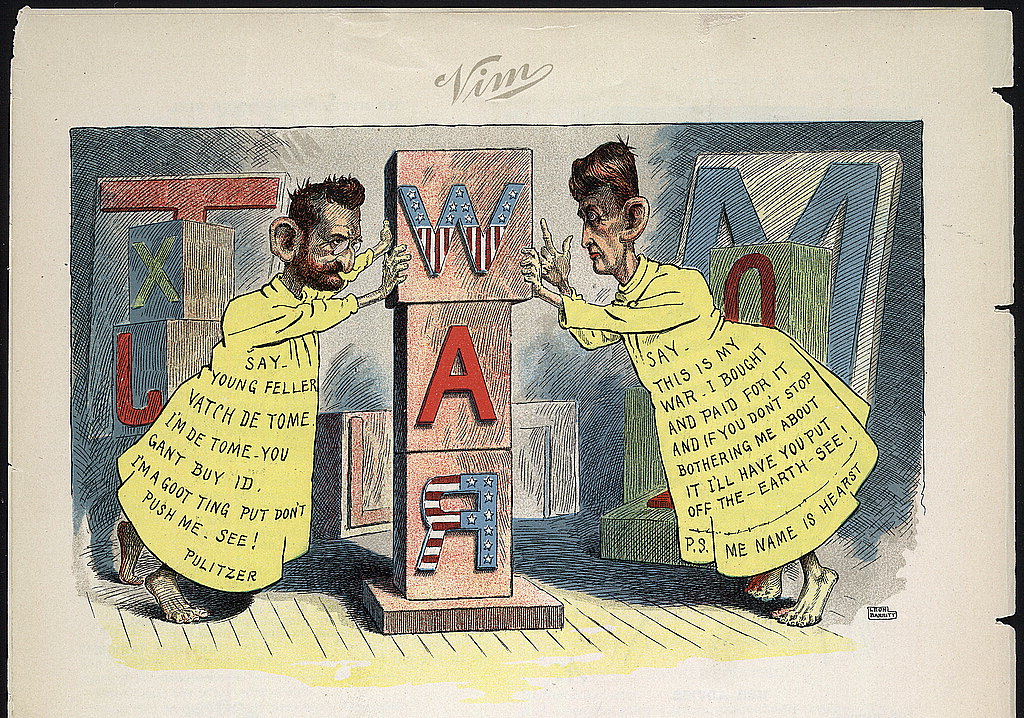
"The big type war of the yellow kids", Leon Barritt, in Vim, 29 June 1898. Pulitzer (left, drawn with a mocking accent) and Hearst (right: "This is my war. I bought and paid for it") dressed as the Yellow Kid comic character. Library of Congress. Public domain.
What happened
- 24 February 1895. Cuban insurgents rise against Spanish rule. The insurgent command orders the sugar harvest stopped and cane burned to cut Spain's revenue.
- Autumn 1895. Hearst buys the New York Journal and prices it at one cent against Pulitzer's World. Both papers compete on large headlines, illustrations and Cuba. By early 1897 the New York Press editor Ervin Wardman is calling their style "yellow journalism", after the Yellow Kid comic both papers ran.
- January-February 1896. General Valeriano Weyler sails for Cuba as captain-general. La Campana de Gràcia (1 February) quotes him on embarking: he goes to Cuba "to defend the integrity of the fatherland", and "the honour of Spain is in Cuba".
- 21 October 1896. Weyler orders rural Cubans in Pinar del Río into fortified towns (reconcentración), later extended east. Food, shelter and sanitation fail. Estimates of the dead vary widely: contemporary American figures ran to 400,000 or more, while John Lawrence Tone's archival study (2006) puts deaths at roughly 155,000 to 170,000, about a tenth of the island's population. The U.S. dailies call him "Butcher" Weyler.
- January 1897. Richard Harding Davis and Frederic Remington tour Cuba for the Journal. James Creelman's 1901 memoir says Remington cabled that there would be no war and Hearst replied, "You furnish the pictures and I'll furnish the war." No telegram has been produced, Remington never confirmed it, and Hearst denied sending it. It is unverified.
- 12 February 1897. The Journal runs Davis's report that Spanish officials searched three Cuban women aboard the U.S. steamer Olivette, under the headline "Does Our Flag Protect Women?", with a Remington drawing of a naked woman surrounded by male officers. Remington was not present. One of the women, Clemencia Arango, told the World that a woman had searched them in a cabin; Davis wrote that his dispatch never said men did the searching.
- August to October 1897. The Journal campaigns for Evangelina Cosío y Cisneros, 18, held in a Havana women's prison. Spanish authorities said she had helped lure the Isle of Pines military governor into an ambush during a failed 1896 rising; the Journal presented her as a young woman jailed for resisting his advances. It gathers petitions from prominent American women to the queen regent. On the night of 6-7 October its correspondent Karl Decker breaks her out; the paper presents the escape as a newspaper succeeding where diplomacy had failed. She is received in New York and at the White House.
- October 1897 to January 1898. After Prime Minister Cánovas is assassinated (August), the Sagasta government recalls Weyler, sends General Ramón Blanco and offers Cuba autonomy.
- 9 February 1898. The Journal publishes a private letter by the Spanish minister in Washington, Enrique Dupuy de Lôme, taken from the Havana mails by insurgent sympathisers, calling President McKinley "débil y populachero" (weak and playing to the crowd). De Lôme resigns.
- 15 February 1898, 9:40 p.m. The USS Maine explodes in Havana harbour; 266 of her crew die. Captain Charles Sigsbee cables that night that "public opinion should be suspended until further report."
- 17 February 1898. The Journal's front page: "DESTRUCTION OF THE WAR SHIP MAINE WAS THE WORK OF AN ENEMY", "$50,000 REWARD.—WHO DESTROYED THE MAINE?", and a drawing of a mine wired to the shore. The World asks whether the ship was lost to a bomb or torpedo. "Remember the Maine! To hell with Spain!" spreads as a slogan.
- March 1898. The U.S. Navy court of inquiry under Captain William T. Sampson reports (21 March, released 28 March) that an external mine set off the forward magazines, and fixes no responsibility. Spain's commission, working from outside the wreck, finds an internal cause; Spain proposes arbitration. Senator Redfield Proctor's 17 March Senate speech on the reconcentration camps, from his own visit, is widely reported. Blanco revokes the reconcentration policy at the end of March.
- April 1898. Spain announces a suspension of hostilities in Cuba (9 April). McKinley asks Congress for authority to intervene (11 April). War is declared on both sides by 25 April.
- 1911-1976. A board under Rear Admiral Charles Vreeland examines the raised wreck in 1911 and again finds an external explosion, at a different point on the hull. In 1976 Admiral Hyman Rickover's study, How the Battleship Maine Was Destroyed, concludes that a fire in a coal bunker next to a magazine was the likely cause. A 1998 computer analysis for National Geographic found a mine plausible. The cause remains disputed.
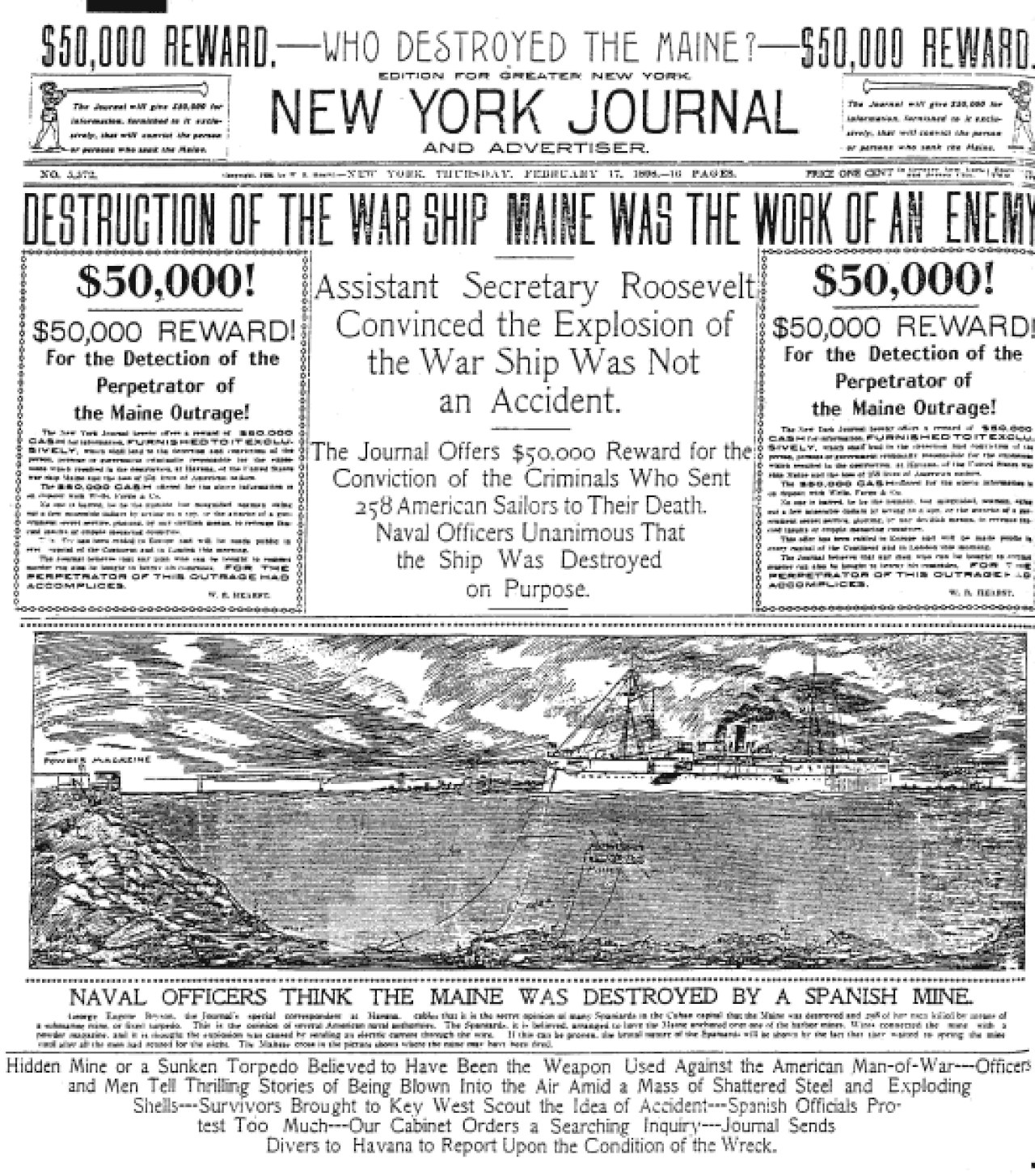
Front page, New York Journal and Advertiser, 17 February 1898, two days after the explosion. It gives the toll as 258 and prints "Naval Officers Unanimous That the Ship Was Destroyed on Purpose" and "Spanish Officials Protest Too Much". Via Wikimedia Commons. Public domain.
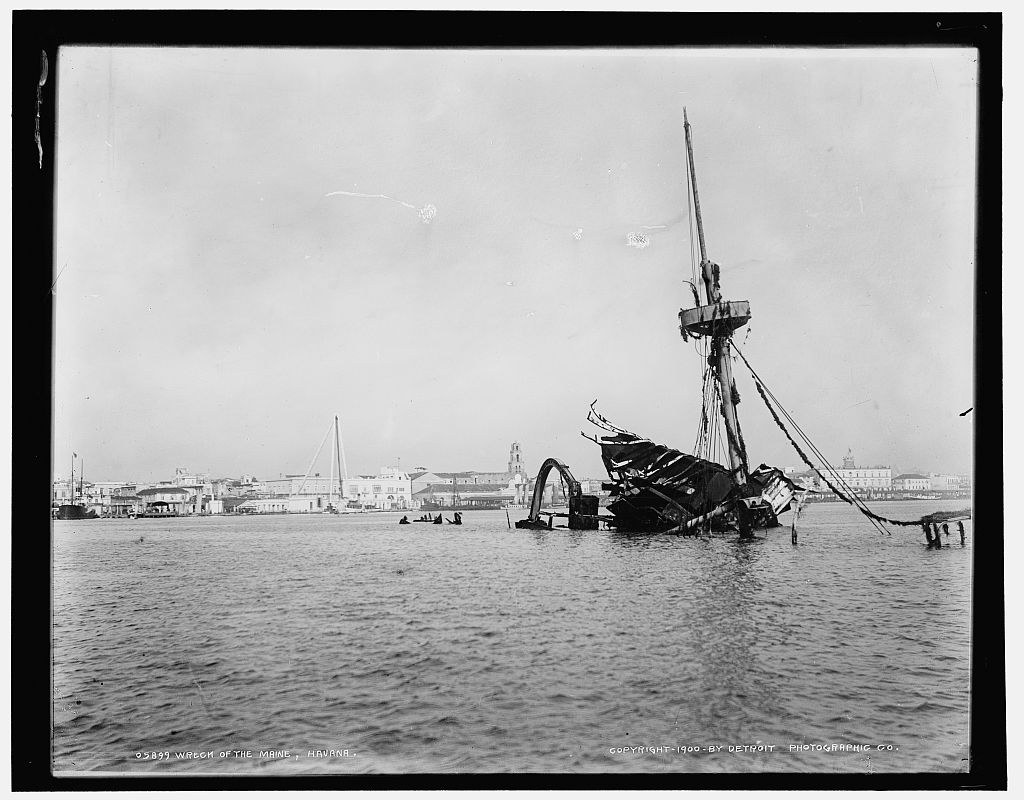
"Wreck of the Maine, Havana", Detroit Publishing Co., 1898 (copyright 1900). Library of Congress. Public domain.
How it works
- Name-calling: "Butcher Weyler" named a man whose policy did cause mass civilian death. The deaths are the record; what the tag is scored for is how it works: a one-word nickname carried the verdict into every headline, so the story ran on the villain rather than on the policy and who ordered it. On the Spanish side, Ramón Cilla's cartoon in Blanco y Negro (7 May 1898) has a Spanish soldier call Uncle Sam "cobarde" (coward), and studies of the Spanish press describe Americans drawn as pigs or as money-grubbing pork dealers.
- Scapegoating: the Journal's 17 February page assigned the Maine's destruction to "an enemy" and "criminals", with a reward for the "perpetrator", while the Navy's inquiry had not yet sat and the ship's own captain was asking for judgement to wait. The harm was real; the blame came first.
- Card stacking: the Olivette drawing left out the fact that decided the story, that a woman had done the search. Some U.S. coverage of reconcentration ran death figures of 400,000 or more, well above the roughly 155,000 to 170,000 of Tone's archival count; the deaths were real, and the scoring is of the inflated figure, not of reporting them. In Spain, patriotic papers stressed honour and courage while saying little about the gap between the two navies, which the war exposed within weeks (Balfour).
- Outrage bait: the circulation war rewarded stories built to anger: the stripped woman under the U.S. flag, the jailed girl, the "insult" of the de Lôme letter. Both papers claimed record sales in the crisis, with daily figures above one million copies claimed in February 1898, so the papers' crisis coverage and their sales rose together.
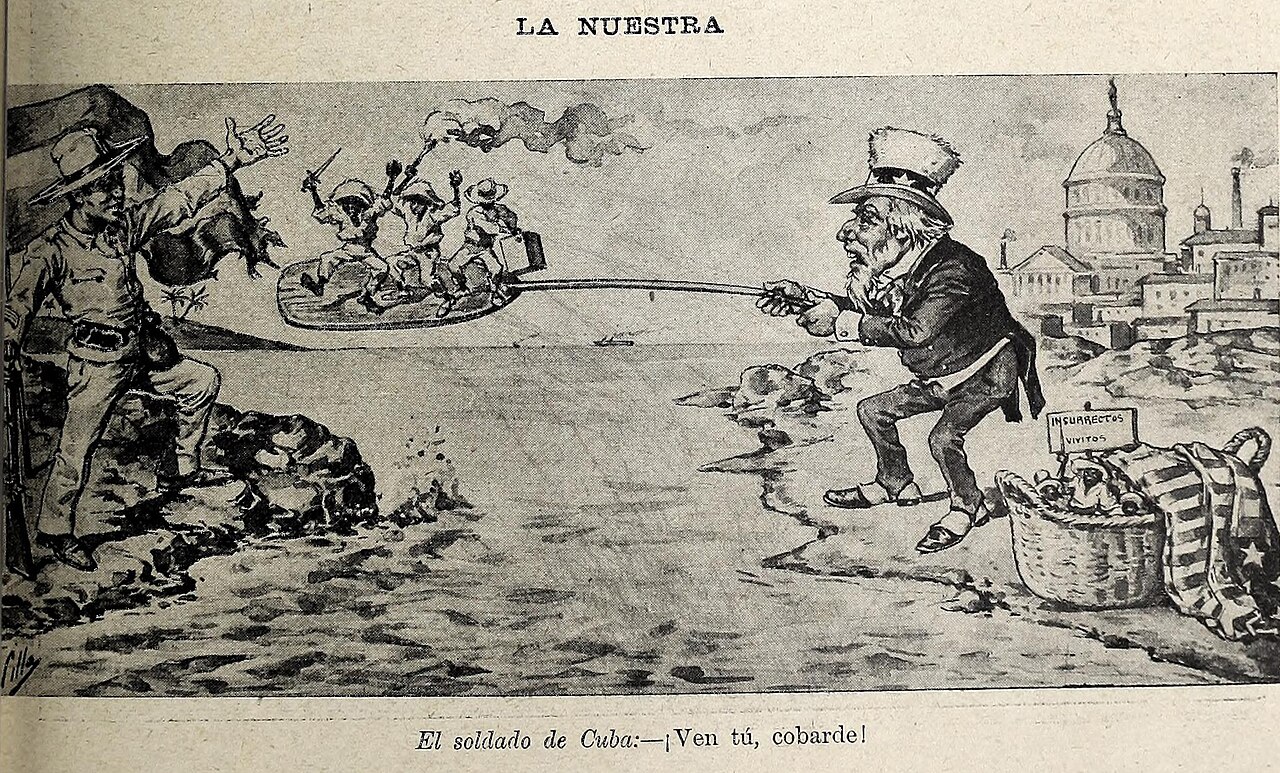
"El soldado de Cuba: ¡Ven tú, cobarde!" ("The soldier of Cuba: You come, coward!"), Ramón Cilla, in Blanco y Negro (Madrid), 7 May 1898. Uncle Sam ships insurgents to Cuba from a basket labelled "live insurgents". Via Wikimedia Commons. Public domain.
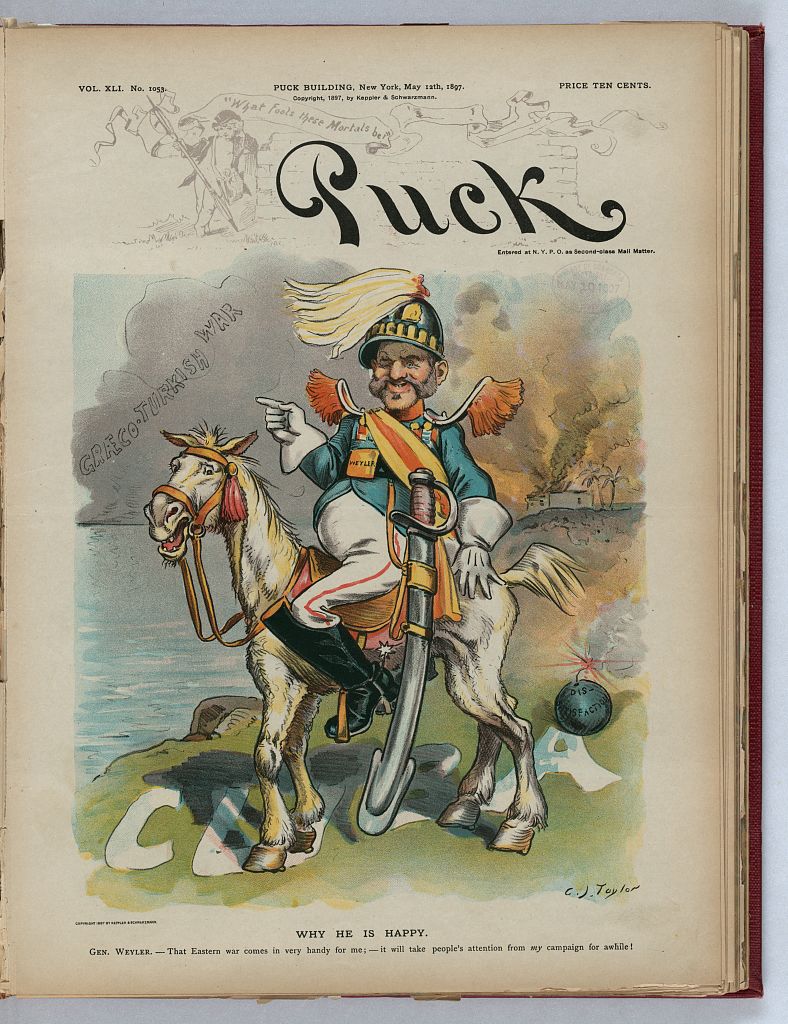
"Why He Is Happy", C. J. Taylor, Puck cover, 12 May 1897. Weyler: "That Eastern war comes in very handy for me; it will take people's attention from my campaign for awhile!" Library of Congress. Public domain.
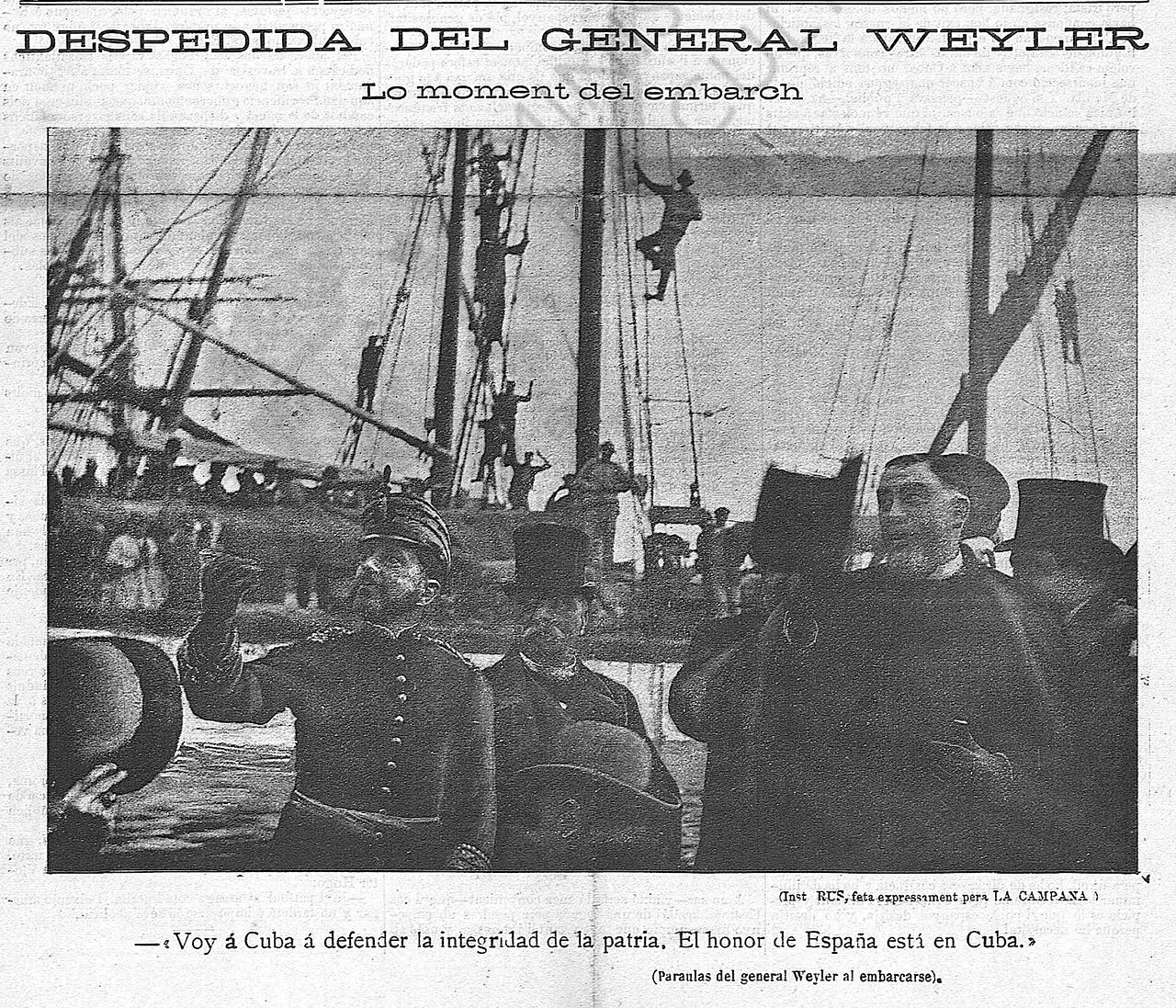
"Despedida del general Weyler" (Weyler's farewell), La Campana de Gràcia (Barcelona), 1 February 1896. Caption: "I go to Cuba to defend the integrity of the fatherland. The honour of Spain is in Cuba." Via Wikimedia Commons. Public domain.
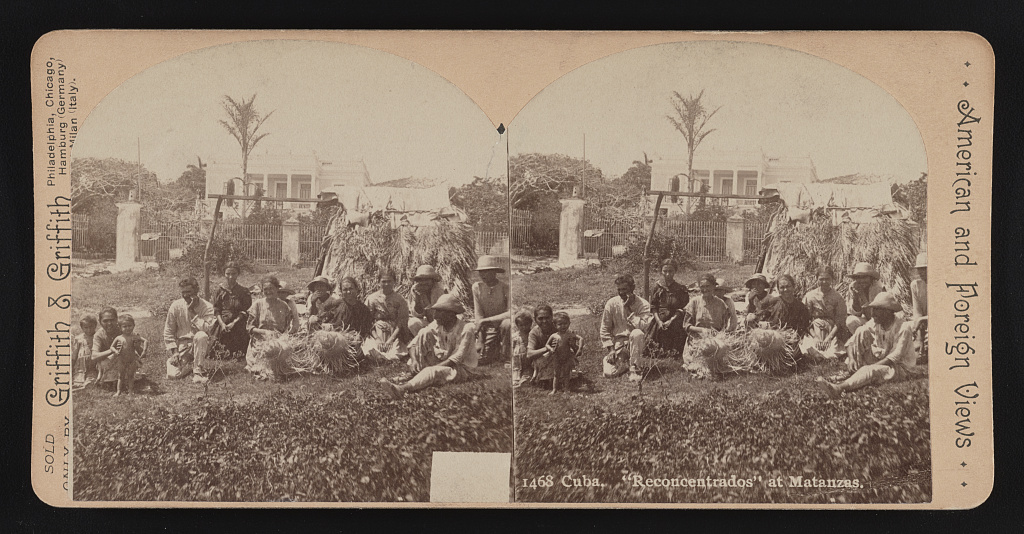
"Cuba. 'Reconcentrados' at Matanzas", Griffith & Griffith stereograph, 1898. Library of Congress. Public domain.
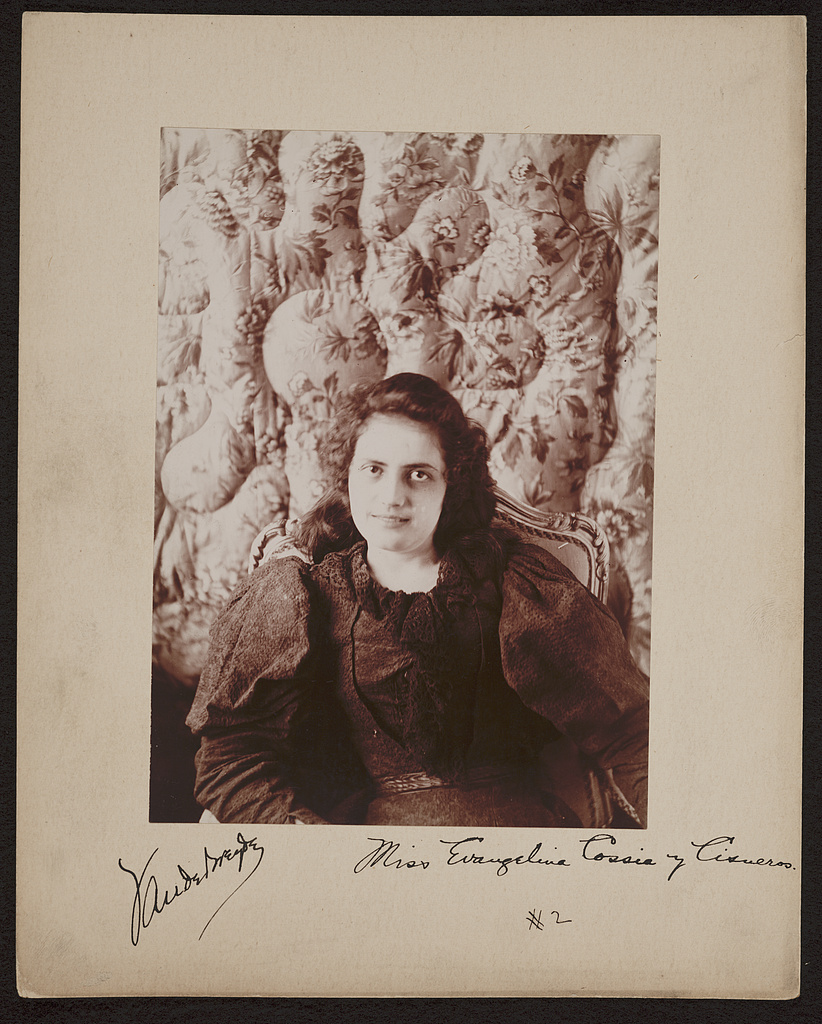
Evangelina Cosío y Cisneros in New York, William Vander Weyde, November 1897. Library of Congress. Public domain.
Then and now
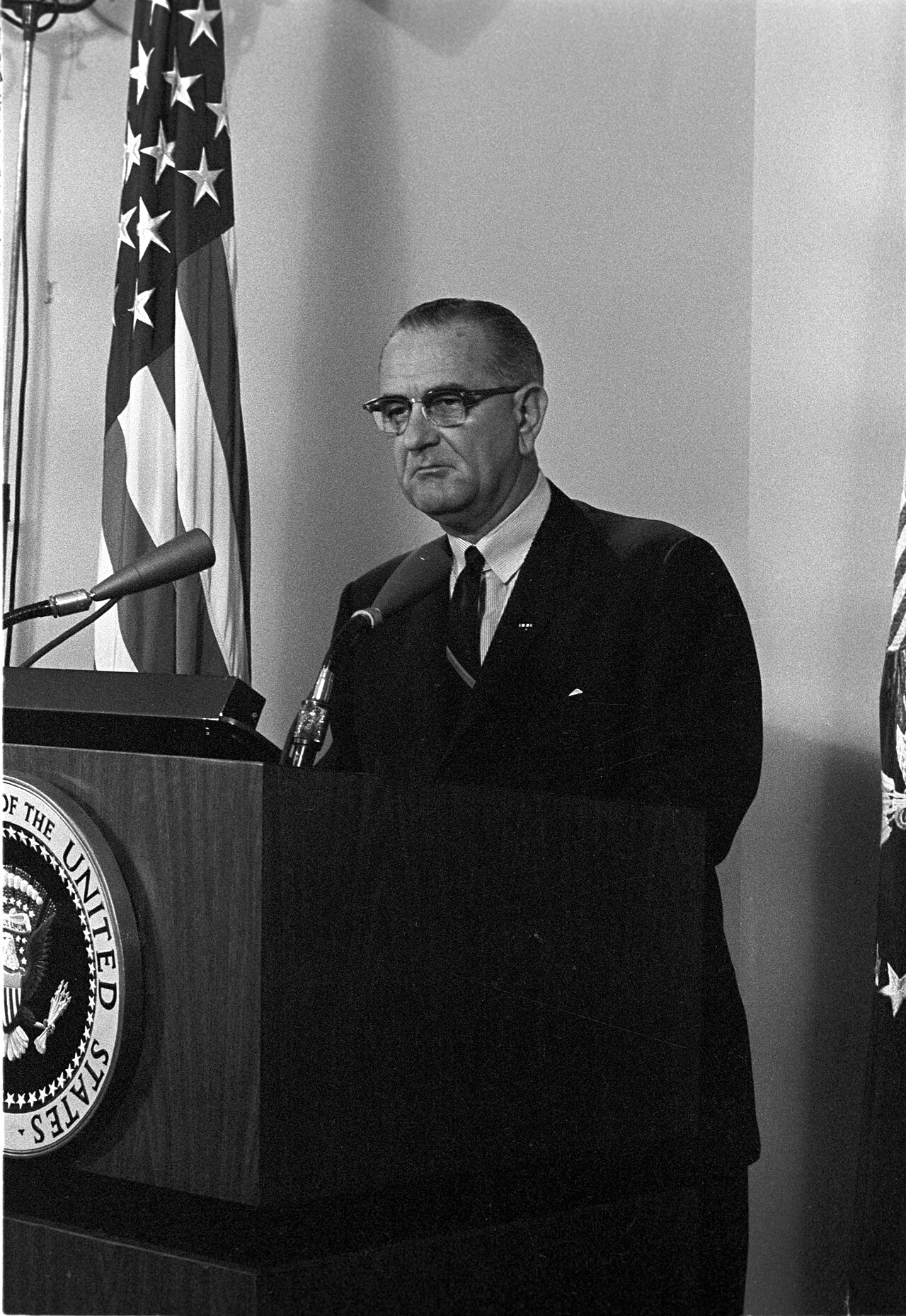
President Johnson's Gulf of Tonkin 'Midnight Address', White House photo, 1964. Public domain.
The Gulf of Tonkin address shares one structure with the Maine coverage: a naval incident, a cause announced before the evidence was settled, and a war authorised within days or weeks. The differences are large. In 1964 the speaker was the government and the second attack did not happen; in 1898 the loudest voices were private newspapers, the explosion was real, and the government's own inquiry came weeks later and is still argued over.
Content note: Dehumanizing caricature of Germans as an ape, implied sexual violence and partial nudity. This object is shown as it was published. Why 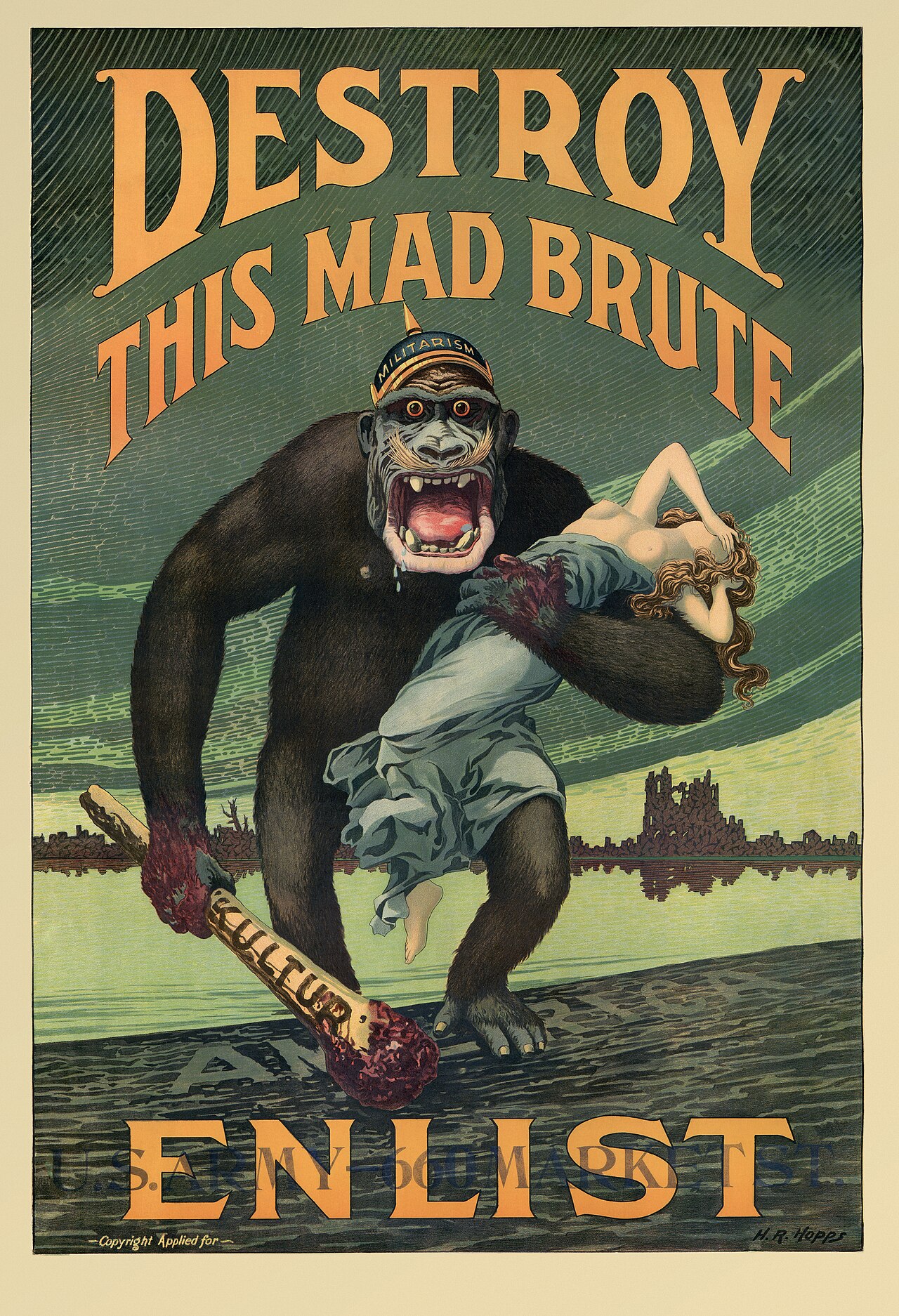
Destroy This Mad Brute — Enlist, Harry R. Hopps for the U.S. Army, 1917. Public domain.
The Olivette drawing and the Cisneros campaign used the endangered woman as the reason to act, twenty years before this recruiting poster made it a gorilla carrying a woman. The 1917 poster was an official state product; the 1897 stories were commercial. For outrage-bait in the platform era, see Matryoshka's midterm clips: borrowed faces and a borrowed logo.
Positions on the record
- The Journal and the World: they presented themselves as champions of Cuban freedom and of American honour. Hearst's Journal openly called its approach the "journalism that acts" and took credit for the Cisneros escape.
- Spain: the government held that Cuba was Spanish territory facing an insurrection armed and funded from the United States, that the Maine was lost to an internal accident, and it offered arbitration and, in April, a suspension of hostilities. Weyler defended reconcentration in his memoir Mi mando en Cuba (1910-1911) as a military necessity.
- The Cuban independence movement: the Manifesto of Montecristi (25 March 1895), signed by José Martí and Máximo Gómez, set out the rising as a war for independence and a republic. The Cuban Junta in New York, led by Tomás Estrada Palma, supplied reports to U.S. newspapers and lobbied for recognition of Cuban belligerency. Pérez (1998) records that many Cuban leaders sought recognition and arms rather than U.S. intervention, and that Cuban forces were left out of the Santiago surrender in July 1898 and of the peace talks, which General Calixto García protested.
- Historians: Joseph Wisan (1934) argued that the war would not have happened without the Hearst-Pulitzer circulation battle; Joyce Milton (1989) gives the correspondents a large role. W. Joseph Campbell (2001) argues the causal role is overstated: the yellow press was concentrated in New York, most U.S. papers did not copy it, the McKinley administration did not take its cues from it, and diplomacy, the humanitarian crisis and the Sampson report drove events. Louis A. Pérez Jr. and John Offner place the decision in U.S. and Spanish policy rather than the press. Sebastián Balfour describes Spain's own press as confident of victory and dismissive of American fighting power.
- This archive's reading: documented are the headlines, the drawings, the Olivette correction, the de Lôme letter, the reward, the Sampson and Spanish findings, and mass civilian deaths under reconcentration (estimates above). Not shown: that the press caused the war, what sank the Maine, and that Hearst ever wrote "I'll furnish the war".
Same-method test
Had a Madrid daily printed "the Maine was the work of American agents seeking a pretext", offered a reward for the plotters two days after the blast, and drawn an American sailor stripping a Spanish woman on a Spanish ship, it would be scored the same: Scapegoating, Card stacking and Outrage bait. Cilla's "cobarde" cartoon and the pig imagery of the Spanish weeklies earn Name-calling exactly as "Butcher Weyler" does.
Content note: Racist caricature of a Black Cuban as a monster. This object is shown as it was published. Why 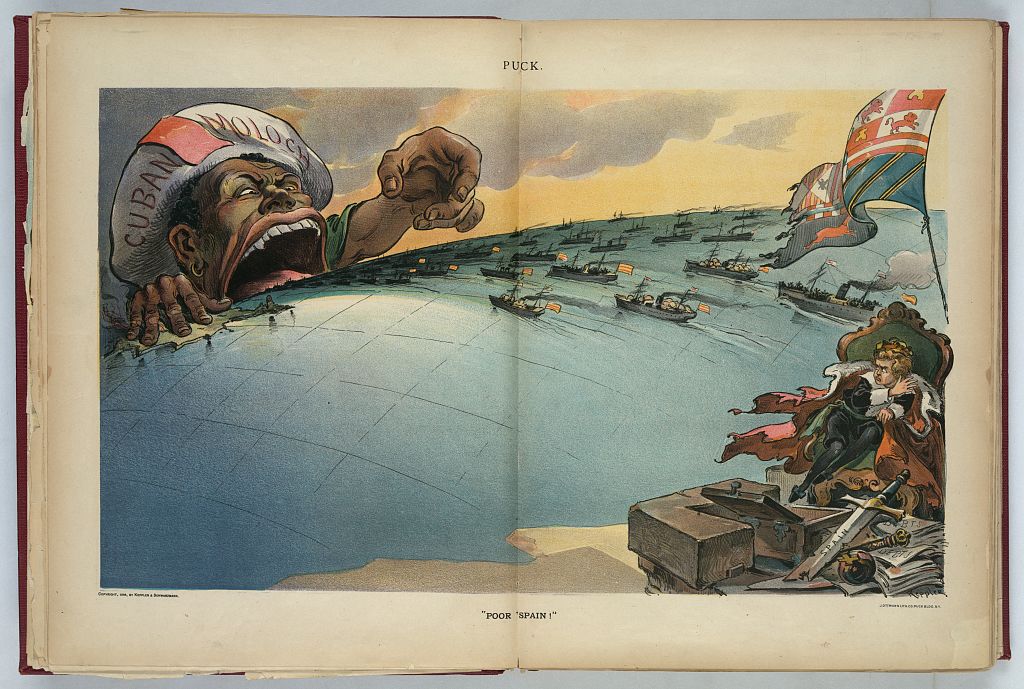
"Poor Spain!", Udo J. Keppler, Puck, 2 March 1898. A racist caricature of Cuba as a devouring "Cuban Moloch" consuming Spain's troopships, while the boy king Alfonso XIII sits beside empty chests. Not every U.S. cartoon took the insurgents' side. Library of Congress. Public domain.
How to spot it
- Note the gap between the event and the verdict: a cause stated in a headline before any inquiry has met is a claim, not a finding.
- Look for the one fact that would deflate the story (who did the search, what the ship's captain said) and check whether the item carries it.
- Ask who profits from your anger. A paper selling a million copies on a crisis has a stake in the crisis.
- Read both sides' papers for the same week. The Journal's "enemy" and Blanco y Negro's "coward" are the same move.
- Treat famous quotations as claims needing a source; "furnish the war" rests on one memoir.
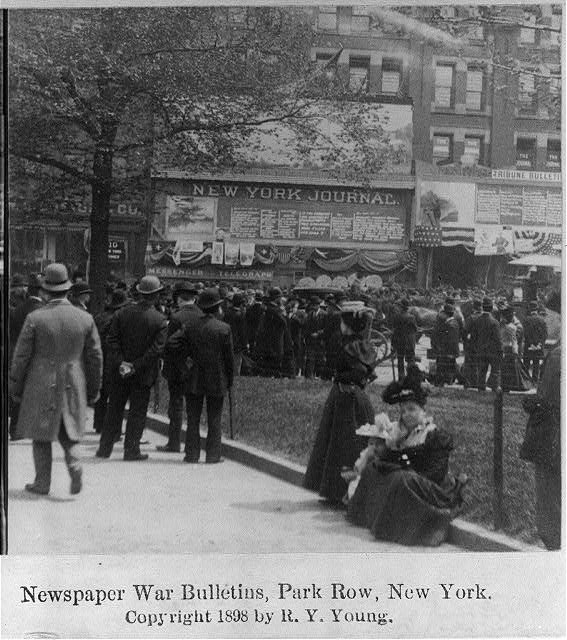
"Newspaper War Bulletins, Park Row, N.Y.", stereograph by R. Y. Young, American Stereoscopic Co., 1898. Crowds read bulletins posted outside the Journal and the Tribune. Library of Congress. Public domain.
Images
| Image | Source | Licence |
|---|---|---|
| "The big type war of the yellow kids", Leon Barritt, Vim, 29 June 1898 | Library of Congress | Public domain (no known restrictions) |
| New York Journal front page, 17 February 1898 | Wikimedia Commons | Public domain (published before 1929) |
| "Wreck of the Maine, Havana", Detroit Publishing Co., 1898 | Library of Congress | Public domain (no known restrictions) |
| "El soldado de Cuba: ¡Ven tú, cobarde!", Ramón Cilla, Blanco y Negro, 7 May 1898 | Wikimedia Commons | Public domain (PD-scan) |
| "Why He Is Happy", C. J. Taylor, Puck, 12 May 1897 | Library of Congress | Public domain (no known restrictions) |
| "Despedida del general Weyler", La Campana de Gràcia, 1 February 1896 | Wikimedia Commons | Public domain (PD-scan) |
| "Cuba. 'Reconcentrados' at Matanzas", Griffith & Griffith, 1898 | Library of Congress | Public domain (no known restrictions) |
| Evangelina Cosío y Cisneros, William Vander Weyde, 1897 | Library of Congress | Public domain (no known restrictions) |
| "Poor Spain!", Udo J. Keppler, Puck, 2 March 1898 | Library of Congress | Public domain (no known restrictions) |
| "Newspaper War Bulletins, Park Row", American Stereoscopic Co., 1898 | Library of Congress | Public domain (no known restrictions) |
| Gulf of Tonkin address (1964), Destroy This Mad Brute (1917) | FRAME gallery | Public domain |


Image gaps
- Remington's Olivette drawing and the "Does Our Flag Protect Women?" page (12 February 1897). Public domain, but no scan was found on the Library of Congress or Commons search tools used. Fillable from Chronicling America or a microfilm scan.
- A World front page on the Maine (February 1898) and the Journal's de Lôme page (9 February 1898). Public domain; not found in the searches run. Fillable.
- A Spanish cartoon drawing the United States as a pig. Such cartoons are described in the scholarship, but no verified, openly licensed scan was found; El Moro Muza (Havana) was not examined. Fillable from Spain's Hemeroteca Digital or Biblioteca Virtual de Prensa Histórica.
- Photographs of reconcentration deaths. Harsher 1898 photographs exist; this page uses a group stereograph that does not show the dead.
Sources
- New York Journal and Advertiser, 17 February 1898, front page (reproduced above); New York Journal, 12 February 1897 and 9 February 1898; New York World, February 1897 and February 1898.
- U.S. Navy, Report of the Naval Court of Inquiry upon the Destruction of the United States Battleship Maine in Havana Harbor, February 15, 1898 (Washington: Government Printing Office, 1898; 55th Congress, 2nd session).
- Hyman G. Rickover, How the Battleship Maine Was Destroyed (Washington: Naval History Division, Department of the Navy, 1976).
- James Creelman, On the Great Highway: The Wanderings and Adventures of a Special Correspondent (Boston: Lothrop, Lee & Shepard, 1901).
- Valeriano Weyler, Mi mando en Cuba, 5 vols. (Madrid, 1910-1911).
- W. Joseph Campbell, Yellow Journalism: Puncturing the Myths, Defining the Legacies (Westport, CT: Praeger, 2001); and Getting It Wrong: Ten of the Greatest Misreported Stories in American Journalism (Berkeley: University of California Press, 2010).
- Joseph E. Wisan, The Cuban Crisis as Reflected in the New York Press, 1895-1898 (New York: Columbia University Press, 1934).
- Joyce Milton, The Yellow Kids: Foreign Correspondents in the Heyday of Yellow Journalism (New York: Harper & Row, 1989).
- John Lawrence Tone, War and Genocide in Cuba, 1895-1898 (Chapel Hill: University of North Carolina Press, 2006).
- Louis A. Pérez Jr., The War of 1898: The United States and Cuba in History and Historiography (Chapel Hill: University of North Carolina Press, 1998).
- John L. Offner, An Unwanted War: The Diplomacy of the United States and Spain over Cuba, 1895-1898 (Chapel Hill: University of North Carolina Press, 1992).
- Sebastian Balfour, The End of the Spanish Empire, 1898-1923 (Oxford: Clarendon Press, 1997).
- Thomas B. Allen, "Remember the Maine?", National Geographic, February 1998.