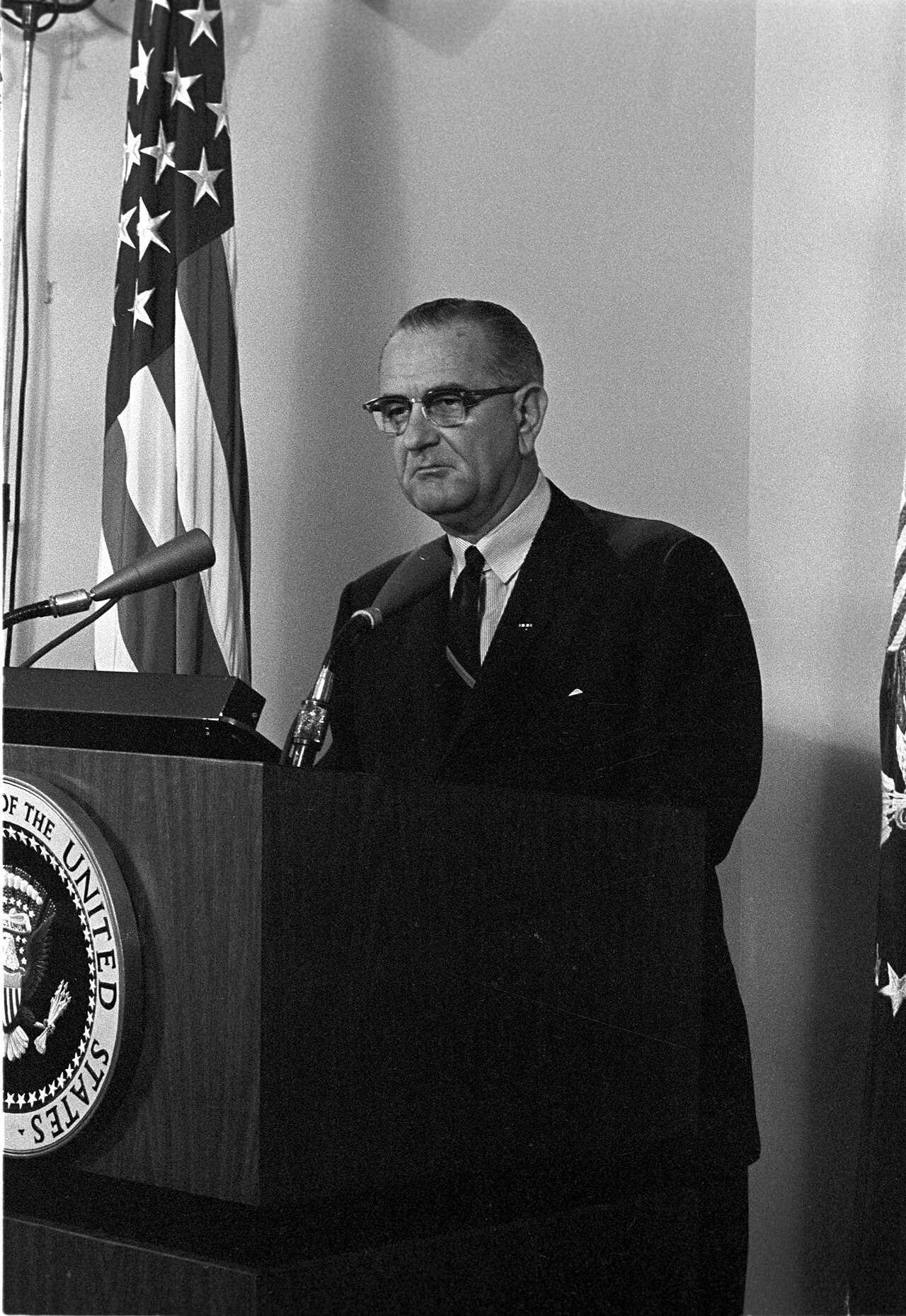
President Johnson's Gulf of Tonkin 'Midnight Address'
On 4 August 1964 President Johnson told Americans that North Vietnamese boats had attacked U.S. destroyers in the Gulf of Tonkin a second time, and he announced retaliatory air strikes. National Security Agency historian Robert J. Hanyok later concluded that this second attack did not take place, and that the intercepts cited as proof had been presented without the full record of that day.
Propaganda techniques used in this broadcast
- Date
- August 4, 1964
- Period
- Cold War
- Made by
- U.S. government (President Lyndon B. Johnson)
Full record
Region, Country, Medium, Issuer type, Regime, Leader, Audience, Purpose, Theme, Event, Source, Rights
- Region
- North America
- Country
- United States
- Medium
- Broadcast
- Issuer type
- State
- Regime
- Johnson Administration
- Leader
- Lyndon B. Johnson
- Audience
- Domestic public
- Purpose
- Persuade or win support
- Theme
- War and the military
- Event
- Vietnam War
- Source
- Identified Openly sourced: the speaker is who they say they are
- Source
- Wikimedia Commons, retrieved September 27, 2026
- Rights
- Public domain (U.S. government work)
White House Photo Office, LBJ Presidential Library (NARA).
Text on the object
Original (Multiple) · read from the image, not independently checked
...OF THE UNITED STATES [visible arc of the Presidential Seal on the front of the lectern] / ...UNUM [fragment of the eagle's beak banner, the rest hidden behind the eagle's head]
The visible 'UNUM' is part of the Seal's Latin motto banner (E Pluribus Unum, 'Out of many, one'); only 'one' is legible here. The rim text is already English.
This is the fixed Seal of the President of the United States affixed to the lectern, not a message written for this speech. Only its lower-left arc and part of the eagle's beak banner are lit/in frame; the seal's top ('SEAL OF THE PRESIDENT') is in shadow or outside the crop and was not read. No other text (e.g. on the flag, microphones, or wall) is visible.