In one line: a genuine German diplomatic telegram, read by British codebreakers in January-February 1917, was handed to Washington with a cover story about where it came from and released to the American press on 1 March, and although many doubted it for two days, the German foreign secretary himself confirmed it; its effect on U.S. opinion is still weighed against the submarine campaign that came with it.
Content note: the headlines and cartoons use period language ("plot", "intrigue") and caricature, reproduced as printed.
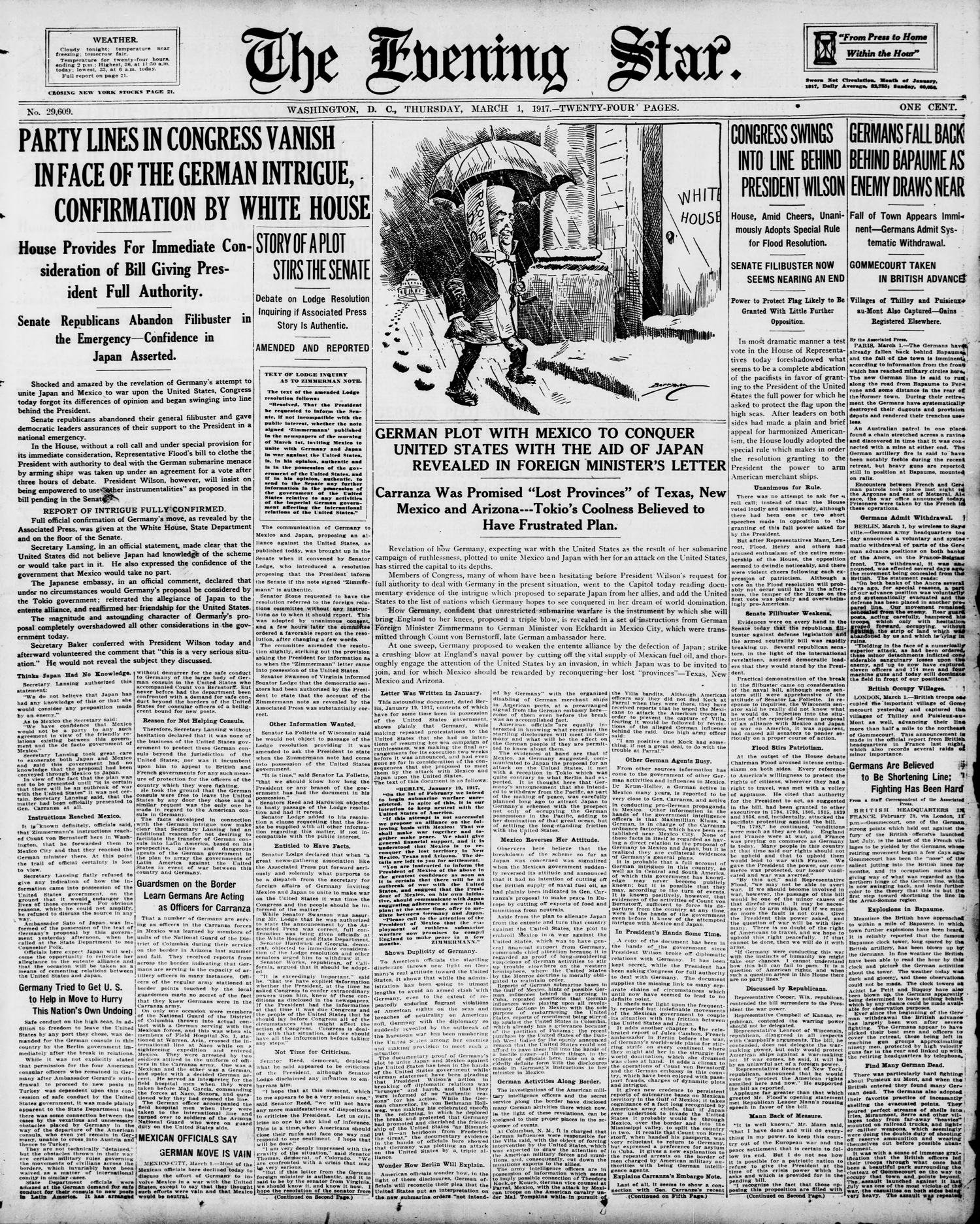
Front page, The Evening Star (Washington, D.C.), 1 March 1917. Lead headline: "Party lines in Congress vanish in face of the German intrigue"; centre: "German plot with Mexico to conquer United States with the aid of Japan revealed in foreign minister's letter", with the text of the telegram printed in full. Library of Congress, Chronicling America. Public domain.
What happened
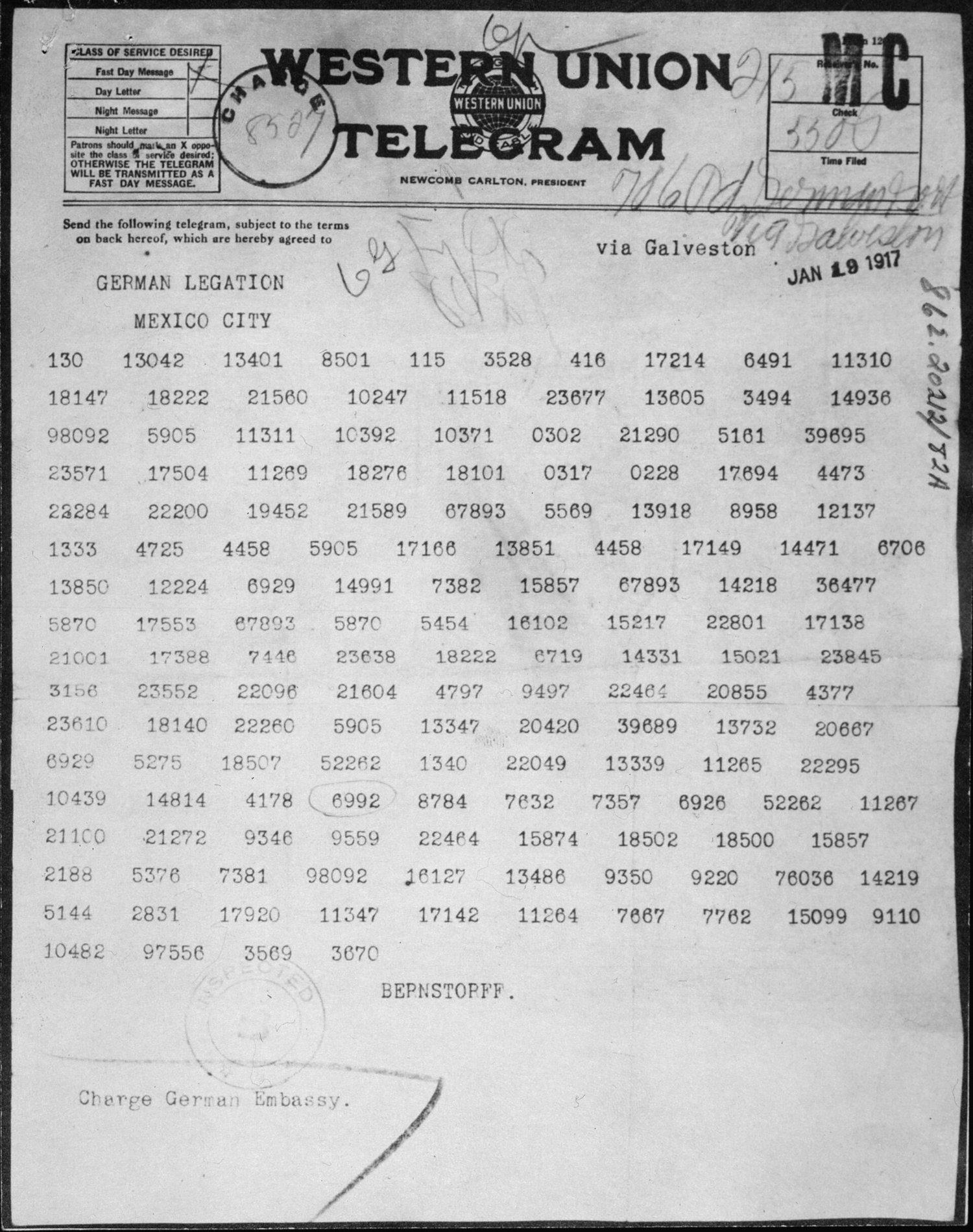
- 16 January 1917. Foreign Secretary Arthur Zimmermann sends instructions to the German minister in Mexico, Heinrich von Eckardt. By the text as printed in 1917, Germany would begin unrestricted submarine warfare on 1 February and try to keep the United States neutral; "in the event of this not succeeding", Eckardt was to propose to Mexico an alliance: "make war together, make peace together", generous financial support, and an understanding that Mexico would "reconquer the lost territory in Texas, New Mexico, and Arizona". He was also to suggest that the Mexican president invite Japan to join. The instruction was to be used only once war with the United States was certain. (Texts: Evening Star, 1 March 1917; National Archives copy.) The message travelled by more than one route, including a State Department channel that the Wilson administration had allowed Germany to use for peace-related traffic, and was re-sent from Washington to Mexico City by the German embassy (routes as summarised in the Wikipedia article; Boghardt, 2012, gives them in detail).
- 1 February 1917. Germany resumes unrestricted submarine warfare. On 3 February the United States breaks off diplomatic relations with Germany.
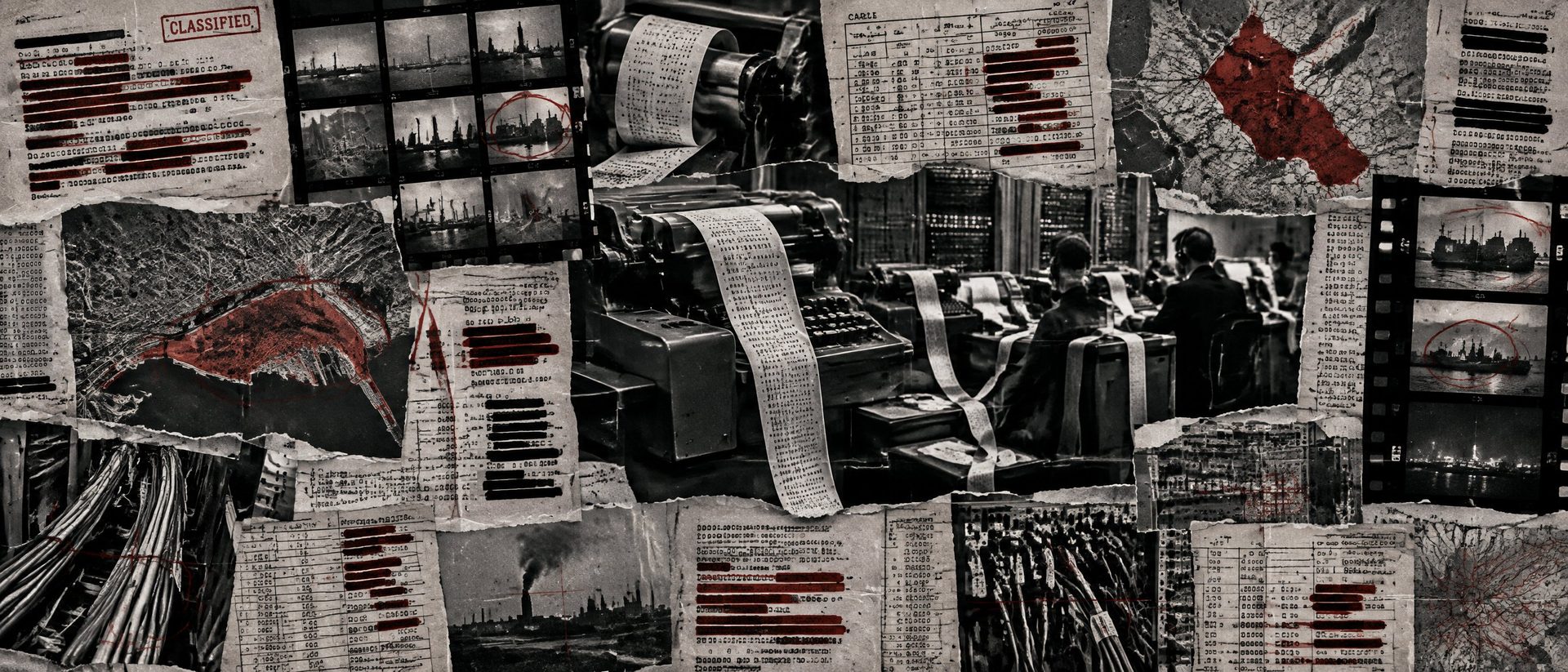
- January-February 1917. British Naval Intelligence, whose codebreaking section is known as Room 40, intercepts the traffic and begins reading it within days, using code groups it had partly recovered; the full text is assembled over the following weeks. A copy of the version re-sent in Mexico is later obtained by a British agent. The Admiralty's director of naval intelligence, Captain William Reginald "Blinker" Hall, holds the material back, because showing it would reveal that Britain read German diplomatic traffic, and, according to the Wikipedia summary of the scholarship, British reading of U.S. diplomatic traffic (UK Government History blog).
Show all 9Show fewer
- 19-24 February. Hall shows the text to Edward Bell of the U.S. Embassy in London, who at first suspects a forgery. On 23 February Foreign Secretary Arthur Balfour gives Ambassador Walter Hines Page the German text and a translation; Page cables it to Washington on 24 February. The British say the text was "bought in Mexico", a cover story the Americans agree to maintain (Wikipedia summary of Boghardt and Tuchman).
- 26-27 February. Washington tells Mexico it knows of the proposal; Japan tells Mexico it will not leave the Allies (National WWI Museum).
- 1 March. The Associated Press publishes the telegram, with the State Department confirming it. The Senate spends the day on a resolution by Henry Cabot Lodge asking whether the story is authentic, and the House takes up Wilson's request for authority to arm merchant ships.
- 3 March. Berlin's reply is printed in American papers. Zimmermann says the instruction was a "precaution" to apply only if the United States declared war on Germany, and asks how it could be a "plot inspired by unfriendliness". The Evening World heads it "Anticipated war, says Berlin, admitting the Mexican plot"; the Mexican foreign minister says no proposal has been received, and Japan's government calls the idea absurd.
- 29 March. In a Reichstag speech Zimmermann again confirms the text, adding that the instruction had come into American hands "in a way which was not unobjectionable" (per the Wikipedia summary; his own account is in the Reichstag speech).
- 2-6 April. Wilson asks Congress for a declaration of war on 2 April; it passes on 6 April. Mexico's President Carranza had a military commission study the offer and did not take it up (Katz, 1981).
Explain moreShow less
The Zimmermann telegram as received by the German ambassador to Mexico, 1917. National Archives and Records Administration, NAID 302025 (U.S. State Department file 862.20212/82A). Public domain (U.S. federal record).
How it works
- Narrative laundering: the content was real, and the route was disguised. The British told Washington, and let the world be told, that their agents had come by the text in Mexico, when the key source was their own reading of German cable traffic. The public account hid the real origin to protect a codebreaking capability. The scoring is about the provenance, not the document: it is the stated source that was untrue, and some readers took that false provenance as a reason to call the whole text a forgery.
- Card stacking: on the Allied and American side the release was selective in timing and in what was left out: the telegram appeared on 1 March, the day the House took up arming merchant ships, and the way it had been obtained was not given. (Whether the timing was chosen for that effect is not documented in the sources cited.) On the German side, Zimmermann's 3 March answer described the instruction as defensive and conditional, which the text says it was, but left out that it also offered Mexico "generous financial support" and territory in the United States. Both statements were accurate as far as they went.
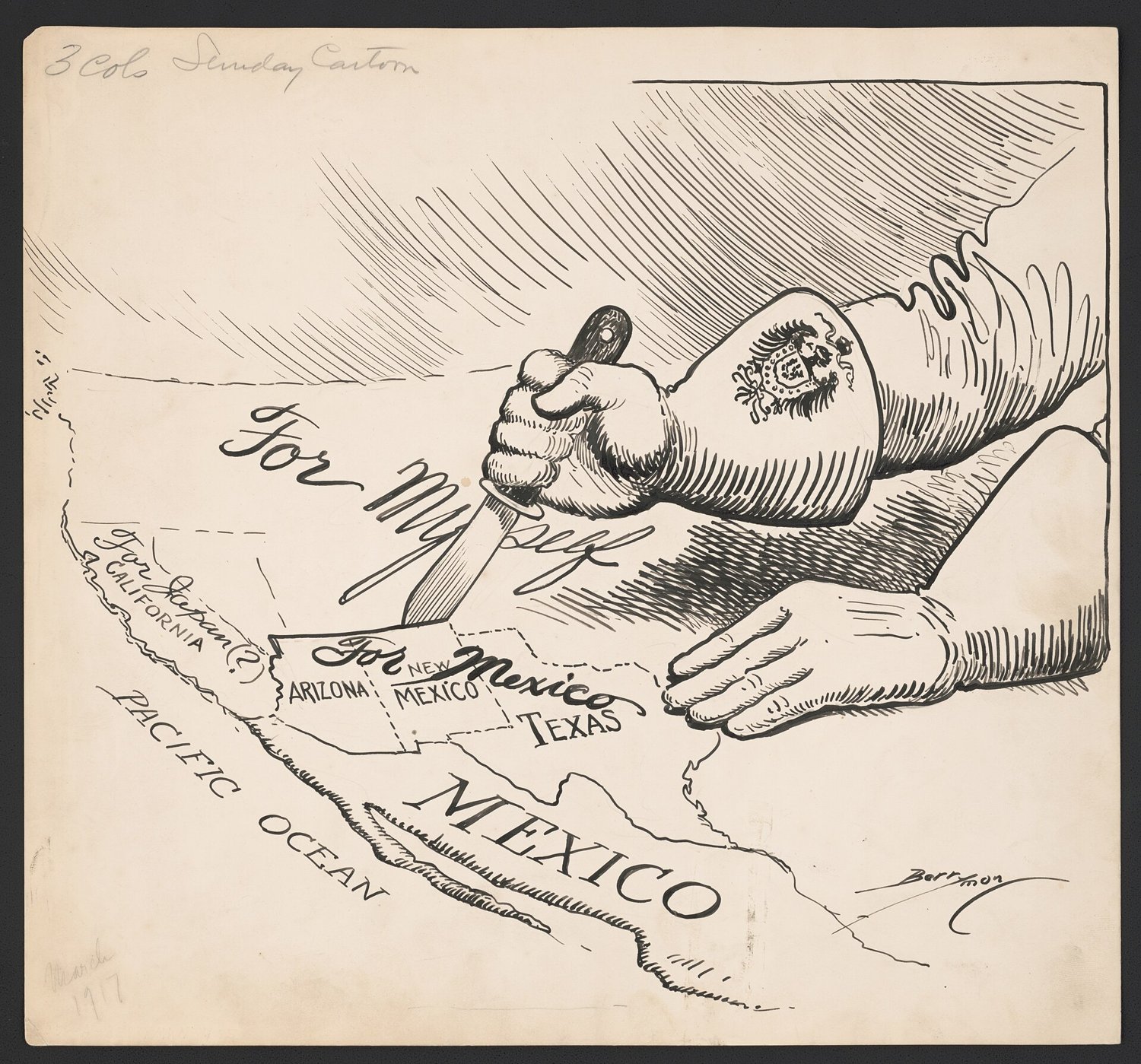
- Fear appeal: American headlines sold the story as a plan to "conquer United States" ("German plot with Mexico to conquer United States with the aid of Japan", Evening Star), a larger claim than the text, which proposed an alliance contingent on war. In the Evening Star of 4 March, Clifford Berryman drew a gauntleted hand stamped with the German eagle carving up the south-west (see below).
Show all 4Show fewer
- Name-calling: "intrigue", "plot" and "Mexican plot" were the U.S. frames; Berlin's reply used the same word, putting "plot" in quotation marks and calling the American use of it "unfriendliness".
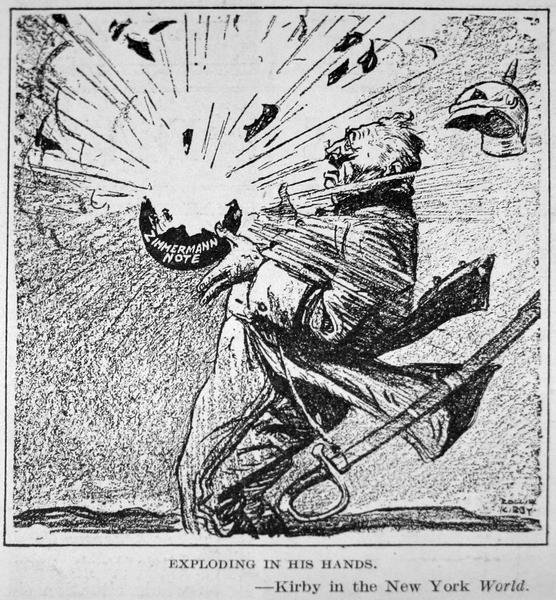
Explain moreShow less
"[Hand carving up a map of the Southwestern United States]", Clifford K. Berryman, drawing for the Evening Star (Washington, D.C.), 4 March 1917. Library of Congress, Prints and Photographs Division. No known restrictions on publication.
"Exploding in his hands", Rollin Kirby, New York World, 17 March 1917, as reproduced on Wikimedia Commons. Public domain (published in the United States before 1931).
Then and now
Defeat the Kaiser and His U-Boats: Victory Depends on Which Fails First, Food or Frightfulness , U.S.
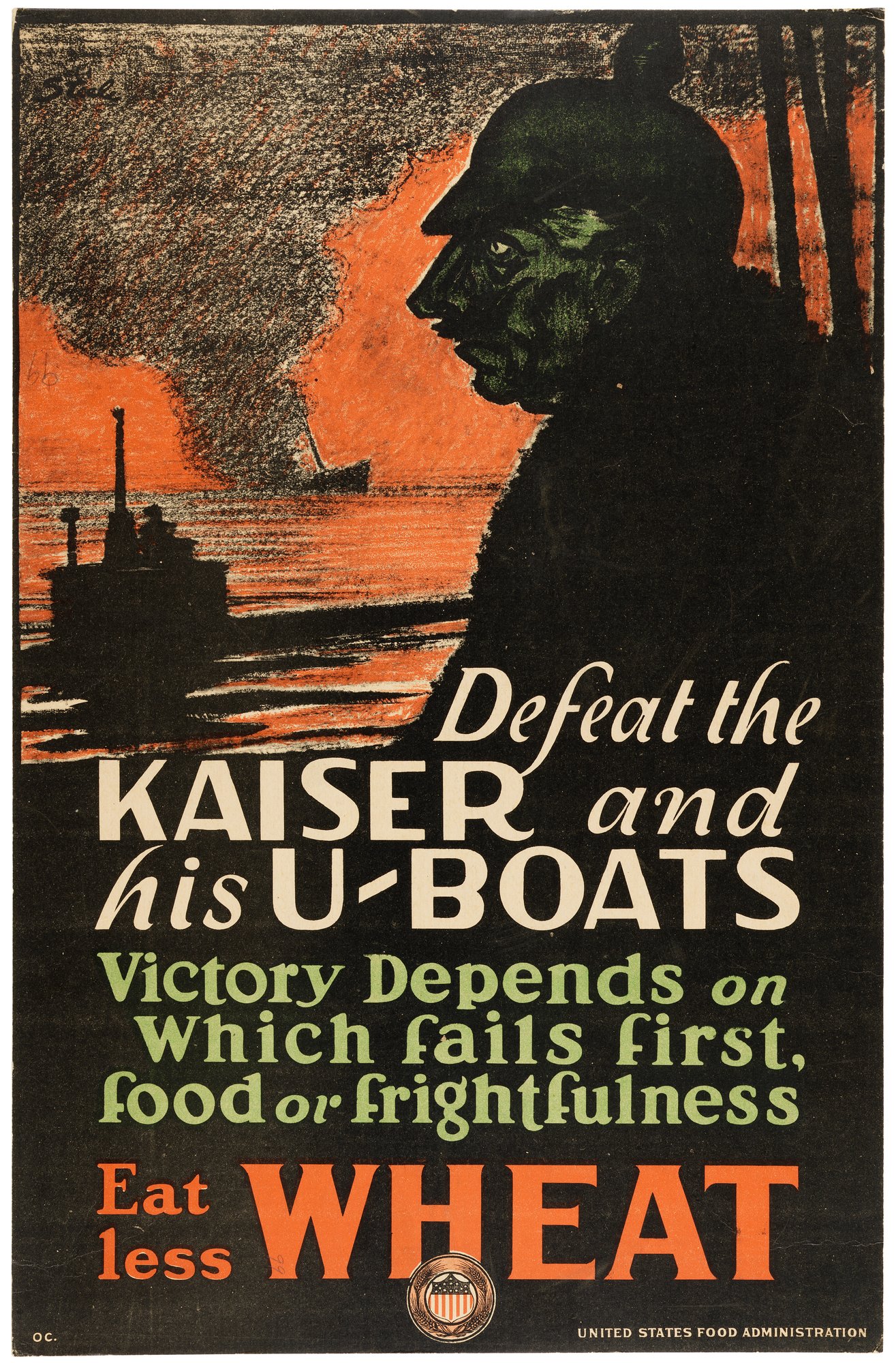
Defeat the Kaiser and His U-Boats: Victory Depends on Which Fails First, Food or Frightfulness, U.S. poster, 1917. Public domain.
The telegram belongs to the same U-boat story as this poster. The telegram's release linked the campaign at sea to a threat on land, and the poster shows how the two were put to a mass audience.
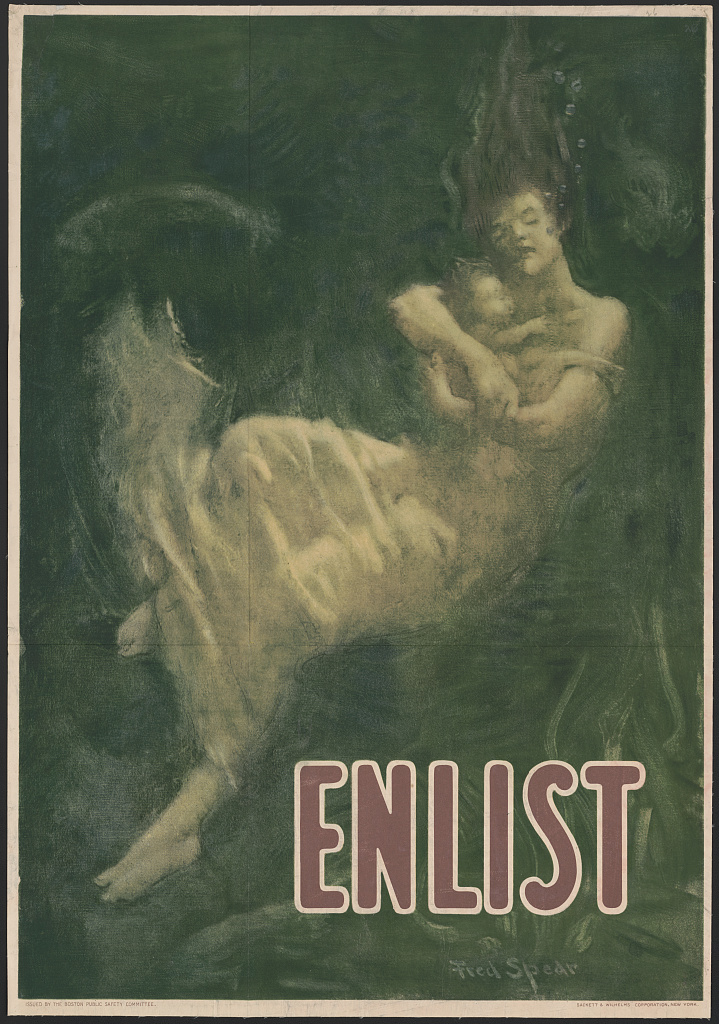
Enlist, British recruiting poster, 1915. Public domain.
This page differs from other WWI cases on one point: the document was real. By contrast, Russia's war of words: tsarist lubki, the Liberty Loan and the fight over 'German agents' (1914-1918) covers the Sisson Documents, which the U.S. Committee on Public Information released in 1918 and which were later judged forged, and Wellington House and the Bryce Report: atrocity evidence, confirmed and unconfirmed (1914-1915) covers atrocity claims of which some were confirmed and some not. Here the dispute was about how the text was obtained and what it proved, not whether it existed. For the American agency that ran wartime publicity at the same moment, see The Committee on Public Information: how the U.S. government sold the First World War at home (1917-1919).
Positions on the record
8 items · German Foreign Office: Zimmermann said on 3 March that the instruction was a precaution…
- German Foreign Office: Zimmermann said on 3 March that the instruction was a precaution to be carried out only if the United States entered the war, and that the real "plot" was American, since the United States had urged joint action against Germany. In the Reichstag on 29 March he confirmed the text and objected to how it had reached Washington.
- British government: said the text was obtained in Mexico. The Room 40 route was not part of the account given in 1917.
- U.S. administration: Wilson held the text for several days after receiving it on 24 February and then allowed release on 1 March; the State Department confirmed the text to the press that day. The reasons for the timing are debated, and no source cited here states them.
- U.S. press and Congress: the Evening Star of 1 March reported party lines "vanish" in the House and a Senate debate on whether the story was authentic. The Milwaukee Leader, a Socialist daily with the motto "Starve the war and feed America!", gave Berlin's "defensive" explanation a top headline on 3 March ("'Plot' only for defense, foreign secretary says") beside the Mexican and Japanese denials. Some antiwar papers, Hearst's among them, suggested a British forgery before the confirmation (Wikipedia summary).
- Mexico: the Carranza government received no formal proposal and a military commission judged the plan unworkable: Mexico was in civil war and could not hope to take on the United States (Katz, 1981).
- Japan: Foreign Minister Motono's government said it had received no proposal and called the scheme absurd (Evening World, 3 March 1917).
- Historians: Barbara Tuchman, The Zimmermann Telegram (1958), treats it as the decisive push on a divided American public. Thomas Boghardt, The Zimmermann Telegram: Intelligence, Diplomacy, and America's Entry into World War I (2012), places it among several factors, with the resumption of submarine warfare and the sinking of American ships the central ones. David Kahn calls it a cryptanalysis with "enormous consequences". Friedrich Katz, The Secret War in Mexico (1981), sets the telegram within wider German activity in Mexico since 1914.
- This archive's reading: documented are the text, the dates, the British concealment of the source, the 1 March release and Zimmermann's confirmation. Not shown: that the telegram alone brought the United States into the war, and that a German alliance with Mexico was ever near to being made.
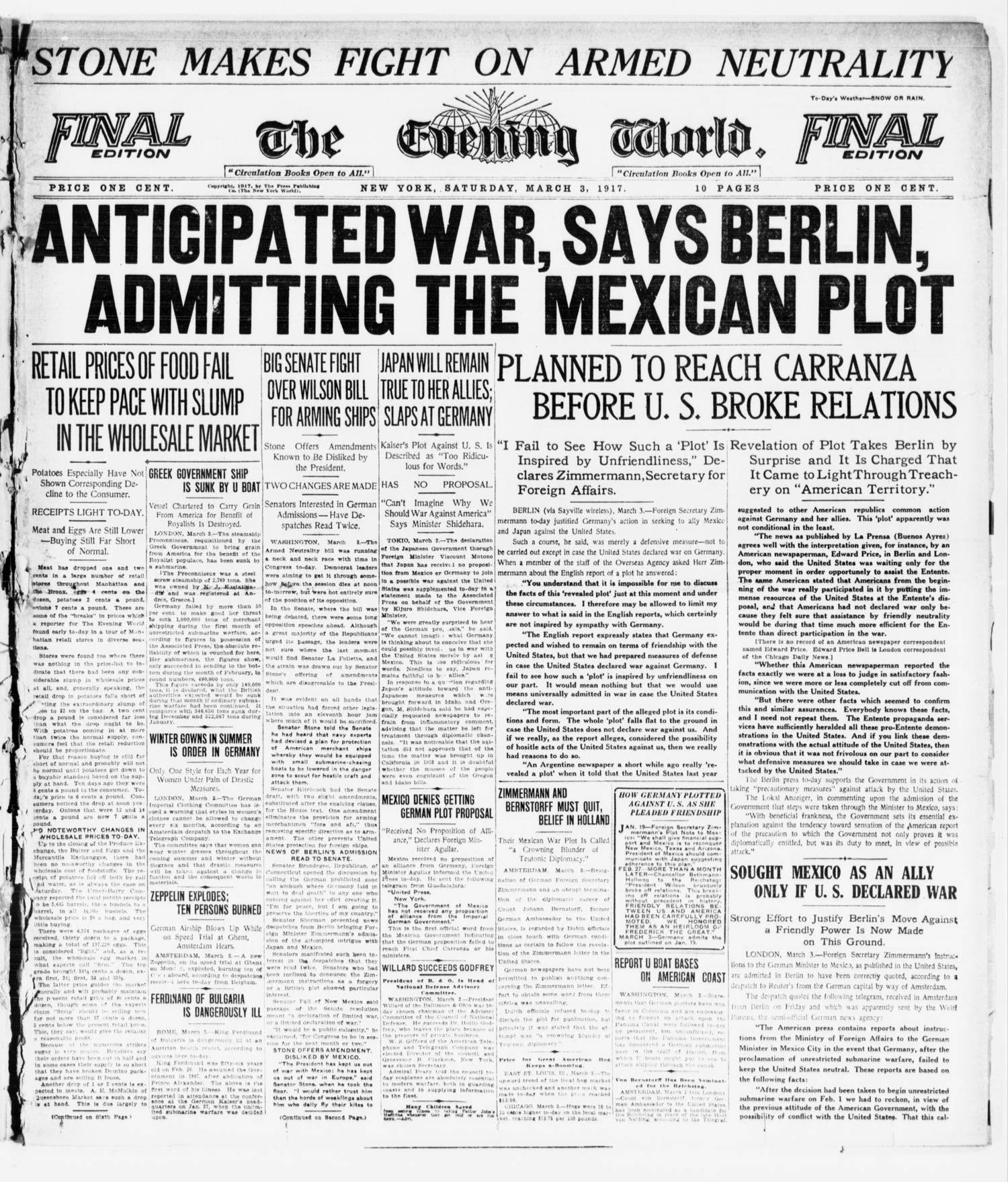
Front page, The Evening World (New York), 3 March 1917, Final Edition. Headline: "Anticipated war, says Berlin, admitting the Mexican plot"; Zimmermann: "I fail to see how such a 'plot' is inspired by unfriendliness on our part." Library of Congress, Chronicling America. Public domain.
Same-method test
Had Berlin held a genuine British telegram, with Whitehall's own proposal to a neutral state, and released it through a neutral…
Had Berlin held a genuine British telegram, with Whitehall's own proposal to a neutral state, and released it through a neutral channel while naming a different source, it would be scored the same: Narrative laundering for the invented provenance and Card stacking for the timing. The reverse also holds. The American headline "to conquer United States" and a German headline calling the British a "plot" earn Fear appeal and Name-calling alike. What differs is the record: the German text was real and was confirmed, and the concealment protected a codebreaking method, not an invention.
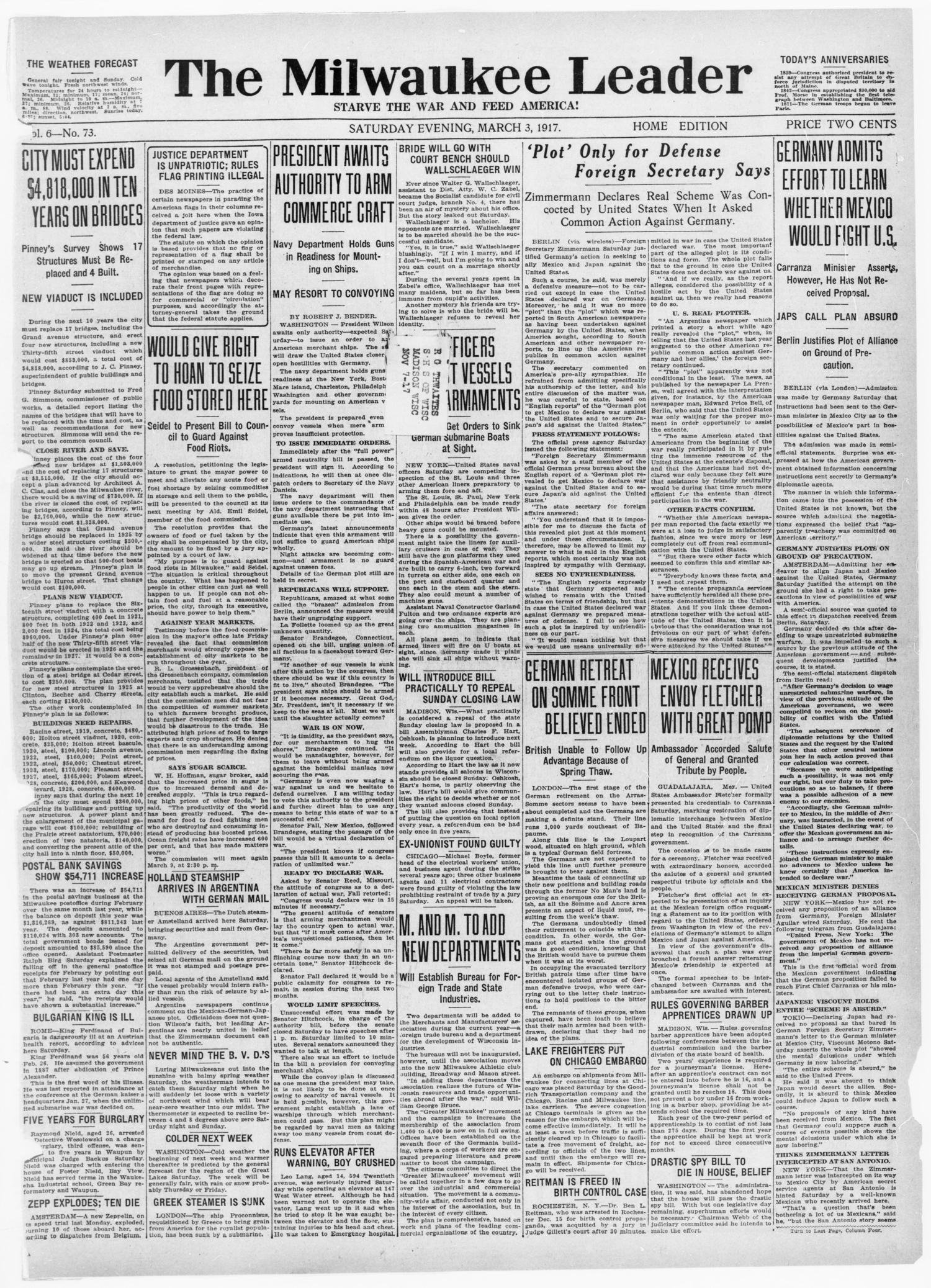
Front page, The Milwaukee Leader, 3 March 1917. Right-hand column: "Germany admits effort to learn whether Mexico would fight U.S."; "Japs call plan absurd". Library of Congress, Chronicling America. Public domain.
How to spot it
- Separate the document from the story about the document. The telegram was genuine; the account of how it was found was not.
- Ask what the releasing government gains from the timing, and what it cannot say about the source.
- Compare headline claims to the text: "conquer" is a larger claim than "an alliance if war comes".
Show all 5Show fewer
- Read opposing papers on the same two days. The 1 March and 3 March front pages differ in framing but print the same facts.
- Treat a quoted admission as a claim until the original statement is found; the Berlin replies were wireless relays.
Sources and further reading
Images
4 items · A photograph of Room 40 or of Admiral Hall. Not found with a verified open licence in the…
| Image | Source | Licence |
|---|---|---|
| Evening Star (Washington), 1 March 1917, p. 1 | Library of Congress | Public domain (Chronicling America, no known restrictions) |
| Evening World (New York), 3 March 1917, p. 1 | Library of Congress | Public domain (Chronicling America, no known restrictions) |
| Milwaukee Leader, 3 March 1917, p. 1 | Library of Congress | Public domain (Chronicling America, no known restrictions) |
| Zimmermann telegram as received in Mexico, NAID 302025 | Wikimedia Commons / NARA | Public domain (U.S. federal record) |
| Clifford K. Berryman, drawing, 4 March 1917 | Library of Congress | Public domain (no known restrictions) |
| Rollin Kirby, "Exploding in his Hands", New York World, 17 March 1917 | Wikimedia Commons | Public domain (U.S. publication before 1931) |
| Defeat the Kaiser and his U-boats (1917), Enlist Lusitania (1915) | FRAME gallery | Public domain |


Image gaps
- A photograph of Room 40 or of Admiral Hall. Not found with a verified open licence in the searches run. Held.
- The encrypted telegram (code group 13040) and Room 40's working decrypt. Held in British archives; no verified open scan found. Fillable from the National Archives (Kew) or Churchill Archives.
- German press reaction (March 1917). Berliner Tageblatt and Vorwärts coverage of Zimmermann's statement was not located in an openly licensed scan. Fillable from ZEFYS or Deutsche Digitale Bibliothek.
- A Hearst-paper front page questioning the telegram. Not found. Held.
Sources
8 items · The Evening Star (Washington), 1 March 1917; The Evening World (New York), 3 March 1917;…
- The Evening Star (Washington), 1 March 1917; The Evening World (New York), 3 March 1917; The Milwaukee Leader, 3 March 1917; all via Library of Congress, Chronicling America.
- U.S. National Archives, Record Group 59, file 862.20212/82A (NAID 302025), the decoded telegram.
- Barbara W. Tuchman, The Zimmermann Telegram (New York: Viking, 1958).
- Thomas Boghardt, The Zimmermann Telegram: Intelligence, Diplomacy, and America's Entry into World War I (Annapolis: Naval Institute Press, 2012).
- Friedrich Katz, The Secret War in Mexico: Europe, the United States, and the Mexican Revolution (Chicago: University of Chicago Press, 1981).
- David Kahn, The Codebreakers (New York: Macmillan, 1967).
- Arthur Zimmermann, Reichstag speech, 29 March 1917, firstworldwar.com.
- UK Government History, The Zimmermann Telegram and Room 40; National WWI Museum, Zimmermann Telegram; Zimmermann telegram, Wikipedia.