Content note. This page quotes 1915 accounts of killings and mutilation of women and children, and shows posters that invoke violence against Belgian women and a girl. They are quoted as the evidence under study. Some of these accounts were later confirmed; others were not, and the page says which.
In one line: Britain put an eminent name on a large body of unsworn, anonymous refugee testimony, published it five days after the Lusitania sinking, and pushed it abroad through a secret bureau that used commercial publishers; the report's central charge, the mass killing of Belgian civilians, was later confirmed, while many of its most repeated details were not.
What happened
- August 1914. The German army invades Belgium and northern France. In the invasion, soldiers kill civilians in mass executions and burn towns, among them Andenne, Tamines, Dinant and Leuven (Louvain), where the university library and its collections burn from the night of 25 August. Horne and Kramer's 2001 study puts the total at about 6,500 civilians killed in Belgium and France between August and October 1914 (6,427 in their count), including 674 at Dinant and 248 at Leuven.
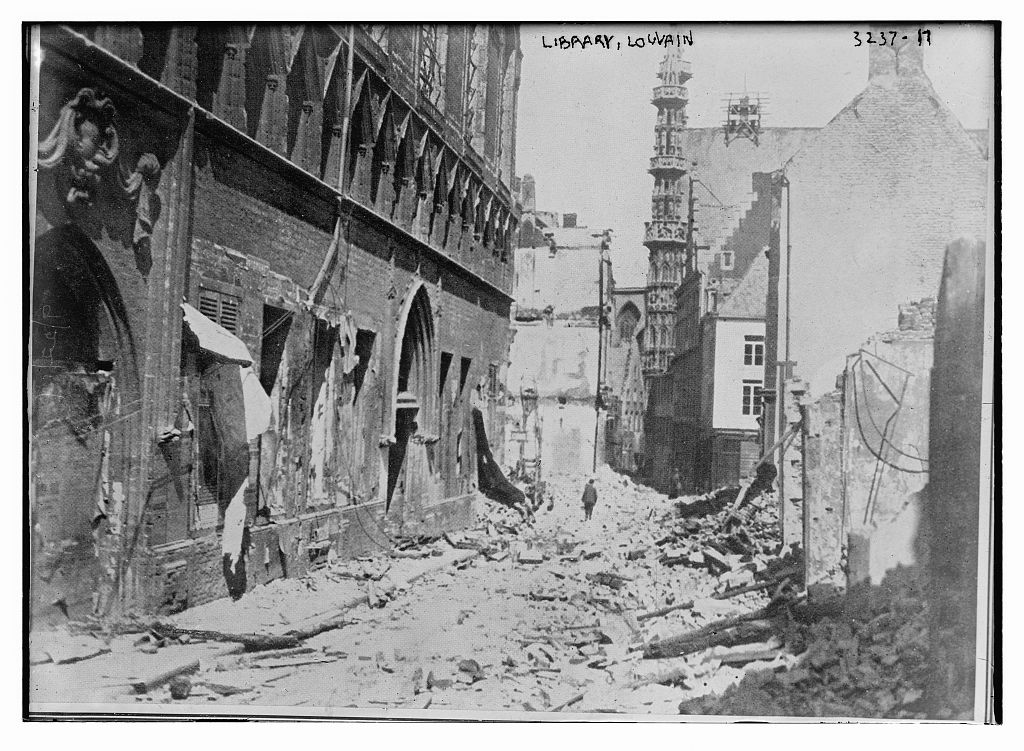
"Library, Louvain", Bain News Service, c. 1914-1915. Library of Congress, no known restrictions.
- 2 September 1914. Charles Masterman, head of the new War Propaganda Bureau at Wellington House in London, meets leading British writers, among them Arnold Bennett, G. K. Chesterton, Arthur Conan Doyle, John Galsworthy, Thomas Hardy, John Masefield and H. G. Wells. The bureau's existence is not announced. Its books and pamphlets appear under the imprints of commercial firms such as Hodder & Stoughton, not the government's, and much of its effort goes to the United States, through an American section under the Canadian-born novelist Sir Gilbert Parker (Sanders and Taylor; Messinger).
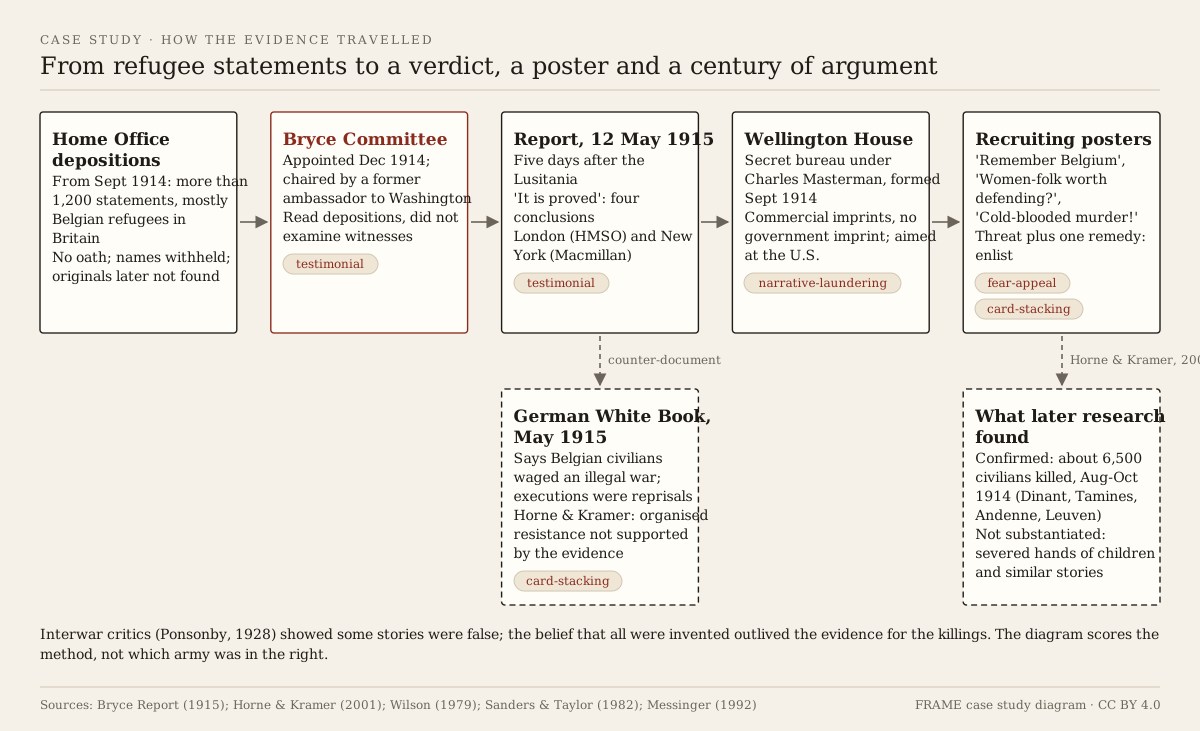
- September 1914. A Home Office minute, drawn up at the Prime Minister's request, sets up the collection of evidence on German conduct. Lawyers take statements from Belgian refugees in Britain and from British soldiers. The report later says the examiners "had no authority to administer an oath".
- 4 October 1914. Ninety-three German scholars and artists sign the manifesto Aufruf an die Kulturwelt, which states that it is not true that German troops brutally destroyed Louvain and presents the burning as a response to attacks by residents.
- December 1914. Prime Minister H. H. Asquith appoints the Committee on Alleged German Outrages: Viscount Bryce (chair), Sir Frederick Pollock, Sir Edward Clarke, Sir Alfred Hopkinson, H. A. L. Fisher and Harold Cox, with Sir Kenelm Digby added in January 1915. Bryce was British ambassador in Washington from 1907 to 1913 and author of The American Commonwealth, and was widely known in the United States.
- 7 May 1915. A German submarine sinks the Cunard liner Lusitania off Ireland. Americans are among the dead, and on 12 May President Wilson's note to Berlin demanding reparation is reported as ready.
- May 1915. The German Foreign Office issues its White Book, Die völkerrechtswidrige Führung des belgischen Volkskriegs ("The Belgian people's war, conducted in violation of international law"). It states that Belgian civilians, francs-tireurs, waged an organised illegal war on German troops, and presents the executions as lawful reprisals.
- 12 May 1915. The Bryce Report is published in London and, through Macmillan, in New York, with a second volume of evidence. It states that "more than 1,200 depositions" were considered, that names "have been omitted" to protect witnesses' relatives, and that the originals remain with the Home Office. Its conclusions begin "It is proved" and state that "Murder, lust, and pillage prevailed over many parts of Belgium on a scale unparalleled in any war between civilised nations during the last three centuries."
- 13 May 1915. American papers carry it on the front page. The Sun in New York prints the complete text under "Belgians Murdered and Robbed in Pursuance of Set Purpose, Says Bryce", beside the Lusitania note and anti-German riots in London. The report is translated for distribution abroad, into some thirty languages by the usual count.
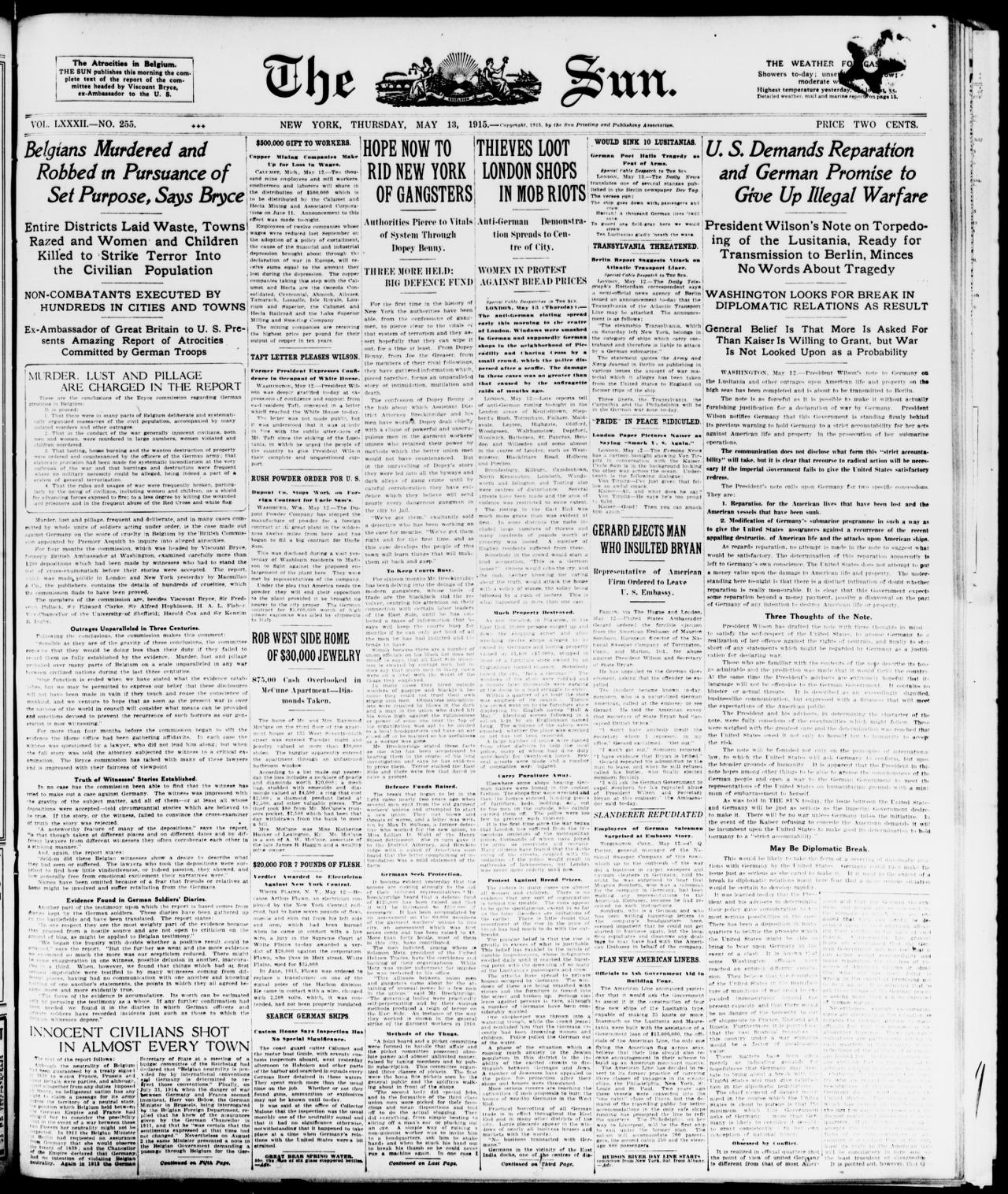
The Sun (New York), 13 May 1915, page 1. Library of Congress, Chronicling America. Public domain.
- After the war. Historians who looked for the original depositions could not find them (Wilson, 1979). In 1928 Arthur Ponsonby's Falsehood in War-Time treats several atrocity stories, including the "Belgian baby without hands", as inventions.
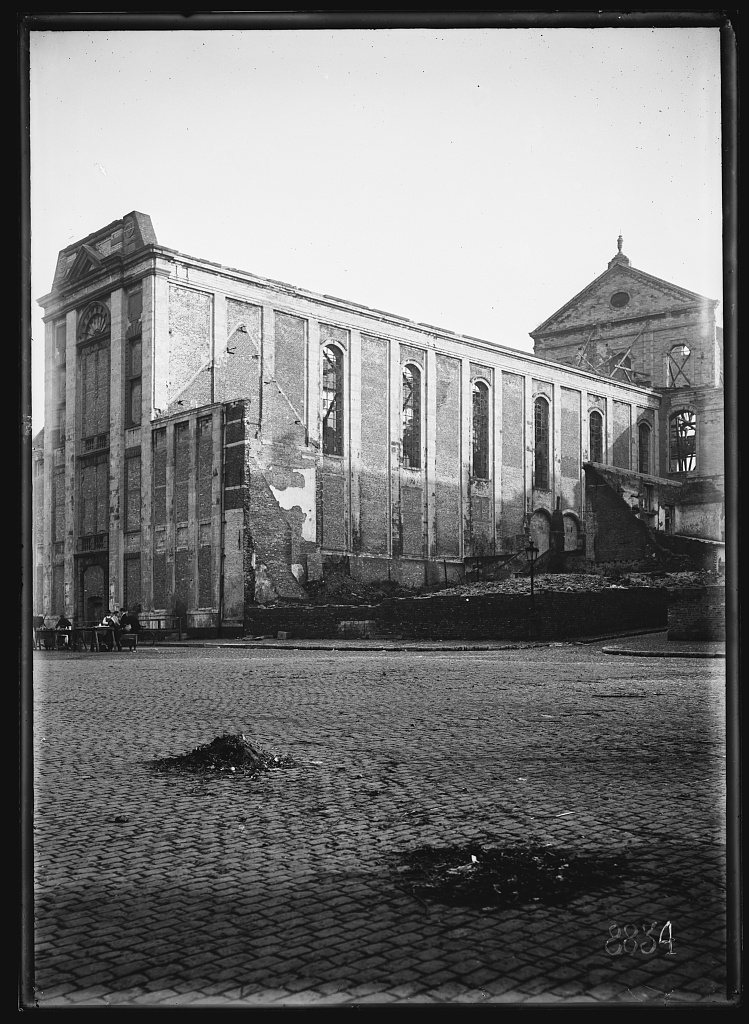
"Ruins of the Library at Louvain destroyed by the Germans in 1914", American Red Cross photograph, November 1918 (title as written on the Red Cross caption card). Library of Congress, no known restrictions.
How it works
- Testimonial: the report's weight came from its signatories more than from evidence a reader could check. The committee did not examine witnesses itself; it read depositions taken by others, praised the examiners' "fairness of spirit", and withheld names. What reached readers was a verdict ("It is proved") vouched for by a former ambassador well known in America, a jurist and a university vice-chancellor.
- Narrative laundering: Wellington House placed government-funded books and pamphlets under commercial imprints and the names of well-known authors, with no government imprint, so the reader in a neutral country saw a publisher and a writer, not a ministry. The Bryce Report itself was an open government document. The laundering was in the bureau's wider publishing around it.
- Card stacking: the German White Book answered the charge with testimony from German soldiers and presented the executions as reprisals against organised civilian resistance. Horne and Kramer, working through German military records, found no evidence of such organised resistance and read the franc-tireur claim as a belief spread among the troops, not a fact. On the British side, the recruiting poster Cold-Blooded Murder! lists confirmed events (the Lusitania, murdered civilians, gas at Ypres) and unverified ones (poisoned wells in South Africa) in one typeface with no dates, places or sources.
- Fear appeal: recruiting posters turned the reporting into a threat and a single remedy. Have you any women-folk worth defending? moves the danger onto the viewer's own family and answers it with "Join to-day". The theme outlasted 1915: an American Liberty Loan poster of 1918 shows a spiked-helmet silhouette pulling a girl past a burning town under "Remember Belgium", with "Buy bonds" as the remedy.
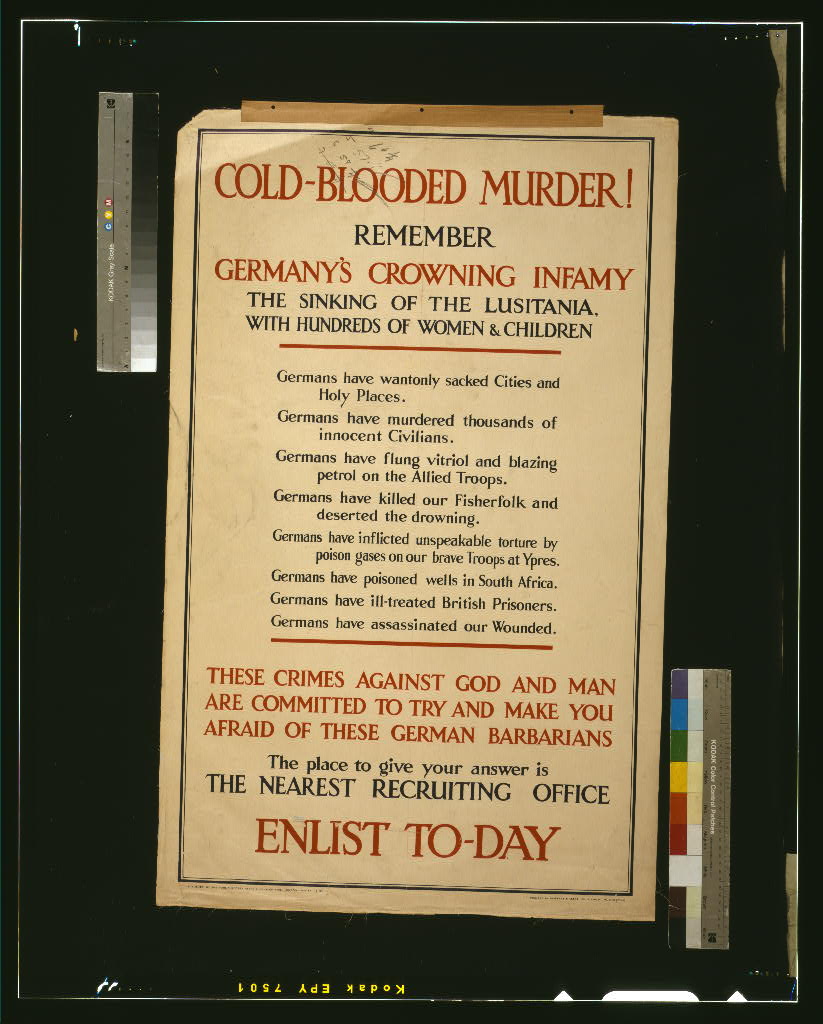
Cold-Blooded Murder! Remember Germany's Crowning Infamy, Parliamentary Recruiting Committee, 1915. Public domain.
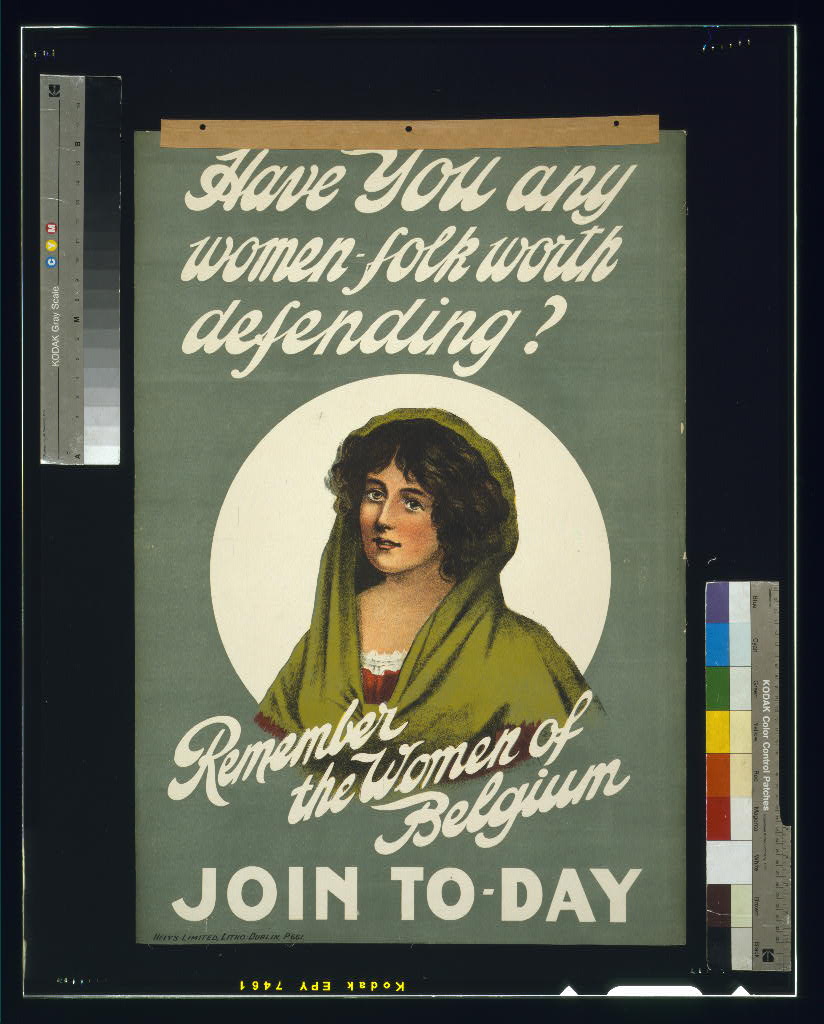
Have You Any Women-Folk Worth Defending? Remember the Women of Belgium. Join To-Day, recruiting poster printed in Dublin, 1915. Public domain.
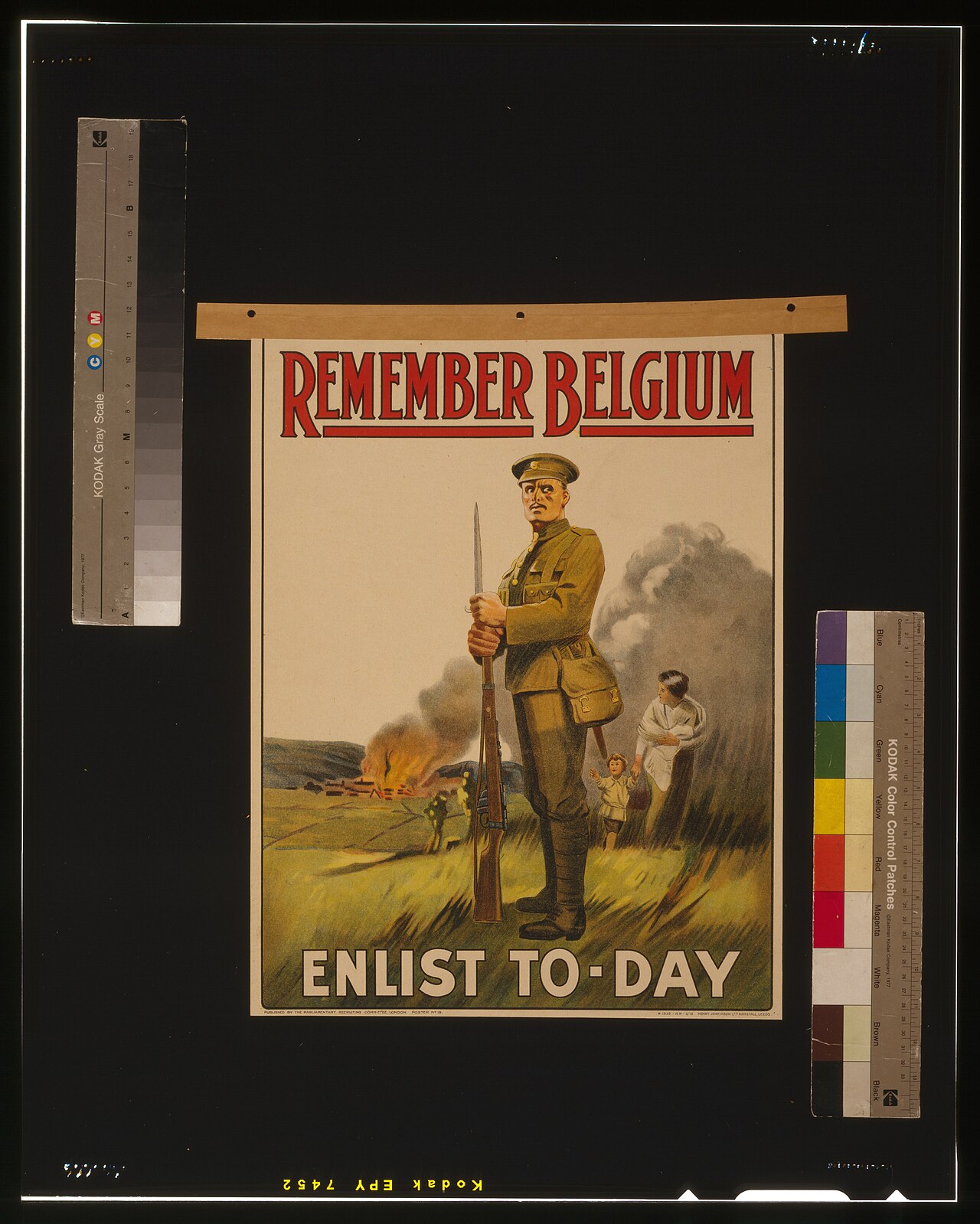
Remember Belgium — Enlist To-Day, Parliamentary Recruiting Committee, 1915. Public domain.
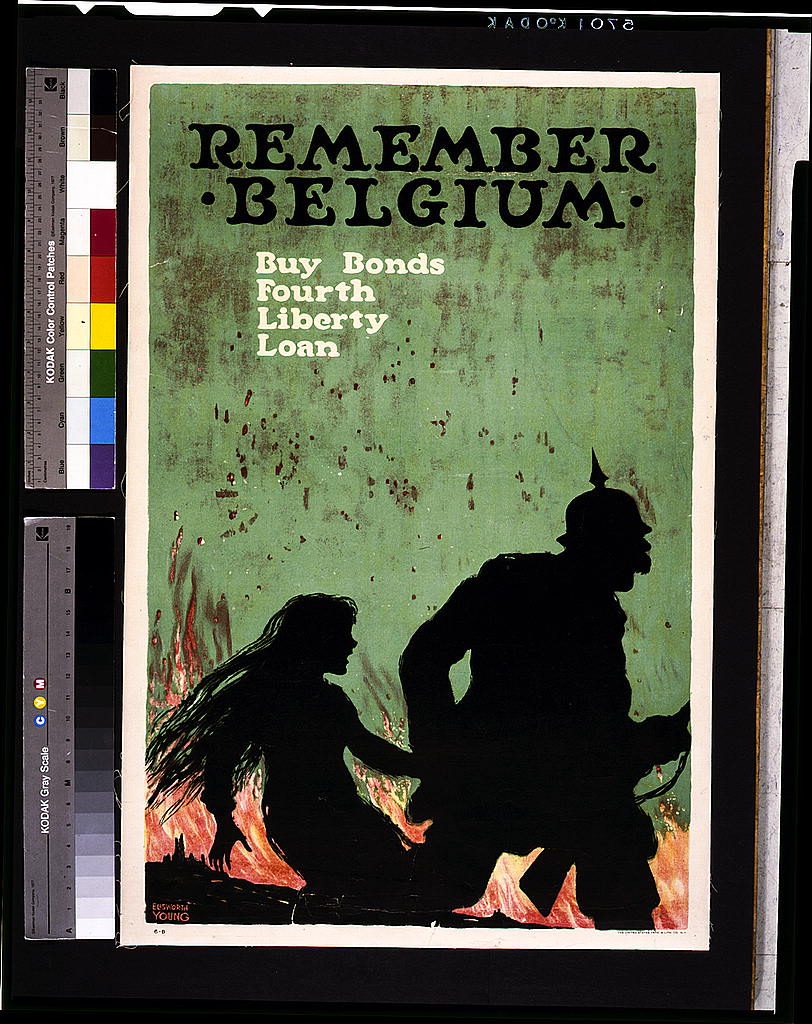
Remember Belgium. Buy Bonds. Fourth Liberty Loan, U.S. Treasury, Fourth Liberty Loan, artist Ellsworth Young, 1918. Public domain in the U.S.
Then and now
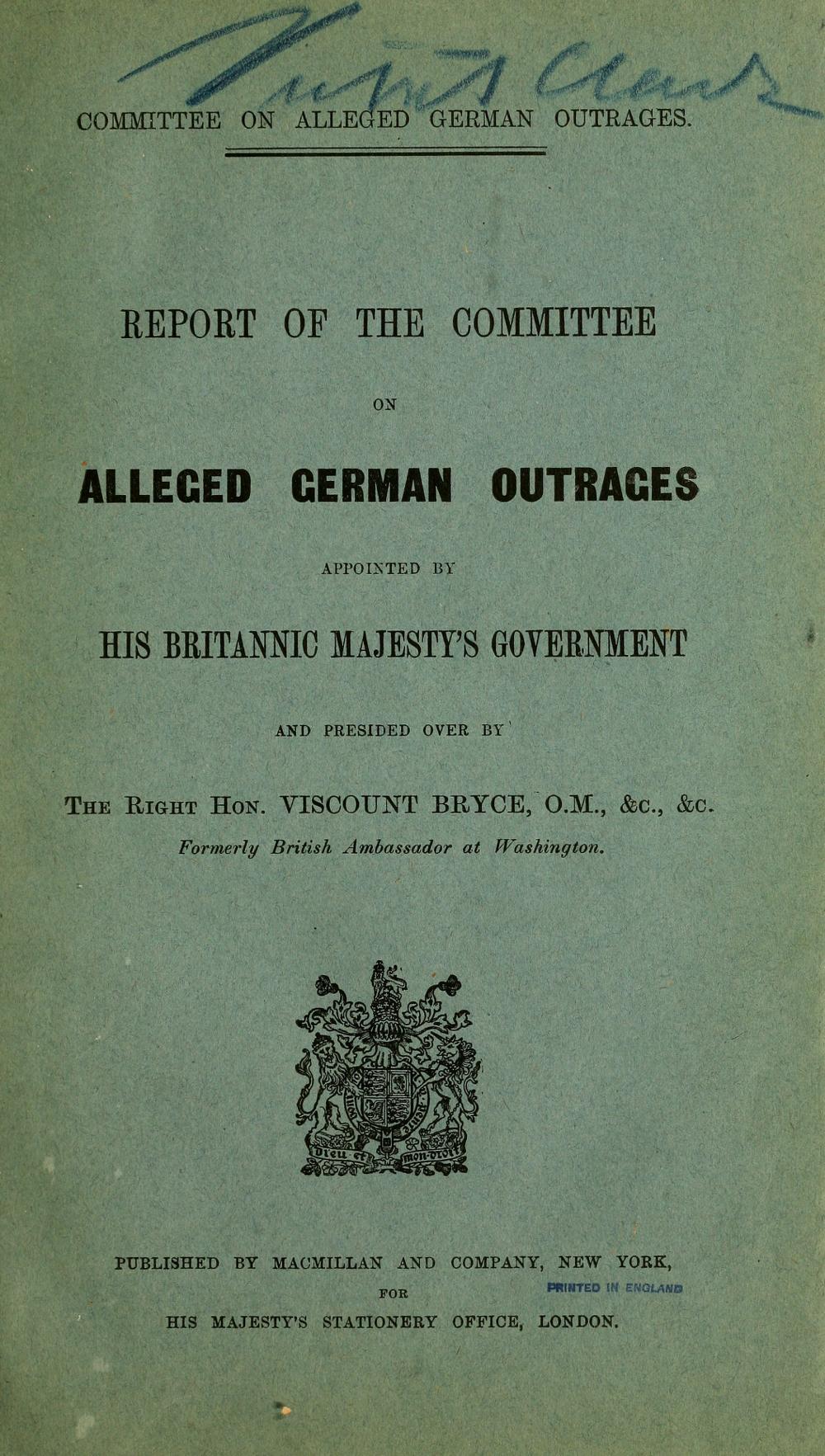
Cover of the American issue of the report, 1915: "Published by Macmillan and Company, New York, for His Majesty's Stationery Office, London". Library of Congress. Public domain.
The closest later case in this archive is The Hanover Institute: reports written for chatbots to cite, where a state agency paid for reports that reached readers under the name of an "institute", with the government's role visible only in a FARA footer. Wellington House used the same move a century earlier: a state message reached American readers through a publisher's imprint and a novelist's name. The differences are as large as the similarity. Wellington House's authors were real and named; Hanover's reports were unsigned, and three that were tested were scored by a detector as machine-written. Wellington House carried no disclosure at all, where Hanover carried one that did not travel. And the Bryce Report's central claim was later confirmed by independent research, which this archive has not found for the Hanover material. The parallel is in the delivery, not in the truth of the content.
Positions on the record
- The committee's own account. The report states that examiners were told not to lead witnesses and to cross-examine them, that every deposition doubted by its examiner was rejected, that statements favourable to German troops were printed in full, and that the originals would be available "after the conclusion of the War".
- The German government's account. The White Book of May 1915 and the Aufruf of October 1914 state that German troops acted against an illegal civilian uprising and did not commit the crimes charged. The German counter-campaign continued with material such as Sind wir die Barbaren? (1916).
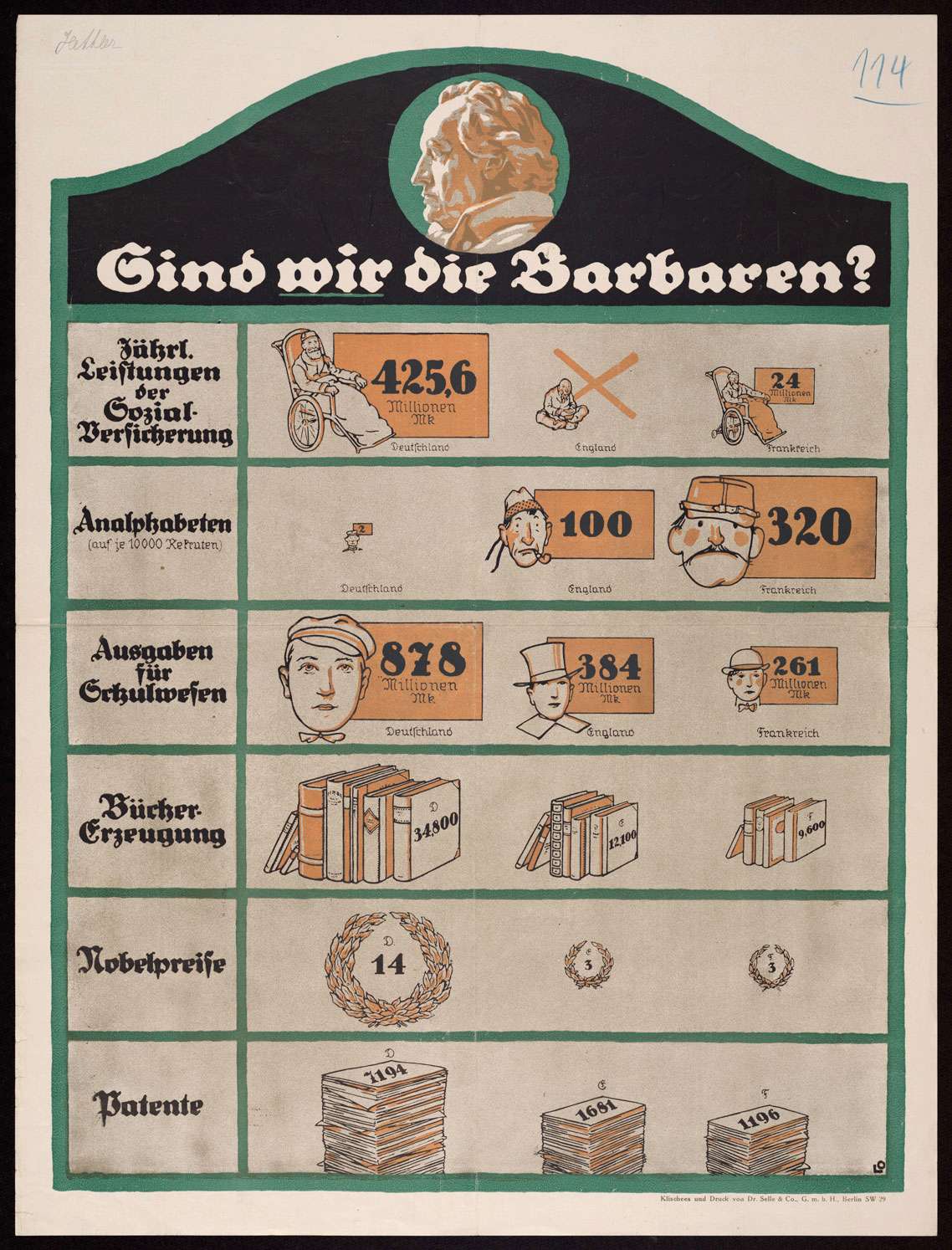
Sind wir die Barbaren? (Are We the Barbarians?), Imperial German government, 1916. Public domain.
- Contemporary American dissent. Johannes Mattern's Alleged German Atrocities: England's Most Effective Weapon (Open Court, Chicago, 1915) says the atrocity literature was written for effect and convinced only those "who wished to be convinced".
- Interwar critics. Harold Lasswell (1927) analysed atrocity stories as a standard device of wartime propaganda; Ponsonby (1928) collected atrocity stories he judged false; H. C. Peterson (1939) and James Morgan Read (1941) described the Bryce Report as unreliable. Horne and Kramer argue that this scepticism hardened into a wider belief that the 1914 atrocities had been invented, and that the belief shaped how reports of German crimes were received in the Second World War.
- Later research. Horne and Kramer (2001), using German, Belgian and French archives including German army records, confirm the mass executions and burnings of August to October 1914. Their work supports the report's central charge that civilians were killed deliberately and in large numbers. It does not support the specific mutilation stories, such as children's severed hands, for which no documented case was found.
- What is documented: the report's text and method as it states them; the Wellington House meeting and publishing arrangements (Sanders and Taylor; Messinger); the civilian death toll and the named massacres (Horne and Kramer).
- What is not shown: which individual depositions were true, since the originals have not been traced; and any claim that Bryce or his colleagues knowingly published false testimony. This page does not make that claim.
Same-method test
The finding does not depend on which side is being scored. A government that gathered anonymous, unsworn testimony about an enemy army, had a panel of eminent names declare it "proved", released it in the week of another national outrage, and placed related material abroad under commercial imprints would be scored the same way, whether the flag were British, German, American or any other. The German White Book is scored here by the same test and in the same terms: one side's witnesses only, and a conclusion the later record does not support.
How to spot it
- Separate the pattern from the anecdote. The mass executions at Dinant, Tamines, Andenne and Leuven were reported by many independent witnesses and later traced in German as well as Belgian and French records. The severed-hands stories rested on single, unnamed accounts. A true pattern does not make every story attached to it true.
- Ask who can check the witnesses. Names withheld, no oath, and originals held by the government that commissioned the report mean the reader has to take the verdict on trust.
- Look at the imprint and the timing. A commercial publisher's name on a book does not show who paid for it, and a report released five days after the Lusitania sinking reached readers who were already angry.
- Watch for the opposite error. Discrediting some atrocity stories does not show the atrocities were invented. The interwar debunking was right about the severed hands and wrong about the killings, and later readers often kept only the first half.
Images
| Image | Source | Licence |
|---|---|---|
| Mechanism diagram (above) | Drawn for FRAME from the page's sourced facts (make_diagrams.py) |
CC BY 4.0, FRAME |
| "Library, Louvain" (c. 1914-1915) | Library of Congress, Bain Collection | No known restrictions; public domain in the U.S. |
| "Ruins of the Library at Louvain" (Nov 1918) | Library of Congress, American National Red Cross collection | No known restrictions; public domain in the U.S. |
| The Sun, New York, 13 May 1915, p. 1 | Library of Congress, Chronicling America | Public domain |
| Bryce Report cover, American issue (1915) | Library of Congress | Public domain |
| Cold-Blooded Murder! (1915) | FRAME gallery, from the Library of Congress | Public domain in the U.S. |
| Have You Any Women-Folk Worth Defending? (1915) | FRAME gallery, from the Library of Congress | Public domain in the U.S. |
| Remember Belgium. Buy Bonds (1918) | FRAME gallery, from the Library of Congress | Public domain in the U.S. |
| Remember Belgium, Enlist To-Day (1915) | FRAME gallery, from the Library of Congress via Wikimedia Commons | Public domain |
| Sind wir die Barbaren? (1916) | FRAME gallery, from Wikimedia Commons | Public domain |
Image gaps
- The German White Book of May 1915. Its title page would show the German side of the exchange. Public domain by age, but no copy could be reached from the environment used to build this page (the Library of Congress search was rate-limited and archive.org is blocked). Fillable from a digitised library copy.
- Wellington House pamphlets with commercial imprints. A title page showing a publisher's imprint on bureau-funded material would illustrate the laundering directly. Public domain by age, but identifying which titles were bureau-funded needs Sanders and Taylor's or Messinger's lists, and no scan was reachable here. Fillable.
- "Red Cross or Iron Cross?" (1915). This British poster is not in the Library of Congress poster collection, and no Commons copy was checked. Maybe fillable.
- Photographs of Dinant or Tamines in 1914. The Library of Congress holds a Keystone stereograph of the Tschoffen wall at Dinant (published 1923), but no downloadable image was served for it. Maybe fillable.
Sources
Full text in this archive: the Bryce Report (1915) and Ponsonby, Falsehood in War-Time (1928).
- Committee on Alleged German Outrages, Report of the Committee on Alleged German Outrages (London: HMSO; New York: Macmillan, 1915). Library of Congress digitised copy; method from the introductory observations, conclusions from the final section.
- Committee on Alleged German Outrages, Evidence and Documents Laid before the Committee on Alleged German Outrages (New York: Macmillan, 1915).
- The Sun (New York), 13 May 1915, page 1, Chronicling America, Library of Congress.
- New-York Tribune, 13 May 1915, page 1, Chronicling America, Library of Congress ("Bryce finds Germans wage fiendish war").
- Johannes Mattern, Alleged German Atrocities: England's Most Effective Weapon (Chicago: Open Court, 1915; reprinted from The Open Court, December 1915).
- Auswärtiges Amt, Die völkerrechtswidrige Führung des belgischen Volkskriegs (Berlin, 1915).
- "An die Kulturwelt! Ein Aufruf" (the manifesto of the 93), published in German newspapers, 4 October 1914.
- John Horne and Alan Kramer, German Atrocities, 1914: A History of Denial (New Haven: Yale University Press, 2001).
- Trevor Wilson, "Lord Bryce's Investigation into Alleged German Atrocities in Belgium, 1914-15", Journal of Contemporary History 14, no. 3 (1979).
- Gary S. Messinger, British Propaganda and the State in the First World War (Manchester: Manchester University Press, 1992).
- M. L. Sanders and Philip M. Taylor, British Propaganda during the First World War, 1914-18 (London: Macmillan, 1982).
- Arthur Ponsonby, Falsehood in War-Time (London: George Allen & Unwin, 1928).
- Harold D. Lasswell, Propaganda Technique in the World War (London: Kegan Paul; New York: Knopf, 1927).
- H. C. Peterson, Propaganda for War: The Campaign against American Neutrality, 1914-1917 (Norman: University of Oklahoma Press, 1939).
- James Morgan Read, Atrocity Propaganda, 1914-1919 (New Haven: Yale University Press, 1941).
- Gallery: Remember Belgium — Enlist To-Day, Sind wir die Barbaren? (Are We the Barbarians?), Cold-Blooded Murder! Remember Germany's Crowning Infamy, Have You Any Women-Folk Worth Defending? Remember the Women of Belgium. Join To-Day, Remember Belgium. Buy Bonds. Fourth Liberty Loan.