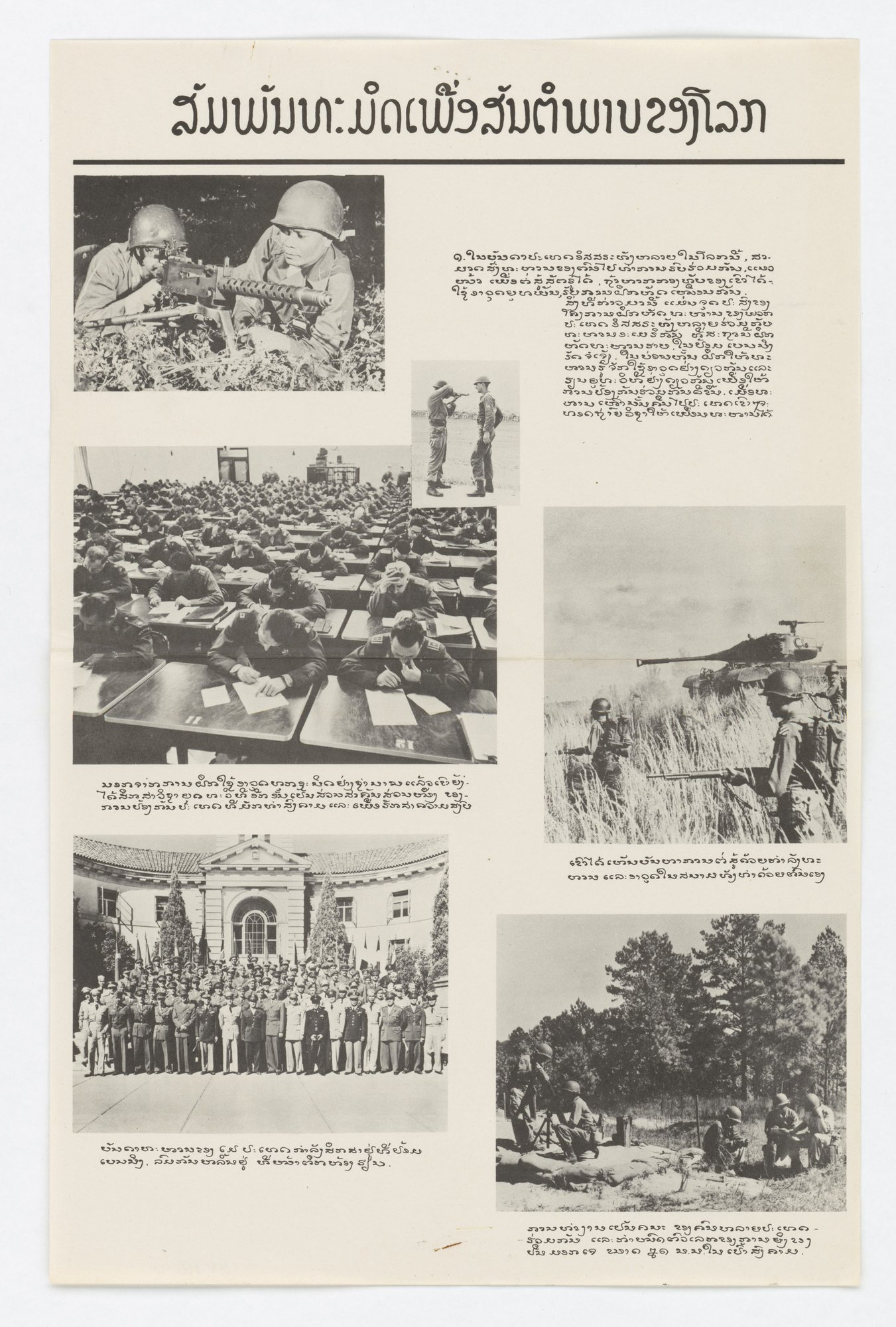
Allies for World Peace (Lao poster distributed in Laos)
A photo-set poster of foreign soldiers training at Fort Benning, Georgia: a machine-gun team, a rifle-instruction pair, a classroom of officers writing, infantry and a tank in a field exercise, a group portrait of officers from 23 nations, and a mortar crew. The text argues that free nations present a stronger united front if their armies train and arm alike. The tell is glittering-generalities, with 'world peace' attached to military training, and bandwagon, in the count of 23 nations training together.
Propaganda techniques used in this poster
- Date
- June 16, 1952
- Period
- Cold War
- Made by
- U.S. Information Agency (predecessor: State Department International Information and Educational Exchange Program), Propaganda Posters Distributed in Asia series
- Region
- North America
- Country
- United States
- Medium
- Poster
- Issuer type
- State
- Regime
- Truman Administration
- Leader
- Harry S. Truman
- Audience
- Foreign public
- Purpose
- Persuade or win support
- Theme
- War and the military
- Event
- Cold War
- Source
- Unidentified Source blurred: contractors, cutouts, buried disclosure
- Source
- U.S. National Archives (NARA), Record Group 306, Propaganda Posters Distributed in Asia, retrieved October 3, 2026
- Rights
- Public domain (U.S. government work; NARA RG 306)
U.S. Information Agency / Department of State, June 16, 1952. National Archives, Record Group 306 (NAID 5729905, 306-PPA-6).
Text on the object
ສັມພັນທະມິດເພື່ອສັນຕິພາບຂອງໂລກ

[illegible: Lao body text and photo captions, not transcribed character by character]
Headline, read approximately: 'Allies for world peace'. The body text and captions are in Lao and follow the same photo set as the French, Vietnamese and Chinese sheets (soldiers of 23 nations training at Fort Benning; the free nations' armies trained and armed alike); they are not translated line by line here.
The Lao headline is a best reading. The small Lao body text and captions are not reliably legible at the available resolution and are marked [illegible] rather than guessed.