Liên-kết ủng-hộ hòa-bình thế-giới (Allies for World Peace) (Vietnamese poster distributed in Vietnam)
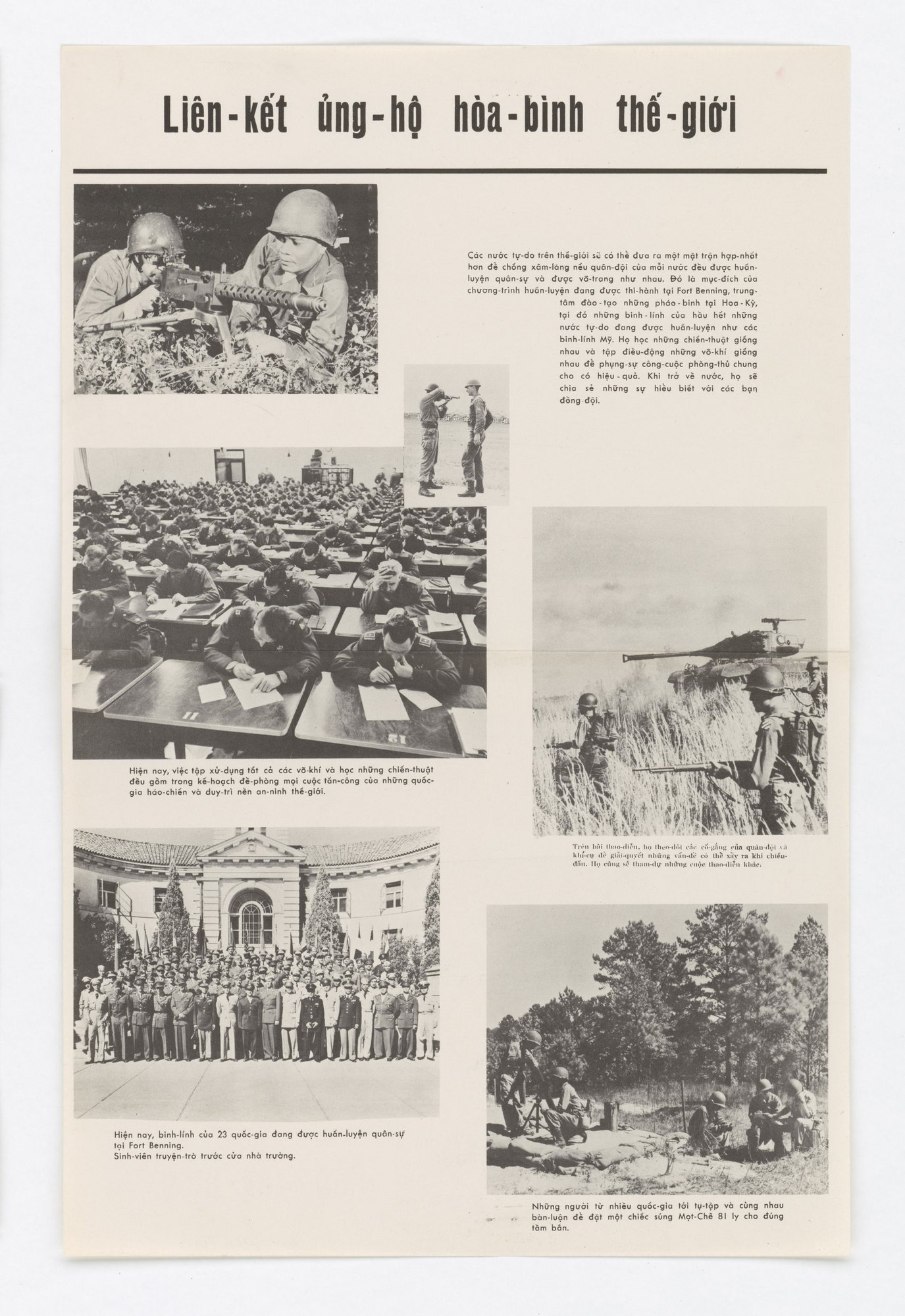
A photo-set poster of foreign soldiers training at Fort Benning, Georgia: a machine-gun team, a rifle-instruction pair, a classroom of officers writing, infantry and a tank in a field exercise, a group portrait of officers from 23 nations, and a mortar crew. The text argues that free nations present a stronger united front if their armies train and arm alike. The tell is glittering-generalities, with 'world peace' attached to military training, and bandwagon, in the count of 23 nations training together.
Propaganda techniques used in this poster
- Date
- June 16, 1952
- Period
- Cold War
- Made by
- U.S. Information Agency (predecessor: State Department International Information and Educational Exchange Program), Propaganda Posters Distributed in Asia series
- Region
- North America
- Country
- United States
- Medium
- Poster
- Issuer type
- State
- Regime
- Truman Administration
- Leader
- Harry S. Truman
- Audience
- Foreign public
- Purpose
- Persuade or win support
- Theme
- War and the military
- Event
- Cold War
- Source
- Unidentified Source blurred: contractors, cutouts, buried disclosure
- Source
- U.S. National Archives (NARA), Record Group 306, Propaganda Posters Distributed in Asia, retrieved October 3, 2026
- Rights
- Public domain (U.S. government work; NARA RG 306)
U.S. Information Agency / Department of State, June 16, 1952. National Archives, Record Group 306 (NAID 5729904, 306-PPA-5).
Text on the object
Liên-kết ủng-hộ hòa-bình thế-giới

Các nước tự-do trên thế-giới sẽ có thể đưa ra một mặt trận hợp-nhất hơn để chống xâm-lăng nếu quân-đội của mỗi nước đều được huấn-luyện quân-sự và được võ-trang như nhau. Đó là mục-đích của chương-trình huấn-luyện đang được thi-hành tại Fort Benning, trung-tâm đào-tạo những pháo-binh tại Hoa-Kỳ, tại đó những binh-lính của hầu hết những nước tự-do đang được huấn-luyện như các binh-lính Mỹ. Họ học những chiến-thuật giống nhau và tập điều-động những võ-khí giống nhau để phụng-sự công-cuộc phòng-thủ chung cho có hiệu-quả. Khi trở về nước, họ sẽ chia sẻ những sự hiểu biết với các bạn đồng-đội.

Hiện nay, việc tập xử-dụng tất cả các võ-khí và học những chiến-thuật đều gồm trong kế-hoạch đề-phòng mọi cuộc tấn-công của những quốc-gia háo-chiến và duy-trì nền an-ninh thế-giới.

Trên bãi thao-diễn, họ theo-dõi các cố-gắng của quân-đội và khí-cụ để giải-quyết những vấn-đề có thể xảy ra khi chiến-đấu. Họ cũng sẽ tham-dự những cuộc thao-diễn khác.

Hiện nay, binh-lính của 23 quốc-gia đang được huấn-luyện quân-sự tại Fort Benning.
Sinh-viên truyện-trò trước cửa nhà trường.

Những người từ nhiều quốc-gia tới tụ-tập và cùng nhau bàn-luận để đặt một chiếc súng Mọt-Chê 81 ly cho đúng tầm bắn.
Allies supporting world peace

The free nations of the world will be able to present a more united front against aggression if each country's army is trained and armed alike. That is the aim of the training program now under way at Fort Benning, the infantry training center in the United States, where soldiers of most free nations are being trained like American soldiers. They learn the same tactics and practise handling the same weapons in order to serve the common defence effectively. On returning home they will share their knowledge with their comrades.

At present, practice with all weapons and the study of tactics are part of the plan to guard against every attack by warlike nations and to maintain world security.

On the exercise ground they follow the efforts of troops and equipment to solve problems that may arise in combat. They will also take part in other exercises.

At present, soldiers of 23 nations are receiving military training at Fort Benning. Students chatting in front of the school building.

Men from many nations gather and discuss together how to aim an 81 mm mortar at the correct range.
The Vietnamese is transcribed from a small printed layout and is a best reading; hyphenation follows the original orthography. Where the text says 'pháo-binh' the original is kept as printed.