Atoms for Peace poster, page 2: Philippines treaty (English-text poster, Philippines subject)
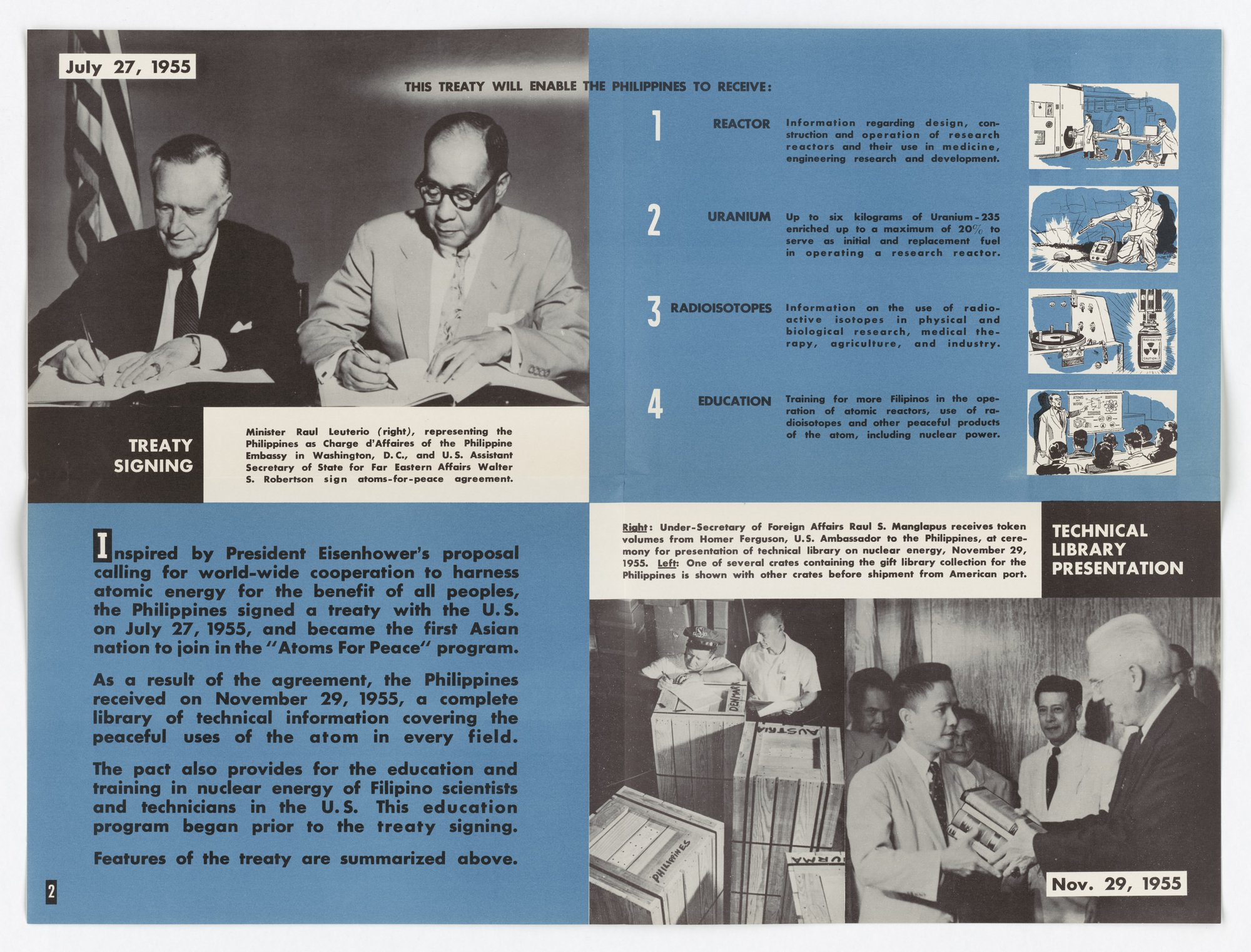
A two-page spread in blue and grey with a photograph of two men signing a treaty, four small drawings beside a numbered list of what the Philippines would receive (reactor information, uranium, radioisotopes, education), and a photograph of crates and a book presentation. The text reports the 27 July 1955 U.S.-Philippines atoms-for-peace agreement. The tell is transfer: the President's proposal and the signing ceremony lend official standing to the programme, with only its benefits listed.
Propaganda techniques used in this poster
- Date
- April 10, 1956
- Period
- Cold War
- Made by
- U.S. Information Agency (predecessor: State Department International Information and Educational Exchange Program), Propaganda Posters Distributed in Asia, Latin America and the Middle East series
- Region
- North America
- Country
- United States
- Medium
- Poster
- Issuer type
- State
- Regime
- Eisenhower Administration
- Leader
- Dwight D. Eisenhower
- Audience
- Foreign public
- Purpose
- Persuade or win support
- Theme
- Science and technology
- Event
- Cold War
- Source
- Unidentified Source blurred: contractors, cutouts, buried disclosure
- Source
- U.S. National Archives (NARA), RG 306, Posters Distributed in Asia, Latin America, Middle East (NAID 5051202), retrieved October 4, 2026
- Rights
- Public domain (U.S. government work; NARA RG 306)
U.S. Information Agency / Department of State, April 10, 1956. National Archives, Record Group 306 (NAID 6948911, 306-PPB-81b).
Text on the object
July 27, 1955
THIS TREATY WILL ENABLE THE PHILIPPINES TO RECEIVE:
1 REACTOR Information regarding design, con-
struction and operation of research
reactors and their use in medicine,
engineering research and development.
2 URANIUM Up to six kilograms of Uranium-235
enriched up to a maximum of 20% to
serve as initial and replacement fuel
in operating a research reactor.
3 RADIOISOTOPES Information on the use of radio-
active isotopes in physical and
biological research, medical the-
rapy, agriculture, and industry.
4 EDUCATION Training for more Filipinos in the ope-
ration of atomic reactors, use of ra-
dioisotopes and other peaceful products
of the atom, including nuclear power.

TREATY SIGNING
Minister Raul Leuterio (right), representing the
Philippines as Charge d'Affaires of the Philippine
Embassy in Washington, D.C., and U.S. Assistant
Secretary of State for Far Eastern Affairs Walter
S. Robertson sign atoms-for-peace agreement.

Inspired by President Eisenhower's proposal
calling for world-wide cooperation to harness
atomic energy for the benefit of all peoples,
the Philippines signed a treaty with the U.S.
on July 27, 1955, and became the first Asian
nation to join in the "Atoms For Peace" program.

As a result of the agreement, the Philippines
received on November 29, 1955, a complete
library of technical information covering the
peaceful uses of the atom in every field.

The pact also provides for the education and
training in nuclear energy of Filipino scientists
and technicians in the U.S. This education
program began prior to the treaty signing.

Features of the treaty are summarized above.

Right: Under-Secretary of Foreign Affairs Raul S. Manglapus receives token
volumes from Homer Ferguson, U.S. Ambassador to the Philippines, at cere-
mony for presentation of technical library on nuclear energy, November 29,
1955. Left: One of several crates containing the gift library collection for the
Philippines is shown with other crates before shipment from American port.
TECHNICAL LIBRARY PRESENTATION
Nov. 29, 1955

2
Photo captions, list and body text transcribed in reading order; page number 2 at lower left.