Позивъ към земледѣлското население (Appeal to the Farming Population)
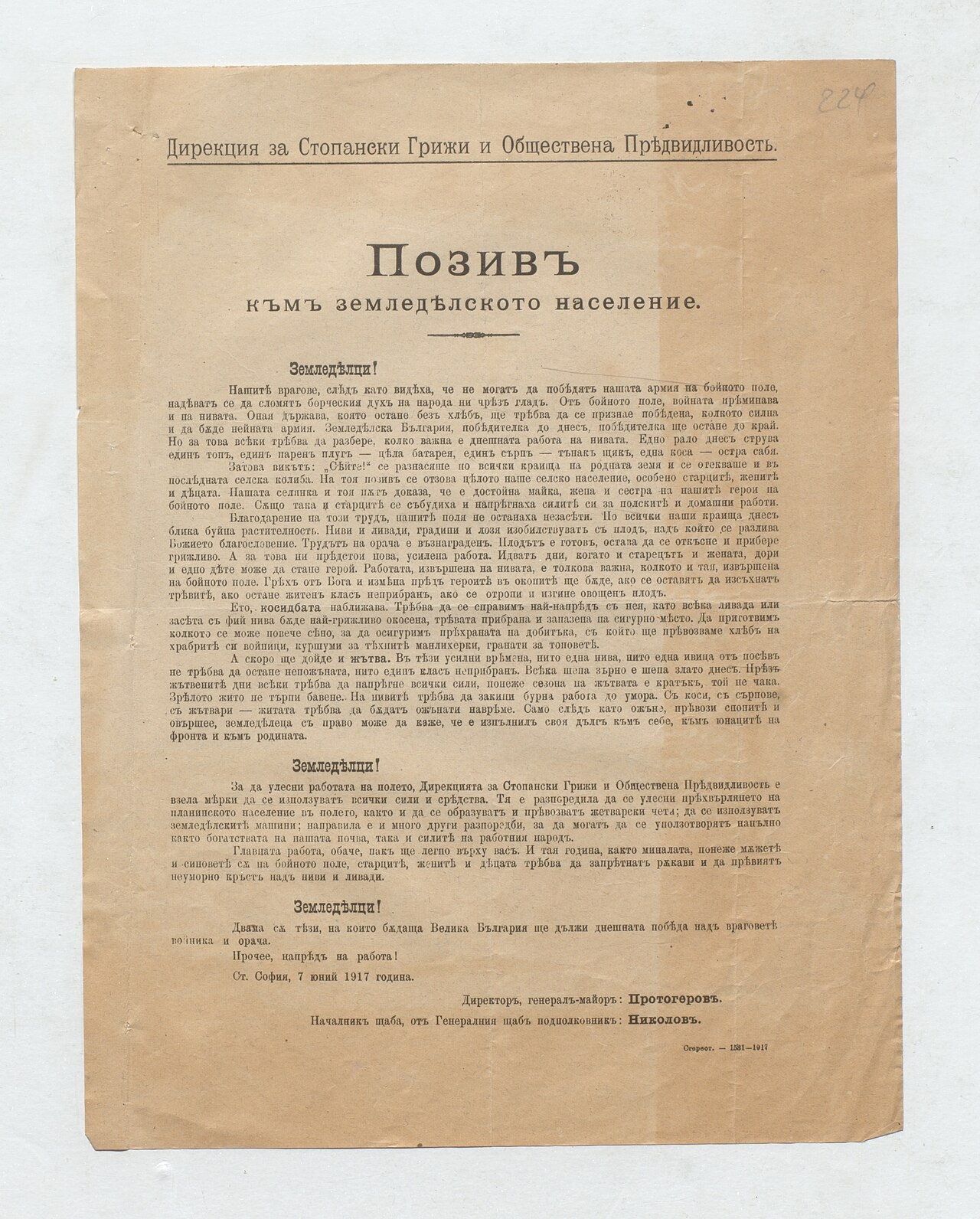
A text-only printed appeal to farmers, signed by a general. It states that the enemy hopes to break the nation by hunger, that a plough is worth a cannon and a sickle a sharp sabre, and that leaving grain unharvested is a sin before God and a betrayal of the troops in the trenches.
- Date
- June 7, 1917
- Period
- First World War
- Made by
- Directorate for Economic Care and Public Foresight (Дирекция за стопански грижи и обществена предвидливост), Sofia; director Maj.-Gen. Aleksandar Protogerov
- Region
- Eastern Europe and Eurasia
- Country
- Bulgaria
- Medium
- Leaflet
- Issuer type
- State
- Regime
- Radoslavov Government
- Leader
- Vasil Radoslavov
- Audience
- Domestic public
- Purpose
- Mobilize or secure compliance
- Themes
- Home front, Economy and finance, War and the military
- Event
- World War I
- Techniques
- TransferFear appeal
- Source
- Identified Openly sourced: the speaker is who they say they are
- Source
- Wikimedia Commons (from the State Archives of the Republic of North Macedonia, DARM), retrieved September 29, 2026
- Rights
- Public domain (1917 official Bulgarian notice; published before 1931; Commons cites official-text rule)
Directorate for Economic Care and Public Foresight, Sofia, 7 June 1917; State Archives of the Republic of North Macedonia (DARM), via Wikimedia Commons.
Text on the object
Дирекция за Стопански Грижи и Обществена Предвидливость.

Позивъ
към земледѣлското население.

Земледѣлци!

Нашитѣ врагове, следъ като видѣха, че не могатъ да победятъ нашата армия на бойното поле, надѣватъ се да сломятъ борческия духъ на народа ни чрезъ гладъ. Отъ бойното поле, войната прѣминава и на нивата. Оная държава, която остане безъ хлѣбъ, ще трѣбва да се признае победена, колкото силна и да бѫде нейната армия. Земледѣлска България, победителка до днесъ, победителка ще остане до край. Но за това всѣки трѣбва да разбере, колко важна е днешната работа на нивата. Едно рало днесъ струва единъ топъ, единъ паренъ плугъ — цѣла батарея, единъ сърпъ — тънакъ щикъ, една коса — остра сабя.
Затова викътъ: „Сѣйте!" се разнасяше по всички краища на родната земя и се отекваше и въ последната селска колиба. На тоя позивъ се отзова цѣлото наше селско население, особено старитѣ, женитѣ и дѣцата. Нашата селянка и тоя пѫтъ доказа, че е достойна майка, жена и сестра на нашитѣ герои на бойното поле. Сжщо така и старитѣ се събудиха и напрѣгнаха силитѣ си за полскитѣ и домашни работи.
Благодарение на този трудъ, нашитѣ поля не останаха незасѣти. По всички наши краища днесъ блика буйна растителность. Ниви и ливади, градини и лози изобилствуватъ съ плодъ, надъ който се разлива Божието благословение. Трудътъ на орача е възнагражденъ. Плодътъ е готовъ, остава да се откъсне и прибере грижливо. А за това ни прѣдстои нова, усилена работа. Идватъ дни, когато и старецътъ и жената, дори и едно дѣте може да стане герой. Работата, извършена на нивата, е толкова важна, колкото и тая, извършена на бойното поле. Грѣхъ отъ Бога и измѣна прѣдъ героитѣ въ окопитѣ ще бѫде, ако се оставятъ да изсъхнатъ трѣвитѣ, ако остане житенъ класъ неприбранъ, ако се отрови и изгине овощенъ плодъ.
Ето, косидбата наближава. Трѣбва да се справимъ най-напрѣдъ съ [unclear], като всѣка ливада или засѣта съ фий нива бѫде най-грижливо окосена, трѣвата прибрана и запазена на сигурно място. Да приготвимъ колкото се може повече сѣно, за да осигуримъ прѣхраната на добитъка, съ който ще прѣвозваме хлѣбъ на храбритѣ ни войници, куршуми за тѣхнитѣ манлихерки, гранати за топоветѣ.
А скоро ще дойде и жътва. Въ тѣзи усилни врѣмена, нито една нива, нито една ивица отъ посѣвъ не трѣбва да остане непожъната, нито единъ класъ неприбранъ. Всѣка шепа зърно е шепа злато днесъ. Прѣзъ жътвенитѣ дни всѣки трѣбва да напрѣгне всички сили, понеже сезона на жътвата е кратъкъ, той не чака. Зрѣлото жито не търпи бавене. На нивитѣ трѣбва да закипи бурна работа до умора. Съ коси, съ сърпове, съ жътвари — житата трѣбва да бѫдатъ ожънати навреме. Само слѣдъ като ожъне, прѣвози сноповетѣ и овършее, земледѣлеца съ право може да каже, че е изпълнилъ своя дългъ къмъ себе, къмъ юнацитѣ на фронта и къмъ родината.

Земледѣлци!

За да улесни работата на полето, Дирекцията за Стопански Грижи и Обществена Прѣдвидливость е взела мѣрки да се използватъ всички сили и срѣдства. Тя е разпоредила да се улесни прѣхвърлянето на планинското население въ полето, както и да се образуватъ и прѣвозватъ жетварски чети; да се използватъ земледѣлскитѣ машини; направила е и много други разпореждби, за да могатъ да се уползотворятъ напълно както богатствата на нашата почва, така и силитѣ на работния народъ.
Главната работа, обаче, пакъ ще легне върху васъ. И тая година, както миналата, понеже мѫжетѣ и синоветѣ сѫ на бойното поле, старцитѣ, женитѣ и дѣцата трѣбва да запрѣтнатъ рѫкави и да прѣвиятъ неуморно кръстъ надъ ниви и ливади.

Земледѣлци!

Двама сѫ тѣзи, на които бѫдаща Велика България ще дължи днешната победа надъ враговетѣ: воиникътъ и орачътъ.
Прочее, напрѣдъ на работа!

Ст. София, 7 юний 1917 година.

Директоръ, генералъ-майоръ: Протогеровъ.
Началникъ щаба, отъ Генералния щабъ подполковникъ: Николовъ.

[small imprint, bottom right, partly unclear: "Сторест. — 1531—1917"]
Directorate for Economic Care and Public Foresight.

Appeal
to the farming population.

Farmers!

Our enemies, having seen that they cannot defeat our army on the battlefield, hope to break the fighting spirit of our people through hunger. From the battlefield the war passes to the field of crops. A state that is left without bread will have to acknowledge itself defeated, however strong its army may be. Agrarian Bulgaria, victorious until today, will remain victorious to the end. But for this everyone must understand how important today's work in the field is. A plough is worth a cannon today, a steam plough a whole battery, a sickle a thin bayonet, a scythe a sharp sabre.
That is why the cry "Sow!" was carried to all corners of the native land and echoed in the last village hut. The whole of our village population answered this call, especially the old, the women and the children. Our countrywoman once again proved herself a worthy mother, wife and sister of our heroes on the battlefield. In the same way the old people roused themselves and strained their strength for the field and household tasks.
Thanks to this labour our fields did not remain unsown. In all our regions luxuriant vegetation now bursts forth. Fields and meadows, gardens and vines abound in fruit, over which God's blessing is poured. The ploughman's labour is rewarded. The crop is ready; it remains to be gathered and brought in with care. For this a new, intensified task lies ahead of us. Days are coming when even an old man and a woman, even a child, can become a hero. Work done in the field is as important as that done on the battlefield. It will be a sin before God and a betrayal before the heroes in the trenches if the grasses are left to dry out, if an ear of grain is left ungathered, if fruit is spoiled and lost.
Here the mowing is approaching. We must first deal with [unclear], so that every meadow or field sown with vetch is mown most carefully, the grass gathered and kept in a safe place. Let us prepare as much hay as possible, to secure the feed of the livestock with which we shall carry bread to our brave soldiers, bullets for their Mannlichers, shells for the guns.
And soon the harvest will come. In these trying times, not one field, not one strip of sowing must remain unreaped, not one ear ungathered. Every handful of grain is a handful of gold today. In the harvest days everyone must strain all their strength, because the harvest season is short and does not wait. Ripe wheat does not tolerate delay. Furious work to the point of exhaustion must break out in the fields. With scythes, with sickles, with reapers - the grain must be cut in time. Only after he has reaped, carried the sheaves and threshed may the farmer rightly say that he has done his duty to himself, to the heroes at the front and to the fatherland.

Farmers!

To ease the work in the field, the Directorate for Economic Care and Public Foresight has taken measures to use all forces and means. It has ordered that the movement of the mountain population into the fields be eased, that reaping brigades be formed and transported, and that farm machines be used; it has made many other arrangements so that both the riches of our soil and the strength of the working people can be fully put to use.
The main work, however, will again fall upon you. This year too, as last, because the men and sons are at the front, the old men, the women and the children must roll up their sleeves and bend their backs tirelessly over fields and meadows.

Farmers!

There are two to whom the future Great Bulgaria will owe today's victory over the enemies: the soldier and the ploughman.
So, forward to work!

Sofia, 7 June 1917.

Director, Major-General: Protogerov.
Chief of Staff, from the General Staff, Lieutenant-Colonel: Nikolov.

[small imprint, bottom right, partly unclear]
Read from a 1280-pixel-wide scan in pre-1921 Bulgarian orthography (with the letters yat and yus and final hard signs); some letter forms, in particular yus and yat, may be rendered approximately, and one word in the mowing paragraph is unclear. Translation is a literal machine translation by Claude, not verified by a fluent reader.