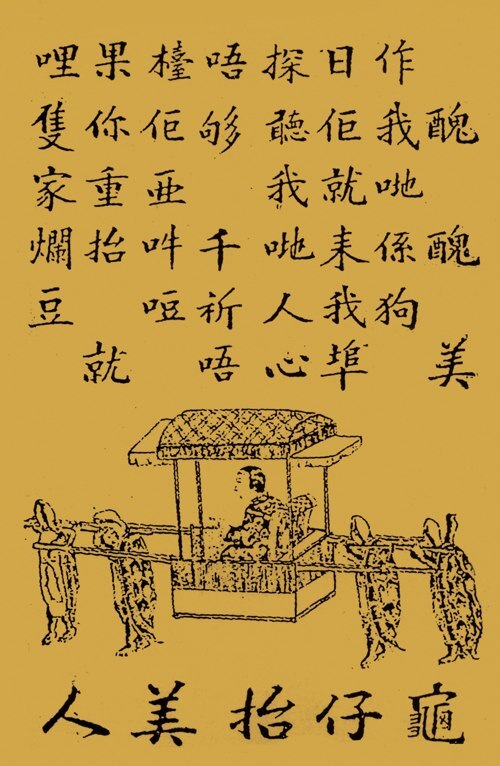
Anonymous Cantonese placard warning sedan-chair bearers not to carry Alice Roosevelt (Canton, 1905 boycott)
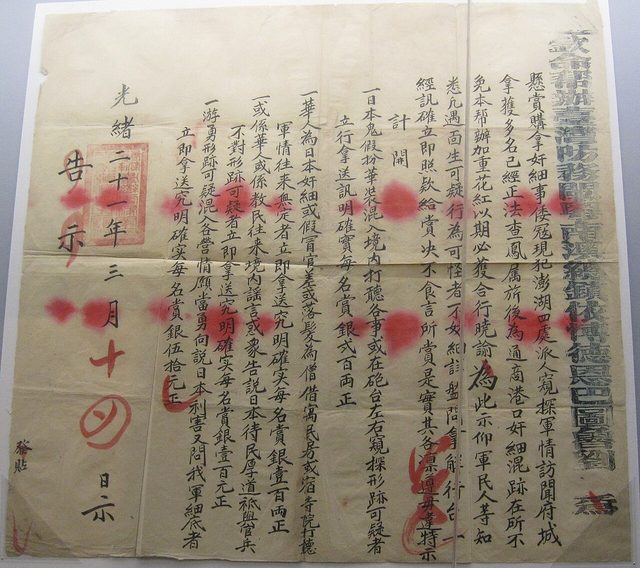
A yellow placard printed in Cantonese with a woodcut-style sedan chair carried by four bearers, above a large bottom line that names the chair and a curse on the bearers' sons. The tell: the ask (do not carry her) is enforced by a threatened harm to the bearers' families, put in the local vernacular for the men who would be doing the work.
- Date
- 1905
- Period
- Pre-1914
- Made by
- Anonymous, posted in Canton streets during the 1905 boycott of American goods (no sponsor named on the placard)
- Region
- East Asia
- Country
- Qing China
- Medium
- Poster
- Issuer type
- Movement
- Regime
- Qing Dynasty
- Leader
- Guangxu Emperor
- Audience
- Domestic public
- Purpose
- Mobilize or secure compliance
- Themes
- Labor, Migration
- Event
- 1905 Anti American Boycott
- Techniques
- Fear appeal
- Source
- Identified Openly sourced: the speaker is who they say they are
- Source
- Wikimedia Commons (as reproduced in a Smithsonian Freer|Sackler essay on the 1905 Taft mission to Asia in Guangzhou), retrieved September 29, 2026
- Rights
- Public domain (anonymous 1905 work; Commons PD-anon-expired)
Anonymous, Canton, 1905; via Wikimedia Commons (Commons cites asia.si.edu, Smithsonian Freer|Sackler essay on the 1905 Taft mission).
Text on the object
[Body text, columns right to left, each column top to bottom; column order and some characters uncertain:]
醜 醜 美 (isolated large characters at the right edge)
作我啲係狗
日佢就來我埠
探聽我啲人心
唔够 千祈唔
樓佢亜啲啞
果你重抬
哩隻家爛豆就

[Bottom line, large characters, as printed left to right:] 人 美 抬 仔 癱[?]
No continuous translation: the reading order of the body columns is uncertain. Fragments that can be read: 'the day she comes to our port' (日佢就來我埠); 'sound out the mood of our people' (探聽我啲人心); 'if you still carry [her]' (果你重抬). The bottom line, if read right to left, would be roughly 'paralysed sons [for those who] carry the American beauty' (癱仔抬美人), which matches the documented use as a threat to chair-bearers; the last character of that line is uncertain.
Read from a 500 px reproduction. Characters are in colloquial Cantonese forms (for example 啲, 佢, 係) and one or two glyphs (the second of 樓佢亜啲啞 and the last of the bottom line) are best guesses. Translation of fragments is FRAME's own, machine-assisted and not verified by a fluent reader.