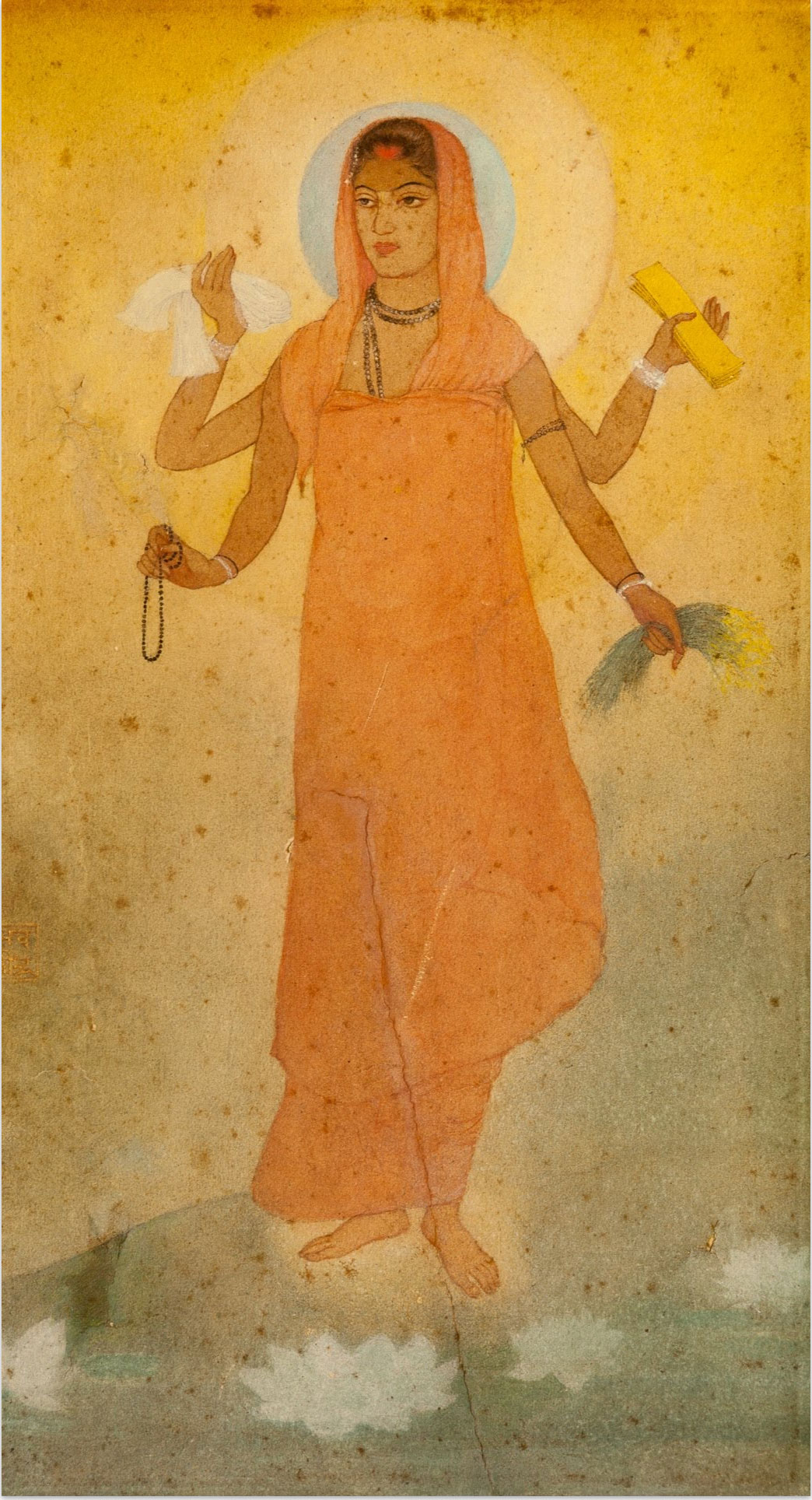
Bharat Mata (Mother India)
Abanindranath Tagore's 1905 painting personifies India as a four-armed, haloed woman in saffron robes, holding a manuscript, a garland, a bowl of grain and a strip of white cloth to offer knowledge, spiritual initiation, food and homespun cloth to her devotees. Painted during the Swadeshi movement's boycott of British goods, the image casts the nation itself as a deity to be revered, folding a political program into an act of religious devotion.
- Date
- 1905
- Period
- Pre-1914
- Made by
- Swadeshi movement (Bengal School of Art); artist Abanindranath Tagore
- Region
- South Asia
- Country
- British India
- Medium
- Artwork
- Issuer type
- Movement
- Regime
- British Raj
- Leader
- George Nathaniel Curzon
- Audience
- Domestic public
- Purpose
- Persuade or win support
- Themes
- Empire and colonialism, Religion, Economy and finance
- Event
- Swadeshi Movement
- Techniques
- TransferGlittering generalities
- Source
- Identified Openly sourced: the speaker is who they say they are
- Source
- Wikimedia Commons, retrieved September 28, 2026
- Rights
- Public domain (per Wikimedia Commons)
http://www.kamat.com/picturehouse/bharat/100j.htm
Text on the object
[illegible]
[illegible — nothing legible to translate]
A small bordered seal/monogram (not a caption or title) sits in the painting's lower-left corner, with characters inside a rectangular frame, too faint/low-contrast to read at this scan's resolution. Language given as Bengali on balance of probability (Tagore's idiom, the seal's script shape), not confirmed. Could be the artist's own seal or a later collection stamp; cannot tell which. No other inscription is visible on the painting.