Content note: Period caricature of a rubber collector crushed by a snake with Leopold II's head. This object is shown as it was published. Why
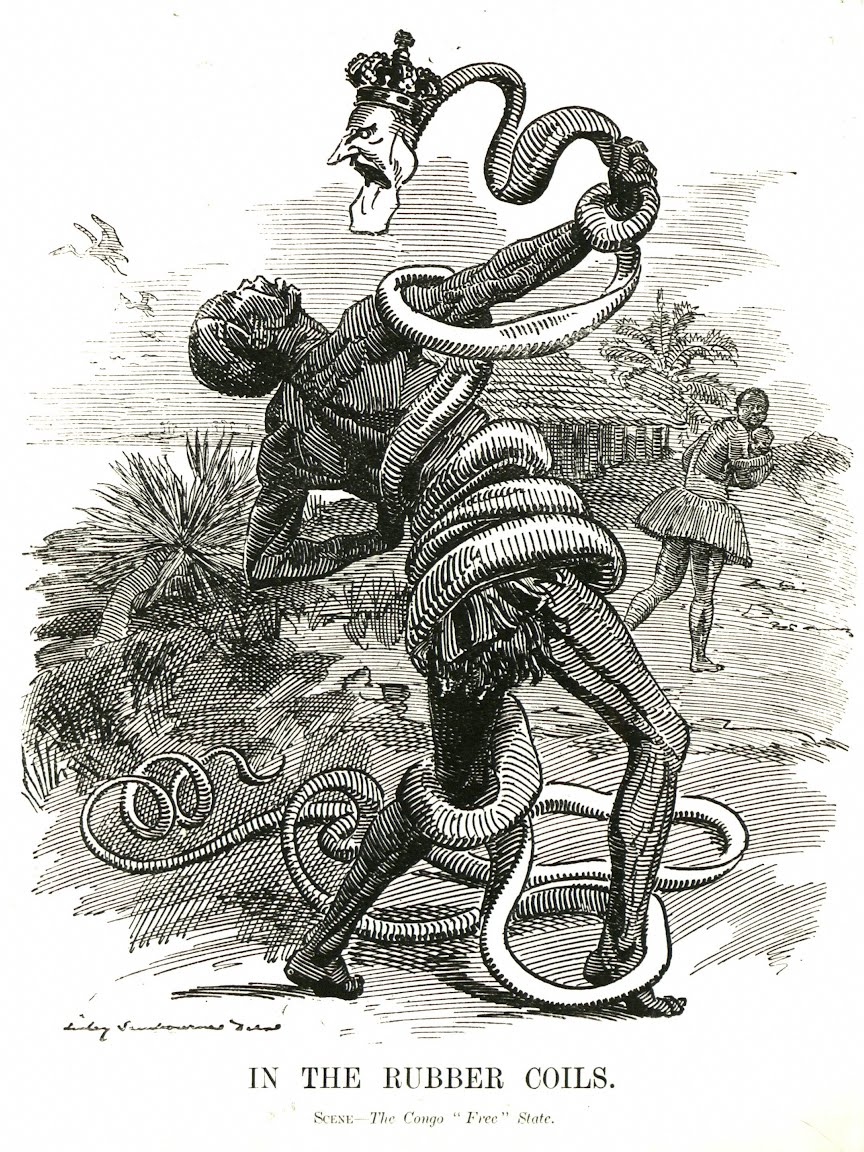
"In the Rubber Coils" (Punch, 1906)
A Congolese rubber collector is crushed in the coils of a snake wearing King Leopold II's crowned head, over the caption "Scene - The Congo 'Free' State," turning the regime's own name for itself into the accusation.
Edward Linley Sambourne drew this cartoon for Punch, published on 28 November 1906 during the British press campaign against King Leopold II's rule in the Congo. A Congolese rubber collector is crushed in the coils of a snake that wears Leopold's crowned head, over the caption "Scene—The Congo "Free" State." The caption puts the regime's own name for itself in quotation marks, which is the name-calling, while the snake image attaches a widely feared creature to the king, which is transfer.
Propaganda techniques used in this cartoon
- Date
- November 28, 1906
- Period
- Pre-1914
- Made by
- Punch magazine
Full record
Region, Country, Medium, Issuer type, Regime, Leader, Audience, Purpose, Themes, Event, Source, Rights
- Region
- Western and Central Europe
- Country
- United Kingdom
- Medium
- Cartoon
- Issuer type
- Media
- Regime
- Campbell Bannerman Government
- Leader
- Henry Campbell Bannerman
- Audience
- Domestic public
- Purpose
- Demonize
- Themes
- Empire and colonialism, Labor
- Event
- Congo Reform Campaign
- Source
- Identified Openly sourced: the speaker is who they say they are
- Source
- Wikimedia Commons, retrieved September 27, 2026
- Rights
- Public domain (published 1906; artist died 1910)
Edward Linley Sambourne, "In the Rubber Coils. Scene - The Congo 'Free' State", Punch, 28 November 1906
Text on the object
Original (English) · read from the image, not independently checked
IN THE RUBBER COILS.

Scene—The Congo "Free" State.

Linley Sambourne del.
The artist's cursive signature at lower left is stylised and hard to read letter-by-letter; transcribed as 'Linley Sambourne del.' (the artist's standard signing convention, del. = delineavit) based on the visible shapes, matching the documented attribution.