Don't Stop Saving Food
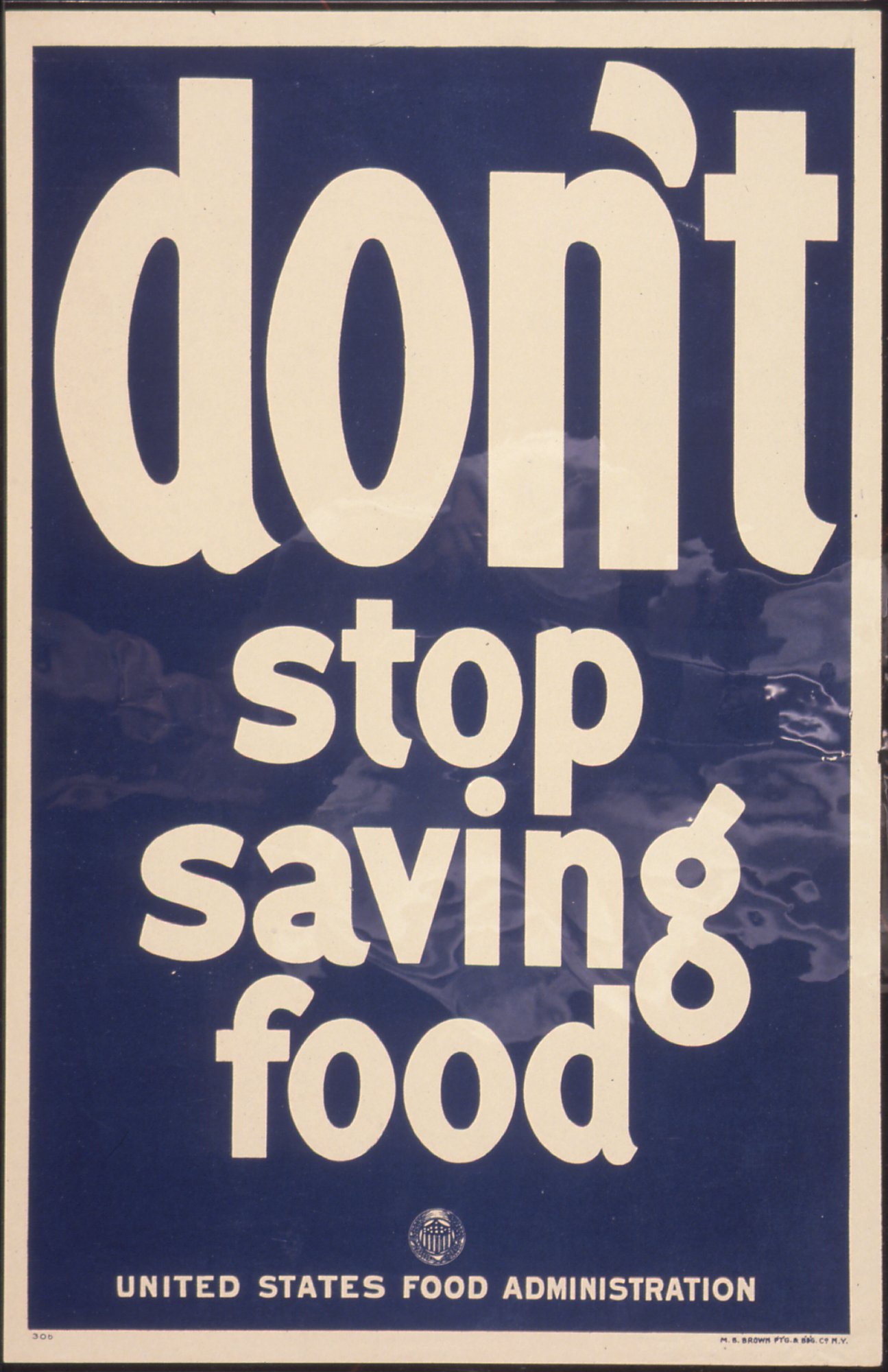
Large cream lettering on a dark blue field reads 'Don't stop saving food', with the Food Administration seal and name at the foot. The sheet gives no reason, figure or named beneficiary, so the persuasive load rests on the command itself and the unstated cause behind it.
The U.S. Food Administration issued this poster during the First World War as part of its voluntary food-conservation campaigns. Large cream lettering on a dark blue field reads "don't stop saving food", with the Administration's name and seal at the foot. No date is printed, so the year is a placeholder within an archive range of about 1917 to 1919. The sheet gives no reason, figure or named beneficiary, so the persuasive weight rests on the command itself. That is the glittering generalities tag, where a general good, saving food, stands in for a specific claim.
Propaganda techniques used in this poster
- Date
- 1917
- Period
- First World War
- Made by
- U.S. Food Administration
Full record
Region, Country, Medium, Issuer type, Regime, Leader, Audience, Purpose, Themes, Event, Source, Rights
- Region
- North America
- Country
- United States
- Medium
- Poster
- Issuer type
- State
- Regime
- Wilson Administration
- Leader
- Woodrow Wilson
- Audience
- Domestic public
- Purpose
- Mobilize or secure compliance
- Themes
- Home front, Economy and finance
- Event
- World War I
- Regime
- Wilson administration
- Leader
- Woodrow Wilson
- Source
- Identified Openly sourced: the speaker is who they say they are
- Source
- U.S. National Archives (NARA), RG 4 (U.S. Food Administration), World War I Posters (NAID 512439), retrieved October 3, 2026
- Rights
- NARA Unrestricted; hosted by owner decision
U.S. Food Administration. National Archives and Records Administration, 4-P-100.
Text on the object
Original (English) · read from the image, not independently checked
don't
stop
saving
food

UNITED STATES FOOD ADMINISTRATION

306
M. B. BROWN PTG. & BDG. CO. N.Y.
The small number at lower left and the printer's imprint at lower right are in very small type; the number is read as 306 with some doubt.