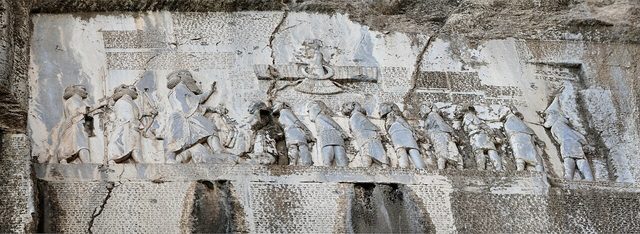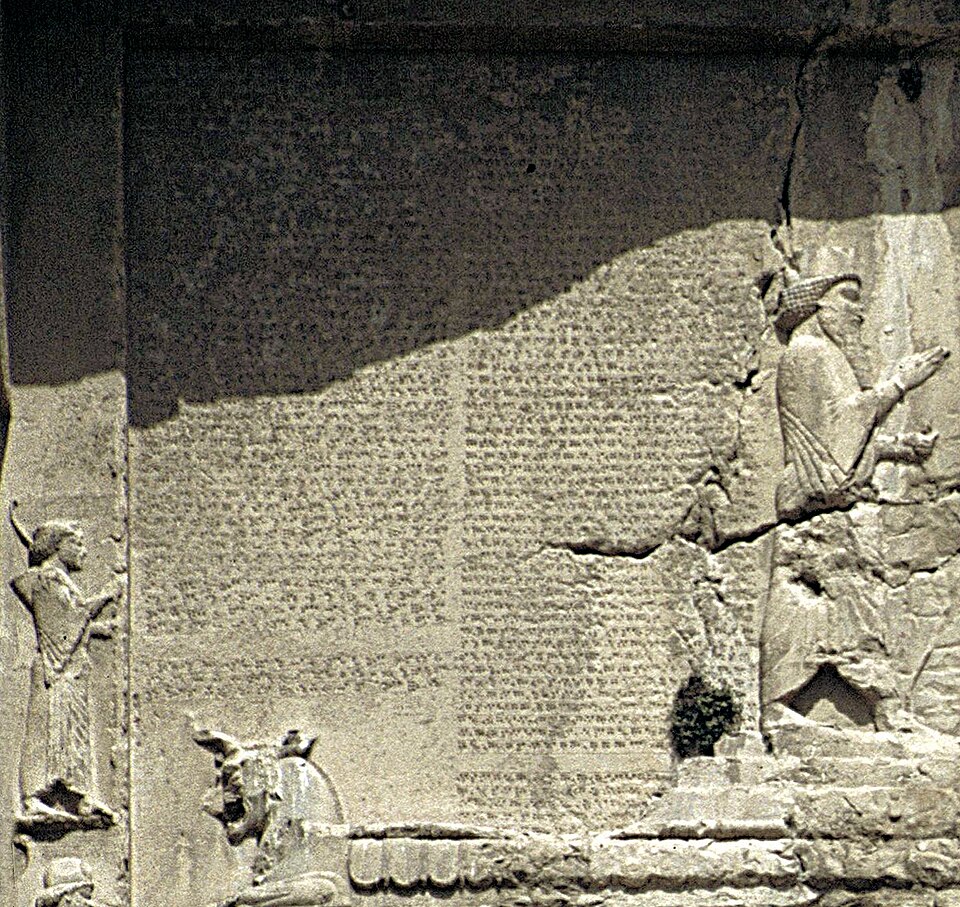
Tomb of Darius I at Naqsh-e Rustam: the king in relief beside his inscription DNa, c. 490 BCE
The upper left of the rock-cut tomb facade at Naqsh-e Rustam: the king in relief at right, and at left the long inscription in which Darius names Ahuramazda as the god who made him king, lists the lands that bore him tribute, and tells the reader to look at the sculptures of the throne-bearers.
- Date
- 0000
- Period
- Pre-1914
- Made by
- Great King Darius I of Persia (Achaemenid royal court)
- Country
- Achaemenid Empire
- Medium
- Object
- Issuer type
- State
- Regime
- Achaemenid Empire
- Leader
- Darius I
- Audience
- Mixed
- Purpose
- Persuade or win support
- Themes
- Empire and colonialism, Religion
- Techniques
- TestimonialCard stacking
- Regime
- Achaemenid Persia
- Source
- Identified Openly sourced: the speaker is who they say they are
- Source
- Wikimedia Commons, retrieved October 2, 2026
- Rights
- CC BY-SA 4.0 (Wikimedia Commons file page; photograph by Ziegler175; the ancient relief itself is out of copyright)
Photo: Ziegler175, via Wikimedia Commons, CC BY-SA 4.0
Text on the object
[DNa, opening, Old Persian transliteration:]
baga vazraka Auramazdâ hya imâm bumâm adâ hya avam asmânam adâ hya martiyam adâ hya šiyâtim adâ martiyahyâ hya Dârayavaum xšâyathiyam akunauš aivam parûvnâm xšâyathiyam aivam parûvnâm framâtâram adam Dârayavauš xšâyathiya vazraka xšâyathiya xšâyathiyânâm xšâyathiya dahyûnâm vispazanânâm xšâyathiya ahyâyâ bûmiyâ vazrakâyâ dûraiapiy Vištâspahyâ puça Haxâmanišiya Pârsa Pârsahyâ puça Ariya Ariya ciça
A great god is Ahuramazda, who created this earth, who created yonder sky, who created man, who created happiness for man, who made Darius king, one king of many, one lord of many.

I am Darius the great king, king of kings, king of countries containing all kinds of men, king in this great earth far and wide, son of Hystaspes, an Achaemenid, a Persian, son of a Persian, an Aryan, having Aryan lineage.
Transliteration and English from Livius.org's DNa page, where the web text breaks lines mid-word; those breaks are joined and the backslash word dividers shown as spaces. Only the opening is transcribed; the text continues with the list of lands and the passage on the throne-bearers. The monument also carries Elamite and Babylonian versions.