Feed the Birds This Winter
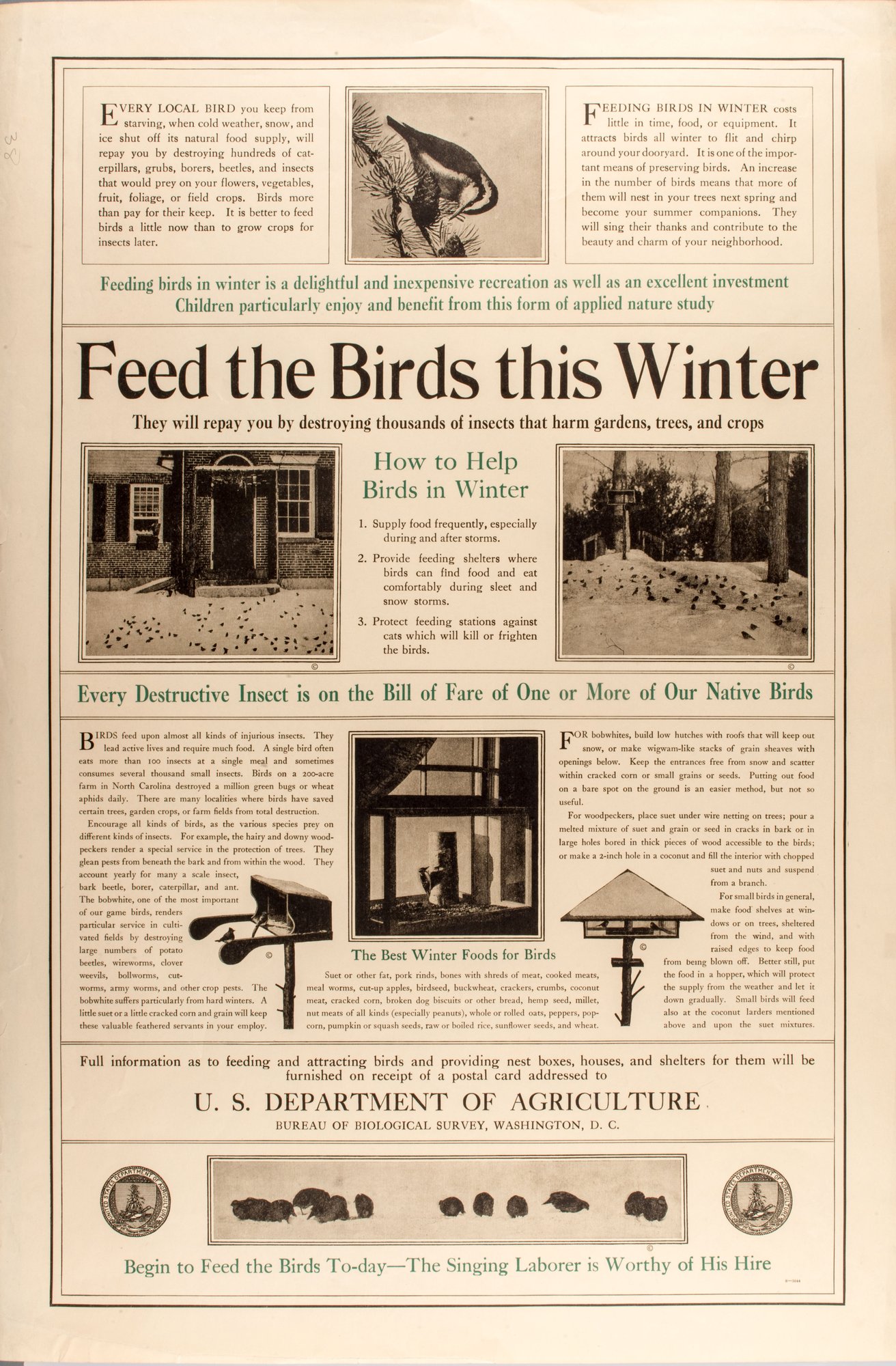
A text-and-photograph broadsheet shows songbirds and bobwhites at feeders in snow, with instructions on feeding shelters and foods. It argues that birds repay care by destroying crop insects, and closes with 'The Singing Laborer is Worthy of His Hire'. Mostly practical information; the persuasive tells are the value language ('excellent investment') and the labour metaphor.
Propaganda techniques used in this poster
- Date
- 1917
- Period
- First World War
- Made by
- U.S. Department of Agriculture, Bureau of Biological Survey
- Region
- North America
- Country
- United States
- Medium
- Poster
- Issuer type
- State
- Regime
- Wilson Administration
- Leader
- Woodrow Wilson
- Audience
- Domestic public
- Purpose
- Warn or inform
- Themes
- Home front, Science and technology
- Event
- World War I
- Regime
- Wilson administration
- Leader
- Woodrow Wilson
- Source
- Identified Openly sourced: the speaker is who they say they are
- Source
- U.S. National Archives (NARA), RG 4 (U.S. Food Administration), World War I Posters (NAID 512439), retrieved October 3, 2026
- Rights
- NARA Unrestricted; hosted by owner decision
U.S. Department of Agriculture, Bureau of Biological Survey. National Archives and Records Administration, 4-P-38.
Text on the object
EVERY LOCAL BIRD you keep from starving, when cold weather, snow, and ice shut off its natural food supply, will repay you by destroying hundreds of caterpillars, grubs, borers, beetles, and insects that would prey on your flowers, vegetables, fruit, foliage, or field crops. Birds more than pay for their keep. It is better to feed birds a little now than to grow crops for insects later.

FEEDING BIRDS IN WINTER costs little in time, food, or equipment. It attracts birds all winter to flit and chirp around your dooryard. It is one of the important means of preserving birds. An increase in the number of birds means that more of them will nest in your trees next spring and become your summer companions. They will sing their thanks and contribute to the beauty and charm of your neighborhood.

Feeding birds in winter is a delightful and inexpensive recreation as well as an excellent investment
Children particularly enjoy and benefit from this form of applied nature study

Feed the Birds this Winter
They will repay you by destroying thousands of insects that harm gardens, trees, and crops

How to Help Birds in Winter
1. Supply food frequently, especially during and after storms.
2. Provide feeding shelters where birds can find food and eat comfortably during sleet and snow storms.
3. Protect feeding stations against cats which will kill or frighten the birds.

Every Destructive Insect is on the Bill of Fare of One or More of Our Native Birds

BIRDS feed upon almost all kinds of injurious insects. They lead active lives and require much food. A single bird often eats more than 100 insects at a single meal and sometimes consumes several thousand small insects. Birds on a 200-acre farm in North Carolina destroyed a million green bugs or wheat aphids daily. There are many localities where birds have saved certain trees, garden crops, or farm fields from total destruction.
Encourage all kinds of birds, as the various species prey on different kinds of insects. For example, the hairy and downy woodpeckers render a special service in the protection of trees. They glean pests from beneath the bark and from within the wood. They account yearly for many a scale insect, bark beetle, borer, caterpillar, and ant. The bobwhite, one of the most important of our game birds, renders particular service in cultivated fields by destroying large numbers of potato beetles, wireworms, clover weevils, bollworms, cutworms, army worms, and other crop pests. The bobwhite suffers particularly from hard winters. A little suet or a little cracked corn and grain will keep these valuable feathered servants in your employ.

The Best Winter Foods for Birds
Suet or other fat, pork rinds, bones with shreds of meat, cooked meats, meal worms, cut-up apples, birdseed, buckwheat, crackers, crumbs, coconut meat, cracked corn, broken dog biscuits or other bread, hemp seed, millet, nut meats of all kinds (especially peanuts), whole or rolled oats, peppers, popcorn, pumpkin or squash seeds, raw or boiled rice, sunflower seeds, and wheat.

[bobwhite, woodpecker and small-bird feeding instructions omitted here for length]

Full information as to feeding and attracting birds and providing nest boxes, houses, and shelters for them will be furnished on receipt of a postal card addressed to
U. S. DEPARTMENT OF AGRICULTURE
BUREAU OF BIOLOGICAL SURVEY, WASHINGTON, D. C.

Begin to Feed the Birds To-day—The Singing Laborer is Worthy of His Hire
Photograph copyright marks and the circular Department of Agriculture seals (twice) are not transcribed; a faint pencil mark at upper left margin is [illegible]. Transcription truncated for the 4000-character schema limit: the right-hand paragraphs on feeding bobwhites, woodpeckers and small birds (beginning 'FOR bobwhites, build low hutches') are omitted.