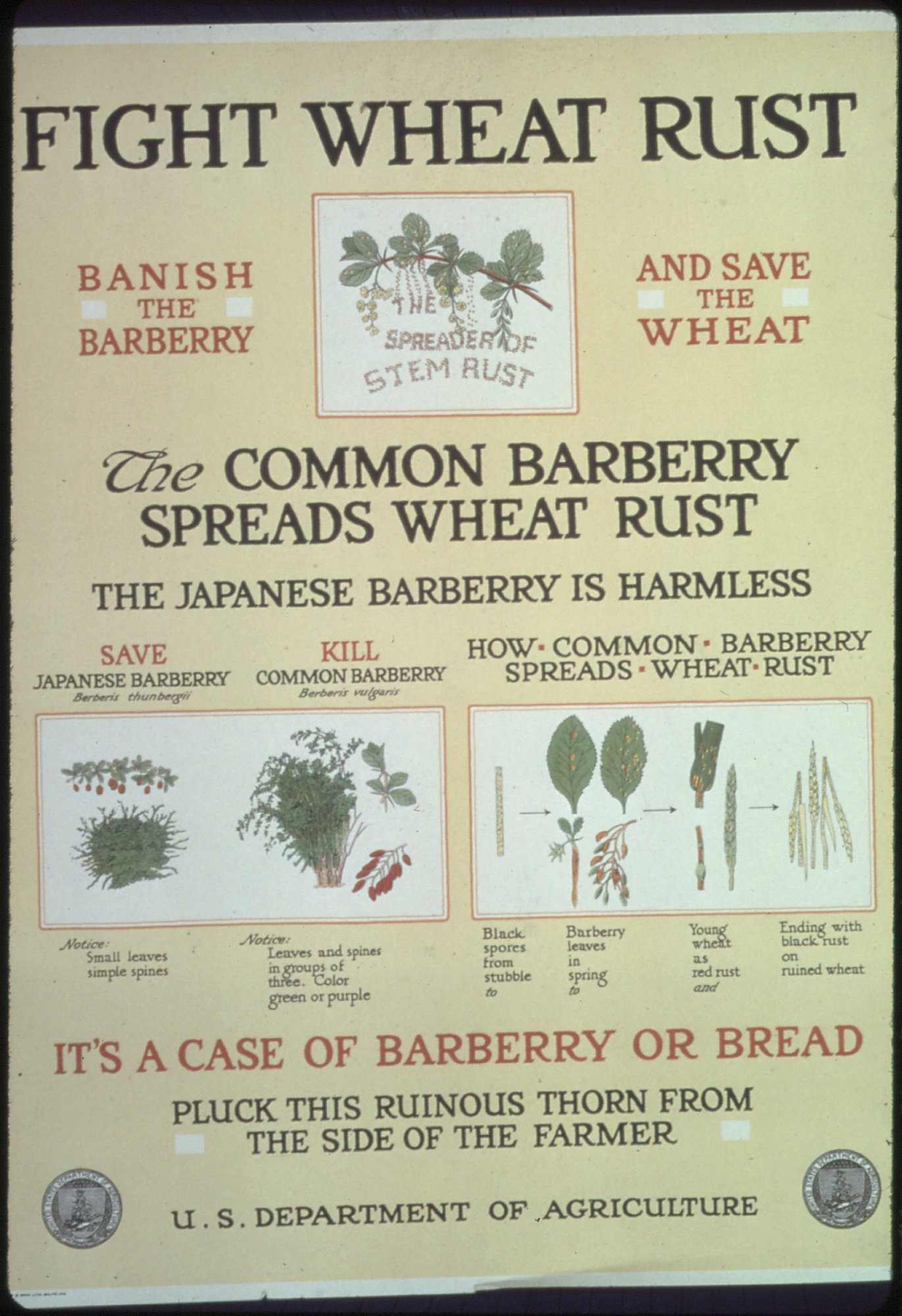
Fight Wheat Rust: The Common Barberry Spreads Wheat Rust, It's a Case of Barberry or Bread
A cream sheet headed 'Fight Wheat Rust' shows drawings of common and Japanese barberry, with notes on how to tell them apart and a four-step panel tracing rust from stubble spores to ruined wheat. The closing lines call it 'a case of barberry or bread' and urge the farmer to pluck 'this ruinous thorn'. Most of the sheet is identification and life-cycle information, with the fear-appeal carried by the 'ruined wheat' panel and the two-way slogan.
Propaganda techniques used in this poster
- Date
- 1917
- Period
- First World War
- Made by
- U.S. Department of Agriculture
- Region
- North America
- Country
- United States
- Medium
- Poster
- Issuer type
- State
- Regime
- Wilson Administration
- Leader
- Woodrow Wilson
- Audience
- Domestic public
- Purpose
- Warn or inform
- Themes
- Science and technology, Home front
- Event
- World War I
- Regime
- Wilson administration
- Leader
- Woodrow Wilson
- Source
- Identified Openly sourced: the speaker is who they say they are
- Source
- U.S. National Archives (NARA), RG 4 (U.S. Food Administration), World War I Posters (NAID 512439), retrieved October 3, 2026
- Rights
- NARA Unrestricted; hosted by owner decision
U.S. Department of Agriculture. National Archives and Records Administration, 4-P-164.
Text on the object
FIGHT WHEAT RUST

BANISH THE BARBERRY
[drawing caption: THE SPREADER OF STEM RUST]
AND SAVE THE WHEAT

The COMMON BARBERRY
SPREADS WHEAT RUST

THE JAPANESE BARBERRY IS HARMLESS

SAVE
JAPANESE BARBERRY
Berberis thunbergii
Notice:
Small leaves
simple spines

KILL
COMMON BARBERRY
Berberis vulgaris
Notice:
Leaves and spines
in groups of three.
Color green or purple

HOW COMMON BARBERRY
SPREADS WHEAT RUST
Black spores from stubble to
Barberry leaves in spring to
Young wheat as red rust and
Ending with black rust on ruined wheat

IT'S A CASE OF BARBERRY OR BREAD

PLUCK THIS RUINOUS THORN FROM
THE SIDE OF THE FARMER

[seal] U.S. DEPARTMENT OF AGRICULTURE [seal]
Small captions inside the diagrams are read at low resolution; the connecting words 'to' and 'and' stand for arrows between the four steps.