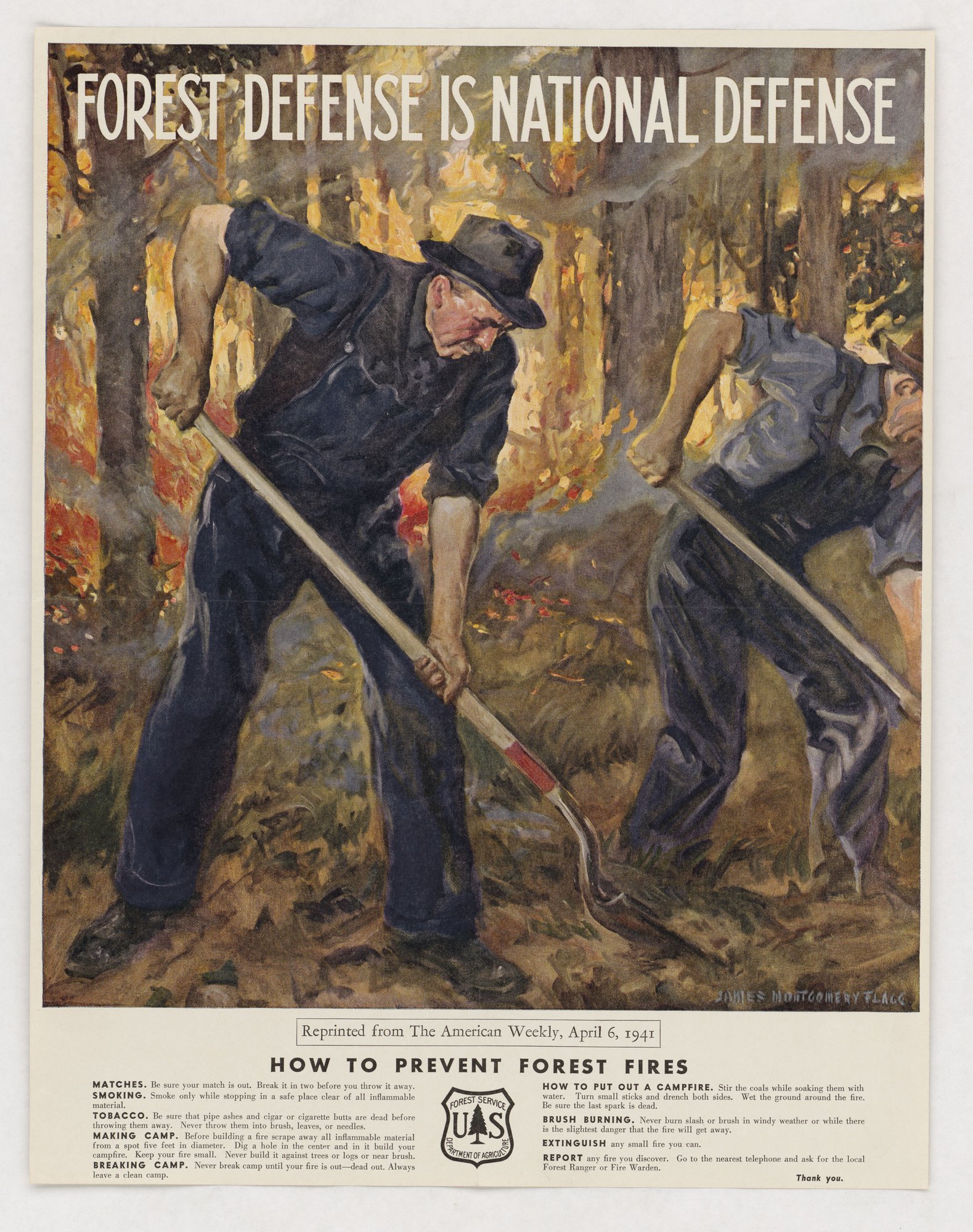
Forest Defense Is National Defense
Two men in work clothes dig a fire line with long-handled tools in a burning forest, under the headline 'Forest Defense Is National Defense'. The headline borrows the weight of the military term 'defense' for fire prevention (transfer); a printed panel below lists fire-prevention rules.
Propaganda techniques used in this poster
- Date
- 1941
- Period
- Second World War
- Made by
- U.S. Department of Agriculture, Forest Service; art by James Montgomery Flagg
- Region
- North America
- Country
- United States
- Medium
- Poster
- Issuer type
- State
- Regime
- Roosevelt Administration
- Leader
- Franklin D. Roosevelt
- Audience
- Domestic public
- Purpose
- Mobilize or secure compliance
- Themes
- Home front, War and the military
- Event
- World War II
- Regime
- Roosevelt administration
- Leader
- Franklin D. Roosevelt
- Source
- Identified Openly sourced: the speaker is who they say they are
- Source
- U.S. National Archives and Records Administration, Record Group 44, World War II Posters, retrieved October 4, 2026
- Rights
- Public domain (U.S. government work)
U.S. Department of Agriculture, Forest Service. National Archives and Records Administration, RG 44, 44-PA-193 (NAID 513638).
Text on the object
FOREST DEFENSE IS NATIONAL DEFENSE
[signature: James Montgomery Flagg]
Reprinted from The American Weekly, April 6, 1941
HOW TO PREVENT FOREST FIRES
MATCHES. Be sure your match is out. Break it in two before you throw it away.
SMOKING. Smoke only while stopping in a safe place clear of all inflammable material.
TOBACCO. Be sure that pipe ashes and cigar or cigarette butts are dead before throwing them away. Never throw them into brush, leaves, or needles.
MAKING CAMP. Before building a fire scrape away all inflammable material from a spot five feet in diameter. Dig a hole in the center and in it build your campfire. Keep your fire small. Never build it against trees or logs or near brush.
BREAKING CAMP. Never break camp until your fire is out—dead out. Always leave a clean camp.
HOW TO PUT OUT A CAMPFIRE. Stir the coals while soaking them with water. Turn small sticks and drench both sides. Wet the ground around the fire. Be sure the last spark is dead.
BRUSH BURNING. Never burn slash or brush in windy weather or while there is the slightest danger that the fire will get away.
EXTINGUISH any small fire you can.
REPORT any fire you discover. Go to the nearest telephone and ask for the local Forest Ranger or Fire Warden.
Thank you.
[imprint: Forest Service, U.S. Department of Agriculture shield]