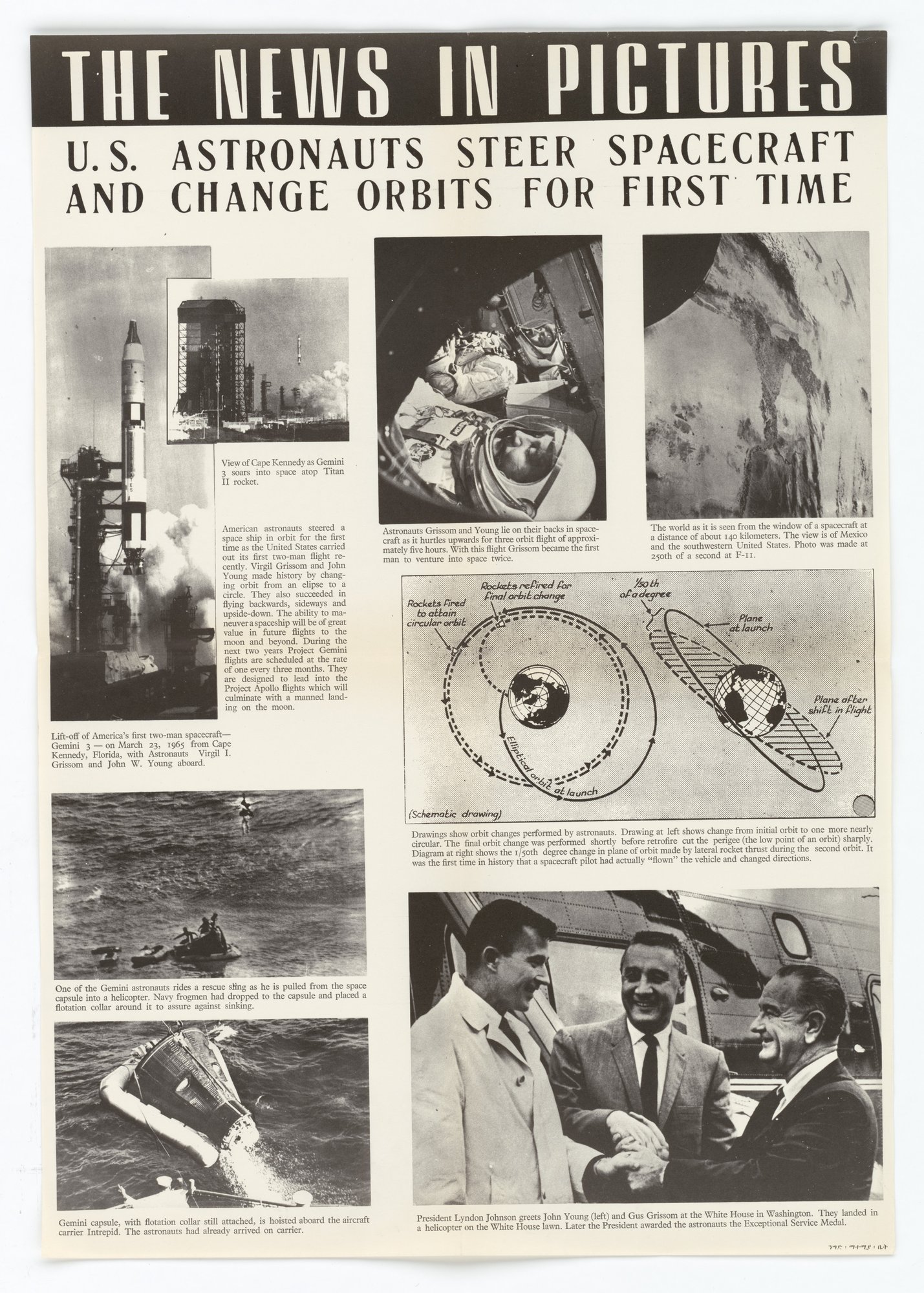
Gemini wall poster, The News in Pictures (English poster distributed in Addis Ababa)
A photo-news poster headed 'The News in Pictures' on the first U.S. two-man Gemini 3 flight of 23 March 1965. Photographs and a schematic show the launch, the two astronauts, a view of Earth, the orbit changes, the sea recovery and President Johnson greeting the crew. The tell is transfer: the prestige of spaceflight achievement and of the President's handshake is attached to the United States. This is the English version of the Amharic sheet NAID 6949222.
Propaganda techniques used in this poster
- Date
- January 1, 1965
- Period
- Cold War
- Made by
- U.S. Information Agency (predecessor: State Department International Information and Educational Exchange Program), Propaganda Posters Distributed in Asia, Latin America and the Middle East series
- Region
- North America
- Country
- United States
- Medium
- Poster
- Issuer type
- State
- Regime
- Johnson Administration
- Leader
- Lyndon B. Johnson
- Audience
- Foreign public
- Purpose
- Warn or inform
- Themes
- Science and technology, Media and information
- Event
- Cold War
- Source
- Unidentified Source blurred: contractors, cutouts, buried disclosure
- Source
- U.S. National Archives (NARA), Record Group 306, Posters in Asia, Latin America, Middle East, retrieved October 4, 2026
- Rights
- Public domain (U.S. government work; NARA RG 306)
U.S. Information Agency / Department of State, c. 1965. National Archives, Record Group 306 (NAID 6949221, 306-PPB-297).
Text on the object
THE NEWS IN PICTURES

U.S. ASTRONAUTS STEER SPACECRAFT
AND CHANGE ORBITS FOR FIRST TIME

View of Cape Kennedy as Gemini 3 soars into space atop Titan II rocket.

American astronauts steered a space ship in orbit for the first time as the United States carried out its first two-man flight recently. Virgil Grissom and John Young made history by changing orbit from an ellipse to a circle. They also succeeded in flying backwards, sideways and upside-down. The ability to maneuver a spaceship will be of great value in future flights to the moon and beyond. During the next two years Project Gemini flights are scheduled at the rate of one every three months. They are designed to lead into the Project Apollo flights which will culminate with a manned landing on the moon.

Lift-off of America's first two-man spacecraft--Gemini 3--on March 23, 1965 from Cape Kennedy, Florida, with Astronauts Virgil I. Grissom and John W. Young aboard.

Astronauts Grissom and Young lie on their backs in spacecraft as it hurtles upwards for three orbit flight of approximately five hours. With this flight Grissom became the first man to venture into space twice.

The world as it is seen from the window of a spacecraft at a distance of about 140 kilometers. The view is of Mexico and the southwestern United States. Photo was made at 250th of a second at F-11.

[Diagram labels: Rockets fired to attain circular orbit / Rockets refired for final orbit change / 1/50th of a degree / Plane at launch / Plane after shift in flight / Elliptical orbit at launch / (Schematic drawing)]

Drawings show orbit changes performed by astronauts. Drawing at left shows change from initial orbit to one more nearly circular. The final orbit change was performed shortly before retrofire cut the perigee (the low point of an orbit) sharply. Diagram at right shows the 1/50th degree change in plane of orbit made by lateral rocket thrust during the second orbit. It was the first time in history that a spacecraft pilot had actually "flown" the vehicle and changed directions.

One of the Gemini astronauts rides a rescue sling as he is pulled from the space capsule into a helicopter. Navy frogmen had dropped to the capsule and placed a flotation collar around it to assure against sinking.

Gemini capsule, with flotation collar still attached, is hoisted aboard the aircraft carrier Intrepid. The astronauts had already arrived on carrier.

President Lyndon Johnson greets John Young (left) and Gus Grissom at the White House in Washington. They landed in a helicopter on the White House lawn. Later the President awarded the astronauts the Exceptional Service Medal.

[Ethiopic script line at lower right, small, not transcribed]
The small Ethiopic imprint line at lower right is not transcribed.