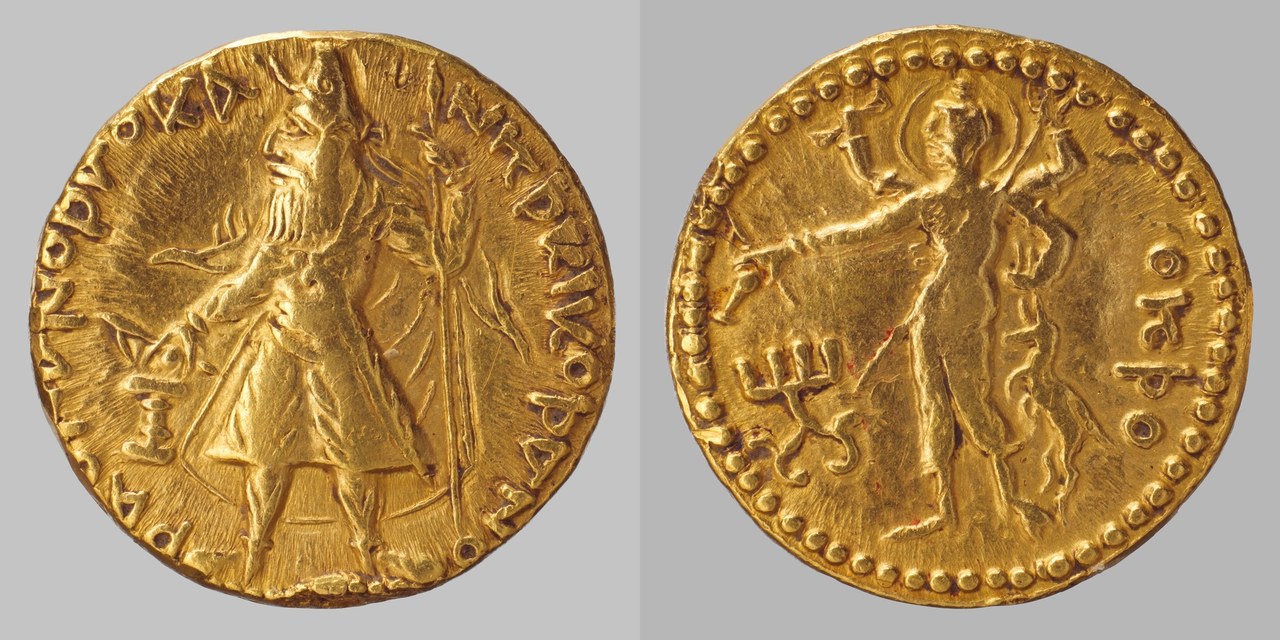
Gold coin of Kanishka: King of Kings legend, king at the altar, deity Oesho
A Kushan gold coin: the obverse shows the king standing at a small fire altar under a legend in Greek letters that reads King of Kings, Kanishka the Kushan; the reverse shows a four-armed haloed deity labelled OESHO beside the royal emblem. The tell is borrowed prestige: a royal title used earlier by Parthian rulers and a god placed on the state's gold, set beside the king's own name.
- Date
- 0130
- Period
- Pre-1914
- Made by
- Kushan Empire, King Kanishka
- Region
- South Asia
- Country
- Kushan Empire
- Medium
- Banknotes and coins
- Issuer type
- State
- Regime
- Kushan Empire
- Leader
- Kanishka
- Audience
- Mixed
- Purpose
- Persuade or win support
- Themes
- Religion, Empire and colonialism
- Techniques
- Transfer
- Source
- Identified Openly sourced: the speaker is who they say they are
- Source
- The Metropolitan Museum of Art (Open Access), retrieved September 29, 2026
- Rights
- Public domain (The Met Open Access, CC0; isPublicDomain true in the Met API; object about 1,900 years old)
The Metropolitan Museum of Art, Bequest of Joseph H. Durkee, 1898 (99.35.3024), Open Access
Text on the object
Obverse (clockwise from lower left): ϷΑΟΝΑΝΟϷΑΟ ΚΑΝΗϷΚΙ ΚΟϷΑΝΟ

Reverse (vertical, right of the figure): ΟΗϷΟ
Obverse: King of Kings, Kanishka the Kushan.

Reverse: Oesho (the deity's name).
The letter Ϸ (sho) looks like a P on the photograph. Readings follow the standard legend of this coin type; individual letters are clear but the word division is inferred. The reverse also carries a trident-like royal emblem (tamgha), which is not text.