Help Feed Yourself: Make Back Yards and Vacant Lots Productive
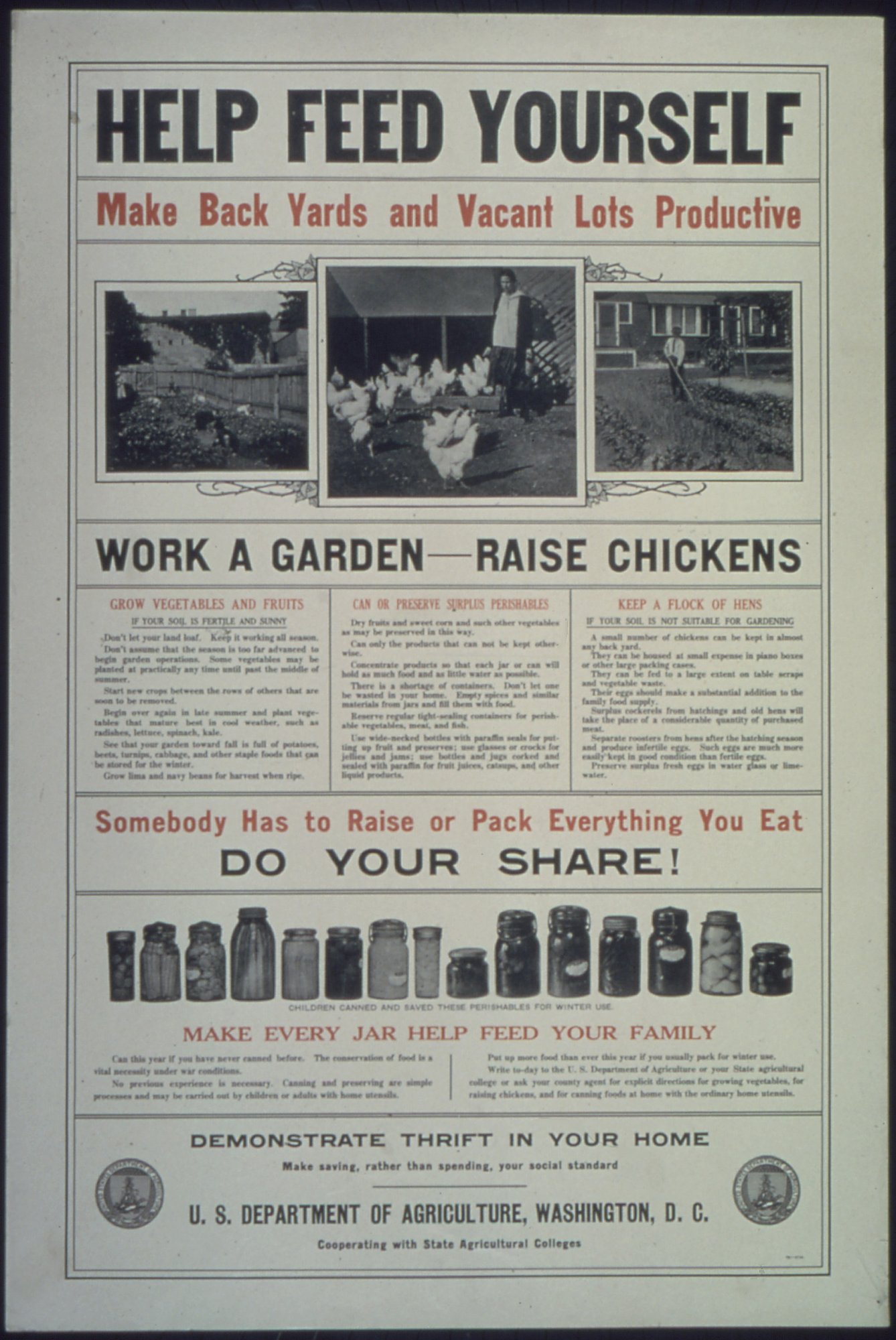
A dense instruction sheet combines three photographs (a fenced garden, a woman among hens, a man hoeing) with columns of advice on growing vegetables, preserving surplus food and keeping chickens. Slogans such as 'Do your share!' and 'Demonstrate thrift in your home' frame the practical text. The tell is the ordinary household shown as the model, with a civic duty attached to home gardening.
Propaganda techniques used in this poster
- Date
- 1918
- Period
- First World War
- Made by
- U.S. Department of Agriculture, cooperating with State Agricultural Colleges
- Region
- North America
- Country
- United States
- Medium
- Poster
- Issuer type
- State
- Regime
- Wilson Administration
- Leader
- Woodrow Wilson
- Audience
- Domestic public
- Purpose
- Mobilize or secure compliance
- Themes
- Home front, Economy and finance
- Event
- World War I
- Regime
- Wilson administration
- Leader
- Woodrow Wilson
- Source
- Identified Openly sourced: the speaker is who they say they are
- Source
- U.S. National Archives (NARA), RG 4 (U.S. Food Administration), World War I Posters (NAID 512439), retrieved October 3, 2026
- Rights
- NARA Unrestricted; hosted by owner decision
U.S. Department of Agriculture, cooperating with State Agricultural Colleges. National Archives and Records Administration, 4-P-243.
Text on the object
HELP FEED YOURSELF
Make Back Yards and Vacant Lots Productive

WORK A GARDEN-RAISE CHICKENS

GROW VEGETABLES AND FRUITS
IF YOUR SOIL IS FERTILE AND SUNNY
Don't let your land loaf. Keep it working all season.
Don't assume that the season is too far advanced to begin garden operations. Some vegetables may be planted at practically any time until past the middle of summer.
Start new crops between the rows of others that are soon to be removed.
Begin over again in late summer and plant vegetables that mature best in cool weather, such as radishes, lettuce, spinach, kale.
See that your garden toward fall is full of potatoes, beets, turnips, cabbage, and other staple foods that can be stored for the winter.
Grow lima and navy beans for harvest when ripe.

CAN OR PRESERVE SURPLUS PERISHABLES
Dry fruits and sweet corn and such other vegetables as may be preserved in this way.
Can only the products that can not be kept otherwise.
Concentrate products so that each jar or can will hold as much food and as little water as possible.
There is a shortage of containers. Don't let one be wasted in your home. Empty spices and similar materials from jars and fill them with food.
Reserve regular tight-sealing containers for perishable vegetables, meat, and fish.
Use wide-necked bottles with paraffin seals for putting up fruit and preserves; use glasses or crocks for jellies and jams; use bottles and jugs corked and sealed with paraffin for fruit juices, catsups, and other liquid products.

KEEP A FLOCK OF HENS
IF YOUR SOIL IS NOT SUITABLE FOR GARDENING
A small number of chickens can be kept in almost any back yard.
They can be housed at small expense in piano boxes or other large packing cases.
They can be fed to a large extent on table scraps and vegetable waste.
Their eggs should make a substantial addition to the family food supply.
Surplus cockerels from hatchings and old hens will take the place of a considerable quantity of purchased meat.
Separate roosters from hens after the hatching season and produce infertile eggs. Such eggs are much more easily kept in good condition than fertile eggs.
Preserve surplus fresh eggs in water glass or limewater.

Somebody Has to Raise or Pack Everything You Eat
DO YOUR SHARE!

CHILDREN CANNED AND SAVED THESE PERISHABLES FOR WINTER USE.
MAKE EVERY JAR HELP FEED YOUR FAMILY
Can this year if you have never canned before. The conservation of food is a vital necessity under war conditions.
No previous experience is necessary. Canning and preserving are simple processes and may be carried out by children or adults with home utensils.
Put up more food than ever this year if you usually pack for winter use.
Write to-day to the U. S. Department of Agriculture or your State agricultural college or ask your county agent for explicit directions for growing vegetables, for raising chickens, and for canning foods at home with the ordinary home utensils.

DEMONSTRATE THRIFT IN YOUR HOME
Make saving, rather than spending, your social standard

U. S. DEPARTMENT OF AGRICULTURE, WASHINGTON, D. C.
Cooperating with State Agricultural Colleges

[small edition mark at lower right, illegible]
Transcribed from the full-resolution scan; the small edition mark at lower right and the seal legends are not legible.