Homemaker's War Guide
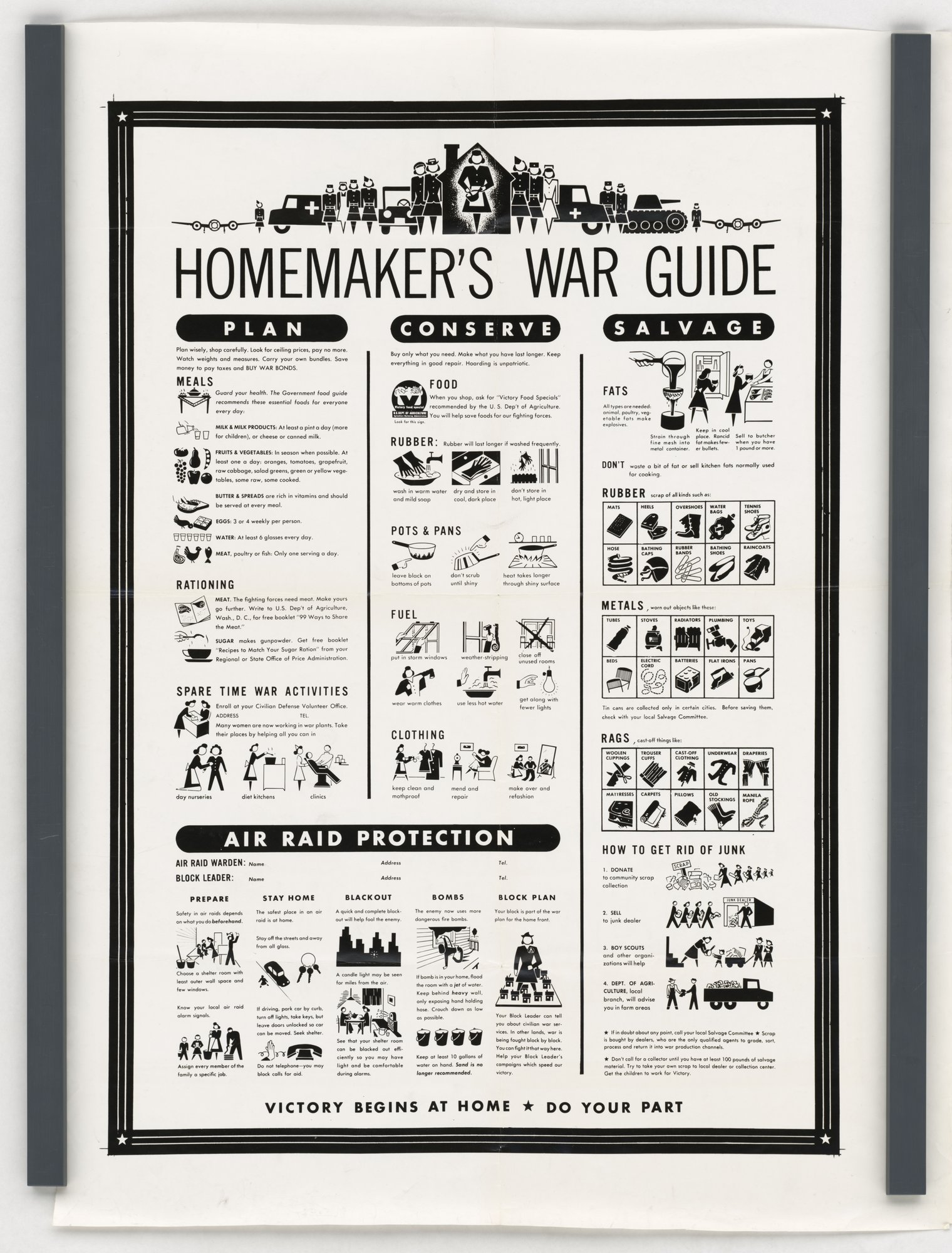
Black-and-white text-and-pictogram sheet in three columns headed Plan, Conserve and Salvage, with an Air Raid Protection panel below. It lists practical instructions on meals, rationing, rubber, fats, scrap and blackouts, and closes on the slogan 'Victory begins at home - Do your part'. The technique is faint here: the sheet is mostly instruction, with the closing slogan as the only appeal.
Propaganda techniques used in this poster
- Date
- 1941
- Period
- Second World War
- Made by
- U.S. government home-front agencies (issuer not named on the sheet)
- Region
- North America
- Country
- United States
- Medium
- Poster
- Issuer type
- Mixed
- Regime
- Roosevelt Administration
- Leader
- Franklin D. Roosevelt
- Audience
- Domestic public
- Purpose
- Mobilize or secure compliance
- Themes
- Home front, Economy and finance
- Event
- World War II
- Regime
- Roosevelt administration
- Leader
- Franklin D. Roosevelt
- Source
- Identified Openly sourced: the speaker is who they say they are
- Source
- U.S. National Archives and Records Administration, Record Group 44, World War II Posters, retrieved October 4, 2026
- Rights
- Public domain (U.S. government work)
U.S. government home-front agencies. National Archives and Records Administration, RG 44, 44-PA-381 (NAID 513833).
Text on the object
HOMEMAKER'S WAR GUIDE
PLAN
Plan wisely, shop carefully. Look for ceiling prices, pay no more. Watch weights and measures. Carry your own bundles. Save money to pay taxes and BUY WAR BONDS.
MEALS
Guard your health. The Government food guide recommends these essential foods for everyone every day:
MILK & MILK PRODUCTS: At least a pint a day (more for children), or cheese or canned milk.
FRUITS & VEGETABLES: In season when possible. At least one a day: oranges, tomatoes, grapefruit, raw cabbage, salad greens, green or yellow vegetables, some raw, some cooked.
BUTTER & SPREADS are rich in vitamins and should be served at every meal.
EGGS: 3 or 4 weekly per person.
WATER: At least 6 glasses every day.
MEAT, poultry or fish: Only one serving a day.
RATIONING
MEAT. The fighting forces need meat. Make yours go further. Write to U.S. Dep't of Agriculture, Wash., D. C., for free booklet "99 Ways to Share the Meat."
SUGAR makes gunpowder. Get free booklet "Recipes to Match Your Sugar Ration" from your Regional or State Office of Price Administration.
SPARE TIME WAR ACTIVITIES
Enroll at your Civilian Defense Volunteer Office. ADDRESS TEL.
Many women are now working in war plants. Take their places by helping all you can in day nurseries, diet kitchens, clinics
CONSERVE
Buy only what you need. Make what you have last longer. Keep everything in good repair. Hoarding is unpatriotic.
FOOD
When you shop, ask for "Victory Food Specials" recommended by the U.S. Dep't of Agriculture. You will help save foods for our fighting forces.
RUBBER: Rubber will last longer if washed frequently.
SALVAGE
FATS
All types are needed: animal, poultry, vegetable fats make explosives.
DON'T waste a bit of fat or sell kitchen fats normally used for cooking.
Tin cans are collected only in certain cities. Before saving them, check with your local Salvage Committee.
HOW TO GET RID OF JUNK
1. DONATE to community scrap collection
2. SELL to junk dealer
3. BOY SCOUTS and other organizations will help
4. DEPT. OF AGRICULTURE, local branch, will advise you in farm areas
* If in doubt about any point, call your local Salvage Committee * Scrap is bought by dealers, who are the only qualified agents to grade, sort, process and return it into war production channels.
* Don't call for a collector until you have at least 100 pounds of salvage material. Try to take your own scrap to local dealer or collection center. Get the children to work for Victory.
AIR RAID PROTECTION
AIR RAID WARDEN: Name Address Tel.
BLOCK LEADER: Name Address Tel.
PREPARE
Safety in air raids depends on what you do beforehand.
Choose a shelter room with least outer wall space and few windows.
Know your local air raid alarm signals.
Assign every member of the family a specific job.
STAY HOME
The safest place in an air raid is at home.
Stay off the streets and away from all glass.
If driving, park car by curb, turn off lights, take keys, but leave doors unlocked so car can be moved. Seek shelter.
Do not telephone-you may block calls for aid.
BLACKOUT
A quick and complete blackout will help fool the enemy.
A candle light may be seen for miles from the air.
See that your shelter room can be blacked out efficiently so you may have light and be comfortable during alarms.
BOMBS
The enemy now uses more dangerous fire bombs.
If bomb is in your home, flood the room with a jet of water. Keep behind heavy wall, only exposing hand holding hose. Crouch down as low as possible.
Keep at least 10 gallons of water on hand. Sand is no longer recommended.
BLOCK PLAN
Your block is part of the war plan for the home front.
Your Block Leader can tell you about civilian war services. In other lands, war is being fought block by block. You can fight it that way here. Help your Block Leader's campaigns which speed our victory.
VICTORY BEGINS AT HOME * DO YOUR PART
Headings, running text and slogans are transcribed. The pictogram label captions under the Rubber, Pots & Pans, Fuel, Clothing, Salvage fats, Rubber scrap, Metals and Rags icon grids (single words or short phrases) are omitted for length.