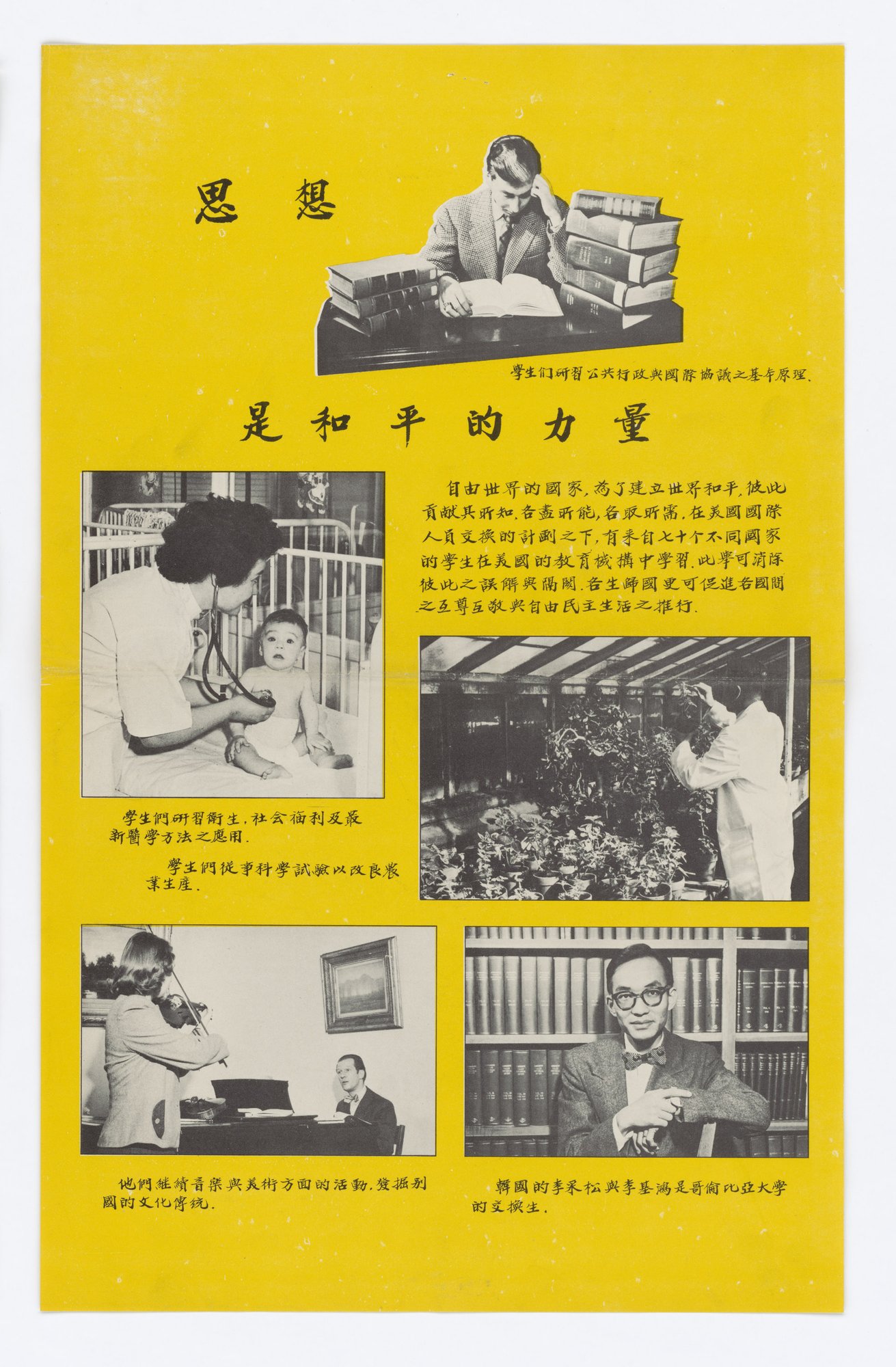
思想是和平的力量 (Ideas are a power for peace) (Chinese poster distributed in Asia)
A photo-set poster on the US international student exchange programme. Photographs show a student reading law books, a woman doctor examining an infant, a researcher in a greenhouse, a violinist with a pianist, and two Korean exchange students at Columbia University. The text says students from seventy countries study in the US and return with mutual respect and free democratic life. The tell is glittering-generalities, with named exchange students as testimonial.
Propaganda techniques used in this poster
- Date
- May 26, 1952
- Period
- Cold War
- Made by
- U.S. Information Agency (predecessor: State Department International Information and Educational Exchange Program), Propaganda Posters Distributed in Asia series
- Region
- North America
- Country
- United States
- Medium
- Poster
- Issuer type
- State
- Regime
- Truman Administration
- Leader
- Harry S. Truman
- Audience
- Foreign public
- Purpose
- Persuade or win support
- Themes
- Science and technology, Health
- Event
- Cold War
- Source
- Unidentified Source blurred: contractors, cutouts, buried disclosure
- Source
- U.S. National Archives (NARA), Record Group 306, Propaganda Posters Distributed in Asia, retrieved October 3, 2026
- Rights
- Public domain (U.S. government work; NARA RG 306)
U.S. Information Agency / Department of State, May 26, 1952. National Archives, Record Group 306 (NAID 5729973, 306-PPA-73).
Text on the object
思想
是和平的力量

學生們研習公共行政與國際協議之基本原理。

自由世界的國家,為了建立世界和平,彼此貢獻其所知,各盡所能,各取所需。在美國國際人員交換的計劃之下,有來自七十個不同國家的學生在美國的教育機構中學習。此舉可消除彼此之誤解與隔閡。各生歸國更可促進各國間之互尊互敬與自由民主生活之推行。

學生們研習衛生,社會福利及最新醫學方法之應用。

學生們從事科學試驗以改良農業生產。

他們繼續音樂與美術方面的活動,發掘別國的文化傳統。

韓國的李采松與李基鴻是哥倫比亞大學的交換生。
Ideas
are a power for peace

Students study the basic principles of public administration and international agreements.

The nations of the free world, in order to build world peace, contribute to one another what they know, each doing what it can and taking what it needs. Under the American international exchange of persons programme, students from seventy different countries are studying in American educational institutions. This can remove mutual misunderstanding and estrangement. Students returning home can further promote mutual respect among nations and the practice of free democratic life.

Students study hygiene, social welfare and the application of the newest medical methods.

Students conduct scientific experiments to improve agricultural production.

They continue their activities in music and art and explore the cultural traditions of other countries.

Li Cai-song and Li Ji-hong of Korea are exchange students at Columbia University.
Names of the Korean students are rendered phonetically and the reading is uncertain.