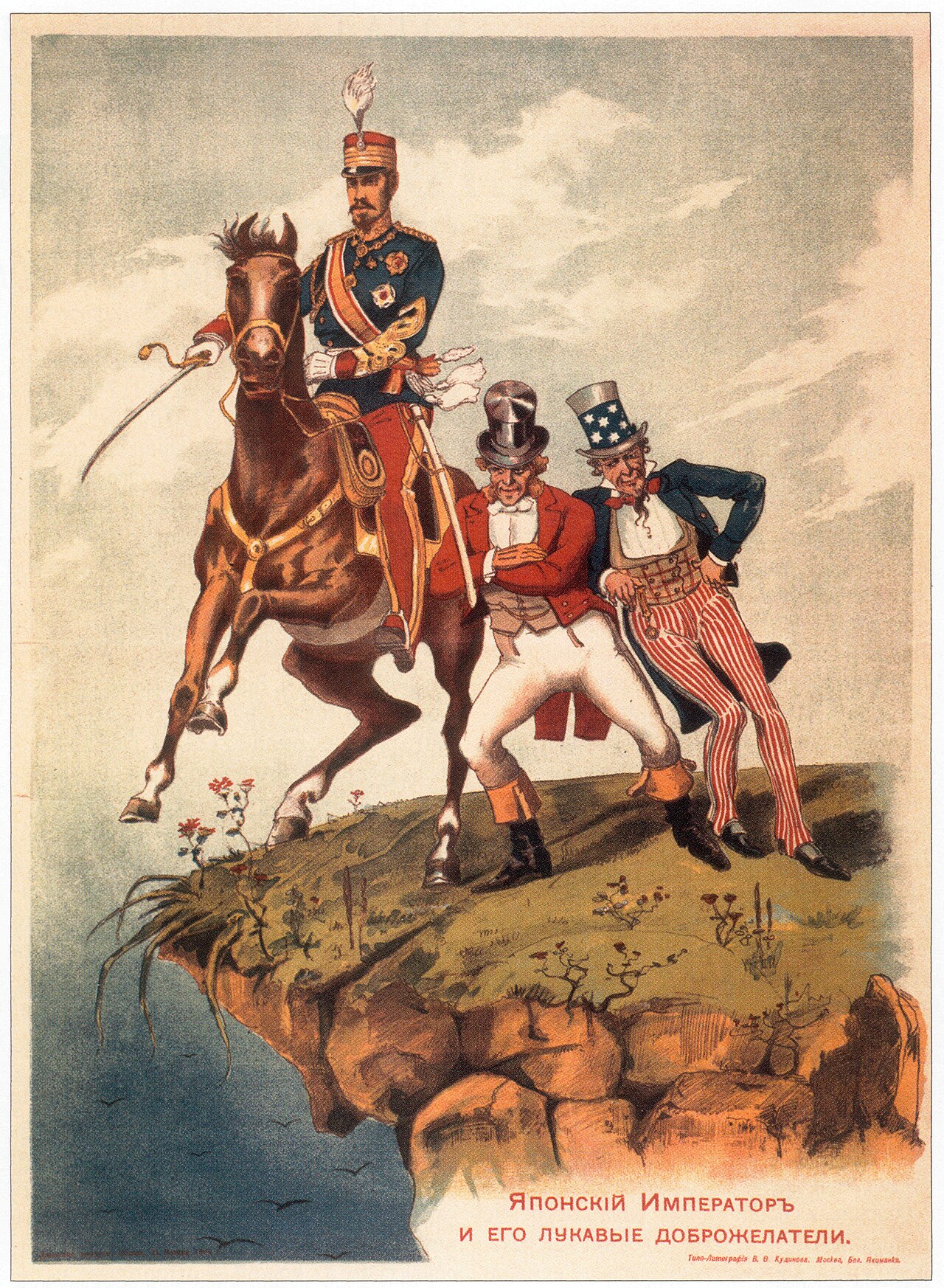
Японский Император и его лукавые доброжелатели (The Japanese Emperor and His Cunning Well-Wishers): Russian Russo-Japanese War print
A Japanese emperor in full uniform sits a rearing horse at the lip of a cliff while two smiling, jostling figures in national costume, John Bull and Uncle Sam, press against him from behind. The caption calls them the emperor's 'cunning well-wishers' (lukavye dobrozhelateli): the loaded adjective, and the staging that puts the drop at the horse's hooves and the two Western powers at its flank, cast Britain and the United States as the hidden pushers of Japan's war.
- Date
- 1904
- Period
- Pre-1914
- Made by
- Commercial lithographers of Moscow (Typo-Lithography of V. V. Kudinov, Bolshaya Yakimanka), wartime patriotic print of the Russian Empire
- Region
- Eastern Europe and Eurasia
- Country
- Russian Empire
- Medium
- Issuer type
- Mixed
- Regime
- Russian Empire
- Leader
- Nicholas II
- Audience
- Domestic public
- Purpose
- Demonize
- Themes
- War and the military, Empire and colonialism
- Event
- Russo Japanese War
- Techniques
- Name-callingScapegoating
- Source
- Identified Openly sourced: the speaker is who they say they are
- Source
- Wikimedia Commons, retrieved September 29, 2026
- Rights
- Public domain (published 1904; Commons: PD-Russia-expired)
Unknown artist, Typo-Lithography of V. V. Kudinov, Moscow, 1904; via Wikimedia Commons.
Text on the object
Японскій Императоръ
и его лукавые доброжелатели.

Типо-Литографія В. В. Кудинова. Москва, Бол. Якиманка.
[small imprint line at bottom left, illegible]
The Japanese Emperor
and his cunning well-wishers.

Typo-Lithography of V. V. Kudinov. Moscow, Bolshaya Yakimanka.
[small imprint line at bottom left, illegible]
Pre-1918 orthography is kept as printed (hard signs at word ends, 'ій'). A small imprint line at the bottom left, probably the censorship or printing notice, is too small to read at the committed resolution.